Political Suicide: The Confederacy’s Declarations of Causes
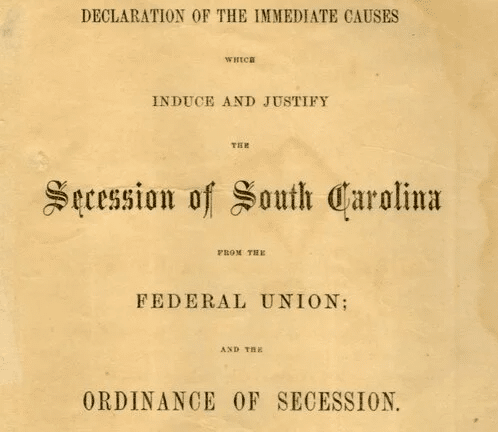
While working on my Emerging Revolutionary War blog, “Why 1776,” I began thinking, how does the 1776 Declaration of Independence compare with the Confederate’s declaration of their independence from the Union? Did the Confederacy even have a declaration? If so, what was it and did it have the same effect as the 1776 declaration?
All thirteen colonies signed the Declaration of Independence in 1776 as one voice, and it’s only two paragraphs. The title itself is a statement, hitting the reader in the gut or giving goose bumps to the colonists. It discusses why the colonies were leaving the British empire and what inalienable rights the colonists were fighting to achieve: “life, liberty, and the pursuit of happiness.” You don’t have to read the whole thing to understand why the People were fighting and what the People were fighting for.
Fast forward eighty-four years, the Confederate government didn’t collectively come up with one declaration. Southern politicians instead thought it’d be a good idea to write individual state declarations, called “declarations of causes.” Some of these were published; others were not. Either way, these declarations had little-to-no positive affect at the political or military level.[1]
The Southern states wanted to show the world their state sovereignty via these individual declarations, but in doing so these declarations identified numerous weaknesses in the Confederacy’s political-military strategy and goals.
For one, the Confederate leadership didn’t speak with one voice. If they didn’t work together to come up with one political declaration, would they be able to come up with one military strategy to win a complex civil war? That’s a weakness you don’t want to reveal to an opponent or potential allies.
The wording is problematic as well. Declaration of “cause” doesn’t have the same punch as “independence.”[2] It’s too broad, conveys little, and falls flat. Moreover, declaration of causes sounds like a lecture is being thrown at the reader. That’s because it is and no one likes to be lectured to.
What’s worse is that the lectures are about the right to own slaves. Here’s a sample of the first paragraph of South Carolina’s declaration, December 1860:
“The people of the State of South Carolina, in Convention assembled, on the 26th day of April, A.D., 1852, declared that the frequent violations of the Constitution of the United States, by the Federal Government, and its encroachments upon the reserved rights of the States, fully justified this State in then withdrawing from the Federal Union; but in deference to the opinions and wishes of the other slaveholding States, she forbore at that time to exercise this right. Since that time, these encroachments have continued to increase, and further forbearance ceases to be a virtue.”[3]
This opening salvo opens a whole can of worms! Right out of the gate, the plantation owners-politicians handicapped themselves. The Federal Government through the years had been mean to the slave holders so South Carolina and the other slave owning states were leaving the union to protect slavery.
Sure, the Northern states wanted to transition the southern states away from their “peculiar institution,” but that’s not a “long train of abuses” against all the Southern people. It’s an affront to one class of people: the ruling class. In addition, wanting to retain the right to own other humans isn’t an “inalienable right”; it’s abhorrent and only important to slave owners, many of whom wouldn’t be doing the fighting.
What was the Southern yeoman supposed to fight for? Ninety-nine percent or more of the Confederate army was made up of lower-middle-class-to-poor men. Many of the working class couldn’t read, and they certainly couldn’t afford or didn’t want slaves. Short-term, politicians convinced their constituents to join the cause to protect their own homes from the “damn Yankees,” but long-term desertion became a problem. The farmers, blacksmiths, lumberjacks, clerks, attorneys, and students wanted to get back home especially as the Union armies began to reoccupy southern territory.[4]
On the international stage, the declaration of causes fell short. Slavery wasn’t in vogue, at least publicly. The British Parliament had abolished the slave trade in 1833. France had dealt with slavery several times.[5] When the time came, Britain and France were willing to turn a blind eye at least in respect to trading with the Southern states. But the Confederacy never had a strong political relationship with any of the European countries.
Political, military, and moral issues weren’t the only issues plaguing these declarations of causes. They all contain a glaring editorial problem. The declarations are too long, including their titles. South Carolina titled their declaration, “Confederate States of America – Declaration of the Immediate Causes Which Induce and Justify the Secession of South Carolina from the Federal Union.” You immediately lose your reader.
What was the Confederate government supposed to do? That’s easy. Publish one declaration. Use the Declaration of Independence 1776 and edit it to fit their 1860 situation (minus the slave issue). The 1776 version shows unity and says everything that needs to be said in just two paragraphs! It’s inclusive and doesn’t mention slavery. It focuses on independence and the inalienable rights of all mankind, “life, liberty, and the pursuit of happiness.” Everybody can get behind those rights. Even the world governments could’ve backed those.
The ruling Southern class, however, couldn’t bring themselves to use a version of the Declaration of Independence 1776. They were led by their hubris and ego. These tied them to their aristocratic-slave system to the end and like an anchor around their neck sunk their cause even before the fighting started.
What do you think the Southern politicians should’ve done?
[1] The published causes include Georgia, Mississippi, South Carolina, Texas and Virginia. American Battlefield Trust, https://www.battlefields.org/learn/primary-sources/declaration-causes-seceding-states.
[2] Virginia calls their document “The Secession Ordinance.” The subtitle is quite long, but it’s does have one of the shorter documents.
[3] https://avalon.law.yale.edu/19th_century/csa_scarsec.asp.
[4] I can relate to the working class of both sides. They got caught in the middle of the ruling classes like many generations. Marine hero General Smedley Butler wrote a fantastic anti-war book called “War is a Racket,” 1935.
[5] Britian continued their aristocratic system locally and aboard. In addition, working conditions were abhorrent throughout their empire. Child labor was common through the 1800s, look up the match stick girls. You will bawl after reading about them. Moreover, Britian and France committed untold crimes against humanity in their colonies around the world.


“What was the Southern yeoman supposed to fight for? Ninety-nine percent or more of the Confederate army was made up of lower-middle-class-to-poor men. Many of the working class couldn’t read, and they certainly couldn’t afford or didn’t want slaves.”
Maybe they knew exactly who their constituents were. Slavery was a social, political, and economic institution that was woven into the very fabric of the south. If you really want to know how prevalent slavery was in the south prior to the Civil War, you need to examine the percentage of slaveholding families, not individuals. Children couldn’t own slaves, and most women did not, but yet if they lived in a household in which another member of the house owned enslaved people, they benefited materially from the south’s “peculiar institution.” If we are going to use that, more useful measure, we get a very, very different picture. Based on the 1860 census, the average percentage of slave holding families across the south was about 30%. It was slightly less in the upper south – places like Maryland, and Tennessee – there it was about 25%. But in the deep south, the percentage climbs to close to 50% of families owning enslaved labor. Those numbers give a far clearer picture of how deeply slavery was embedded in the antebellum south.
Even yeoman farmers who did not own slaves believed they had a stake in the institution. They feared slave revolt, and they were profoundly disturbed by the threat of what the end of slavery might do to the social structure of the south. As the yeoman farmer Richard Arnold put it in 1860, “slavery is so mingled with our social conditions that it would be impossible to eradicate it.” Similarly, a Louisiana artilleryman wrote in 1862, “I never want to see the day when a negro is put on an equality with the white person.” In December 1862 Robert E. Lee wrote to the Confederate Secretary of War about his feelings toward the Emancipation Proclamation. He called emancipation a “savage and brutal policy”, and one that left Confederates, “no alternative but success or degradation worse than death.” Lee hope that every effort would be made to, “save the honor of our families from pollution, our social system from destruction.” Slavery was undergirded by white supremacy. If you really want to parse language for the sake of accuracy, we can just drop the word “slavery” and simply replace it with “white supremacy.” If you think about it that way, you can see what unified white Southerners in their experiment in rebellion.
Agree. One can debate (propose) that there were other issues that led to secession. That only serves to minimize and distract from the fact that slavery was THE mitigating factor. All other arguments, no matter which one one chooses to bloviate over are a distraction. Each state made it abundantly clear in their secession letters that slavery was the reason for succession. The concerns of the yeoman farmers (and Mr. Lee) make it clear that even non-slave owning individuals recognized the importance of the institution of slavery to the Southern way of life. That this debate continues is perplexing. What can possibly be left of that poor dog one beats the argument over.
This article begs the question, if South Carolina’s Declaration of Causes was more like a lecture, what did the rest of it say? All it’s saying here is that the other “slaveholding states,” until that time, had restrained SC from pursuing secession. What were the specific complaints leading to the decision to secede? I’m not arguing that the preservation of slavery wasn’t among those complaints, but if so, it’s not articulated in this introductory paragraph. Also, I think each state having its own declaration was the result of the way in which the states seceded (or attempted to). They didn’t do it all at once but over the course of several weeks/months. Additionally, not having a top-down, monolithic approach was kind of the point of their whole thing, at least at the beginning.
https://avalon.law.yale.edu/19th_century/csa_scarsec.asp
This is a full copy of SC’s secession declaration. I agree that there are stronger pieces of evidence of slavery’s primacy to the document than the introduction.
The first half of the document (about 13 paragraphs) is SC’s argument that they are allowed to secede, based on their reading of the Declaration & Constitution. The second half (13 paragraphs before a one-paragraph conclusion) list out WHY they want to leave. This section is all about northern states’ alleged threats to slavery, and the alleged threat presented by the incoming Lincoln administration. Sampling of representative quotes:
— (In regard to the Fugitive Slave Clause of the Constitution): “For many years these laws were executed. But an increasing hostility on the part of the non-slaveholding States to the institution of slavery, has led to a disregard of their obligations, and the laws of the General Government have ceased to effect the objects of the Constitution.”
— “In many of these States the fugitive is discharged from service or labor claimed, and in none of them has the State Government complied with the stipulation made in the Constitution. The State of New Jersey, at an early day, passed a law in conformity with her constitutional obligation; but the current of anti-slavery feeling has led her more recently to enact laws which render inoperative the remedies provided by her own law and by the laws of Congress. In the State of New York even the right of transit for a slave has been denied by her tribunals; and the States of Ohio and Iowa have refused to surrender to justice fugitives charged with murder, and with inciting servile insurrection in the State of Virginia.”
— “Those States have assume the right of deciding upon the propriety of our domestic institutions; and have denied the rights of property established in fifteen of the States and recognized by the Constitution; they have denounced as sinful the institution of slavery; they have permitted open establishment among them of societies, whose avowed object is to disturb the peace and to eloign the property of the citizens of other States. They have encouraged and assisted thousands of our slaves to leave their homes; and those who remain, have been incited by emissaries, books and pictures to servile insurrection.”
— “A geographical line has been drawn across the Union, and all the States north of that line have united in the election of a man to the high office of President of the United States, whose opinions and purposes are hostile to slavery. He is to be entrusted with the administration of the common Government, because he has declared that that ‘Government cannot endure permanently half slave, half free,’ and that the public mind must rest in the belief that slavery is in the course of ultimate extinction.”
I think a link to the text is helpful. I have read it – I was trying to encourage the author develop her argument a little and delve more into what the document says. I do disagree with the assertion that “the Northern states wanted to transition the southern states away from their ‘peculiar institution.'” Were they trying to do that in 1860? Of course abolitionist organizations existed, but I don’t think there was any widespread momentum to abolish slavery on a national level. The Southern states would have blocked any abolition amendment.
Using today’s language, the southern leaders should have gotten on the right side of history.
They didn’t have the vision or the free thinking needed to break out of their racist views. But it was clear that the world was removing slavery as an institution, nation by nation. Europe, Russia and South America had outlawed it by 1835. Brazil hung on until 1888, but their leaders had seen it coming earlier.
As Lincoln stated, once it was removed from the US, it would no longer be able to exist in the western world.
To “Mark” above: Does anyone think it’s news that slavery was a big factor in the economy of the South? The North was certainly aware of it and participated willingly in their cotton goods manufacturing and, even more importantly, in funding an average 90% of the US Treasury with tariffs on imports secured by cotton exports. Without a tradeable good, imports had to be paid for in specie, and there wasn’t enough gold in the US to pay for $366 million in imports. In 1859-60, cotton and cotton goods exports accounted for 66% of exports, plus 5% in tobacco, or 71% of total exports. The alternative to tariffs was an income tax, not a happy topic for anyone, especially Northern industrialists. So, reiterating the trope that Southern women and children also benefited from slavery, as well as the majority of the South that didn’t own slaves, is useless because it leaves out 22 million people in Northern States that also benefitted directly from manufactures and from a well-funded US Treasury, spending at a level that would otherwise have been impossible without cotton exports. Beyond that, the Southern objection was primarily to abrupt abolition as promoted by very vocal Unionists, which would bankrupt the South (and did) versus the gradual emancipation chosen by Northern States when freeing their slaves.
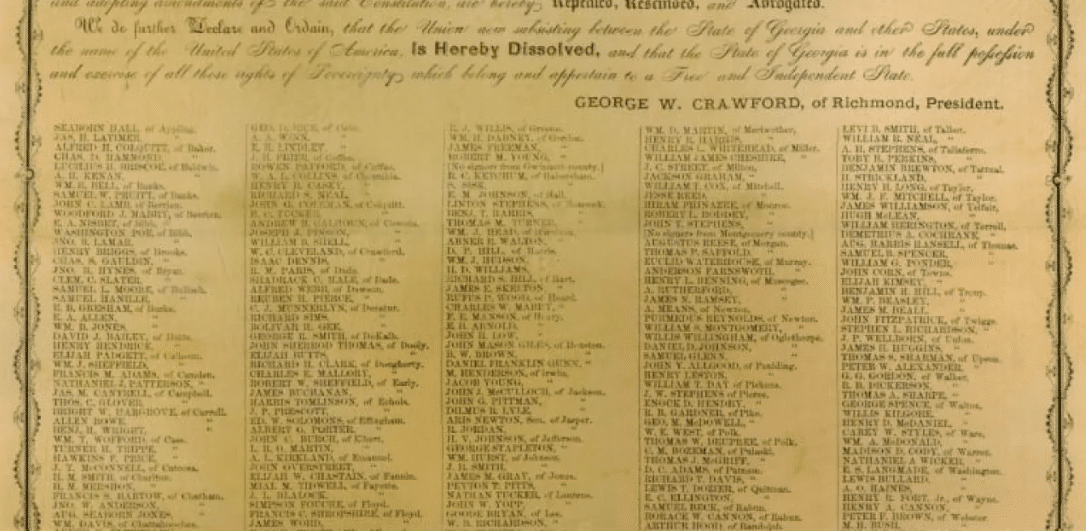
Virginia did not publish a declaration of causes, just an ordinance of secession, which the other seceding states all did. The four recognized declarations are from South Carolina, Georgia, Mississippi, and Texas. Florida wrote one, but never voted on it or published it.
All five of the declarations, plus all of the ordinances of secession, and much, much, more, can be found here:
https://www.civilwarcauses.org/
“The British Parliament had abolished the slave trade in 1833.” The British actually abolished the slave trade in 1807. They abolished slavery in the British Empire in 1833.
That’s an interesting point about a united Confederate declaration in lieu of individual state declarations and ordinances … the problem in 1860, however, was there was no consensus regarding secession — the lower south seceded between December 1860 and February 1861 and the upper south between April and June 1861 … the first Confederate gov’t (with only six seceding states) convened in Montgomery 4 Feb 1861 … they wrote a Constitution on 8th and elected Jefferson Davis as President on the 9th — no grass growing on those dudes … but when your nation is founded on one principle — that all men ARE NOT created equal, the Confederate “founders” had an easy job — copy the United States Constitution, season it with slavery and call it done.
The United States’ Declaration of Independence was the product of two Continental Congresses 1774 and 1775, two years before the declaration in July of 1776 … in those 24 months, the Founders petitioned Parliament repeatedly, petitioned King George III to no avail, and fought the British at Lexington and Concord in April 1775 … so, the colonies had the time to arrive at what became those timeless principles you mention and the 18 grievances against KB III.
Even the Founders, many of them slaveholders, saw the inherent paradox in the opening sentence of the Declaration’s Preamble ” … that all men are created equal, that they are endowed by their Creator with certain unalienable Rights … ” the men in Montgomery had no such misgivings as they believed only white men were created equal … even if there was a Confederate declaration of independence, it is hard to imagine what it might have said worth remembering.
We are talking about the same union, controlled by yankees, who allowed Oregon to enter as a Whites-Only State? The same union in which the State of Illinois prohibited any blacks from settling therein? Just making sure we are all talking about the same union.
We should all remember how black men lost the right to vote in PA…in the late 1830s…because their numbers had swelled to the unbearable level of 2 percent of the electorate…hard to believe any of them remained behind after PA eliminated slavery by purchasing the freedom of these slaves…wait…no, they didn’t do that, did they? Nope, they just encouraged said slaves to be sold down the river…to New Jersey.
All this presentism…all this wokeness…all of the purity of the north on display…despite Booker T. Washington stating the most fortunate group of blacks on the planet to be those who went through the US slave system. And of course, he was right…the black family wasn’t destroyed until crusaders infiltrated the black movement from the northerly direction…in the 1960s…black family destruction the intended outcome. White Southern Males lorded over the God-blessed, black nuclear family. It was a rare case of “New boss is not the same as the old boss”.