Let’s Shed a Tear for Hans Heg and the 15th Wisconsin
ECW welcomes back guest author James Marten.
“Next fall I am coming home to stay for good,” a 32-year-old Wisconsin colonel wrote to his eight-year-old daughter just before Christmas 1862, “and then we will have nice times, wont [sic] we.” He shared a few bits of news before promising her that “when I get into Battle I might get shot, but if you are a good girl . . . God will take care of me for you.”[1]
We’ll never know what possessed a father to make such an irresponsible vow to a young child, but in any event Col. Hans Heg, who had commanded the 15th Wisconsin since its organization in February 1862, was—perhaps inevitably—killed less than a year later at Chickamauga. He had survived Perryville and Stone’s River; without him, the regiment later fought at Missionary Ridge, Resaca, and Jonesboro.[2]
Aside from his misguided effort to assure his children, the most unusual thing about Heg and his regiment was their ethnicity. They were mostly immigrants from Norway, with a sprinkling of Danes and Swedes. The literature on the Civil War is filled with accounts of immigrant recruits from Germany, boasting ironically that “I fits mit Sigel!” and Ireland, with their emerald flags soaked in blood on countless battlefields. But the story of the 15th Wisconsin and its original commander offers a unique window into Civil War memory.
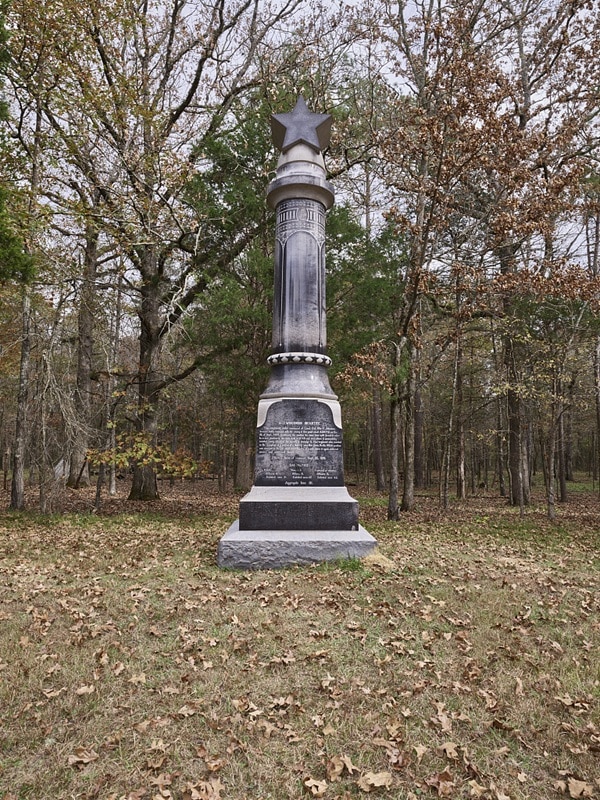
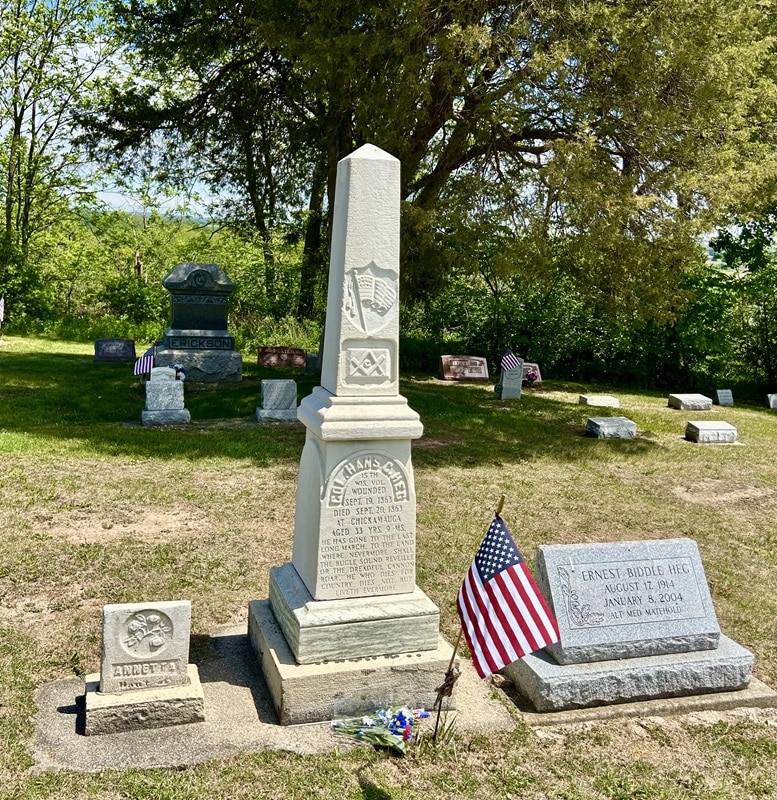
Eleven-year-old Heg arrived in southeastern Wisconsin with his family in 1840. He spent two years prospecting for gold in California in his early twenties. After returning to Wisconsin in 1851, he worked as a merchant and invested in a flour mill, joined a militia unit (rising to the rank of major), and became active in Free Soil and then Republican Party politics. He was elected to his local town and county boards, was a commissioner of the Racine County Poor Farm, and served as a justice of the peace. Enthusiastically anti-slavery, he was also a dedicated prison reformer who, as the first Norwegian to win a state-wide campaign in Wisconsin, was elected prison commissioner in 1860. He left that post to raise the 15th Wisconsin. By the fall of 1863, he was commanding a brigade, and in that capacity he was mortally wounded on September 19 and died the next day.[3]
A few days after Chickamauga, the Wisconsin State Journal confirmed “the painful rumor” that Heg had been killed. “Thus is added another of our best and bravest to the victims of this accursed rebellion.”[4] Heg’s competence and bravery, and his high-profile leadership of a small but prominent set of newcomers to America, captured the sympathy of his fellow immigrants, of Wisconsinites of all ethnic backgrounds, and of his countrymen back in Norway.
This led to a remarkable quantity and variety of memorials for someone of his rank. A pyramid of shells marks the spot where he fell on the battlefield of Chickamauga, while in the 1920s a memorial park was established near Heg’s homestead in Racine County, and a Second World War “Liberty Ship” sailed under his name.[5]
And, most notably, Heg is the subject of one of the more prominent memorials in downtown Madison. The movement to honor Heg in particular and Norwegian veterans in general had begun early in the 20th century; a 1914 pageant in St. Paul with 1,500 actors and thousands more spectators, presented Heg as a model Norwegian, abolitionist, and military hero.
The effort to commission a statue of the martyred colonel was bolstered by the last major reunion of survivors of the 15th Wisconsin in the state capitol in Madison in September 1917. At the evening campfire, a Norwegian studies professor from the university delivered a rousing speech on Heg’s leadership, Norwegian immigrants’ loyalty, and the successful abolition of slavery. For the next few years a campaign to honor all Scandinavian Civil War soldiers by erecting a statue of their most prominent officer raised funds—at events sometimes called “Heg Fests”—in Wisconsin, Minnesota, Illinois, and other states, as well as in Norway.[6]
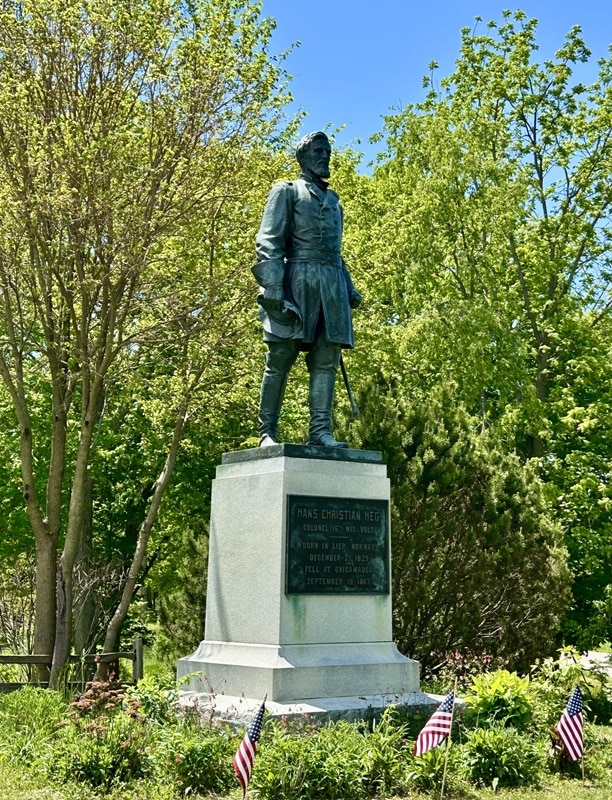
Indeed, the statue created by the Norwegian-American sculptor Paul Fjelde was unveiled in Lier, Norway, in June 1925, a little over a year before the Wisconsin legislature finally agreed to fund the pedestal and place the statue in front of the main entrance of the state Capitol. Residents of southeastern Wisconsin raised money to have yet another copy of the statue cast, and in 1928 the third version was unveiled at the dedication of Heg Memorial Park.[7]
An honored guest at the dedication was Hilda Heg Fowler, the woman who as a little girl had been assured by her father that, if only she behaved, he would return safely from the war.[8]
Heg has a cameo in perhaps the most distinctive work of Civil War memory. In 1972, a popular Norwegian performer named Erik Bye produced an album called Jeg Vet En Vind, which featured an original song called “Gudmund Gudmundson (Et borgerkrigsportrett),” or “A Civil War Portrait.”
“A faded image on the wall catches my attention,” it begins, “A face from distant times.” It is “a cheerful soldier from the valley,” in his uniform, and “with a shiny pistol in his fist.” The set of the man’s mouth is “fierce and manly,” but “his eyes show fear,
for it’s Gudmund Gudmundson
Who is at the photographer’s studio
As a raw recruit with Colonel Hegg.
The song’s many verses take Private Gudmundson “to the green plains of the South, where he will die with a bloody chest, in Lincoln’s blue army.” The moving middle section captures the moment of Gudmundson’s death:
Who were you Gudmund Gudmundson
With fear and fire in your eyes?
What was your dream and thought
In your red moment
When death was near?And you fell to your knees on the grass
And dug your nails
Into a bloody, foreign ground.Did you curse that day
You crossed the ocean?
Was your mouth filled with honor?
Was it closed in prayer?Or did you catch a glimpse of Wisconsin
And a cottage and a woman,
Who had waited long
For a meager soldier’s pay.
The song shades into an anti-war tone—Bye was writing in the early 1970s, after all—in the next section, which describes the inevitable fading away of the memory of the soldier and the regiment, and questions the motivations and even Gudmondson’s awareness of the issues over which the war had been fought:
But no tears shall be shed for Fifteenth Wisconsin,
No longer mourn Valdreskompani.
No roses grow over Chickamauga’s earthworks,
And Private Gudmund Gudmundson, from the old country. . .Did you fall in Lincoln’s faith,
For freedom for the many?
And did you hear in death
That a slave shackle broke?You fade, Gudmund Gudmundson
And your features disappear.
They fade in a haze,
Like the smoke of a thousand rifles.Soon you are taken by the wind
And no one shall know
About Private Gudmund Gudmundson.[9]
The extent to which the memory of Hans Heg vanished like smoke in the wind was reflected in the coda that ends this tale of the Norwegian-American patriot. During Madison’s Black Lives Matter demonstrations in June 2020, which frequently coalesced on the square around the state capitol, the arrest of a protester sparked anger and some violence. Some of that anger was directed toward the two most prominent statues on the capitol grounds, a century-old female figure representing “Forward,” the state’s motto, and the statue of Heg, which was decapitated and thrown into a nearby lake. Both were restored—with help from the National Endowment for the Humanities—and returned to their pedestals.[10]
Hans Heg’s sudden—and temporary—return to public awareness reflected the profound irony that the statue of a noted (in his time) abolitionist would be desecrated by protestors for racial justice. Such are the complications and fog of Civil War memory in modern America.
James Marten is professor emeritus of history at Marquette University and a former president of the Society of Civil War Historians. His most recent book is The Sixth Wisconsin and the Long Civil War: The Biography of a Regiment (Chapel Hill: University of North Carolina Press, 2025).
Endnotes:
[1] Hans Heg to Hilda Heg, December 19, 1862, The Civil War Letters of Colonel Hans Christian Heg, ed. By Theodore C. Blegen (Northfield: Norwegian-American Historical Association, 1936), 157.
[2] “15th Wisconsin Infantry Regiment,” Wisconsin Civil War Regiments, Wisconsin Genealogy Trails, https://genealogytrails.com/wis/military/cw/15thWIInfReg.html.
[3] Ella Stratton Colbo, Historic Heg Memorial Park (Racine, WI: Waterford Post, 1940), 21-22.
[4] Wisconsin State Journal, September 29, 1863.
[5] “Hans C. Heg Memorial Shell Monument,” Historical Marker Database, https://www.hmdb.org/m.asp?m=102047; Colbo, Historic Heg Memorial Park, 45-47; “Liberty Ships built by the United States Maritime Commission in World War II, http://www.usmm.org/libertyships.html#anchor435994.
[6] Remi Berg, “Transatlantic Memory and Identity: The Legacy of Colonel Heg and the 15th Wisconsin in Norway and Norwegian America” (2024). Electronic Theses and Dissertations. Paper 4426, https://dc.etsu.edu/etd/4426.
[7] Ibid.
[8] Colbo, Historic Heg Memorial Park, 48.
[9] The lyrics and translation can be found at “Gudmond Gudmundson,” Sonichits, https://sonichits.com/video/Erik_Bye/Gudmund_Gudmundson. A Youtube audio of the song can be found here: https://www.youtube.com/watch?v=8o5TUozjQXw.
[10] “Statue of Colonel Hans Christian Heg, who helped defeat slavery, is toppled, The Times (Madison), June 25, 2020; “’Forward’ & Heg statues reinstalled after being toppled during last year’s protests,” WMTV News, https://web.archive.org/web/20230606104038/https://www.nbc15.com/2021/09/21/forward-heg-statues-being-restored-tuesday-after-last-years-protests/.


I enjoyed your post and learning a little more about Heg. Thanks.
Very interesting window into a seldom explored topic in Civil War ethnic studies. It’s a pity some people are so historically ignorant and simply lash out at anything representative of the past – without knowing anything about it. I partly blame a the neglect of local / state history in schools and the tendency of people to “learn” everything about history from popular media.
Not sure a representative of the past, but a white American’s representation. Heck BLM and ANTIFA members here are guilty of what some call terrorist activity in the destruction of memorials to Lincoln and Grant, the 2 Americans most instrumental in the freeing of the slaves and protection of the former slaves in the Reconstruction era.
Hans Heg’s brigade was the unit that tried to replace Thomas Wood’s division that was ordered to move by William Rosecrans to fill in a gap that wasn’t there in the Union lines at Chickamauga. Rosecran’s order resulted in a real gap in the lines that lead to a victory for Braxton Bragg’s Army of Tennesee and Rosecrans’ retreat to Chattanooga. Heg’s bigade could not resist James Longstreet’s two division corps’ attack where Wood’s division previously defended. Heg’s fatal wounding occurred while trying to stem that Confederate onslaught. However, Heg’s unit was part of the Army of the Cumberland that stormed Missionary Ridge during the Battle of Chattanooga that sent Bragg’s army scurring back to Georgia.
Heg- “No good deed goes unpunished…”