Book Review: Three Roads to Gettysburg: Meade, Lee, Lincoln, and the Battle that Changed the War, The Speech that Changed the Nation

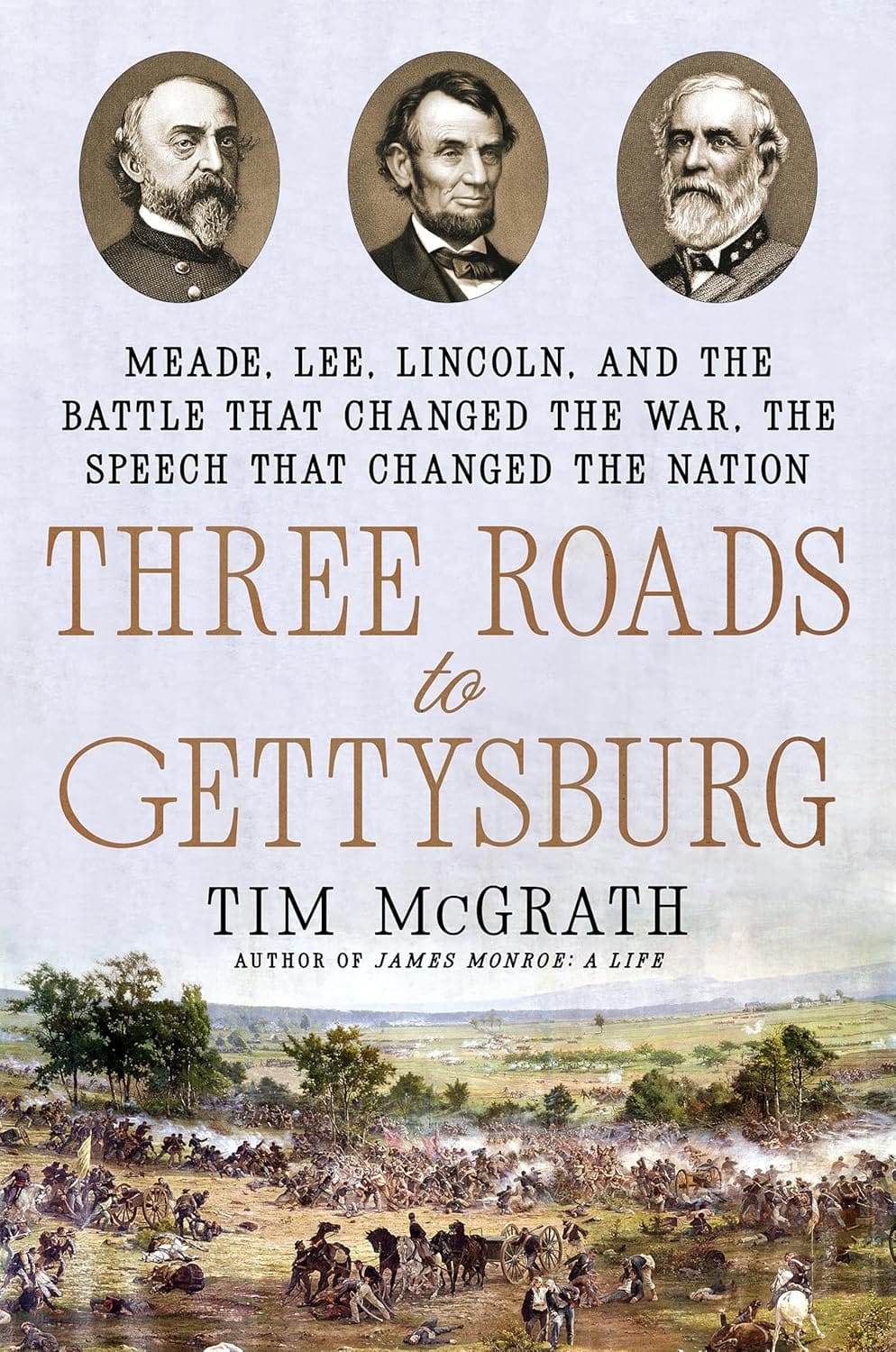
Three Roads to Gettysburg: Meade, Lee, Lincoln, and the Battle that Changed the War, The Speech that Changed the Nation. By Tim McGrath. New York: Penguin Random House, 2025. Hardcover, 517 pp. $39.00.
Reviewed by R. Michael Gosselin
“There is a divinity that shapes our ends / Rough-hew them how we will.” -Hamlet
It was never about the shoes, of course. It was the roads: Emmitsburg, Chambersburg, Mummasburg, Taneytown, Baltimore. The list reads like a litany of predestination—a map of inevitability. Certainly, Sherman saw war that way. “War is cruelty and you cannot refine it,” he declared, right before expelling the citizens of Atlanta. “You might as well appeal against the thunderstorm as against these terrible hardships of war.” And he ends his Memoirs with a nod to Shakespeare: “As ‘all the world’s a stage, and all the men and women merely players,’ I claim the privilege to ring down the curtain.” History, then, is a drama with a received script, in which Agency performs Destiny.
Such a vision informs the structure of Three Roads to Gettysburg: Meade, Lee, Lincoln, and the Battle that Changed the War, The Speech that Changed the Nation, by Tim McGrath. Here McGrath, whose previous works include James Monroe: A Life, and John Barry: An American Hero in the Age of Sail, maps the trajectories of its three players, from pre-cradle to post-grave, focusing on the literal and metaphorical roads that carried them to Gettysburg. His book is at once a captivating, dramatic read and a treatise on the seeming inexorability of history.
The story begins in medias res, with the train carrying Lt. Col. James Hardie and Abraham Lincoln’s empowering dispatch to Maj. Gen. George G. Meade rushing through the summer night. “A few hours later,” McGrath writes, “the locomotive’s wheels and brakes screeched and steam hissed from its sides as the engineer brought it to a halt.” This isn’t just dramatic—it’s cinematic. But we don’t catch up with Hardie again until chapter seven. The preceding chapters are all exposition, as McGrath separately lays out the paths of Meade, Robert E. Lee, and Lincoln, from their ancestries up until the 1840s.
The three characters do not appear on stage together until later in the book. And it is here, in chapter four, that the reader first notices McGrath’s skills as a storyteller, as the players are drawn—slowly but surely—toward their common destination. Another example of those skills is the use of dramatic punctuation. “It was not a charge but a march,” he writes of the Union attack on Marye’s Heights at Fredericksburg, “an orderly, awe-inspiring march, incredibly beautiful to behold…until the guns opened fire.” Still another is his use of textual breaks to build suspense. For instance, describing the end of Gettysburg’s first day of battle, he writes, “But this time the rebels had driven the Yankees to the very ground that would change the course of the battle.” Then there’s a break, and he leaves the reader hanging while he “cuts” to Meade back in Taneytown.
They—and we—finally reach Gettysburg in chapter eight, and one can imagine McGrath trying to decide just how much territory the battle needs for his imagined audience. It covers, appropriately enough, three chapters. While not as detailed as, for example, Gettysburg’s Peach Orchard: Longstreet, Sickles, and the Bloody Fight for the “Commanding Ground” Along the Emmitsburg Road, by James A. Hessler and Britt C. Isenberg, or the multi-volume work of Harry Pfanz, McGrath’s description is brief enough to avoid commandeering the entire book, but expansive enough to educate a newcomer, while still satisfying those knowledgeable readers who are all-too-happy to linger, once again, on that field. The following chapter brings Lincoln to Gettysburg four months later and recounts the delivery of the Gettysburg Address.
The denouement is covered in the chapter, “Aftermath,” which maps the post-war paths of the three protagonists. Meade’s road passes through Farce—through squabbles with “Historicus,” a Gettysburg-embittered Maj. Gen. Abner Doubleday, and various Congressional committees—and ends in semi-obscurity. “The postwar years,” McGrath writes, “were not kind to George Meade.” Lee’s road, on the other hand, while shorter, is traveled with a calm pathos, like the cadence at the end of a stormy symphony. After suffering a stroke, “he lingered for two weeks, unwilling or unable to answer any entreaties. ‘The silence was awful!’ [daughter] Mildred recalled.” It’s an ending worthy of Hamlet: “The rest is silence.”
Lincoln’s road ends abruptly and is mercifully portrayed as such in the book: “That night [after a cabinet meeting] he went to Ford’s Theatre and history.” And that’s it. Unlike the unnecessary—indeed, almost voyeuristic—depiction of the assassination at the end of Steven Spielberg’s 2012 film, Lincoln, McGrath displays both a sensibility for the man’s dignity and a respect for the reader’s intelligence. Bravo.
In the final chapter of Three Roads to Gettysburg, McGrath offers a reconsideration of the Gettysburg Address and asks us to keep in mind the “opportunity and responsibility of living up to Lincoln’s challenge.” He closes with an exhortation: “’The remedy,’ Lincoln said, ‘is in our hands.’ Our hands.” We have gone from feet to hands. And it is here that McGrath lifts us from the road of destiny to remind us that we also have agency—that can we still shape our national ends, rough-hew them how we will.
————
Michael Gosselin is an Associate Professor of English at Genesee Community College in Batavia, NY. This is his second guest post at ECW, the first being “‘You Might Not Like the Guy’: An English Professor Reads the Journals of Charles Wainwright,” from January 13, 2023. In addition, Professor Gosselin has contributed appendix chapters in two Savas Beatie books by Derek Maxfield: Hellmira: The Union’s Most Infamous Civil War Prison Camp—Elmira, NY, and Man of Fire: William Tecumseh Sherman in the Civil War.


