“It Strikes Me That Your Rear Is in the Opposite Direction:” The Ordeal of Captain Kellogg
6TH Wisconsin Infantry
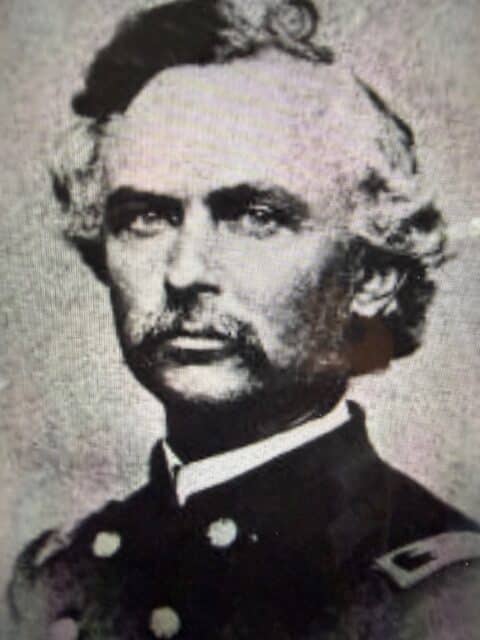
John Azor Kellogg was born March 1820 in Bethany, Pennsylvania. He was the son of American Revolutionary War soldier Nathan Kellogg and his wife Sarah (Quidor) Kellogg. The family moved to Wisconsin in 1840 and settled at Prairie du Chien.
John studied law and was admitted to the bar in 1857. On October 5, 1852, he married Adelaide Worthington of Prairie du Sac and had three children. He joined a militia unit as a first lieutenant of the Lemonweir Minute Men, which became Company K of the 6th Wisconsin Volunteer Infantry. He was soon promoted to captain and took part in the battles of the famous Iron Brigade. [1]
On the morning of May 5, 1864, Capt. Kellogg and the 6th Wisconsin deployed into the straggly second- and third-growth forest known as the Wilderness. As they moved forward, ducking under branches or around brambles and bushes, visibility was limited. They knew the Confederates were somewhere ahead, and they stopped short of seeing any signs of the enemy and began to throw up breastworks.
Soon an orderly from Col. Bragg, his regimental commander, appeared ordering Kellogg report to the brigade commander, Gen. Lysander Cutler for skirmish duty. As Kellogg walked back through the lines of the Iron Brigade, other captains, evidently pleased that they weren’t chosen, began teasing Kellogg with remarks about writing to his loved ones back home or shaking his hand saying that it might be “the last time we ever see you.” Kellogg retorted, “I expect you fellows will be all wiped out before I get back” and “look out you don’t get run over by the line of battle, when they follow me in.” [2]
When Kellogg reported at the general’s tent, he found the Cutler pacing inside. Inviting Kellogg in, he explained:
“Captain, your work this morning will not be play. Out front – I do not know exactly how far, but probably within a mile – you will find the sharpshooters deployed as skirmishers. You will join them. Use your own company as you think best; take command of the line and advance until you raise the enemy and bring on an engagement. Take along plenty of orderlies and report frequently.” [3]
Kellogg led his company forward into the Wilderness. It was somewhat disorientating in that maze of scrub pine when Kellogg discovered a long line of graybacks approaching. His men halted and opened fire. Only thirty or forty yards away from the rebel line, Kellogg’s men had the advantage of surprise and cover, being behind trees and logs whereas the rebels were in line. But when the enemy fired a volley, the captain wrote later, “How the bullets sung and whistle around us.” [4]
Kellogg sent word back to Cutler who ordered the brigade to support Kellogg’s company, but the Confederates were too many and charged, outflanking the Yankee position. Kellogg’s men were forced back in disorder, but the Confederates caught up, and the combat became hand-to-hand. As his company was being overrun by the Rebels, the captain took a blow to the head and was knocked out. When he came to “he was foggy-headed, bleeding from his nose and ears, and too dizzy to stand up straight” and behind the enemy’s line. [5]
Losing all sense of direction, Kellogg staggered off to find his regiment, but instead stumble into men from the 13th Georgia Infantry. He was soon face to face with that unit’s colonel, John Harris Major, who had become lost in the melee among the tangled trees. The Georgian colonel asked, “Captain, were you in the skirmish line out yonder?”
Kellogg responded: “I am a prisoner, sir, and must decline to answer any questions touching on our position or forces.”
“That’s all right, Captain, but . . . do you know where Gordon’s brigade is?”
“Gordon’s brigade! Why I don’t even know where I am myself.”
“Then there are two of us in the same fix. To tell the truth, I am lost,” exclaimed the colonel. “I got through an interval in your lines, I think; at all events, I found myself in your rear without knowing how I got there and was trying to get back when you uns run over us. We just lay still, and the Yankees passed us.”
“In which direction did they go?” asked Kellogg.
“Out yon,” the colonel said pointing.
“Then it strikes me that your rear is in the opposite direction,” said the captain.
“Well, yes. I reckon so,” the colonel said, before ordering a corporal to take Kellogg to the rear and turn him over to the provost guard. [6]
Kellogg was soon transfered to a number of prison camps, successively at Lynchburg and Danville, Virginia, Macon, Georgia, and Charleston, South Carolina. On October 5, 1864, while being transferred once again, this time to Columbia, South Carolina, Kellogg escaped by jumping from a moving train and making his way successfully back to Union lines. In his absence he had been promoted to major, then colonel. Returning to duty, he saw the surrender of Lee’s army at Appomattox Court House on April 9, 1865, and was promoted to brevet-brigadier general for his actions leading up to the surrender.
After the war he returned to Wisconsin and was appointed U.S. Pension agent at LaCrosse until 1875, when he left to return to private law practice in Wausau, Wisconsin. Later, he was elected as a State Senator from 1877-80.
One day, just after the war’s end, John Kellogg was walking along the street in Milwaukee when he happened upon his old commander, Lysander Cutler. The two hadn’t seen each other since that fateful day in May when Kellogg received orders from Cutler to “report frequently.” Cutler, not being in good health and recognizing Kellogg, approached. Cutler’s “usually stern face became [even] more stern [sic], his chin quivered, [and] he grasped my hand more firmly,” recorded Kellogg. At length, Cutler, who would not survive long after this encounter, blurted out, “You’ve been a terrible long-time reporting.” [7]
John A. Kellogg died February 10, 1883, and is buried at Maple Lawn cemetery in Fairbault, Minnesota. [8]
[1] Kellogg, John Azor, Capture and Escape: A Narrative of Army and Prison Life, Madison: WS: Wisconsin History commission, Democrat Printing Company, 1908. pp. xi-xii & xv. Capture and Escape: A Narrative of Army and Prison Life – John Azor Kellogg – Google Books
[2] Marten, James, The Sixth Wisconsin and the Long Civil War: The Biography of a Regiment, Chapel Hill, NC: The University of North Carolina Press, 2025, p.132.
[3] Kellogg, Capture and Escape, p. 7.
[4] Ibid. p. 9.
[5] Marten, The Sixth Wisconsin, p. 132-133.
[6] Ibid.
[7] Kellogg, Capture and Escape, p. 201.
[8] Kellogg, Capture and Escape, p. xiv. John Azor Kellogg Find-a-Grave. John Azor Kellogg (1828-1883) – Find a Grave Memorial


This is a great story that perfectly illustrates how confusing the Wilderness was, but one line stuck out to me – “In his absence he had been promoted to major, then colonel”! How does that happen without his even being present??
His escape and return to Union lines sounds like quite a tale in itself!
What a wonderful story. Thanks!
Wow! Great, thanks
Kellogg was plagued by the hit on the head for the rest of his life. When he returned to the regiment he applied to the surgeon for relief of headaches and dizziness but nothing helped. After the war the issues continued and it likely contributed to his death at such an early age.