Book Review: The Battle of Fort Stedman: Lee’s Forlorn Hope, March 25, 1865

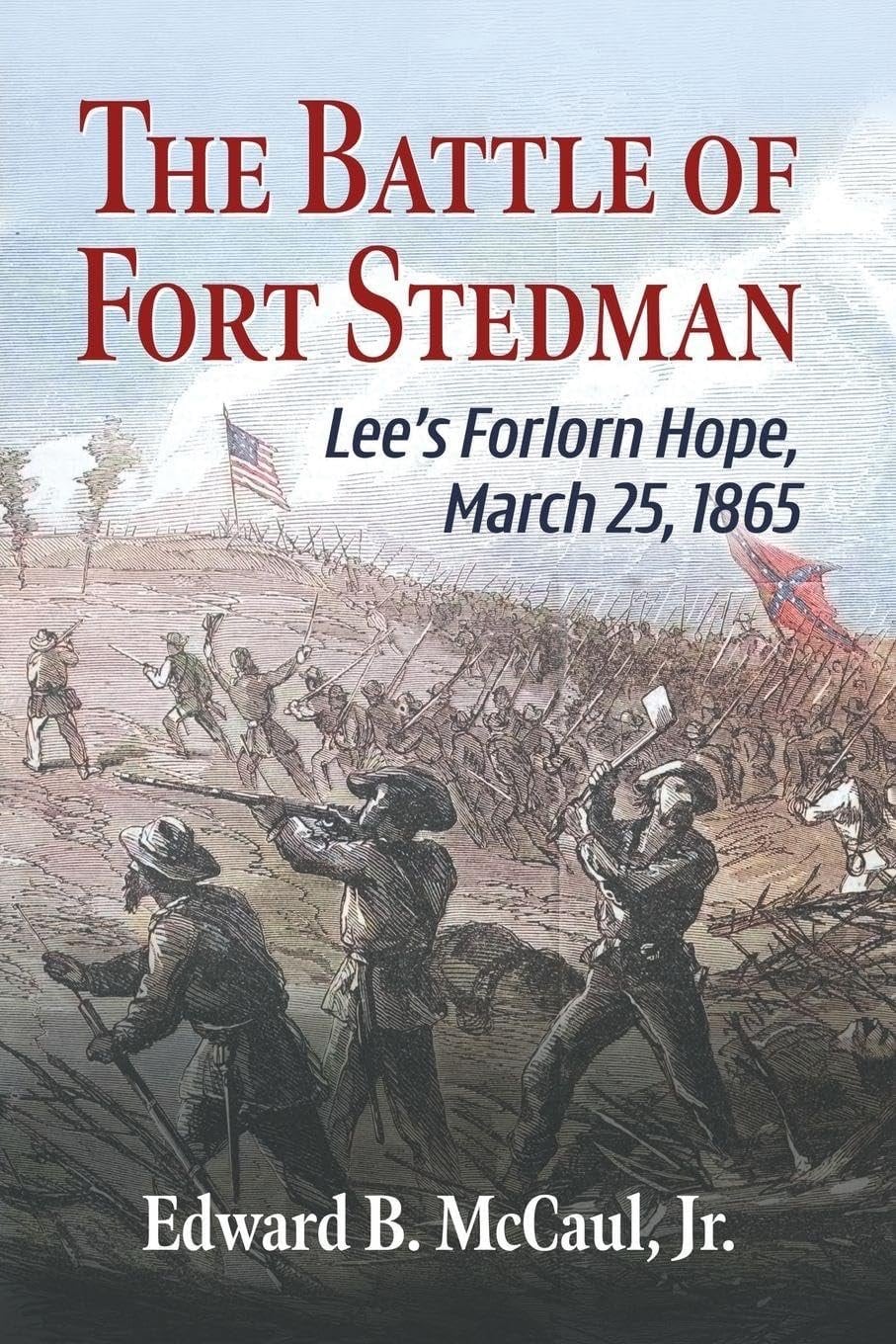
The Battle of Fort Stedman: Lee’s Forlorn Hope, March 25, 1865. By Edward B. McCaul, Jr. Jefferson, NC: McFarland, 2026. Paperback, 209 pp. $39.95.
Reviewed by Sean Michael Chick
Until the last few years, several battles of the Petersburg campaign were without detailed studies. Last year, though, Jerusalem Plank Road and Hatcher’s Run each were the subject of excellent studies by John Horn and Nigel Lambert, respectively (Lambert’s book is free and can be found here: https://www.hatchersrunbattle.com/). Fort Stedman did have a previous work in The Battle of Fort Stedman from 1889. It was both a history of the battle and Union veteran William Henry Hodgkins’s own experience in the battle. Edward B. McCaul has filled the contemporary void with The Battle of Fort Stedman: Lee’s Forlorn Hope, March 25, 1865.
McCaul provides a thorough and detailed analysis of the planning for the Confederate attack and the course the battle followed. The emphasis is very much on the commanders and the decisions they made. Few works discuss geography in this much detail and how it affected the battle from planning to the last shots being fired. It is not surprising given the author’s West Point training and previous book, The Key to the Shenandoah Valley: Geography and the Civil War Struggle for Winchester.
The book’s best part details the planning. This is important because our main Confederate source is John B. Gordon’s memoirs. Gordon was a great writer, but his memoirs, like all such works, should be treated carefully. McCaul does just that by considering both the other sources, particularly reports from the time with recollections and military practicality. As for the battle, the narrative that develops is of a complicated plan with little hope of success, but one where the first phase was brilliantly carried out. This was due both to planning and also personnel. The best units in Gordon’s Second Corps were selected to lead the way. After that, the attack fell apart rather quickly and resulted in a punishing defeat for the Army of Northern Virginia. The plan was bold, but it was too much to ask of an army so weakened in a war most knew was lost even if they would not admit it to others.
McCaul believes that in some ways Fort Stedman anticipated later tactics in World War I. Yet, the author might overstate the uniqueness of the tactics Gordon employed. It might have been best to compare this attack to other assaults during the campaign where a well-fortified position was assaulted. In all cases the attacks failed even after initial success, and for much the same reasons the Confederates failed here. This reviewer also admits to being heavily biased against the Civil War being the “first modern war” and believes it is better to compare it more to the fighting that came before than to what came after, despite a few worthwhile comparisons. However, Americans seemingly always like to consider the future more than the past, even when writing about 1865.
The Battle of Fort Stedman is not a flashy account. The account is laden with quotations, but not that many from soldiers. One will not get many memorable anecdotes. McCaul perhaps is wary of them. For instance, the battle’s most known anecdote, where a Rebel sentry warned a Federal picket the attack was just about to begin, is called into question. McCaul sees it as a dramatic incident injected by Gordon in his memoirs. In my own work I have found the story of Philip Sheridan jumping his horse over the Rebel works at Five Forks is very likely a fabrication by Horace Porter, so I liked this part.
McCaul’s book has only two issues. One is the frequent use of block quotations. It works in that McCaul wants the reader to see exactly what was said. In that regard, it aids his analysis. However, the use is too frequent. The narrative as such does not flow. The other is the sources used are more limited and slant towards the Confederacy. There were few contemporary Rebel accounts, so most are memoirs or postbellum articles. The Union side is not as well represented. The National Tribune is not cited at all. This is fine enough considering what the book is trying to do. However, it means that there is a window for scholars to look more into the Federal experience and their reaction to the attack. One question remains as to how much warning the Federals near the front had, a thorny question just as it was at Shiloh and Cedar Creek.
Despite the reservation about the sources, at least on the Union side, the book works. McCaul’s analysis is supported by some good maps. There are numerous period and contemporary photographs. Within the analytical framework, instead of a narrative one, McCaul gets high marks. There is not much here that is fanciful or overly dramatic. His conclusions are fair, although I had a few disagreements. One was McCaul’s contention that Eugene Waggamann’s Louisiana brigade was not the lead element of one attacking column. This reviewer disagrees on that point.
The Battle of Fort Stedman is more about analyzing commanders and plans than telling twice-worn tales with purple prose. The book is instead about trying to understand one of the war’s most unusual and desperate operations. It is about understanding how this battle was fought. In that regard, the book is a fine contribution.


I look forward to reading this. Thank you for your review.
In conclusion, another history written by a non- writer.
I can’t help noticing the similarities with my own ECW article on this subject published in October. Great minds think alike?