Book Review: A Sight Never to be Forgotten: Eyewitness Accounts from Union Chaplains at Gettysburg

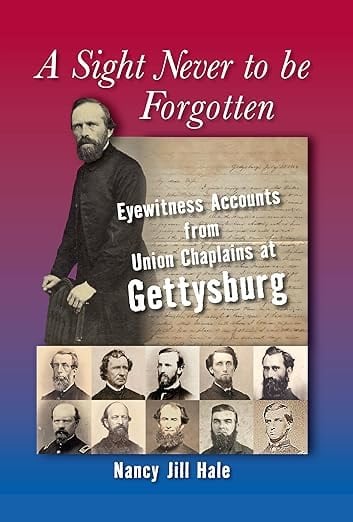
A Sight Never to be Forgotten: Eyewitness Accounts from Union Chaplains at Gettysburg. By Nancy Jill Hale. Gettysburg: Gettysburg Publishing, 2025. Hardcover, 368 pp. $35.95.
Reviewed by Jonathan W. Peters
Historians have examined the Battle of Gettysburg from almost every conceivable angle. Many have published broad campaign summaries, while even more have written micro-histories of particular engagements. Some have detailed unit histories, while others have focused on specific soldiers.
Another class of participants has received significant attention within the last thirteen years. Following upon the success of his three books on Civil War chaplains, John W. Brinsfield, Jr. delivered a series of lectures in 2013 on some of the Northern and Southern chaplains at Gettysburg. Three years later, he converted his lectures into a book titled, Summon Only the Brave!: Commanders, Soldiers, and Chaplains at Gettysburg.[1]
Nancy Jill Hale has now capitalized on Brinsfield’s labors to release A Sight Never to be Forgotten, a comprehensive collection of eyewitness accounts written exclusively by or about Union chaplains. In this book, Hale assembles the records of forty-nine chaplains and divides them into eight chapters based on the seven infantry and one cavalry corps of the Army of the Potomac. Each chapter also includes synopses of corps and brigade activities, as well as miniature biographies of the chaplains. Several photographs are interspersed throughout the text, although no maps are given to orient readers on the action. The book concludes with an appendix of all the Union chaplains at Gettysburg, listing their regiments and denominations.
Hale precedes all the accounts with an introductory essay on the history of the chaplaincy leading up to Gettysburg. As Hale explains, Congress passed a bill at the beginning of the war allowing the field officers of each regiment to choose one chaplain who must be “a regularly ordained minister of some Christian denomination.” The following summer, Congress modified the wording to permit ministers from any “religious denomination,” but strengthened the law otherwise to ensure that only men of “good standing” could enter the service. The War Department advised these chaplains to wear a plain, all-black uniform, but many chose to wear civilian clothes or a captain’s uniform as their pay-grade was that of a cavalry captain.
Other than reporting to the commanding officer on “the moral and religious condition” of the regiment, the government did not specify the duties of a chaplain. Instead, each minister had to create his own field of service. Besides the customary preaching and praying, many chaplains chose to counsel soldiers, distribute religious literature, care for the sick and wounded, write and deliver mail, bury the dead, and in a few cases, fight in battle. These venues, when used wisely, helped chaplains to develop intimate relationships with officers and enlisted men alike, and thereby guide them in their preparations for eternity.
Hale mistakenly claims that all the chaplains offered the same message of salvation. She thinks that they all appealed to the “evangelical[, revivalistic] theology” of the Second Great Awakening which emphasized man’s ability to save himself through faith and repentance (30), but a cursory glance at the seminaries and denominations from which the chaplains came proves that not all were evangelical (e.g., Unitarians, Universalists, Roman Catholics, and Orthodox Jews). Some were evangelical and evangelistic, but were not revivalistic (e.g., Old School Presbyterians).[2]
Despite this criticism, Hale makes a valid case that “chaplains perceived and interpreted” the battle of Gettysburg differently from other participants. Unlike the combatants, “whose focus was limited to killing the enemy directly in their front,” chaplains sometimes stood just behind the battle lines of their regiments, granting them “a wide-angle view.” Others stationed further to the rear could not see the actual fighting but were able to view its effects as they ministered to the wounded in the hospitals. (viii) Regardless of their location, “all of [the chaplains] shared the collective pain of battle and its gruesome aftermath.” (27) Although they could be misinformed about things they heard secondhand, Hale generally considers their descriptions of events to have a high degree of truthfulness due to their fellowship with the men, their detachment from the chain of command, their accountability to God, and in a number of cases, their immediacy in writing.
Overall, Hale’s book offers an impressive array of primary resources. No student of the battle or chaplains today can reasonably do without it. Indeed, they may hope that in time, Hale will assemble a companion volume on Confederate chaplains, and thereby provide an even fuller picture of the ministry at Gettysburg.
Jonathan W. Peters serves as an administrative assistant at Reformation Bible Church and Harford Christian School in Darlington, Maryland, where he also teaches a course on the Civil War to 5th grade students. He was interviewed in PCN’s Battlefield Pennsylvania: The Battle of White Marsh (2019), and he transcribed and annotated Our Comfort in Dying: Civil War Sermons by R. L. Dabney, Stonewall Jackson’s Chief-of Staff (Sola Fide Publications, 2021).
[1] John W. Brinsfield, Jr., William C. Davis, Benedict R. Maryniak, and James I. Robertson, Jr., Faith in the Fight: Civil War Chaplains (Mechanicsburg, PA: Stackpole Books, 2003); John W. Brinsfield, Jr., The Spirit Divided: Memoirs of Civil War Chaplains – The Confederacy (Macon, GA: Mercer University Press, 2005); John W. Brinsfield, Jr. and Benedict R. Maryniak, The Spirit Divided: Memoirs of Civil War Chaplains – The Union (Macon, GA: Mercer University Press, 2007).
[2] See Iain H. Murray, Revival & Revivalism: The Making and Marring of American Evangelicalism 1750-1858 (Carlisle, PA: The Banner of Truth Trust, 1994).


Its easy today to not realize and miss HOW IMPORTANT RELIGION IS to these war participants. In 1860 over 90% of the US was Christian. What is 90%? Today 90% of the US speaks English, to give an idea of what 90% is.