In Memoriam: John Griffiths, great-great grandson of Ulysses S. Grant
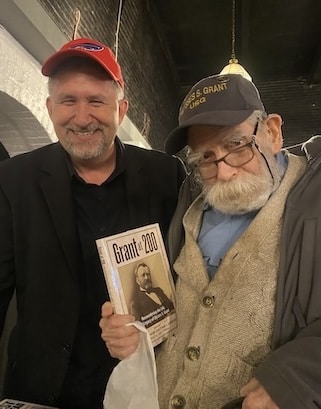
I was saddened today to hear the news of the passing of John Griffiths. John was the great-great-grandson of Ulysses S. Grant, descended from Ulysses S. Grant III as a grandfather. A resident of Fredericksburg, Virginia, John has been a familiar face at area Civil War events for decades, and in his younger years, he frequently appeared as Grant, including at Appomattox.
John would have been 88 on July 15.
I first met John in August 2015 while doing a program for the Friends of the Wilderness battlefield. The blog post I wrote about that encounter, “Meeting Grant’s Great-Great Grandson,” has become one of the all-time most-read posts in ECW history.
In August 2019, I had the chance to profile John for the Central Virginia Battlefield Trust’s magazine, On the Front Line. CVBT has kindly allowed me to reprint that feature for you here as a tribute to our mutual friend.
————
John Griffiths is of another time, or so it seems. But for his natty button-down dress shirt, he might be a wizened Civil War veteran who has stepped out of a black-and-white portrait photograph to sit a spell with me.
To conjure the past, he tilts back his head and closes his eyes, which otherwise shine from beneath bushy eyebrows as wild as the Wilderness. His voice sounds like the high smooth creak of an antique door hinge sliding open to reveal friendly secrets. When he speaks, he unspools family stories, generation upon generation, back to his grandfather’s grandfather, Ulysses S Grant.
“He was the right man for the job,” John says. “He wasn’t a man who made excuses. He was willing to do what was necessary to get the job done.”
Names and dates and places come easy to John. 81, who lives in Fredericksburg. As the son of a military officer, he and his family moved around a lot in the years leading up to and during World War II, but they finally settled in Arlington, Virginia. Following high school, he became a draftsman. “It’s all computerized now,” he says, “but I did ink on paper, pencil on Mylar—I did it all. I got out just as it was becoming all computerized.”
By that point, he was working for the U.S. Army at Fort Lee in Petersburg, but then he made a career change and took a job as curator at the Marine Corps’s ordinance museum in Quantico, which is what also finally brought him to Fredericksburg. John worked at the museum until his retirement in January 1998.
“For the first couple years, I didn’t do anything,” he grins. “I sat on the couch and watched television. Then I realized, ‘This is pointless.’” He began going to the gym—and still goes, five days a week. “That’s my goal, anyway,” he said. “That and the fact that I’m very involved in Civil War things.”
He also became interested in historic preservation. He was an early member of the Association for the Preservation of Civil War Sites—a forerunner of what’s now the American Battlefield Trust—as well as an original member of the Central Virginia Battlefield Trust, assisting with CVBT’s efforts to purchase a portion of Willis Hill from Montfort Academy. John is also a member of the Ulysses S. Grant Association and, locally, a supporter of the Friends of Wilderness Battlefield (FoWB).
“John is a regular attendee at our many living history events,” says FoWB President Mark Leach. “He almost always dresses in period attire as a captain in the Union Army. I love to point him out to guests and tell them about his relationship to U.S. Grant. Needless to say, visitors are excited to visit with John and get photos with the celebrity.”
Indeed, I first met John through one of Mark’s introductions at Ellwood, a historic home on the Wilderness battlefield Grant visited during the May 1864 fight there. John’s gracious patience with a starstruck writer made a strong impression on me.
CVBT President Tom Van Winkle calls John “a fixture at local historical events.” “He cares deeply about preservation of our Civil War battlefields,” Van Winkle days, “and the depth of the man goes beyond his lineage.”
John’s lineage stretches back to the former president and general in chief of the arm through Grant’s oldest son, Fred Dent Grant, and Fred’s son, Ulysses S. Grant III. John’s mother was Ulysses III’s oldest daughter.
But John says he had two other ancestors in “the Yankee army” besides his famous one: George Griffiths served in Company C of the 3rd Illinois Volunteer Cavalry and Rusty Holywood, from Wisconsin, served as an assistant surgeon with the 23rd Wisconsin Volunteers Infantry. He can also trace ancestors back to the Revolution and the French and Indian War.
Through his great-great grandmother, Julia Dent—Grant’s wife—he can even trace a connection to James Longstreet, who was Julia’s cousin. “It’s tenuous, but it’s a connection,” John admits.
John conjures tales for everyone on the family tree. His great-grandfather had been assigned to George Custer’s regiment but was on leave at home for the birth of his daughter, Julia, when Custer met his end at the Little Big Horn. “He was supposed to be in the field,” John says. Had that happened, he adds, it’s likely John wouldn’t be here to tell the tale.
“I remember my great aunt Julia very well,” John says, “so that was a connection, too.”

John’s grandfather, Ulysses Grant III, came along in 1881. One of the final photos of Grant shows his family clustered around him on the porch of a house on Mt. McGregor in upstate New York. John’s grandfather, four years old, wears poofy knickers and a broad sun hat and bow “in the style of Little Lord Fauntleroy.”
That same year, 1885, Grant wrote a letter “The President of the United States” to “ask for the favor of the appointment of Ulysses S. Grant [III] . . . as a cadet, at West Point.” President McKinley would be the eventual recipient of the letter and make the appointment. Grant III graduated sixth in the same West Point Class of 1903 in which Douglas MacArthur graduated first.
John’s passion for historical preservation stems from his interest not just in his family’s connections but from his broader interest in military history. “The important thing is to have an interest,” he says. “I’m very interested in the fact that these battles took place and that these battlefields exist. I want to help see that they exist for some time.”


I have fond recollections of seeing John during the CVBT events that I’ve attended over the years. He was such a friendly and personable fellow.
And I used to chuckle when I spotted his car in the parking lot with his personalized “FOSSIL” license plate.
The lyrics to “The Vacant Chair” come to mind as we Civil War travelers bid John farewell.
Condolences to John’s family and friends. My father passed away this past March at the age of 91. He would have been 92 this December. His great-great grandfather, a William Jones of the 27th Louisiana, was captured and paroled by John’s great-great grandfather back in July of 1863. Godspeed John and Dad!
I was John’ Corporal and he my Sargent in the Rev War First Maryland Regiment 1970-1984 and then he was in our Baltimore Light Artillery since 1986. Always a dear friend and many great memories. May his memory be a blessing. Bob Hines
I first met him at the Wilderness/Spotsylvania reenactment in 2014. He was telling me about his ancestors. I’m almost ashamed to admit that I thought he had dementia at the time – who thinks you’re ever going to meet the great-great grandson of Ulysses S. Grant?!
After I saw Chris Mackowski’s article in 2015, I realized he was the real deal! He would come into Wegmans every so often, and I even checked out his groceries a few times. Everytime he came in, I would have to tell one of my co-workers who he was. I hadn’t seen him in a few years, though.
John was a very gentle man
I remember Meeting him at the 154th Appomattox in 2019, he was really friendly
man he’ll be dearly missed
John Grant Griffiths (or “JGG”) was one of a kind, for sure. Having first met him in 1962 at the N-SSA’s Spring Regional, we became good friends in the RevWar First Maryland Regt (1964-1970) and I was later his supervisor at the Marine Corps Museum from 1987 until the mid-1990s, after which we remained close friends for the next 25 years, and later through his declining years. He has left an enduring legacy in the historical world through his dedication and devotion to the preservation and study of military history, and it is evidenced by the many, many friends he has left behind. Few men are able to do that….. Fill to me the parting glass, goodnight, and God be with you, John. Your pal, Ken Smith-Christmas
R-R-Reveille! Get up, sleepy head. John needs you.
Good bye my old friend. I will miss your stories around the camp fire at the civil war reenactments.