A Charleston Consul in Boston Harbor: William Trapmann and Civil War Diplomacy
ECW welcomes guest author David C. Moore.
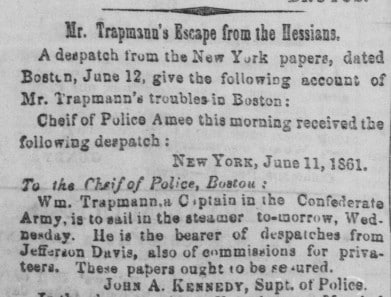
On the morning of June 12, 1861, Boston police boarded the British steamer America shortly before it sailed for Liverpool. They were looking for William Hume Trapmann, a Charleston merchant, Prussian consul, and suspected Confederate courier. A telegram from John Kennedy, New York’s superintendent of police, had warned that Trapmann was “a Captain in the Confederate Army” carrying “despatches from Jefferson Davis” and “commissions for privateers.” The papers, Kennedy insisted, “ought to be secured.”[1]
When confronted, Trapmann produced papers identifying him as a Prussian consul at Charleston. He also displayed a British passport signed by Robert Bunch, the British consul at Charleston. He claimed he carried official dispatches for Lord Lyons, the British minister to the United States, making any search diplomatically sensitive. According to one newspaper account, Trapmann warned that interference with him might bring the “vengeance” of the British government.[2]
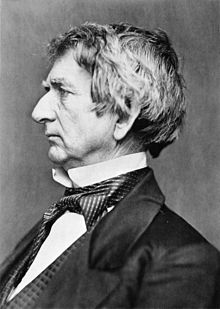
The Boston police searched his baggage and room, but found nothing that justified holding him. Shortly after the America sailed, a second telegram from Secretary of State William Seward arrived with sharper instructions: “Arrest and hold Wm. Trapmann, of Charleston, S.C., for treason. He is to sail in the steamer to-day. Secure his papers. By order of the Secretary of State.” By then, Trapmann was gone.[3]
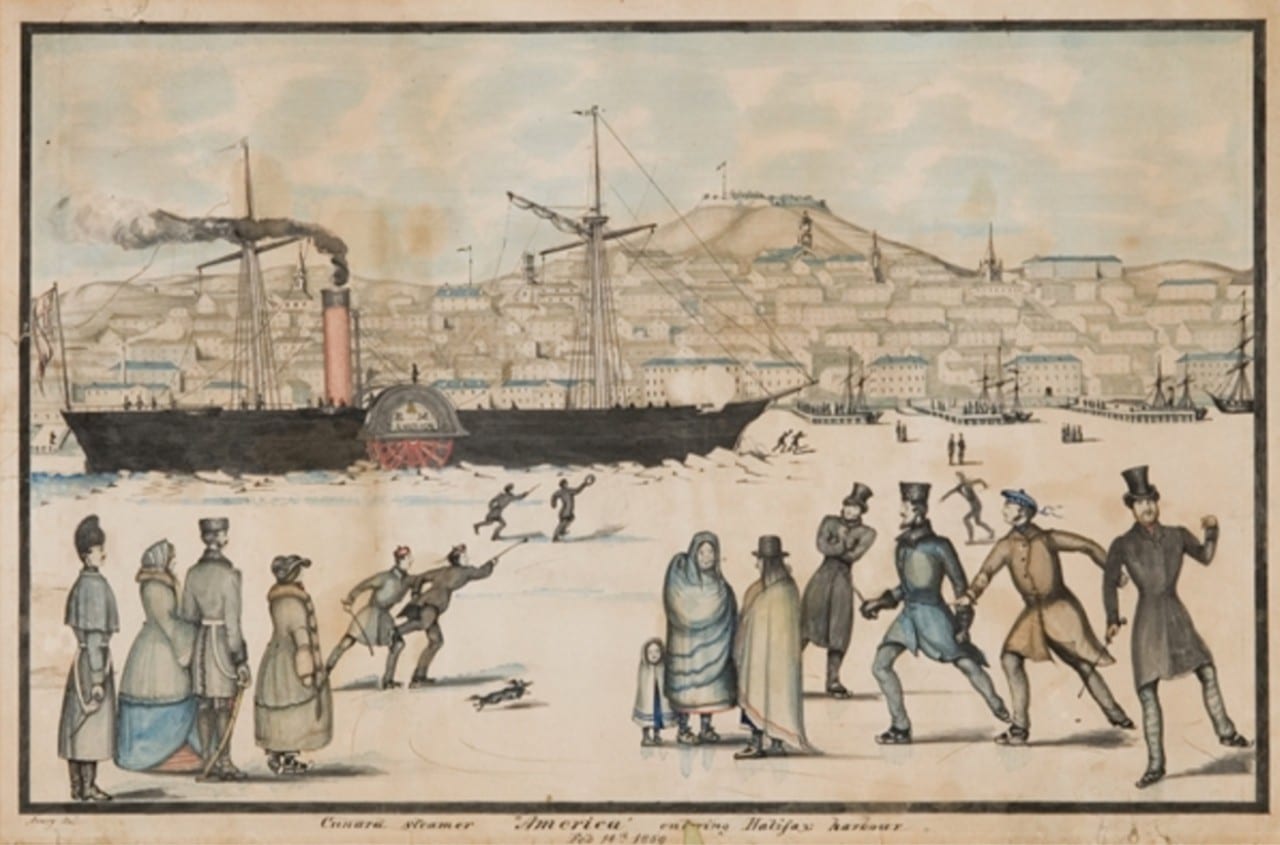
Trapmann’s case revealed how difficult it was, especially in the war’s opening months, for Union authorities to distinguish neutral travel, consular privilege, commercial activity, and Confederate diplomacy. Confederate diplomacy rarely traveled under a single, easily identifiable flag. It moved through merchants, steamships, private letters, family networks, and neutral ports. On the Boston wharf, federal authority collided with foreign privilege before the United States had a clear script for handling either.
Trapmann was deeply embedded in Charleston’s commercial world. He was the owner of Green, Trapmann & Co., a factoring and commission firm. The business operated within the cotton economy that linked Charleston merchants and planters to the wider Atlantic trade.[4] His consular status was in addition to this mercantile identity. In 1856, Trapmann asked Secretary of State William L. Marcy for a passport identifying him as “Prussian Consul for the State of South Carolina.”[5] Consuls were usually commercial representatives rather than full diplomatic envoys, but their recognized status still made searches and arrests politically delicate. For a merchant-consul like Trapmann, any search or arrest without convincing evidence risked becoming an international problem.
The diplomatic consequences of the Trapmann search appeared almost immediately. On June 14, Baron von Gerolt, the Prussian envoy in Washington, complained formally to Secretary Seward. Gerolt asked “upon what circumstantial evidence or what proof” American authorities had acted against Trapmann.[6]
Seward defended the government by pointing to intelligence received in New York. According to Gerolt’s later summary, Seward said private letters had supplied “circumstantial evidence” that Trapmann was “an officer of the disunionist army of South Carolina” and was carrying dispatches from the “pretended authorities of the Insurgents to their agents in Europe.”[7] Seward also noted that “a very large number of letters and parcels addressed to parties in the Eastern Cities and in Great Britain” were dropped in the mail before boarding. Seward argued this created a “strong presumption that many of these letters were communications having purposes hostile to the Government.”[8]
Gerolt forwarded a letter from A. G. Rose, Trapmann’s father-in-law, who called the accusations “slanderous.” Rose insisted that Trapmann’s trip was a honeymoon. Trapmann had married Rose’s daughter on May 30 and left the same day for Boston, intending to cross to Europe aboard the America.[9] Rose also denied that Trapmann carried Confederate privateering commissions. The only sealed papers in his possession, Rose said, were British dispatches given to him by the British consul at Charleston. The claim that Trapmann carried “Privateering Licences from the Confederate government,” Rose wrote, was “utterly false & unfounded.”[10]
If Trapmann had been under pressure to serve the Confederacy militarily, Gerolt argued, his departure from Charleston could show not guilt, but avoidance. On July 2, he told Seward that Trapmann’s departure, “far from appearing suspicious,” seemed to show that he wanted to withdraw from any military obligation at Charleston.[11] For Gerolt, the question was not Trapmann’s innocence, but whether American authorities could interfere with a recognized Prussian consular officer on uncertain evidence.
Trapmann remained in Europe during the war, and the surviving record still does not prove what he carried in June 1861. Later evidence does help explain why Union officials viewed Charleston’s overseas commercial networks with suspicion. One example came from the capture of the British blockade runner Bermuda, seized by the U.S. Navy in 1862. The vessel carried munitions, cannon, and watermarked paper intended for Confederate banknotes. In the prize case that followed, the Supreme Court described correspondence found aboard the ship, including “numerous letters of friendship and business” from people abroad to people in the rebel states, among them letters to “Mrs. Trapman [sic], Mrs. Trenholm, Mrs. Rose.” The ship also carried requests for goods to be brought through the blockade.[12]
This evidence places Trapmann’s household and commercial contacts to the same Atlantic world that sustained Confederate supply efforts. That world included Fraser, Trenholm & Co., the Liverpool branch of the powerful Charleston firm John Fraser & Co., which became a major Confederate financial and logistical agent in Europe. Trapmann’s own mercantile connections also continued after his departure; the Fraser, Trenholm papers list later correspondence from “W. H. Trapmann” concerning cotton business and shipping inquiries.[13]
During the war, Trapmann’s Charleston property was damaged during the siege of Charleston. In October 1865, Henry Meyer, the Swiss consul acting as Trapmann’s attorney, filed an affidavit seeking recovery of the property to prevent its seizure. Meyer swore that Trapmann had gone to Europe in June 1861 on commercial business, had remained there ever since, and had taken “no part, neither directly nor indirectly, in the political events that took place since in this country.”[14]
Trapmann’s story does not produce a simple verdict. Federal authorities believed he might be carrying Confederate dispatches and privateering commissions. Prussian diplomats insisted that American officials had acted on inadequate evidence. His father-in-law said the journey was a honeymoon and that the sealed papers were British, not Confederate. Later records placed Trapmann’s family and commercial circle within the broader Atlantic world that supported Confederate blockade running.
Ultimately, Trapmann was a Charleston cotton merchant, Prussian consul, bearer of claimed British dispatches, and Southern insider. The Trapmann incident was more than a Boston wharf curiosity. In miniature, it anticipated the diplomatic problems that erupted later that year in the Trent Affair. Neutral ships, consular status, private correspondence, and Confederate diplomacy could quickly turn a domestic rebellion into an Atlantic crisis.
David C. Moore is a lieutenant colonel in the United States Air Force and a graduate of Gettysburg College. He holds a Master of Public Administration from Rutgers University and is pursuing a Master of Science in International Relations at Troy University. A Civil War living historian, he reenacts with Company B of the 28th Massachusetts Volunteer Infantry.
Endnotes:
[1] John A. Kennedy to Joseph M. Wightman, June 11, 1861, Notes from the Legations of the German States and Germany in the United States to the Department of State, 1817-1906, National Archives, Record Group 59 (hereafter German Legation Notes).
[2] “The Boston Police in a Quandary,” Richmond Daily Dispatch, June 17, 1861.
[3] Kennedy to Osborn, June 12, 1861, German Legation Notes.
[4] Census of the City of Charleston, South Carolina, for the Year 1861 (Charleston, 1861), 83.
[5] “William H. Trapmann,” passport application, June 11, 1856, U.S. Passport Applications, 1795-1925, National Archives Microfilm Publication M1372, roll 56, Record Group 59; Ancestry.
[6] Gerolt to Seward, June 14, 1861, German Legation Notes.
[7] Gerolt to Seward, June 21, 1861, German Legation Notes.
[8] Seward to Gerolt, June 19, 1861, German Legation Notes.
[9] A. G. Rose to Gerolt, June 18, 1861, enclosed in Gerolt to Seward, June 28, 1861, German Legation Notes.
[10] Rose to Gerolt, June 18, 1861.
[11] Gerolt to Seward, July 2, 1861, German Legation Notes.
[12] The Bermuda, 70 U.S. 514, 520–22 (1865).
[13] “Civil War and the Confederacy: The Business Records of Fraser, Trenholm & Company of Liverpool and Charleston, South Carolina, 1860-1877,” Merseyside Maritime Museum, B/FT 1/118 and B/FT 1/120.
[14] “William H. Trapmann,” property record, Charleston, SC, 1865-1872, U.S. Bureau of Refugees, Freedmen, and Abandoned Lands Records, 1865-1878, National Archives Microfilm Publication M869, roll 31, Record Group 105; Ancestry.


Great report! But, it hardly seems fair that while 1856’s Presidential Candidate John Fremont was in Europe buying up all the surplus weapons he could get his hands on for the USA, the agents suspected of operating on behalf of the CSA were… ALSO allowed to sail for Europe, even from Northern cities.
Pesky things: laws and rules of evidence in time of war. But the period following the Surrender of Fort Sumter until U.S. Congress met in Special Session July 1861 could best be described as a prepping and posturing Phony War. Lincoln’s Administration had to tick all the boxes to get Europeans to respect his Blockade of Southern Ports; and draconian measures had to be kept in their lockers lest sympathetic Europeans found cause to Recognize the Confederate States of America as a Sovereign State.