Trigonometry and Tragedy: Did battlefield math play a part in Gettysburg’s most famous civilian death?
ECW welcomes back guest author Mike Busovicki.
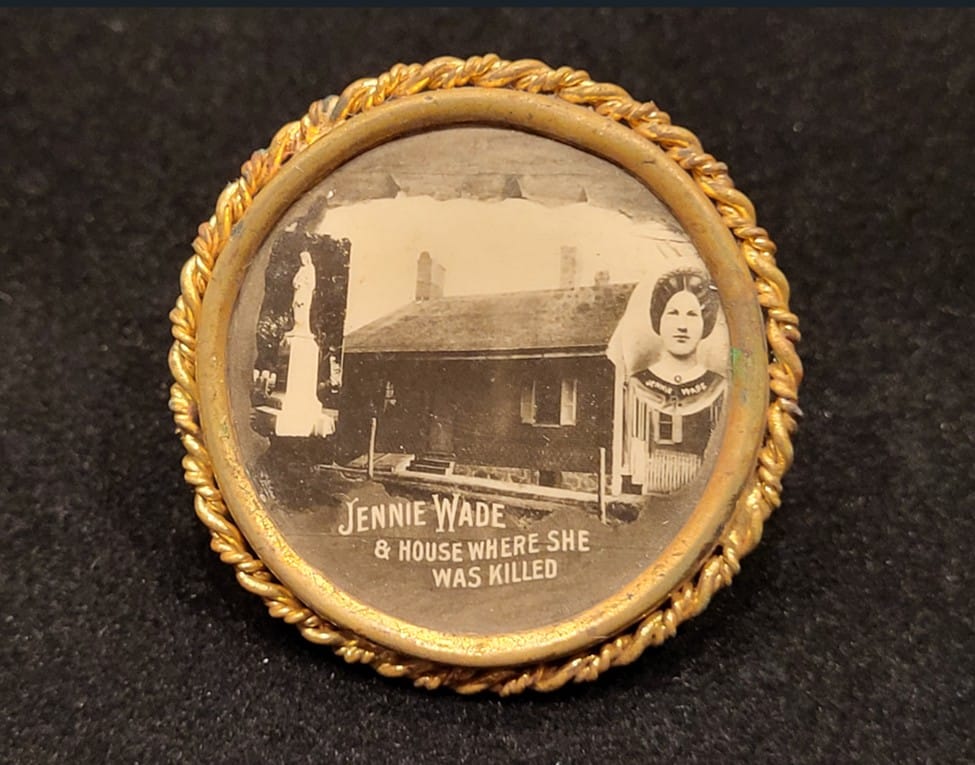
As the Civil War ripped through American communities, collateral damage – our modern sanitized term for civilian casualties – was inevitable. Approximately 30 citizens were killed or injured as a result of the battle of Gettysburg, often from handling unexploded ordinance or loaded weapons. However, Jennie Wade was the only one killed by direct fire during the battle. While unlikely Confederates specifically sought to kill Wade, it was inevitable that anyone remaining in the town risked their lives if they ventured outside of their cellars.
Most Civil War engagements occurred in the open with few landmarks to help gauge distance and coordinate fires. Combatants largely had to calculate range and adjust fire using visual cues and easily identifiable reference points. Viewers of the HBO WWII series The Pacific, recall Eugene Sledge using a farmhouse to guide additional mortar salvos. Once the gunners had the range, he chillingly radios confirmation back, sealing the fate of any inhabitants: “Target. Mark it ‘concentration Baker’ for this sector.”[1] Wade’s house may have been a similar reference point.
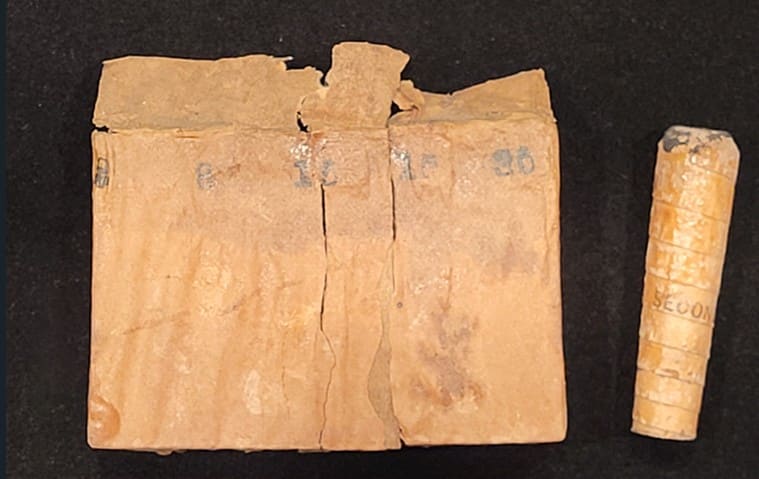
Adding or dropping adjustments, windage, and calculating fuse length largely depended on accurately estimating the distance to the targets. Essential for line-of-sight gunnery, flight time exacerbates all other variables. Objects with sharp outlines (like a house) appear closer, while irregular ones (trees) appear farther because their silhouette merges with or are obscured by the background. Objects that contrast (color, brightness) appear closer than those that blend in. Observers often underestimate range over flat or featureless surfaces. Targets appear farther downhill; those uphill, closer. At several hundred yards, a person’s head and limbs start to become indistinguishable from the torso. Having a familiar-sized object like the farmhouse to self-correct your estimates is invaluable.[2]
“Formerly artillery began battles; it could take its position… and deliver its fire without incurring danger or loss from the fire in return of the infantry. [Now] it would be impossible for a field-battery to remain in front of infantry at a distance of 810 yards for ten minutes; three minutes alone sufficed at that distance… to wound the men and horses to such an extent as to disable the piece.” – Future Confederate General Cadmus Wilcox[3]
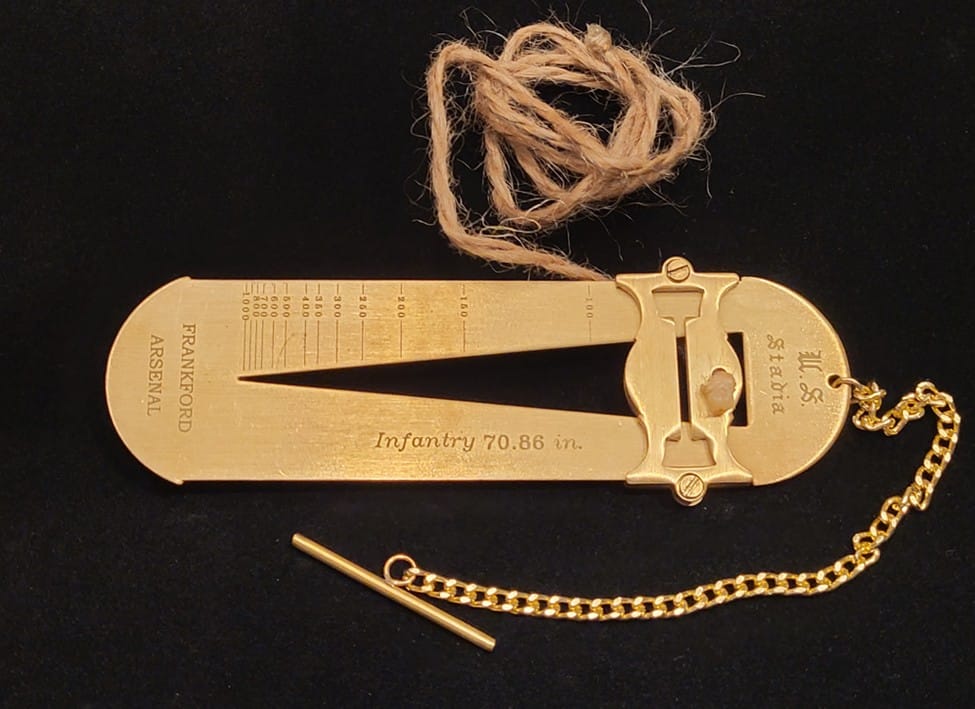
Wilcox and others’ pre-war studies of the rifle helped revolutionized anti-artillery tactics. He discusses several tools like the tige – a piece of ivory or wood with man-sized marks at regular distances. Others included the Malphet tool (metal tubes with improved tige-like scales), and the Porro instrument, an optical device using prisms and lenses. While simple and portable, the tige was inaccurate past 250 yards; the others expensive and fragile. The most reliable tool was the stadia – a metal scale with a small rectangular window (aperture). It used basic trigonometry, capitalizing on the fact objects appear smaller at a constant rate. The user held the stadia approximately 2 feet away (some gripped the end of an appropriate measure of string with their teeth). At that length, when a target filled the aperture, the corresponding mark indicated the range in yards. A stadia was the coveted prize of unit marksmanship competitions.
“The fire of the ordinary musket is uncertain beyond 200 yards, the variations in height, from one shot to another, at that distance, often exceed one or one and a half yards… In general, the infantry soldier in the excitement of battle, does not make full use of the accuracy of fire of his arm… but these arms exhibit their marked superiority when used by isolated marksmen… in deliberate firing from behind obstacles” – Union General John Gibbon [4]
When practical, guards unloaded their muskets after being relieved by firing at targets placed at known distances to maintain proficiency. Regular training taught them to use the point of impact to bring the next shot on target, like Sledge and the farmhouse.[5] Still, range is only part of the story. Wind and barometric pressure can create more “drag” on a bullet, making it fall faster or drift sideways. A gentle breeze – 5 mph or so, just enough to cool your cheek – can still move a bullet a few inches past 100 yards. At 10 mph, enough to make noise blowing across your ear, wind creates more dramatic drift.[6] Without additional tools, the only way to determine how much these variables are influencing your rounds is to take a shot and see how far off it lands.
The Federals on Cemetery Hill presented inviting targets, but the smoke from black powder rifles (A) gave away Confederate sharpshooters’ position and (B) prevented firing from inside the room or attic like modern day snipers. They needed to quickly fire and make corrections with the least amount of time exposed from a window. Major Eugene Blackford, commander of the 5th Alabama occupying the town, described the action on July 3:
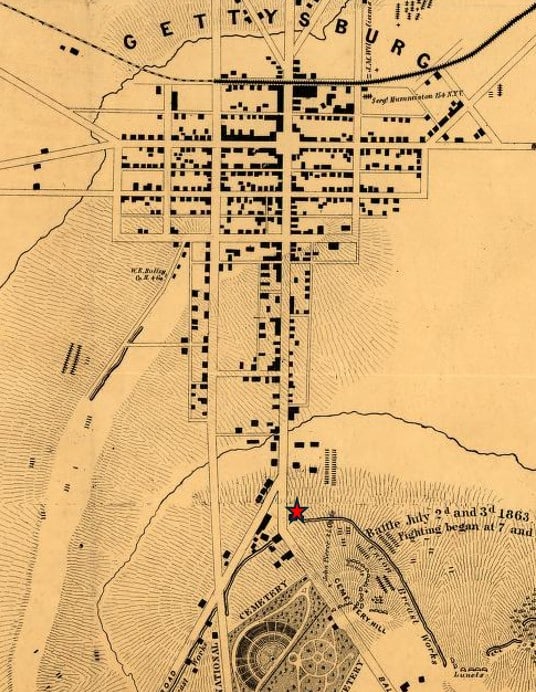
“I took position in the suburbs of Gettysburg, as near the enemy’s lines as possible, the men being sheltered in the houses. At daybreak on the 3d, we opened fire upon the enemy’s artillery and skirmishers, and upon their lines… the average number of rounds fired was not less than 200, at ranges varying from 300 to 500 yards… One battery near us, after firing several shots at us, was removed out of our sight.”[7]
The north face of Cemetery Hill had very few features in July 1863. Devoid of trees or houses, Union troops constructed lunettes and threw up other hasty defenses. One of the few structures was a duplex where John Lewis McClellan and his wife, Georgia (no relation to the general) were renters. Georgia had just given birth and was attended by her mother and sister, Mary Virgina (“Jennie”) Wade. Without other landmarks, the house became an inadvertent “focus” for rebel fire, as a 10-pound artillery shell pierced the home on July 2. Confederates looking to suppress the Yankees, whose breastworks ran right up to the McClellan’s home, undoubtedly used it as a visual reference. It’s a lot easier to send the next round “25 yards to the left of the red brick house.”
By the third day of the battle, all the glass in the windows had been shot out so no other easy “downrange indicators” were left, making the door an inviting target, along with its size and contrast in color from the brick walls. Your average entry way is just under 7 feet high and about 3 feet wide. A “ballpark” estimate says a person is somewhat shorter and about half as wide. A bullet strike would send paint flying – instant verification your estimates were correct and you could hit someone with the same calculations.
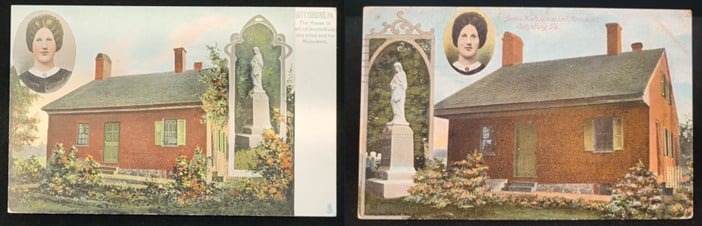
At 8:30 on the morning of July 3, a single rifle round slammed through the door on the north side of the McClellan house, continued through a second door, and struck Wade in the back, killing her instantly. Like other battle casualties, Jennie was buried multiple times; once for expediency, then reburied as the town reclaimed its yards and fields from what the Angel of Death had sown. Initially interred in her sister’s back yard, her body was moved to the German Reformed Church graveyard in 1864 and then to her final resting place in Evergreen Cemetery in 1865.[8]
Nothing can replace downrange feedback (seeing where rounds impact), and I can personally confirm field expedient measures are still in use, including using building as target reference points. Snipers were a constant concern when we fought in Ramadi, Iraq throughout 2006. Our troops, who didn’t have range finders either, would sometimes take a shot at a door of abandoned buildings that harbored enemy fighters to verify they had correctly calculated the range and windage should they need to engage that location.[9] While difficult to definitively say if (or how much) the Confederates purposely fired on the McClellan house to fine tune range adjustments, with at least one artillery and over 150 bullet strikes, that humble house on Baltimore Street confirmed one of Murphy’s Laws of Combat: objects that stand out on the battlefield attract fire.
Mike Busovicki is an Iraq War Infantry Veteran. He evaluates disability claims for the Department of Veterans Affairs and holds a master’s degree in public and international affairs.
Endnotes:
[1] @ BuriedReels: “One round, HE.” Excerpt from The Pacific, Episode 9, HBO (2010). https://www.youtube.com/shorts/HUe2jAyjzyU
[2] Author’s notes, Expert Infantry Badge training, 2005.
[3] Wilcox, Cadmus. Rifles and Rifle Practice: An Elementary Treatise Upon the Theory of Rifle Firing, D. Van Norstrad, New York, NY 1859, 247
[4] Gibbon, John, The Artillerist Manual (reprint). Dayton, Morningside, 1991, 230-231.
Yee, Gary. Sharpshooters 1750-1900. Sharpshooter Press, Broadmoor, CA, 2009.
[5] “A System of Target Practice for the Use of Troops.” U.S. War Department, Washington, D.C., 1862, 38-43.
[6] Beckstrand, Tom. “Buck the Wind”, Precision Hunter, Spring 2026, 65-66.
[7] Official Report of Major Eugene Blackford. U.S. National Park Service: https://share.google/2lSZz6KsUJGfHVMB6
[8] The Life & Death of Jennie Wade, with Tim Smith. Recorded on April 19, 2025, at the Adams County Historical Society. YouTube, https://www.youtube.com/watch?v=gEF28qfAjV0
Who Shot Jennie Wade? The History Explorer: https://www.youtube.com/watch?v=gUkURKBn7Fc
[9] Permitted within our rules of engagement (ROE) and cleared with higher before test firing if troops were not already in enemy contact.


This is an excellent piece and the author’s expertise really shines through. I’m surprised there aren’t more comments. I did read one account that Union soldiers were upstairs or in the attic when she was shot, so maybe the sharpshooters were aiming at them and missed?
I appreciate the feedback! I love the additional comments and ability to continue the conversation as well. I think if someone wants to comment they have to sign up for WordPress, and not everyone has an account. Glad you found it interesting; here is an additional range estimation practical exercise you can try (I had to cut for length and didn’t want to stray off of the main story line):
Holding a “thumbs up” at arm’s length allows you to quickly estimate range. Say you want to know how far away a horse is. With the right thumb at arm’s length, you close your right eye and cover the horse with your thumb. Next, simultaneously close your left eye and open the right eye. How far did your thumb “jump” to the left? Well, it appeared to move three times the length of the horse (say, 8 feet from nose to tail, so 24 feet). Now multiply by ten… the horse is approximately 240 feet away. Similarly, a large barn, much farther away, is probably 100 feet long. Here, the “thumb jump” estimation was twice the length of the barn. So, 200 feet x 10 = the barn is ~ 2,000 feet away.
I think the Confederates were certainly aiming at Union men on Cemetery Hill, though I haven’t seen reports where Yankees were actively firing *from* the Wade home itself (if someone does have that documentation though, please comment below! Always open to new info, sources, and interpretation). The green door in the postcard pictures is where the shot that killed Jennie came through (the north side), while the second floor windows are on the east and west sides. The second floor and McClain side of the duplex appear to have been empty at the time of the battle according to Georgia’s post-war writing about the ordeal. The tour guide in the “Who Shot Jennie Wade” and Tim Smith clips from my sources do not mention Union men using the home as a defensive position, but do note troops asked the family for water and food, as well as relief from minor injuries.
There was another example I found of purposely using man-made structures as a means for sighting in weapons in a mid-20th Century Army operator’s manual for tracked vehicles. It directs the operator to sight the machine gun by aligning the axis of the gun bore “on a target with clearly defined right angles at approximately 500 meters in range. [Align] center of barrel on aiming point using elevating and traversing mechanisms.” And the aiming point in the diagram provided? The corner of a window of a house, not unlike the north face of the Wade home, with its clearly outlined windows and door… (from TM 9-2300-224-10/3/4, Flame Thrower, Self-Propelled, M132, April 1965, p. 22)
Very interesting. I appreciate your attention to detail. Most historians aren’t ballistics experts, so this definitely sheds a different light on the subject. I never would have thought about it this way but you make a compelling argument.
thanks Mike, nice piece … i was surprised to read that the round that killed Jennie had enough energy to pass thru two doors before hitting her … that would seem ot indicate the Conderate riflemen were fairly close — abt 200 yards — and, and to your point, the shot was likely not an errant round … i.e., the house was taking direct fire.
Thanks Mark! Yeah, given the kinetic energy the round had, I think intent and proximity both played a factor. In Yee’s book, he reports the average penetration of rifled musket balls from Sharps, Enfield, and Spencer rifles into different objects from 10 to 15 yards – dry yellow pine: 2.75″ to 3.25″. Softer wood like green palmetto palm: 7.5″ to 8.5″. Dry bundles of brush (i.e., “fascine”): 8.5″ to 9.5″. Dry sandbags: 6″ to 7″. Wet sandbags: 7.5″ to 8.5″. Loose damp sand (defensive berm): 8″ to 14″. Tightly-packed cotton packed in sandbags: 22″.
Another good book is Earl J. Hess’ book “The Rifle Musket in Civil War Combat, Reality and Myth”, University of Kansas Press, 2008. Hess makes it clear the “bullet proof vests” sold to troops were largely ineffective, and the amount of damage inflicted on the human body was terrific. So powerful was the rifle round that it could not only cause instant death, but almost instant rigor of the body, freezing the victim in its last act (pp. 80-82).
The effectiveness of cotton against a lead slug was most surprising to me; I’ve read the effectiveness of cotton bale earthworks made famous in the War of 1812 Battle of New Orleans has been exaggerated. Utilized more for expediency in putting up forms of “concealment” (keeps you out of view of the enemy) than actual “cover” (protects you from a rifle round), the defense could bolster it with more robust materials when time and availability permitted. However, like a crude form of Kevlar (and when thick enough), the fibers can possibly slow projectiles down to a survivable velocity or minimize the damage inflicted. Confederate ships at the Battle of Galveston utilized cotton bales to protect personnel and vulnerable parts of the ship like the boilers. Check out Donald A. Frazier’s article “Cottonclads in a Storm of Iron” from the June 1994 issue (Vol 8, No 3) of Naval History Magazine from the U.S. Naval Institute.
P.S.: For black powder demonstrations and living history discussions, I like the videos from Cap and Ball, Brandon Fisichella, and Battlefield Curator (all on YouTube).