Book Review: To Save Us All from Slavery’s Power: Republican Alarms, Southern Terrors, and the Plunge into Civil War

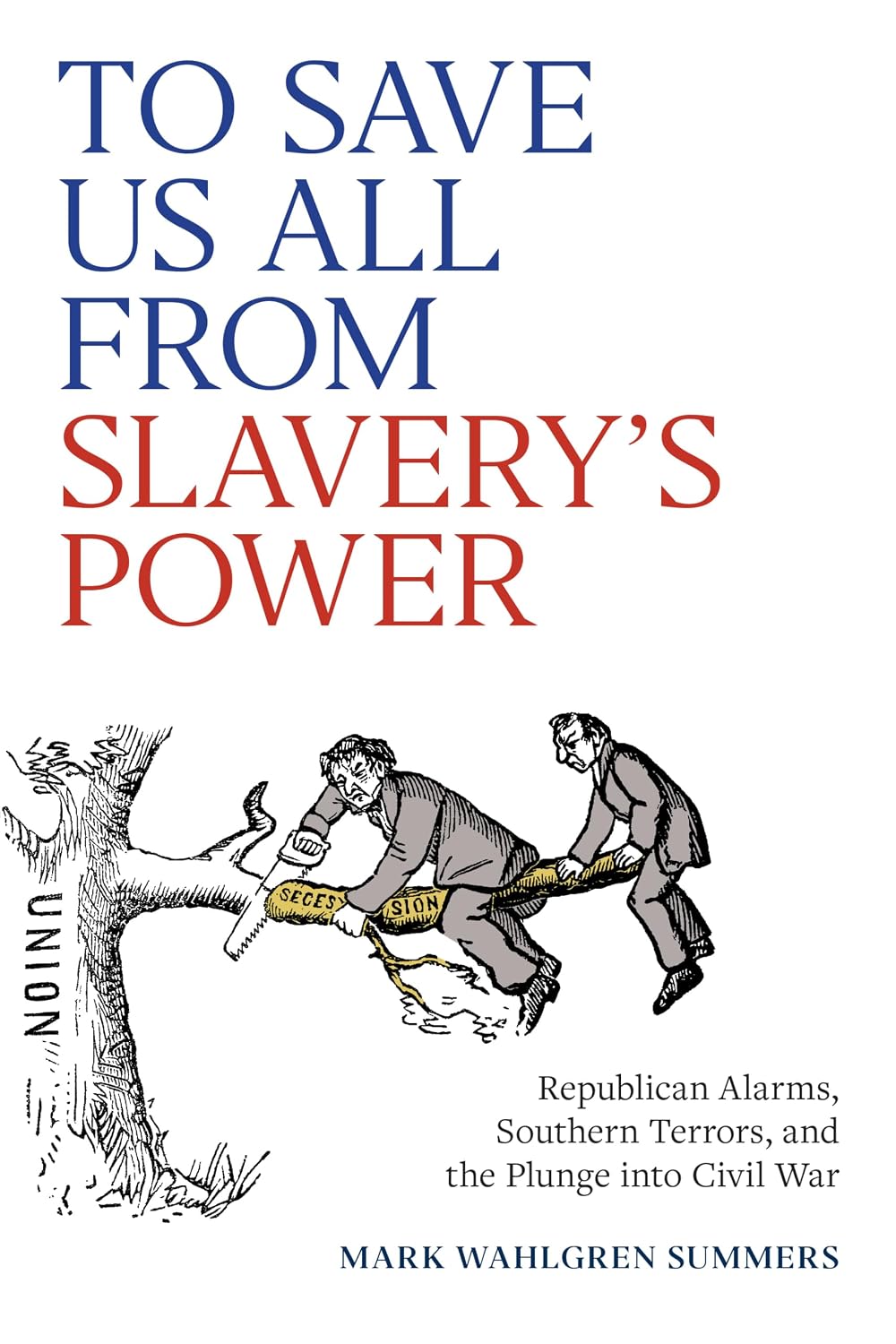
To Save Us All from Slavery’s Power: Republican Alarms, Southern Terrors, and the Plunge into Civil War. By Mark Wahlgren Summers. Charlottesville, VA: University of Virginia Press, 2026. Softcover, 312 pp., $32.50.
Reviewed by Tim Talbott
Particularly over the past decade, journalists and authors have spilled an ocean of ink, consumed countless bytes of digital memory, and expended seemingly endless hours of on airtime discussing the growing political polarization of the United States. Without taking a thoughtful and nuanced look back to other troubled times in American history, some sensationalist voices claim that our current situation is “unprecedented” and that we are navigating “uncharted waters.” In an attempt to get higher ratings of viewership, these voices only add emotional reaction rather than careful consideration to our growing divide.
Mark Wahlgren Summers’ latest book, To Save Us All from Slavery’s Power: Republican Alarms, Southern Terrors, and the Plunge into Civil War, does not make explicit comparisons or offer personal or judgmental political commentary about the past’s relevance to current events, but in some cases it is virtually impossible to miss rhyming similarities as he skillfully discusses the events and the sectional reactions to those events spanning from John Brown’s Harper’s Ferry raid to the secession crisis of 1860-61.
Summers admits that “one more book centered on 1860 may seem like no blessing to any bookshelf, with so many popular and keen-eyed accounts already limning that critical year, when the republic of the Founders lurched toward a final reckoning on slavery and a near-death experience.” But rather, his intention with the book is “to focus not on who the Republicans were electing so much as what they were winning,” and why it “was a critical year—one where not just freedom in the territories but the liberty for all Americans seemed under threat.” Additionally, he explains, “it also suggests that what Republicans meant to do in the short term may have been far less revolutionary than recent scholarship has led casual readers to infer.” (2)
To Save Us All from Slavery’s Power opens with a thoughtful introduction and a contextual prologue cleverly titled, “’60 Shades of Brown.” The prologue sheds valuable light on how both sections of the nation interpreted this polarizing event. While the slave states viewed the raid as just the tip of the iceberg of what abolitionists planned for the future destruction of slavery, and thus set about passing measures to better protect the peculiar institution, Republicans saw southerners’ reactions to Brown and his strike at slavery as sheer hysteria over an event that was actually extremely limited in its duration, chances of success, scope of influence, and scale of involvement. As would be the case throughout 1860, both sides were looking past each other, neither really willing to consider or appreciate the perspective of the other.
The book’s fourteen chapters explore the various topics and events surrounding the primary divisive political issue of the day, slavery. Summers fills each chapter with evidence gleaned from primary sources like national and state legislative records, speeches, and personal correspondence, but perhaps makes best use of period newspapers. In a day long before cable news networks and talk radio, newspapers were how the vast majority of Americans consumed news about current events. Unfortunately, much like many modern news outlets today, newspapers were typically the mouthpieces of the political parties of that era. As Summers notes, “it was to the editors’ interests not to soften but to heighten the issues at stake, to make them more momentous than, on reflection, they might have been. It was not in the interest of the editors to allay fears and reassure their readers of the good intentions on the other side. It was in their interest to do whatever could get out the vote, and get it out in its fullest force, its indignation white hot.” (31)
Brown’s raid sparked a wave of reaction not seen in the slave states since Nat Turner’s Rebellion almost thirty years earlier. A rise in tarring and feathering, expulsions, beatings, and even killings fell on those who expressed free speech or whom southerners suspected of possessing abolitionist or anti-slavery reading materials or for just expressing such sentiments. Reports of such deeds, of course, made their way to northern newspapers who increasingly viewed the practitioners of slavery as anti-democratic, in violation of the Constitution’s First Amendment, and a threat to the nation’s very survival. Again, neither side was willing to consider a differing perspective, let alone engage in any kind of constructive and productive discourse.
Summers covers a whole gamut of issues inflamed by the growing divide rooted in slavery, including but not limited to: congressional rhetoric and feuding, the potential enslavement or expulsion of free Blacks, potentially reopening the international slave trade, enforcement of the fugitive slave law, Republican efforts at denationalizing slavery and limiting slavery’s spread, and the fusion of previously unaligned political parties to gain power. Prejudicial newspaper reporting on these various issues sowed the seeds of countless and false conspiracy theories, most originating in mere rumor but unfortunately believed as gospel by many on each side.
Summers’s book is indeed a blessing to any bookshelf. For those who continue to see otherwise, it clearly makes the claim, and backs it up with a mountain of evidence, that slavery was the central dividing issue that brought about the war. But as he shows, there’s so much more to all of that. Additionally, it also serves as a vivid reminder of the folly of not taking seriously the concerns, no matter how far-fetched they may seem to be, of the other side. It is a timely study with much for us to consider.


Really enjoyed this review, well written as always, Tim. Your first paragraph happens to be one of my pet peeves about present-day politics – folks saying “our current situation is ‘unprecedented!'” It really hammers home why studying history is so important. We know the past and the present often rhymes as you so elegantly put it.
Except…little of the country on either side gave a fig about slavery. Only 2% of Northerners identified as Abolitionists, only 0.05% joined Abolitionist societies, only 7% of Southerners owned slaves – and the rest drew no benefit from the practice – and in the 1860 election, while winning the Electoral College fair and square, Abraham Lincoln got less than 50% of the popular vote in the North, zero votes in the South, and just 39% overall. So, the war was not fought to make “a final reckoning on slavery” – which was legal, protected by the Constitution, and not finally amended out of existence until eight months after the war concluded – whilst six slave states remained in the Union through the war. I’ve collected copies of hundreds of recruitment posters from the war, North and South – not a single one ever calls men to arms to destroy or preserve slavery. The view that the conflict was a reckoning on slavery is a post-war revisionist one designed to make things simple, tidy and black & white. It tramps on the subtleties, contradictions and head-scratching oddities of the war that make its study so fascinating.
Just because a mid-19th century American did not identify as an abolitionist on one side or own an enslaved person(s) on the other side did not mean that they did not feel that they had a stake in whether slavery was going to expand, remain where it was, or go away. You appear to be the one who is trying to make things “tidy and black & white” by thinking only those two camps had a concern in the matter. If only people within those two groups were the only ones that slavery concerned, slavery would not have been the major political football that it was and required compromise after compromise from the beginning of the United States of America until the secession crisis.
Read period newspapers, from both the free states and slave states, slavery is THE WHAT that was being discussed and debated . . . by many many people who weren’t abolitionists or didn’t own slaves. Slavery and the issues it caused mattered to people from all walks of life in both sections. Yes, there were gradations of anti or pro-, and sure, some people had little stake or care in the institution, but it if you are arguing that the slaves states who seceded did not do so because of the Republican Party’s threat to the expansion of the institution, and that their secession was not brought on by the election of a Republican president, then you’re just ignoring a mountain of primary source evidence, not what you call post-war revisionism.
Slavery did not have to be a United States war aim in 1861 for it to have been the primary cause of the war. The initial seven Deep South slave states seceded over threats to their economic, political, social, and cultural “cornerstone” institution. If they had not seceded, there would not have been a reason for Lincoln to call for 75,000 volunteers. And there would not have been a war exactly when it happened. But there would have always been agitation on that issue. That is why many northerners who weren’t abolitionists when to war, to preserve a Union that the slave states attempted to shatter.
I think your southern boys in 1860 would vigorously disagree with you, considering they explicitly put in writing that preserving slavery was the entire point of their rebellion. And quite a few people “gave a fig about slavery”— enough to hand Lincoln 180 electoral votes and an outright popular majority across the free North on an explicitly Republican Party anti-slavery platform. Pulling off a 40% national plurality is especially impressive when you remember ten soon-to-be Confederate states were too terrified to even let Lincoln’s name appear on a ballot.
Your recycled 7% talking point is just classic Lost Cause math, easily debunked by the 1860 census showing nearly a third of Southern households owned human chattel. Reading local enlistment posters while dodging the Confederate Constitution, the secession declarations, and Stephens’s “Cornerstone Speech” isn’t uncovering deep historical subtlety—it’s typical Lost Cause historiography, a willful and frankly weird penchant for ignoring hard historical facts in favor of comforting bedtime stories.