Standing up to Stonewall
ECW welcomes guest author Stan Haynes.
It was a welcome boost to the low morale of a war-weary Northern public. The story, as relayed, was one of patriotism, literally of flag-waving in the face of danger. Of taunting one’s enemy. Of David versus Goliath. It was about Barbara Fritchie, an elderly Unionist widow, staring down Confederate Gen. Thomas “Stonewall” Jackson, defying him, and of Jackson blinking.
Fritchie’s heroics were told in verse, in a poem written by John Greenleaf Whittier, a prominent New England poet, and published in the prestigious Atlantic Monthly in October 1863. The setting was Frederick, Maryland, a year earlier in September 1862, when an invading Confederate army marched through the town’s streets while en route westward to battle along Antietam Creek.
Titled “Barbara Frietchie [sic],” Whittier’s poem told of the Maryland town’s mostly pro-Union residents, fearing possible retribution, pulling down all of the Stars and Stripes flags that lined the streets, including Fritchie’s, in the hours before the Rebel army passed through.
The plucky ninety-six-year-old Fritchie, “[t]he bravest of all in Frederick town,” was appalled, and she “took up the flag the men hauled down.” She placed it prominently on a pole from a second-floor window of her Patrick Street home. The poet then described Gen. Jackson and his soldiers marching by Fritchie’s residence, of Jackson eyeing the flag and ordering one of his men to fire upon it, breaking the flag’s staff and shattering window panes. An enraged Fritchie “snatched the silken scarf,” leaned out of her window, and “shook it forth with a royal will” at the passing Rebels.
Then came the most dramatic moment in the encounter between the nonagenarian and the general. Looking Stonewall in the eye, Barbara shouted “Shoot, if you must, this old gray head, but spare your country’s flag.” Her words both moved and embarrassed Jackson, as “a shade of sadness, a blush of shame” came over his face. The old woman’s “deed and word” had stirred “the nobler nature within him.” The general turned to his men and barked an order: “Who touches a hair of yon gray head dies like a dog! March on!” Fritchie’s “free flag” waved over the heads of “the rebel host” the rest of the day, as thousands of soldiers marched by.
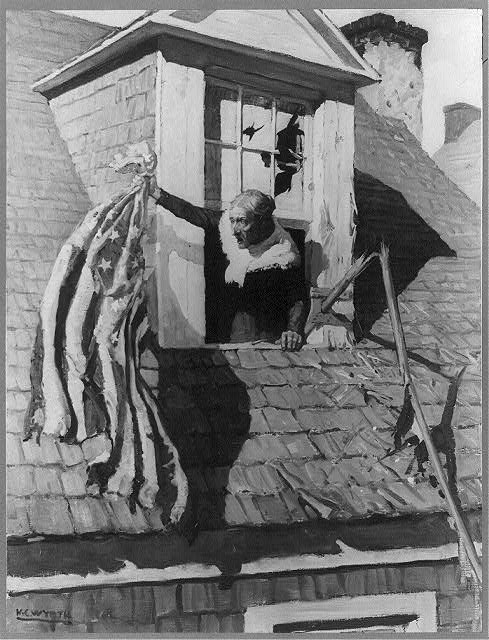
By the time the poem was published, a year after the events it depicted, both of the protagonists were dead. Fritchie died in December 1862, three months after the Confederate army passed through her town. Stonewall Jackson died several months later, in May 1863, mistakenly shot by his own soldiers.
Whittier acknowledged their passing in his poem, writing that “Barbara Frietchie’s work is o’er, and the Rebel rides on his raids no more.” Give “honor to” Fritchie for her bravery, the poem concluded, and may the “flag of Freedom and Union” wave over her grave; but also, for his compassion toward her, “let a tear fall, for her sake, on Stonewall’s bier.”
The poem was quickly reprinted in newspapers throughout the Union states, making Fritchie a beloved national icon. Almost as soon, questions began to be asked about the story’s authenticity. The whispers grew over the years. The facts show that while many of Jackson’s soldiers passed by Fritchie’s house, the general himself did not. He took a different route that bypassed Fritchie’s portion of Patrick Street.
A neighbor directly across the street from Fritchie, who watched the Rebel soldiers pass by, saw none of what was depicted in the poem. He wrote in his diary that it “is not true—I do not believe one word of it.” Fritchie was said by some to have been bedridden at the time, too frail to appear at a window. Still, she was known by family and friends to be an ardent patriot. As author Steven Stotelmyer has observed, “Barbara definitely wore her patriotism on her sleeve . . . There was never any doubt in the minds of those who knew Barbara Fritchie that” the events related in the poem “could have been true.”
Credible sources do verify that Fritchie appeared at her doorway holding a small American flag, but that it had occurred days later when Union troops marched by. Two other Maryland women, Mary Quantrill and Nancy Crouse, were said to have had hostile flag-involved encounters with Confederate troops and were alleged by some to have been the ones that the poem should have honored.
Whittier responded to his critics, insisting that he had acted in good faith and that the poem accurately portrayed the facts as presented to him. He advised that he had gotten the story from an acquaintance, Mrs. E. D. E. N. Southworth, a noted novelist.
Both Whittier and Southworth were Quakers and abolitionists. In September 1863 Southworth, who lived in Washington, wrote to Whittier that she thought the story would be perfect material for one of his works. She advised that, not long after the fighting at Antietam, a brief article had appeared in a Washington newspaper about Barbara Fritchie having displayed the only Union flag when Confederate troops had passed through Frederick. She added that she had later “heard the whole story,” which was provided to her “from friends who were in Frederick at the time.”
Whittier completed his poem within two weeks of receiving Southworth’s letter, and it basically told the story as she had relayed it to him. He sent her a copy of the poem, stating, “If it is good for anything thee deserve all the credit for it.” Later, an embattled Whittier wrote that Fritchie’s story “had gained public credence in Washington and Maryland before my poem was written,” adding that he believed “it had foundation in fact.”
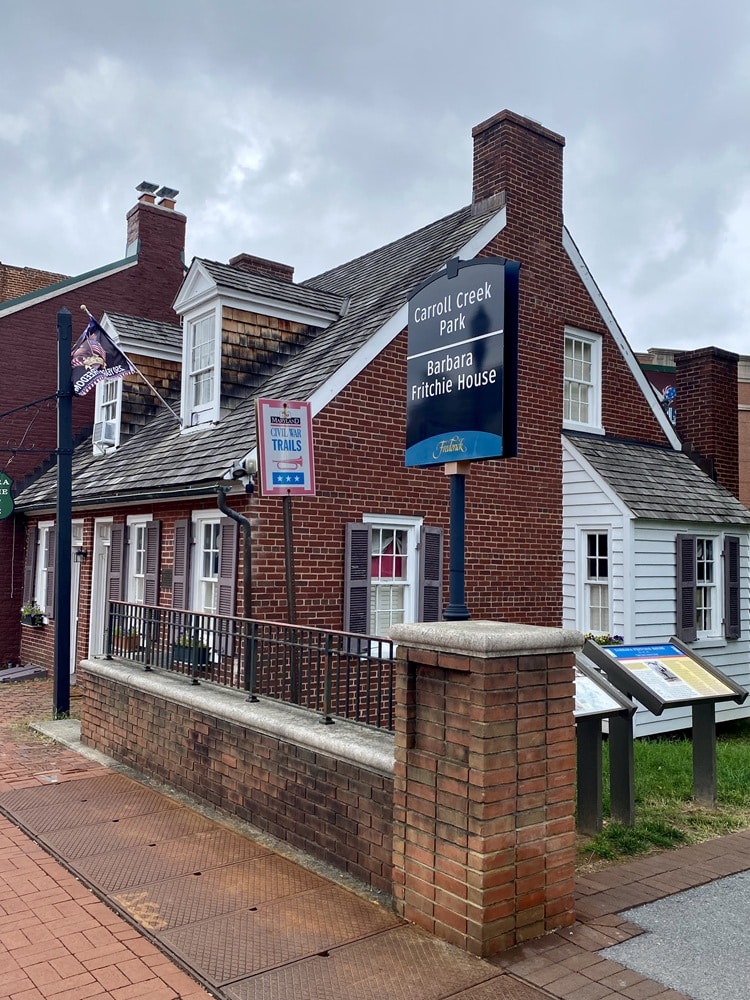
The poem made Frederick almost as popular as its heroine. Whittier wrote of the town’s “clustered spires” and of the surrounding bountiful land being as “fair as the garden of the Lord.” Frederick embraced the Barbara Fritchie legend. On the site of her home, which had been torn down due to flood damage in the late 1860s, a replica was built in 1926, which was a museum for several years. It is now privately owned and a guesthouse. Outside, there is signage of the famous event said to have occurred there, including several lines of the poem painted on a nearby wall. For decades, the Barbara Fritchie Restaurant was a popular eatery in Frederick.
In the midst of World War II, when morale in the United States was, as in 1863, low from war weariness, the story of Barbara Fritchie once again made headlines. Whittier’s poem was so popular that, for generations, it was often required to be memorized by schoolchildren. In May 1943, as Franklin Roosevelt and Winston Churchill traveled by car back to Washington from the presidential retreat now known as Camp David, they passed by the reconstruction of Fritchie’s home in Frederick. Churchill surprised Roosevelt by reciting, perfectly, all thirty stanzas of the poem, which he had learned as a child in England.
How do legends get formed? They often have a kernel of truth and are something that we want to believe. An old woman, known to be patriotic, stood in her doorway and waved a flag at Union troops. The story passed from ear to ear, was embellished, different aspects were added and, by the time it made its way to the poet Whittier months later, Barbara Fritchie was a symbol of the defiance of the Union-loving citizens of Frederick to the Confederate army, and she confronted none other than Stonewall Jackson himself. As it turned out, it was too good to be true, but it is a great story and a great poem.
Stan Haynes is the author of several books on American history, including a new 2026 book entitled And Slavery No More, which is set during the Confederate army’s 1862 Maryland Campaign. Visit his website at www.stanhaynes.com.
Sources:
Blank, Trevor J. and Puglia, David J. Maryland Legends: Folklore from the Old Line State. Charleston: History Press, 2014, pp. 133-43.
Cox, Richard P. Civil War Maryland: Stories from the Old Line State. Charleston, SC: The History Press, 2008.
Soodalter, Ron. “Shoot, If You Must, this Old Gray Head,” HistoryNet.com, November 7, 2017.
Stotelmyer, Steven R. From Frederick to Sharpsburg: People, Places, and Events of the Maryland Campaign Before Antietam. Sharpsburg: Antietam Institute, 2023, pp. 52-85.
Whitter, John Greenleaf. The Complete Poetical Works of John Greenleaf Whittier. Boston: Houghton, Mifflin and Company, 1882, pp. 196-97.


What a name – “Fritchie.” Perfect for a disagreeable old woman…
I’ve seen similar stories, but in the opposite direction. Seems both sides were eager to demonstrate how civilians on the home front displayed patriotism in the face of the enemy.
Never, ever let facts get in the way of a good story!