“A scene that was anything but encouraging”: Overlooking the Battle of Second Manassas
164 years ago today, the Confederate Army of Northern Virginia won a significant, if incomplete, victory over Union forces under the often-maligned Gen. John Pope at the battle of Second Manassas.
With around 20,000 casualties, it was the 9th bloodiest battle of the war, ranking just behind the bloodbath at Antietam a few weeks later. It was a significant tactical victory, and one of the Army of Northern Virginia’s best performances of the war.
In spite of that cost, it can be easy to overlook Second Manassas, especially given that it was wedged between the Seven Days’ and Maryland campaigns.
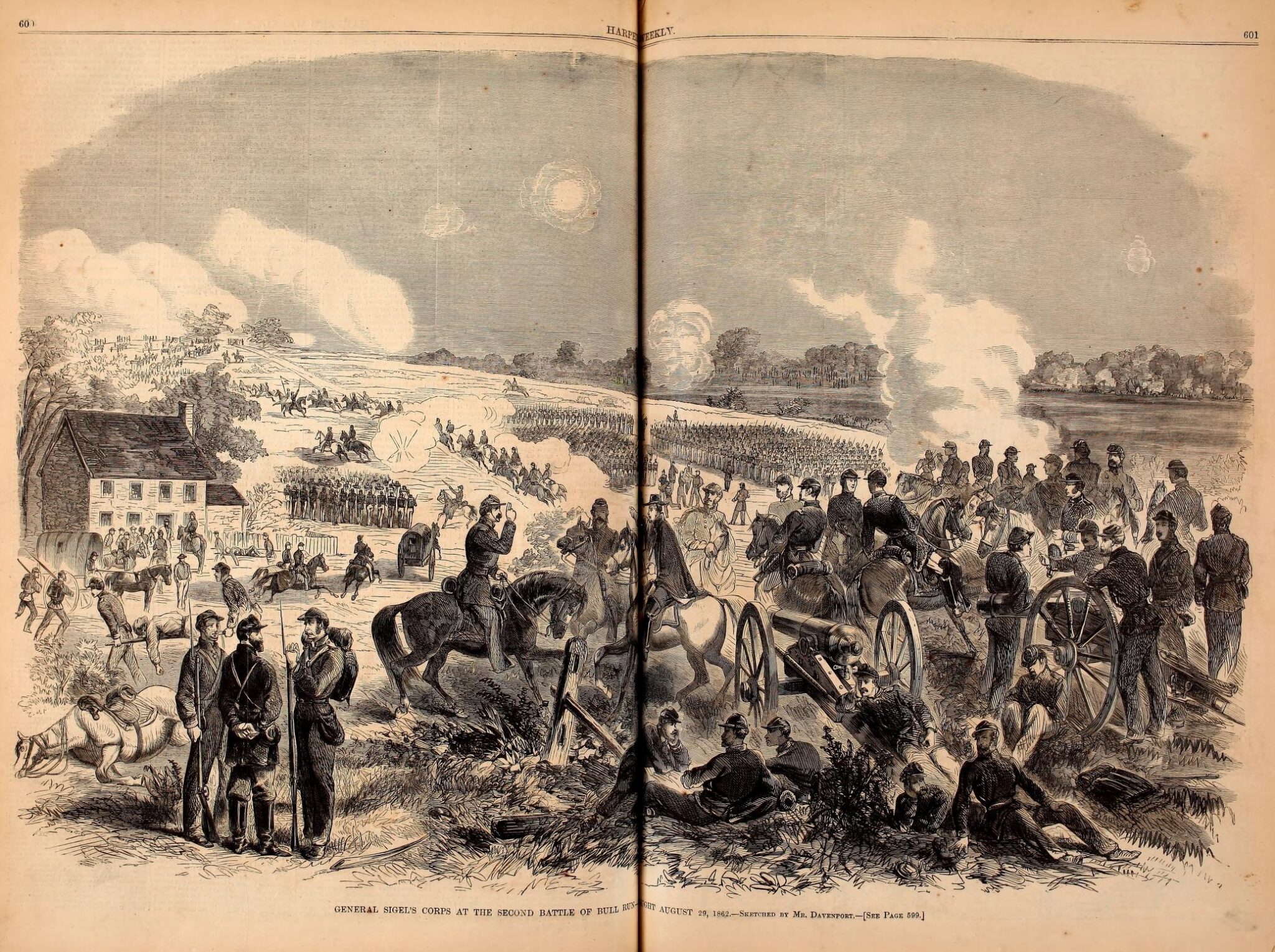
Harper’s Weekly was one of the most widely read periodicals during the war, if not an unbiased one. They devoted virtually no attention to Second Manassas – just one illustration, and a short reprinted article that emphasized the excellent condition of the Union army as it withdrew from what they inexplicably claimed was a battle that was “done in two hours.”[1]
In contrast, the following week’s issue of Harper’s Weekly devoted significantly more attention to the defense of Cincinnati…a city that was never actually attacked by the small Confederate force that briefly approached its outskirts during the Kentucky Campaign.[2]
The accounts of soldiers on the field painted a much more desperate picture, especially as the Union army made its final stand at Chinn Ridge on August 30, 1862. In the face of an onslaught by half of the Confederate army under Gen. James Longstreet, one Union soldier recalled, “Wounded men were everywhere…trying with all their strength to get away to a safe distance.”[3]
Another Federal soldier wrote, “Officers and men shouting, shells tearing through and exploding, the incessant rattle of muskets, the cries of the wounded—all combined made up a scene that was anything but encouraging.”[4]
Once the Union army escaped the immediate battlefield on the night of August 30th into the 31st, the victory offered little hope of netting major strategic gains for the Rebels. The Federals fell back to the safety of Washington, D.C.’s defenses, and reinforcements from the Army of the Potomac.
With the possible asterisk of Union General Phil Kearny’s death in the aftermath of the battle, the biggest impact of Second Manassas may well have been that it gave Lee the confidence and breathing room to invade Maryland, setting the stage for the much more famous battle of Antietam.
[1] “The Second Battle of Bull Run,” Harper’s Weekly, September 20, 1862. Accessed via Internet Archive.
[2] “Our Army At Cincinnati,” Harper’s Weekly, September 27, 1862. Accessed via Internet Archive.
[3] Sam Smith, “Moments in Time: The Battle of Second Manassas – Longstreet’s Assault,” American Battlefield Trust.
[4] Ibid.


Nice article, Pat! I’ve often said that Second Manassas might have been Lee’s best battle
The Second Manassas / Bull Run campaign definitely deserves more attention. The events surrounding Stuart’s Catlett Station raid were probably among the most colorful of the war.
Pat, fine job of highlighting an under appreciated battle, one in which – in my opinion – Lee got as close as he ever would to his goal of annihilating an entire federal army.
Another important result of the battle was that it led to the court marital and career destruction of Maj. Gen. Fitz John Porter, whom John Pope blamed for an essentially treasonable failure to support him.