The Heartfelt Side of Alexander Hays
ECW welcomes back guest author Michael L. Giorgianni
One of my favorite activities is traveling to historically significant places, and like many of you, I take advantage of every opportunity to walk where history happened. Often, plans of going on road trips are thwarted by life getting in the way. Visiting a local hero’s final resting place would have to fulfill my history wishes.
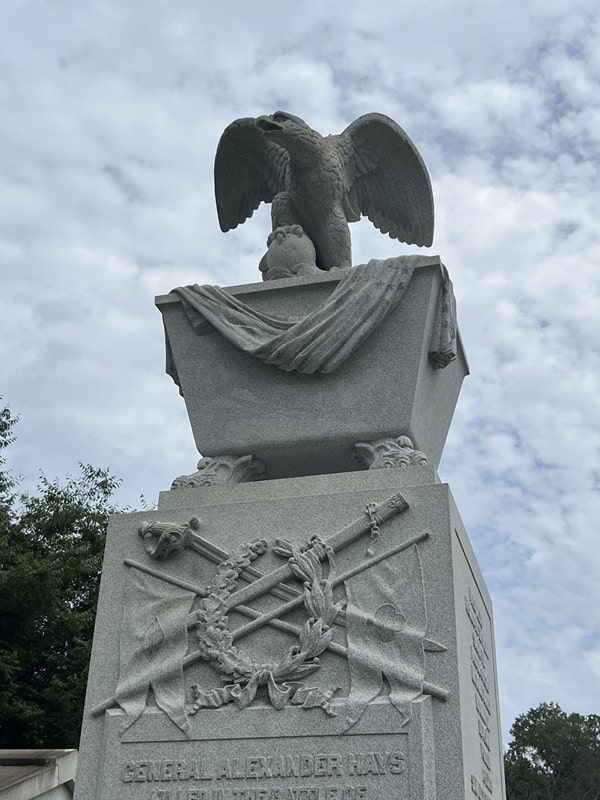
The journey involved traveling to Pittsburgh’s Allegheny Cemetery to visit Gen. Alexander Hays’ monument on a pleasant July day. Walking around this courageous warrior’s grave, I noticed the graves of many of his relatives resting beside his impressive monument. It struck me that family and personal connections were a significant part of his life. Perhaps no other account demonstrates the tender relationships Hays had with others than that of then-presidential candidate Ulysses S. Grant, who asked to visit Hays’ monument on a campaign stop in 1868. Newspapers accounts stated that Grant was “weeping like a child” as he remembered his service with “Sandy” Hays at West Point, the Mexican-American War, and Civil War.[1]
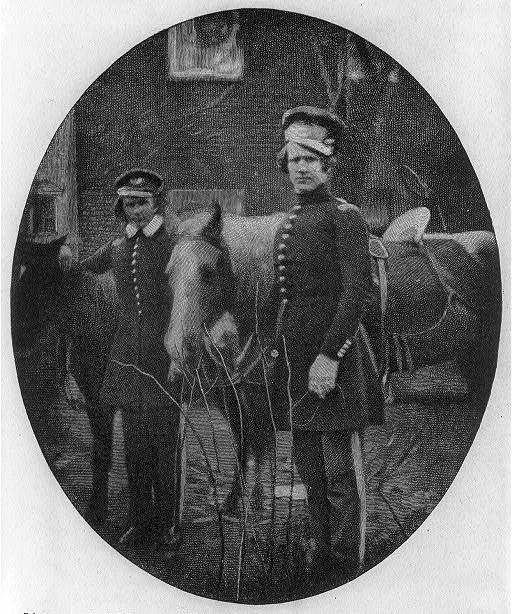
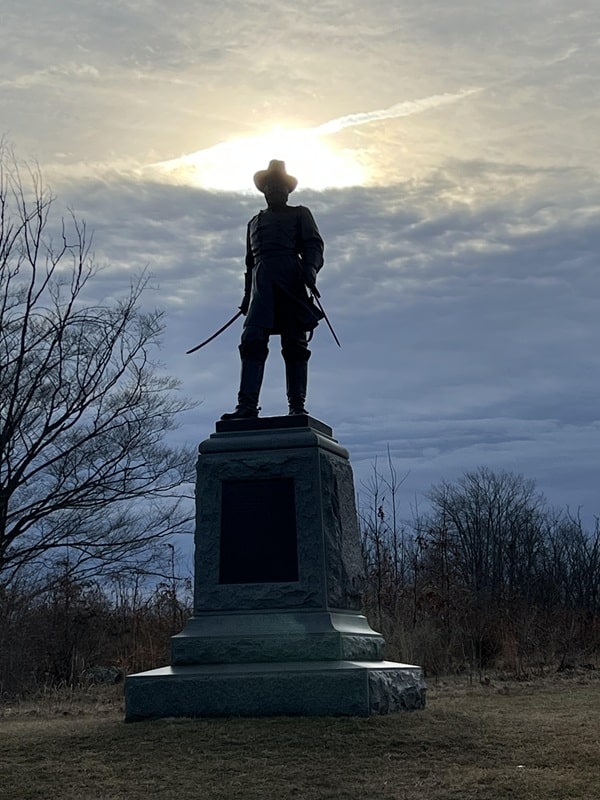
Many students of the Civil War may be most familiar with Hays’ performance commanding the 3rd Division of the II Corps on Cemetery Ridge at Gettysburg. Hays’ division, dubbed as his “bluebirds,” played critically pivotal roles in fighting at the Bliss Farm, halting Brig. Gen. William Barksdale’s relentless charge of July 2 and repulsing the left flank of the Pickett-Pettigrew-Trimble charge of July 3. Through these actions, and many others dating back to the 17 engagements Hays took part in during the Mexican-American War, Hays has been characterized as rough, courageous, gruff, theatrical, and fearless. Accounts suggest Hays was a born soldier whose abilities shined in the most difficult situations.
A closer examination reveals a tender, caring side of the man who famously dragged captured Confederate battle flags from his horse in front of his division after the Confederates were turned back on July 3. The following examples reveal the caring, often overlooked, nature of this Pennsylvania soldier who was killed the following year at the battle of the Wilderness at the age of 44.
Although Hays certainly was demanding of his men, he would not accept unjust treatment. While serving as colonel of the 63rd Pennsylvania regiment, Hays’ unit was stationed near Alexandria, Virginia when a medical incident occurred in camp. A cook was badly scalded on the legs while preparing rations one evening, prompting the doctor to be called. When notified, he refused to come, stating that this situation could wait to be handled the next day. The doctor further stated, “I’m not going to get out in the cold night for any damned soldier in the army.” Hays was informed of the doctor’s response and ordered a group of soldiers to immediately march the doctor to treat the cook and, after the wounds were dressed, Hays “gave that doctor such a lecture as he would likely never forget,” and placed the doctor under arrest for a week.[2]
Prior to being severely wounded at the battle of Second Bull Run on August 29, 1862, Hays and the 63rd Pennsylvania were fighting on the right flank of Gen. Joseph Hooker’s brigade when Hays came upon one of his men badly wounded in the leg. Soldiers assisting the wounded man explained they had no bandages to stop the bleeding. Hays immediately took off his coat and vest to remove his shirt. Handing the men his shirt, Hays told them to “make bandages out of that as far as it will go.”[3]
Hays’ letter to his wife of December 28,1862 reveals that this hardened soldier, who had witnessed many deaths, still found it agonizing to see a dying soldier surrounded by family in their final moments together. The following excerpt demonstrates the impact of this distressing situation:
“I have returned from my samaritan tour of the hospitals. I left Capt. Boisol dying. Around him were his wife, mother, father, and little ‘Joe.’ I would rather fight a battle than witness such a scene. The poor old father and mother, submissive; the wife, broken down from her incessant watch and anxiety, could not control herself. She has proved herself a much nobler woman than we were willing to believe, and I hope she will get credit for it at home. But the most affecting of all was the actions of little ‘Joe.’ Shedding tears, like a man, he stood by his father’s bedside alternately kissing his forehead, stroking back his hair to look into his closing eyes, and wiping the cold sweat of death from his brow. Why should death distress others more than the one who dies? Poor Boisol’s sufferings have been dreadful. Shot through the bladder, he has died by inches, for 15 days.”[4]
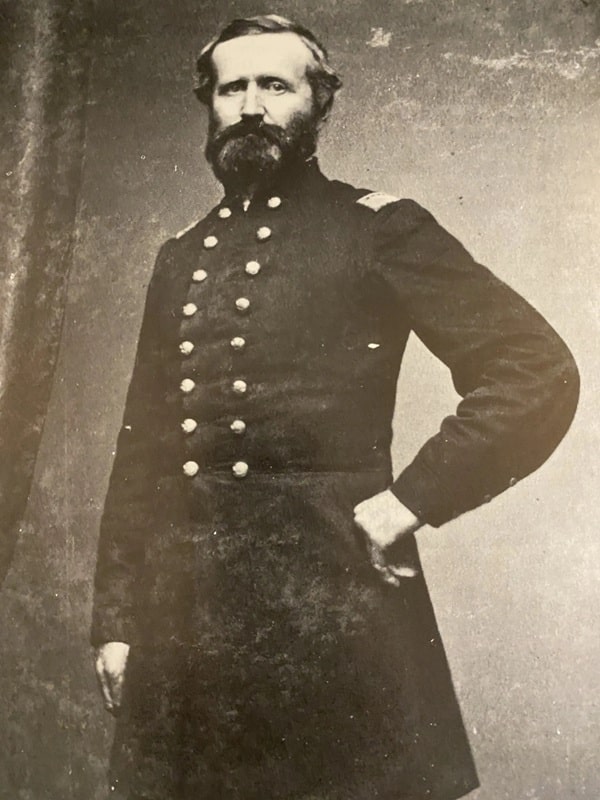
Still another example of Hays’ humanity, kindness, and personable nature comes from Lt. George Yost’s description of his first meeting with Hays following his taking command of the brigade on January 6, 1863. Hays’ reputation as a disciplinarian had preceded him, creating an intimidating climate for the young officers who would now be serving under him. Yost removed his hat and said “good morning” upon meeting Hays. This excerpt is from Yost’s initial conversation when nervously reporting for brigade guard duty:
Brig. Gen. Alexander Hays: Good morning, lieutenant. Yes, damn cold morning, but I guess you are tough. Lt. Yost: I told him I was.
Brig. Gen. Alexander Hays: Put on your hat, don’t mind such an old cuss as I am. Got any straw over there?
Lt. Yost: I told him I thought not.
Brig. Gen. Alexander Hays: Well then go and rob my horse. He is tough like myself. Sit down lieutenant and I’ll tell you one thing you must always do and that is “rebuke selfishness” among your men. Tell them to be kind to each other for a man can be kind and gentlemanly if he is a soldier and so he went on for half an hour. I think he is a good old fellow and kind hearted too if he is rough.[5]
By examining his personal correspondence and recollections of those who knew him, we find that Gen. Alexander Hays was a complex man. His kind and caring ways seem to defy the widely accepted view of a man that lacked kindness or any concern for others. Perhaps, it is more fitting to view Alexander Hays as having varied temperaments and traits that were revealed according to the situation. Ulysses S. Grant’s tearful reaction on that 1868 day displays the powerful effect Hays had on those throughout his life.
Michael Giorgianni is a lifelong western Pennsylvania resident who taught middle school social studies in the Hempfield Area School District for over 27 years. He frequently provides presentations in the Pittsburgh area to others with a passion for history.
Endnotes:
[1] “Grant and Hays,” Evening Chronicle (Pittsburgh, PA), September 18, 1869, “GRANT AND HAYS,” Pittsburgh Daily Post (Pittsburgh, PA), December 24, 1879
[2] Gilbert Adams Hays, comp., Under the Red Patch: Story of the Sixty Third Regiment. (Pittsburgh, PA: Sixty-Third Pennsylvania Volunteers Regimental Association, 1908), 70-71
[3] Hays, Under the Red Patch: Story of the Sixty Third Regiment, 105
[4] George Thornton Fleming, Life and Letters of Alexander Hays (Pittsburgh, PA: Gilbert Adams Hays, 1919), 229.
[5] Letters of Lt. George L. Yost, February 5, 1863, R. Michael Yost collection


Thank you for a great post. Not many are familiar with Hays and your article was enlightening.
Well done. Your post highlights the intense emotions felt between comrades in arms, especially those between a commander and his soldiers.
Very moving remembrance of Alexander Hays.
Nicely done, great piece about a great American … gents like General Hays always make the best commanders … i once a had a boss who said if you take care of your people, the mission takes care of itself.