What Was So Wrong About the Dred Scott Decision? [Part II]
Part I of this post promised the reader an examination into whether the Supreme Court’s Dred Scott decision[1] properly earned its “worst decision” moniker.
The author of the majority opinion, Chief Justice Roger B. Taney, first addressed the issue of black citizenship that was touched on in Part I. Taney concluded that blacks were not citizens because historically, none of the original states had considered them part of their body politic at the time the Constitution was adopted. He wrote:
‘We think they … were not intended to be included, under the word “citizens” in the Constitution, and can therefore claim none of the rights and privileges which that instrument provides for and secures to citizens of the United States. On the contrary, they were at that time [1787] considered as a subordinate and inferior class of beings who had been subjugated by the dominant race, and, whether emancipated or not, yet remained subject to their authority, and had no rights or privileges but such as those who held the power and the Government might choose to grant them.’[2]
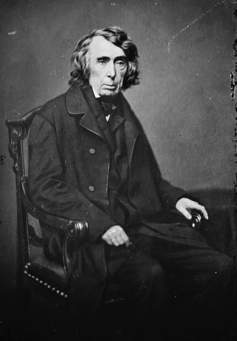
Taney’s repeated reference to “rights and privileges” was to the Constitution’s mandate that each state must treat all other states’ citizens as having the same rights and privileges as enjoyed by its own citizens.[3] Taney’s decision that African Americans were not citizens barred free states from endowing their black citizens with rights that slave states would have to honor.
Taney’s position was eviscerated by Justice Benjamin Robbins Curtis, who in his dissenting opinion provided extensive evidence of black citizenship afforded by early American states: “At the time of the ratification of the Articles of Confederation, all free native-born inhabitants of the States of New Hampshire, Massachusetts, New York, New Jersey, and North Carolina, though descended from African slaves, were not only citizens of those States, but such of them as had the other necessary qualifications possessed the franchise of electors, on equal terms with other citizens.”[4] Curtis’s exposure of Taney’s false recitation of history was widely used by opponents of Taney’s decision to discredit the Court’s ruling.[5]
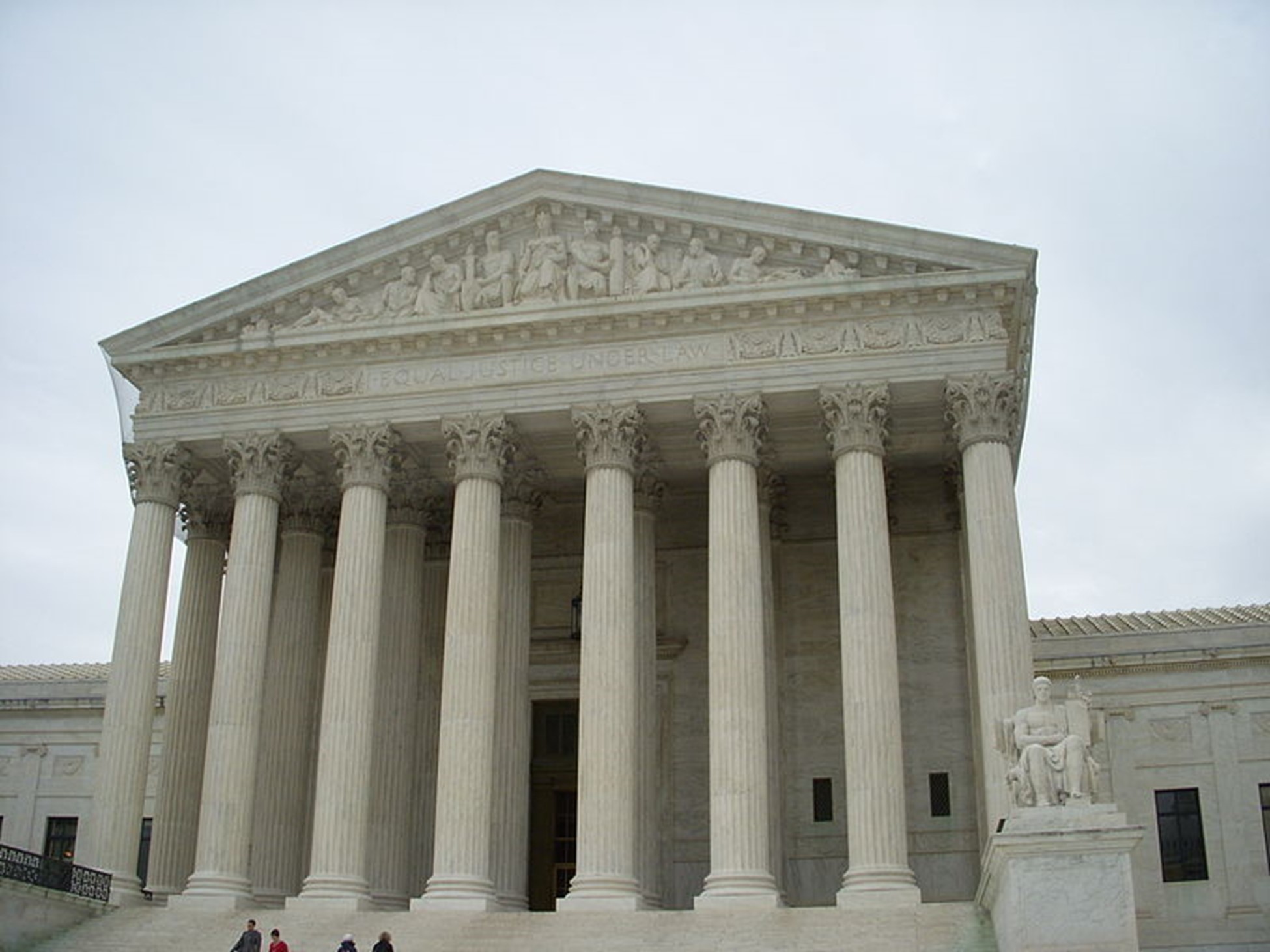
Significantly, and as explained in Part I, once Taney concluded that Scott was not a citizen, the Court lost jurisdiction to hear Scott’s case on the merits. Any further discussion was merely nonbinding dicta (as would be pointed out by the anti-Dred Scott forces).[6]
Nevertheless, Taney kept going, ultimately reaching the conclusion that Congress was Constitutionally barred from excluding slavery from federal territory. This remarkable announcement flew in the face of decades of Congressional action (e.g., the 1820 Missouri Compromise) based upon the settled belief that Congress had the power to regulate slavery in U.S. territories.
To reach his conclusion, Taney had to address the Constitution’s provision that “[t]he Congress shall have Power to … make all needful Rules and Regulations respecting the Territory or other Property belonging to the United States…”[7] To get around that troublesome explicit grant of authority, Taney claimed—unsupported by history or convincing legal analysis—that that clause only applied to the territory held by the U.S. at the time the Constitution was adopted.[8]
Taney did concede the obvious; Congress must of necessity have some authority over new territories. Yet he asserted that such power was limited to establishing order and public safety. And, to set up the result he wanted, Taney stressed that any such legislation of course must guarantee residents all Constitutional protections, including the right not to be deprived of property without due process. This led to his conclusion: “[A]n act of Congress which deprives a citizen of the United States of his liberty or property merely because he came himself or brought his property into a particular Territory of the United States, and who had committed no offence against the laws, could hardly be dignified with the name of due process of law.” And “property” included enslaved persons.[9]
Taney’s analysis ignored the fact that if a territory’s law prohibited slavery within its borders, then someone who voluntarily introduced an enslaved person therein had committed an “offense against the laws.” Moreover, a judicial proceeding would be required before an enslaved person were declared free by virtue of his or her presence in the territory, furnishing due process.
Nevertheless, by virtue of his tortured logic, Taney concluded that the Missouri Compromise was unconstitutional. Neither Congress nor any territorial government itself could prohibit slavery in any territory. [10] All territories henceforth must enter the Union as slave states. Nothing could be done by Congress to alter this new slave state path, because the Court had set the path in Constitutional cement. Further, all knew that “it was far easier to prevent slavery from taking root in a territory … than to dismantle slavery after statehood.”[11]
Finally, and most ominously, Taney’s opinion could be seen as setting up a future decision further expanding enslavers’ rights throughout the entire nation. Taney had stressed that the right to hold persons as property was a Constitutionally protected right.[12] The Constitution’s “privileges and immunities” clause protected the rights of citizens of each state while within another state. Could that mean that free states could be barred from excluding slavery within their borders? The concurring opinion of Justice Wayne highlighted that very question and suggested a future answer.
“A question has been alluded to, on the argument, namely, the right of the master with his slave of transit into or through a free State, on business or commercial pursuits, or in the exercise of a Federal right, … being a citizen of the United States, which is not before us. This question depends upon different considerations and principles from the one in hand, and turns upon the rights and privileges secured to a common citizen of the republic under the Constitution of the United States. When that question arises, we shall be prepared to decide it.”[13]
At the time of Dred Scott, another case was making its way through the judicial system. The Lemmon case involved a Virginian who had briefly stopped in New York with his seven enslaved persons while en route to Texas. Local abolitionists had quickly filed suit on behalf of the enslaved and won their freedom. The owner, with the support of the Commonwealth of Virginia, was in the process of litigating the right of New York to free his human property. It was widely expected that this case would end up in the Supreme Court. The issue would be whether a free state had the right to interfere with slavery within its own borders.[14]
Justice Wayne’s opinion suggested that the Supreme Court was aware of this dispute and preparing to address it. Many in the North, including Abraham Lincoln in his famous “House Divided” speech, feared that the result would be a decision that Northern free states were Constitutionally bound to admit slavery within their borders. Such a perceived “conspiracy” to nationalize slavery, using Dred Scott as a jumping off point, further inflamed passions in the North.[15]
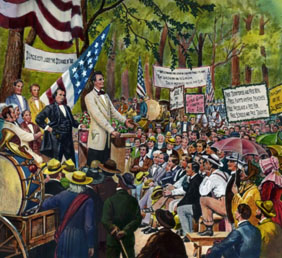
(Credit: Bettmann Archives/Getty Images).
How then should one assess the Dred Scott decision? Was it as “bad” a decision as posterity has judged it? Consider the following.
- Slavery being such a volatile political issue, one would expect the nation’s high court to tread cautiously, perhaps heeding the first precept of the Hippocratic Oath: “First, do no harm.”
- There were two perfectly legitimate legal avenues available to the Court to resolve the case before it without inflaming matters. The Court refused to take either.
- Taney’s opinion that African Americans were not U.S. citizens rested upon a blatant misrepresentation of the historical record, as Justice Curtis proved.
- Once the Court concluded that Scott, as a non-citizen, had no standing to sue the lack of jurisdiction should have ended the case right there.
- When Taney nevertheless pressed forward to address the merits of Scott’s appeal, all he wrote thereafter was technically dicta, subjecting the decisions reached to legitimate attack as not worthy of obedience. This ensured further bitter dispute.[16]
- The assertion that Congress’s express Constitutional authority to enact territorial legislation only extended to territories held at the time of the adoption of the Constitution was so bereft of convincing legal and historical authority as to undermine the legitimacy of the analysis.
- The ultimate conclusion that neither Congress nor any territorial government could lawfully exclude slavery from a territory, rather than appearing as a well-reasoned and analytically sound result, seemed a blatantly pro-slavery, results-orientated, decision.
- Rather than settling the national slavery debate, the Court’s controversial decision sparked a new conflict between those who insisted that the Supreme Court had decreed the last word on slavery in the territories, versus those who refused to accept that decision as legitimate. This led pro-slavery adherents to conclude that their opponents were willing to defy the law as part of their fanatic zeal.
- By contrast, the perception that the Supreme Court had made a purely political decision severely damaged its credibility as an institution. As a later Chief Justice, Charles Evans Hughes, was to write: Dred Scott was a “self-inflicted wound[]… that undermined confidence in the Court … It was many years before the Court, even under new judges, was able to retrieve its reputation.”[17]
Worst Supreme Court decision, indeed.
[1] Scott v. Sandford, 60 U.S. 393 (1856), https://supreme.justia.com/cases/federal/us/60/393/.
[2] Scott, 60 U.S. at 404-405.
[3] Constitution, Article IV, Section 2 (“The Citizens of each State shall be entitled to all Privileges and Immunities of Citizens in the several States”).
[4] Scott, 60 U.S. at 572-573 (Curtis, J., dissenting).
[5] Finkelman, 40, 107; Carden, 241.
[6] Finkelman, 33. Ironically, one who made the dicta argument was the anti-slavery Congressman Calvin Chaffee, who in 1850 had married the widow of Scott’s owner. Finkelman, 18-19, 46-47.
[7] Constitution, Article IV, Section 3.
[8] Scott, 60 U.S. at 432, 436, 438. Finkelman, 34-35, addresses the absurdity of Taney’s argument on the territories issue.
[9] Scott, 60 U.S. at 447-452.
[10] Scott, 60 U.S. at 451, 452.
[11] Finkelman, 37-38 (emphasis supplied).
[12] Scott, 60 U.S. at 451, 452.
[13] Scott, 60 U.S. at 468 (Nelson, J., concurring) (emphasis supplied).
A “concurrence” is an opinion in which a judge agrees with the result set forth in the majority opinion but writes separately, either because the judge disagrees with the reasoning that led to the result, or because the judge wishes to emphasize a particular point.
[14] Marie Tyler-McGraw and Dwight T. Pitcaithley, “The Lemmon Slave Case: Courtroom Drama, Constitutional Crisis and the Southern Quest to Nationalize Slavery,” Common Place, The Journal of Early American Life (Fall, 2013), https://commonplace.online/article/lemmon-slave-case/.
[15] Finkelman, 41-43.
[16] New York Herald editor Horace Greeley snorted that Taney’s opinion had no more validity than might be expressed in any “Washington bar room.” Finkelman, 40.
[17] Charles Evans Hughes, The Supreme Court of the United States: Its Foundation, Methods and Achievements, an Interpretation (Columbia University Press, New York, NY, 1928), 50-51, https://archive.org/details/supremecourtofun0000hugh/page/n5/mode/2up.


Good series. Kevin. Dred Scott was truly an awful decision for all of the reasons you discuss and, given its role in helping push the country towards its greatest tragedy, it surely has a strong case to make for “worst decision.” That said, Plessy v Ferguson’s effective repeal of the 14th Amendment and its wholly dishonest claim that enforced racial segregation doesn’t “stamp the colored race with a badge of inferiority” and, if it does, it is “solely because the colored race chooses to put that construction upon it” means it doesn’t concede that title without a fight. But at least it gave us Justice John Marshall Harlan’s principled and heroic lone dissent that includes one of the most important constitutional law statements ever–“Our Constitution is colorblind, and neither knows nor tolerates classes among citizens.” Honorable mention also goes to Lochner v New York and all “substantive due process” cases, including those on the other end of the political spectrum like Roe v Wade, and to Korematsu v United States (justifying internment of Japanese-Americans during WWII) and Wickard v Filburn which completed the process of letting the federal government slip its constitutional leash via an excessively broad construction of the Commerce Clause that said a famer growing wheat for his own personal use is within the power to “regulate interstate commerce.”