Before Chancellorsville: The Untold Court Martial of Joseph Hooker
ECW welcomes guest author Travis P. Wagner.
On September 16, 1864, Maj. Gen. Henry W. Halleck wrote a confidential letter to his close friend William Tecumseh Sherman. In the letter, he explained Joseph Hooker’s hostility toward him. He told Sherman, “His animosity toward me arises from another source. He is aware that I know something about his character and conduct in California, and fearing that I may use that information against him…I know of no other reason for his hostility to me. He is welcome to abuse me as much as he pleases; I don’t think it will do him much good or me much harm.”[1]
What exactly did Halleck know about Hooker’s behavior in California?
Joseph Hooker was one of the most complex and controversial commanders of the Civil War. His military career included both notable successes and serious failures. Hooker pushed hard for command of the Army of the Potomac by actively lobbying several congressmen while undermining George McClellan and Ambrose Burnside. Hooker earned a reputation for belittling others, both publicly and privately, to make himself seem superior. This behavior alienated many of his fellow officers throughout his career, especially during the Civil War.
Where did Hooker’s ambitious behavior come from? What happened earlier in Hooker’s career that created such lasting friction with his fellow officers and commanders?
The answer is rooted in two overlooked past events: the 1848 Pillow Affair and Hooker’s 1851 profiteering scandal and court martial in California. These two pivotal events, along with other controversial action, explains why Hooker gained powerful enemies. It also provides new context for understanding his behavior and rivalries during the Civil War.

Hooker’s troubles in California, along with his antagonistic behavior toward his colleagues and commanders, stem from his support of Maj. Gen. Gideon Pillow against Maj. Gen. Winfield Scott during the Mexican-American War. During the war, Hooker served on the staff of five senior officers, where he learned the art of military politics.
His most influential teacher was Gideon Pillow, who was politically connected, but militarily inept. Pillow was the former law partner of President James K. Polk. Pillow wrote after-action reports and “private” letters claiming excessive credit for his exploits, especially for the victories at the battles of Contreras and Churubusco. He downplayed and belittled Scott’s efforts.
Outraged by this humiliation and insubordination, Scott had Pillow arrested and charged with conduct unbecoming an officer, leading to a court martial. However, President Polk changed Pillow’s court martial to a court of inquiry and had Scott arrested instead. The most prolific witness who testified in support of Pillow during the inquiry was Joseph Hooker.[2] By supporting Pillow, he created an enemy in Scott. Hooker’s short-sighted and selfish actions followed him for years.
In 1849, brevet Lt. Col. Joseph Hooker arrived in Sonoma, California, to replace Sherman as the assistant adjutant general of the army’s Pacific Division. As the Gold Rush was booming, many of his fellow officers, especially Sherman, were doing well financially. Hooker viewed land speculation as a quick way to get rich, but he needed funds.

He came up with a simple plan. Posing as a government agent, he bought hay from local farmers at market prices. He, along with his occasional partner Alfred Gibbs, sold the hay to the army for more than double the price through the division’s quartermaster, a subordinate lieutenant. With his significant earnings, he started purchasing lots in Sonoma and bought a large ranch nearby.[3]
While Hooker’s shady activities were well known in the area, two critical factors led to his arrest and court martial. First, Col. Ethan Allen Hitchcock arrived in Sonoma in July 1851 as the new commander of the Pacific Division. He was specifically recruited by Secretary of War Charles M. Conrad and commander in chief Winfield Scott to put an end to the profiteering. They had learned about Hooker’s activities through an anonymous letter from California.[4]
Hitchcock knew Hooker because after his court of inquiry, Gideon Pillow had published harsh attacks against Scott and his inspector general, Hitchcock. The second factor was Lt. George H. Derby, who soon became America’s first nationally famous humorist under the names Squibob and John Phoenix. Derby was arrested by Hooker for allowing a prisoner to escape, which triggered a bitter feud. This led Derby to file charges against Hooker for the profiteering. Both courts martial were held in December 1851. The advocate general for both trials was Capt. Henry W. Halleck. Nearing the end of his trial, Hooker viciously attacked his commander in his written defense. He claimed, among other things, that he and Derby conspired to persecute him.
Based on his behavior during the court martial, Hooker was no longer welcome in the Pacific Division. Rather than accept a new posting, he chose to resign and stay in Sonoma. What followed were years of struggles as a failed gambler, farmer, and politician. Although he secured a few army contracts, he never managed to escape debt.
Realizing he was not suited for civilian life, he decided in 1857 to rejoin the army.[5] He began writing to various politicians to seek a commission. This included positions in the paymaster department and as a regimental commander. He highlighted his character and skills in these letters. He even reached out to his friend, Oregon Senator Edward D. Baker, who was later killed at the battle of Ball’s Bluff. Unfortunately for Hooker, any appointment required approval of the commander in chief, Winfield Scott, who was loath to forgive him.
When the Civil War broke out, Hooker was confident that the Union Army would seek him out. The army desperately needed experienced field commanders. He was a West Point graduate, a combat veteran, a proven field commander, and a former assistant adjutant general of the 1st Artillery Regiment, the 1st Military Department, and finally, the Pacific Division.
But once again, Scott was in his way. Hooker, always the gambler, decided to go to Washington, DC, to make his case in person. After receiving a large sum of money as a gift from a friend to pay off his debts and buy a ticket, Hooker left San Francisco on May 21, 1861.[6]
Even in Washington, he could not secure the commission he believed he deserved. Finally, a stroke of good luck: After the Confederate victory at First Bull Run, Winfield Scott retired on November 1, 1861. Scott had recommended Maj. Gen. Henry W. Halleck as the new general in chief, which could have added to Hooker’s challenges. Lincoln chose Maj. Gen. George B. McClellan instead.
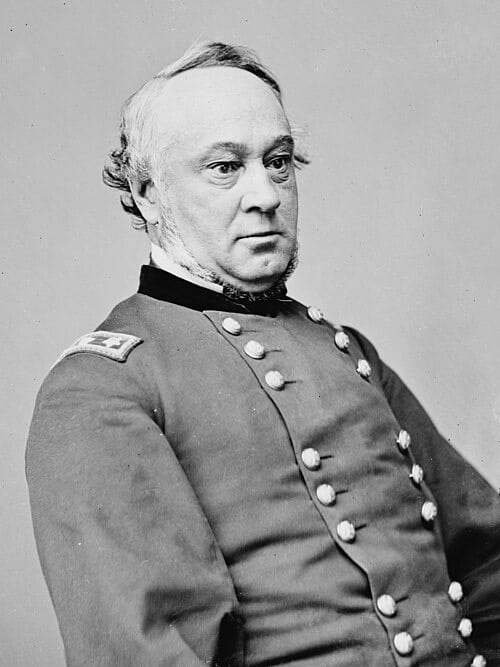
Hooker finally secured his commission and was appointed a brevet brigadier general of volunteers. He received his first command, an infantry brigade stationed at Bladensburg, Maryland. He quickly took charge of a division and, in May 1862, was promoted to brevet major general of volunteers. That June, his division participated in the Peninsula Campaign, which included the battles of Williamsburg, Fair Oaks, Glendale, and Malvern Hill, as well as the siege of Yorktown.
He demonstrated that he was an effective field commander. But in typical Hooker fashion, this was not enough. Hooker believed he was the superior commander and that his colleagues, especially McClellan, were all inferior. Therefore, Fighting Joe Hooker should be the commander of the Army of the Potomac. He pressed his case by writing letters to various politicians, criticizing the skills and efforts of others, especially McClellan and Burnside, while promoting his own superiority.[7] Hooker had learned from Gideon Pillow that bypassing the chain of command and criticizing commanders was acceptable if it meant personal advancement.
After attacking and lobbying against McClellan and Burnside, Hooker finally received what he believed he deserved: command of the Army of the Potomac on January 26, 1863. William Tecumseh Sherman noted, “I know Hooker well, and tremble to think of his handling 100,000 men in the presence of Lee…Let Hooker once advance or move laterally and I fear the result.”[8] Lincoln also felt uneasy about Hooker, as noted in his famous letter appointing him.[9] A few months later, Hooker’s arrogance and brashness were crushed by Robert E. Lee at the battle of Chancellorsville. True to form, Hooker blamed others for his defeat. As Lee began his invasion of the North, Hooker insisted on taking control of the 10,000 troops stationed at Harper’s Ferry. Halleck refused. Hooker tried to bypass him by appealing directly to President Lincoln. Hooker, known for being a poor gambler, issued an ultimatum: he would either get these troops or resign his command. On June 24, 1863, just four days before Gettysburg, Hooker was replaced.[10]
Travis P. Wagner is a Professor Emeritus at the University of Southern Maine. His latest book is, Military Honor on Trial: The Saga of Joseph Hooker and George H. Derby.
Endnotes:
[1] The War of the Rebellion: A Compilation of the Official Records of the Union and Confederate Armies. Vol. 39. US Government Printing Office, 1892, 857.
[2] Roy P. Stonesifer, “Gideon J. Pillow: A Study in Egotism.” Tennessee Historical Quarterly, Vol. 25, no. 4 (1966), 340-350.
[3] Courts Martial of Joseph Hooker and George H. Derby, RG 153: Records of the Judge Advocate General’s Office (Army), Entry 15, Court-Martial Case Files (1809-1894). 7E3: 13/15/4 Box 203, Case HH121, National Archives and Records Administration, Washington, DC.
[4] Ethan Allen Hitchcock, Fifty years in camp and field, diary of Major-General Ethan Allen Hitchcock, USA. (G. P. Putnam and Sons,1909), 382.
[5] Joseph Hooker, to James W. Denver, May 2, 1857. Wyles SC 517. Department of Special Collections, UC Santa Barbara Library, University of California, Santa Barbara.
[6] E. Wells, “The Silver Sixties: Tom Fitch’s Story of California-Nevada Comstock Days,” San Francisco Call, April 23, 1921, 12.
[7] Joseph Hooker to James Nesmith, May 5, May 13, and July 11, 1862, James Nesmith Papers, Oregon Historical Society, MSS 577, Box 2, Folder 9.
[8] Brooks D. Simpson and Jean V. Berlin, eds. Sherman’s Civil War: Selected Correspondence of William T. Sherman, 1860-1865 (UNC Press Books, 2014). 452.
[9] Abraham Lincoln, Selections from the Writings of Abraham Lincoln (Scott, Foresman, 1922), 362-364.
[10] OR, Vol. 39, 60.


A few corrections on Hooker’s promotions. Hooker’s promotions in the US Volunteers during the war were full promotions, not brevet awards. For example, he was promoted to the full rank of brigadier general in the USV in May 1861 and to the full rank of major general in the USV in May 1862. Subsequently, Hooker was promoted to the full rank of brigadier general in the US Army in September 1862 –making him a senior officer in the regular army. He received a brevet award to major general in the US Army in March 1865 and was retired as a full major general in the US Army in 1868 for disabilities, which was a common practice. See Hooker’s official biography compiled by George W. Cullum at the USMA, https://penelope.uchicago.edu/Thayer/E/Gazetteer/Places/America/United_States/Army/USMA/Cullums_Register/919*.html