Gettysburg Off the Beaten Path: The Skirmish at Brinkerhoff’s Ridge
ECW welcomes back guest author Colton Pikovsky.
As Maj. Gen. Edward Johnson’s Confederate division scurried up the slopes of Culp’s Hill in a failed attempt to capture the right of the Union fishhook line, Johnson was probably wishing that he was not one brigade short. The Stonewall Brigade, commanded by Brig. Gen. James Walker, was over a mile away protecting the Confederate army’s flank. Throughout July 2, Walker’s men skirmished with Union cavalry of Brig. Gen. David Gregg’s division. The skirmish at Brinkerhoff’s Ridge may not have resulted in any great losses for either side, but its consequences on Johnson’s July 2 assault cannot be ignored.
Around noon, Gregg’s division arrived at the intersection of Low Dutch Road and the Hanover Road with his two present brigades under colonels John Irvin Gregg and John McIntosh. Nearby, men of the 9th Massachusetts Infantry, detached from the V Corps to protect the Union’s far left, had been skirmishing all day and were irked “protect(ing) an inactive cavalry force large enough and assuredly brave enough to take care of its own front.”[1] Around 6 p.m., the cavalry relieved the infantrymen and deployed to protect the Baltimore Pike, the Union’s main supply line and escape route, with the 16th Pennsylvania Cavalry connecting with Neill’s Brigade of the VI Corps near Wolf’s Hill.[2] While the cavalry took to their positions, the division’s artillery, Battery H, 3rd Pennsylvania Heavy Artillery (commanded by Capt. William Rank), rolled up with their two-gun section of 3-inch ordnance rifles.[3] The undermanned battery had never seen combat and had recently traded in their heavy siege guns for light pieces, with most of the battery having yet to be refitted.[4]
On the Rebel side, the men of Walker’s Stonewall Brigade were themselves annoyed with their duty defending the army’s flank, a job meant for cavalry. Butternut cavalry under Brig. Gen. Albert Jenkins had been ordered to screen the Confederate left, but the wounding of Jenkins near Blocher’s (Barlow’s) Knoll prevented the distribution of the order.[5] As the 9th Massachusetts went to rejoin the V Corps, John Gregg ordered the 10th New York Cavalry to replace them.[6] “(I)t seemed almost like a dream to the boys” in the 10th, who now returned to the fields of Gettysburg where they had spent 72 days training in 1861.[7]
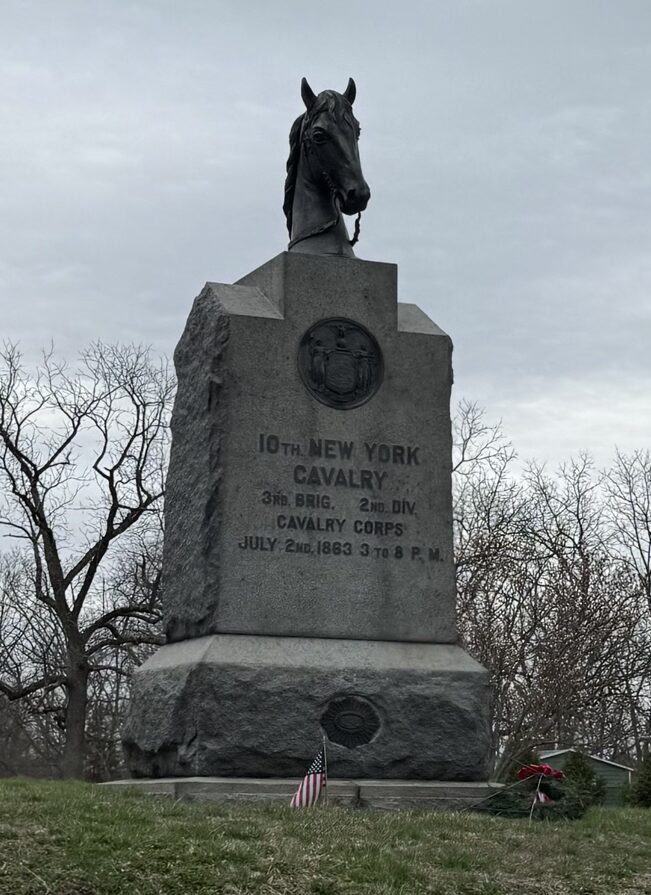
The troopers moved west down the Hanover Road before splitting into squadrons, groups of two companies, while Rank’s guns were deployed near the home of Abraham Reever.[8] Major Matthew Avery, commanding the 10th, sent one squadron north of the road and into the wheatfield of John Cress where the squadron began advancing to the western slope of Brinkerhoff’s Ridge.[9]
Around the same time the 10th was advancing, Walker’s men were ordered farther to the left of the divisional line, arriving near the eastern slope of the ridge near the same time the skirmishers of the 10th were crossing the field. Walker dispatched Col. John Nadenbousch and his 333-man 2nd Virginia to “clear the field” of the cavaliers.[10] Nadenbousch’s men soon “drove him (the cavalrymen) from our front for some distance, killing, wounding, and taking some few prisoners.”[11]
Seeing his skirmishers falling back, Maj. Avery dispatched two more squadrons towards the ridge while “the balance of the (R)egiment” moved to the “left of the Hanover Road.”[12] While the men south of the road held their own, the squadrons to the north were not forcing Avery to commit his reserve, Co. F, to the fight.[13] The reserve, too, fell back, and “Avery came riding up in a rage” to the line demanding to know why, but a volley causing him to dodge led him to exclaim that they “ought to have done it” earlier.[14]
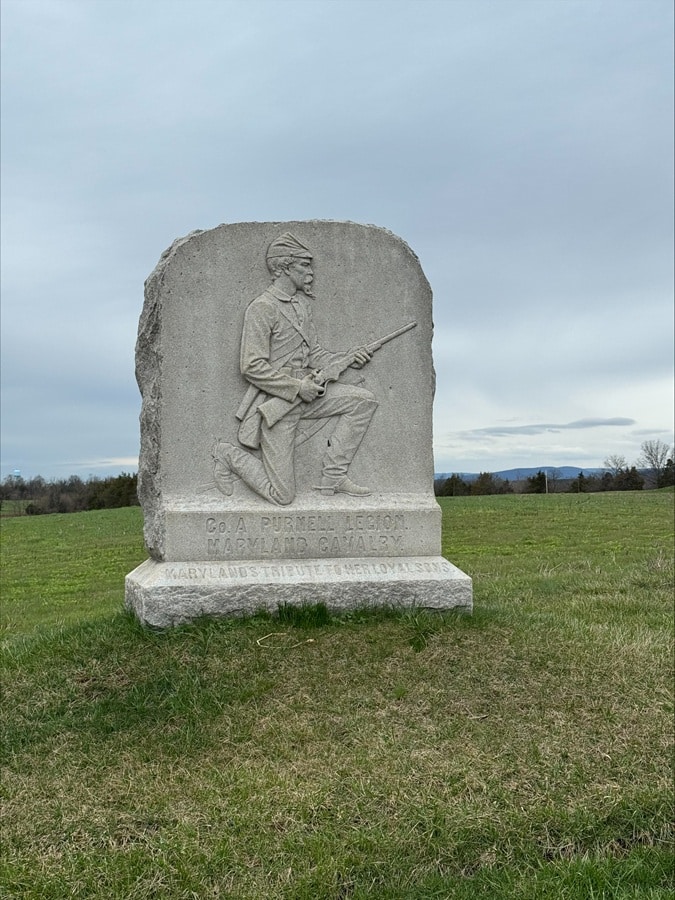
Nearby, the brigade of Col. McIntosh observed the skirmish. Seeing the skirmish line failing, McIntosh sprang into action and ordered forward the 3rd Pennsylvania Cavalry, 1st New Jersey Cavalry, and the single company of the Purnell Legion (Maryland).[15] The men raced towards a stone wall running north along modern-day Hoffman Road, which was on a rise of ground between Brinkerhoff’s Ridge and the Cress Farm. As the Union cavalry made their dash, so, too, did the Rebels of the 2nd Virginia, creating a foot race for the vital piece of cover. The deciding factor in the race to the wall was a well-placed shot from Rank’s greenhorn section which temporarily staggered the Virginians and allowed McIntosh’s men to take the position.[16]
The 3rd Pennsylvania Cavalry held the wall north of the Hanover Road as the Purnell Legion and 1st New Jersey Cavalry positioned themselves just below the crest of the rise that ran on the south side of the road, “taking advantage of every ditch and little inequality in the surface of the ground.”[17] The Keystoners punched loopholes into the wall and began to unload on the Virginians who fell back, regrouped, and tried again.[18]
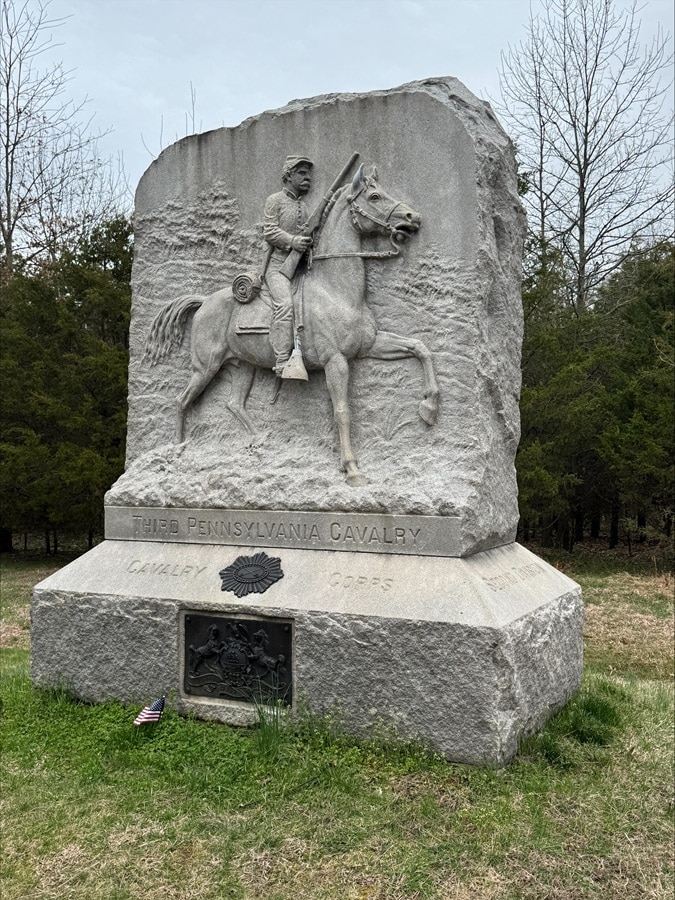
After repeated advances against the wall, Col. Nadenbousch shifted his men left and were briefly able to get onto the flank of the Pennsylvanians; however, the cavalry’s reserve advanced, and the rebels “were obliged to give way” before their “perfect discipline and cool advances,” and held the wall even as their ammunition ran out.[19]
Around 8:00 p.m., Nadenbousch withdrew, leaving behind two companies to guard his rear.[20] Upon returning to the brigade, Nadenbousch reported to Walker that he faced “a large force of cavalry (supposed to be two brigades), two regiments of infantry, and a battery of artillery.”[21] Thus when Johnson gave Walker the option to rejoin the division or protect the flank, Walker chose the latter, believing the division’s “flank and rear would be uncovered and unprotected.”[22] While Walker rejoined the division around 2:00 a.m., he “did not arrive in time to participate in the assault” on Culp’s Hill.[23]
Though Johnson’s division outnumbered the XII Corps brigade of Brig. Gen. George S. Greene, who was left practically alone to hold the hill earlier in the day, Greene’s breastworks and the terrain gave him the advantage. While Greene’s line bent, needing support from regiments of the I, II, and XI Corps, the Yankees held until the remainder of the XII Corps arrived from their attempt to support the Army of the Potomac’s left flank. Back at Brinkerhoff’s Ridge, Brig. Gen. Gregg realized the importance of holding the intersection of the Hanover and Low Dutch roads and requested additional support, which came in the form of Brig. Gen. George Custer’s brigade of Michigan cavalry and several batteries of artillery. The request was fateful as the next day J.E.B. Stuart’s cavalrymen attacked the intersection before being driven off in the fighting at East Cavalry Field.
The action at Brinkerhoff’s ridge resulted in three men wounded for the southerners, while the Union lost four killed, eight wounded, and three captured.[24] Though the losses were relatively light compared to other areas of the Gettysburg battlefield, the impact of the fight for the ridge was anything but. Today the site of the battlefield is on private property, only marked by a small road-side sign, the monuments of the 10th New York Cavalry and Rank’s Battery, and a plaque at the intersection of Hoffman Road and the Hanover Road near the site of the now demolished stone wall telling the few who stop to read it about the often-overlooked skirmish.
————
Colton Pikovsky is currently a law clerk and holds a JD from American University in Washington, DC. As a fellow with the Marshall-Brennan Constitutional Literacy Project, Mr. Pikovsky taught constitutional law at Capital City Public Charter School. In November 2025, Mr. Pikovsky won the American Battlefield Trust’s Ultimate GettysNerd 2.0 Competition.
Endnotes:
[1] Harry Pfanz, Gettysburg-Culp’s Hill and Cemetery Hill (Chapel Hill: The University of North Carolina Press, 1993), 154.
[2] Eric J. Wittenberg, Protecting the Flank (Celina: Ironclad Publishing, 2002), 13-17.
[3] Wittenberg, Protecting the Flank, 18.
[4] Wittenberg, Protecting the Flank, 18.
[5] Wittenberg, Protecting the Flank, 21-22, 24.
[6] Wittenberg, Protecting the Flank, 18.
[7] Noble D. Preston, History of the Tenth Regiment of Cavalry New York State Volunteers, August, 1861, to August, 1865 (New York: D. Appleton and Co., 1892), 106; Wittenberg, Protecting the Flank, 13. See also George A. Rummell III, 72 Days at Gettysburg: Organization of the 10th Regiment, New York Volunteer Cavalry (Shippensburg, PA: White Mane, 1997).
[8] Pfanz, Gettysburg-Culp’s Hill and Cemetery Hill, 162.
[9] Wittenberg, Protecting the Flank, 18-19.
[10] Wittenberg, Protecting the Flank, 24-25.
[11] The War of the Rebellion: A Compilation of the Official Records of the Union and Confederate Armies, Series 1, Vol. 27, Part 2, 521.
[12] Pfanz, Gettysburg-Culp’s Hill and Cemetery Hill, 163.
[13] Preseton, History of the Tenth Regiment of Cavalry New York State Volunteers, 106.
[14] Preseton, History of the Tenth Regiment of Cavalry New York State Volunteers, 111.
[15] Wittenberg, Protecting the Flank, 35-36.
[16] Wittenberg, Protecting the Flank, 35-36.
[17] Wittenberg, Protecting the Flank, 35-36.; Henry Pyne, The History of the First New Jersey Cavalry (Trenton: J. A. Beecher, 1871), 164.
[18] Wittenberg, Protecting the Flank, 36.
[19] Wittenberg, Protecting the Flank, 37-38; History of the Third Pennsylvania Cavalry, Sixtieth regiment Pennsylvania volunteers, in the American Civil War, 1861-1865 (Philadelphia: Franklin Printing Company, 1905), 258.
[20] Wittenberg, Protecting the Flank, 38.
[21] OR, Vol. 27, Part 2, P. 518.
[22] OR, Vol. 27, Part 2, P. 518.
[23] OR, Vol. 27, Part 2, P. 504.
[24] Pfanz, Gettysburg-Culp’s Hill and Cemetery Hill, 167.


A bit of ECW trivia: Wittenberg’s book on Brinkerhoff’s Ridge is one of ECW co-founder Kris White’s favorite CW books.