Brig. Gen. W. H. M. Fishback of the Kansas State Militia
ECW welcomes back guest author William M. Koch.
William H. M. Fishback is largely remembered as part of a footnote in history, and not a flattering one at that. As a brigadier general in the Kansas State Militia, mobilized to oppose Maj. Gen. Sterling Price’s 1864 Missouri campaign, Fishback was arrested for disobedience of orders and mutiny. While his story ends there in most sources, Fishback’s significance extends far beyond the mutiny at Hickman Mills, Missouri.
Fishback was born in 1829 and attended Knox College in Illinois and the University of Indiana. He was admitted to the bar in Indiana in September 1854. The following year, he married Sarah Thomas. He was a deputy treasurer of Warren County, Indiana in 1855 and moved to Mills County, Iowa the following year, where he practiced law.[1]
In Frankfort, which was then the seat of Montgomery County, Fishback dabbled in the practice of law and also taught school. In May 1858 he was defeated as the Republican candidate for county superintendent of schools.[2] Fishback moved to Olathe in the Kansas Territory during the winter of 1858-1859, where he again took up the practice of law.[3] Kansas statehood and Civil War followed in 1861.
In the fall of 1861, Fishback was elected to the Kansas House of Representatives, and to the Kansas Senate the following year.[4] As a representative, he was the chair of the elections committee and a member of the judiciary committee; in the Kansas Senate he again joined the judiciary committee.[5] A brief look at his political involvement shows the effects of the war on Kansas.
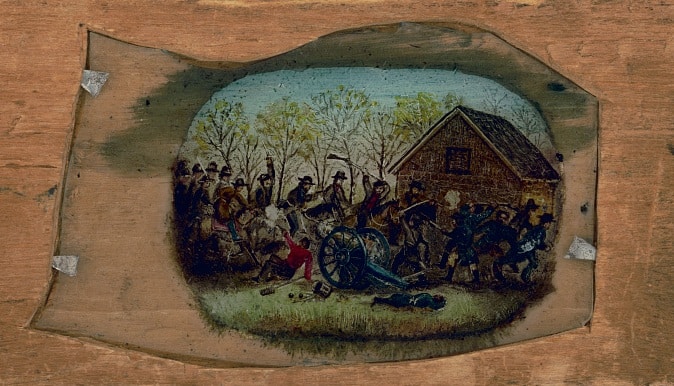
Raids made into eastern Kansas by pro-Confederate guerrillas based in Missouri caused significant damage and consternation, and in May 1863 Kansas Gov. Thomas Carney requested that the War Department fund a home guard unit intended to protect the Kansas side of the state line; the request was denied.[6] In response, Carney appointed Fishback as one of his aides-de-camp, with the rank of lieutenant colonel, and sent him to the national capital to lobby for the raising of a regiment for duty on the Kansas border.[7] While in Washington, Fishback spoke with both of Kansas’ senators, James Lane and Samuel Pomeroy. Lane viewed Carney as a political rival and was unhelpful, but Pomeroy intervened with Secretary of War Edwin Stanton, who authorized the recruitment of two regiments.[8]
On August 21, Missouri guerrillas led by William Clarke Quantrill raided Lawrence, Kansas and massacred roughly 150 civilians. The outcry against Maj. Gen. John M. Schofield (who commanded the Department of the Missouri) and Brig. Gen. Thomas Ewing (who was in charge of the Missouri-Kansas border counties) was great. Lane condemned Ewing and began to openly criticize Carney and called for the men of Kansas to gather at Paola on September 8 for a punitive expedition into Missouri. Instead of putting Missouri to the torch, the crowd at Paola simply produced a resolution calling for splitting Kansas off into its own military department and for Ewing and Schofield to be relieved of command. Fishback was one of the vice presidents of this Paola gathering.[9]
The military situation in Kansas became more serious in the fall of 1864. In September, Confederate troops commanded by Maj. Gen. Sterling Price entered Missouri from Arkansas. After failing to capture St. Louis and Jefferson City, Price’s men drove west towards Kansas. Maj. Gen. Samuel R. Curtis, who had been placed in command of a new Department of Kansas on January 1, 1864, called on Carney to mobilize the Kansas State Militia, but the governor, who did not initially believe that Kansas was in danger, demurred until October 9.[10] Fishback, with the rank of brigadier general, was ordered to assemble the militiamen of Miami, Franklin, Lyon, Morris, and Osage at Paola. Fishback’s home county of Johnson was part of the district of Brig. Gen. Melvin S. Grant.[11]
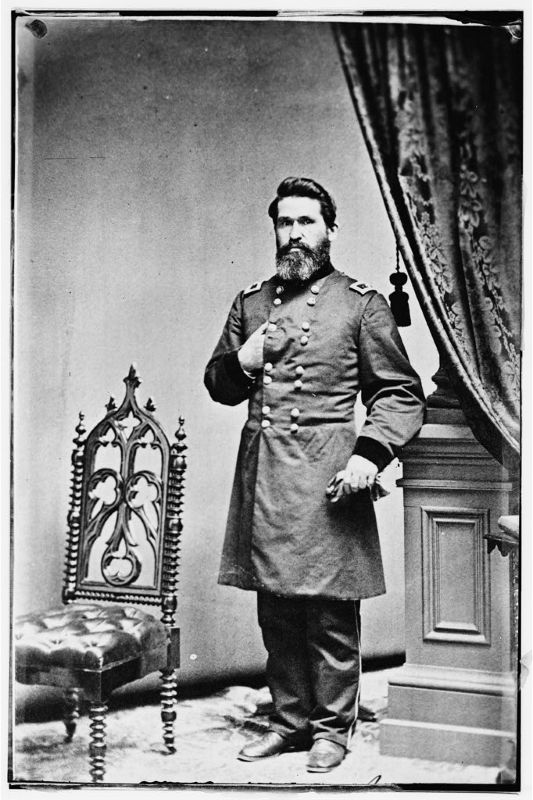
Many in Kansas viewed the militia callout to be a political ruse by Curtis to prevent the east Kansas militiamen from voting and thus likely lead to a victory by Lane’s forces in the fall elections.[12] There were political difficulties with moving the militiamen across the border into Missouri, but the 5th, 6th, and 10th regiments of the militia were sent to Hickman Mills, Missouri where they became part of the division of Maj. Gen. James G. Blunt, who assigned the three regiments to the brigade of Col. Charles W. Blair.[13]
The officers of these three militia regiments wanted to report to Fishback rather than directly to Blair; this resulted in an anomalous position where Fishback operated in a role that historian Lumir F. Buresh compared to a Soviet-era political commissar. With Blunt aligned with Lane and Fishback a supporter of Carney, this was a potentially tumultuous command structure. To make matters worse, the commander of the 6th regiment, Col. James Snoddy, was a hyper-partisan newspaper editor with a particular loathing of Blunt and Lane.[14]
The majority of the militia regiments were still in Kansas, where they had much better food and lodging than was available to the units at Hickman Mills.[15] On October 16, Fishback and Snoddy decided they had seen enough and began marching their men back to Kansas. Blunt quickly nipped this in the bud by arresting the two officers, citing “disobedience of orders and mutinous conduct in the face of the enemy” in his official report of the campaign. Blunt attributed the actions to the two officers being “the instruments selected by the Executive of Kansas and others […] to carry out their mischievous and disgraceful designs” and refrained from having them executed; he considered Snoddy’s behavior to have been worse than Fishback’s.[16]
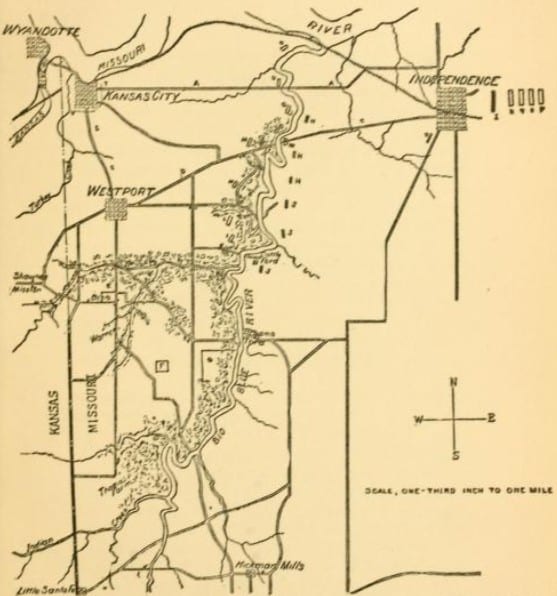
Curtis had Fishback released on October 19, and he rejoined his men, who were at that time encamped along the Big Blue River. Fishback’s men were lightly engaged along the Big Blue on October 22 and fought at Westport the following day. On October 26, with Price in retreat, Curtis released Fishback’s militia organization, allowing the men to return to their homes. Fishback’s official report for the campaign is an interesting document which describes Blunt’s decision to place the militia under Blair’s command as a “most wanton and uncalled for assumption of authority” and quotes a militia order which he believed justified the mutiny at Hickman Mills.[17]
Fishback continued to have an active civilian career. Having previously campaigned for the Kansas Deaf and Dumb Asylum to be located in Olathe, he joined the organization’s board of trustees in 1872. He also served three terms as Olathe’s mayor.[18] He later left Kansas and moved to Gunnison, Colorado.[19] He unsuccessfully ran for governor in 1886 as the Prohibition candidate.[20] By 1907, Fishback was residing in Wyoming.[21] He died in late 1915, but to his former neighbors back in Iowa he had long since been “swallowed up somewhere in the great west”.[22]
————
William M. Koch has been interested in the Civil War since a childhood visit to Wilson’s Creek National Battlefield. He is a certified public accountant and resides in southwestern Missouri.
Endnotes:
[1] The United States Biographical Dictionary. Kansas Volume (Chicago, IL and Kansas City, MO: S. Lewis & Co., 1879), 75-76; H. Charles Ulman. Lawyers’ Record and Official Register of the United States (New York, NY: A. S. Barnes & Co., 1872), 504.
[2] W. W. Merritt, Sr. A History of the County of Montgomery from the Earliest Days to 1906 (Red Oak, IA: The Express Publishing Company, 1906), 150, 204, 324.
[3] Ed Blair. History of Johnson County, Kansas (Lawrence, KS: Standard Publishing Company, 1915), 81, 92.
[4] Blair, 77.
[5] United States Biographical Dictionary, 75.
[6] Albert Castel. Civil War Kansas: Reaping the Whirlwind (Lawrence, KS: University Press of Kansas, 1997), 116-117.
[7] United States Biographical Dictionary, 75.
[8] Castel, 117-118.
[9] Castel, 132, 146-149; Frank J. Welcher. The Union Army, 1861-1865: Organization and Operations. Volume II: The Western Theater (Bloomington, IN: Indiana University Press, 1993), 93; Daniel W. Wilder. The Annals of Kansas (Topeka, KS: Geo. W. Martin, 1875), 348-349.
[10] William L. Shea. Union General: Samuel Ryan Curtis and Victory in the West (Lincoln, NE: Potomac Books, 2023), 200, 222-228.
[11] J. C. Petherbridge. Kansas State Militia, 1864 (Kansas City, MO: Frank T. Riley Pub. Co., 1902), 7.
[12] Castel, 187-188.
[13] Lumir F. Buresh. October 25th and the Battle of Mine Creek (Kansas City, MO: The Lowell Press, 1977), 46-47; Kyle S. Sinisi. The Last Hurrah: Sterling Price’s Missouri Expedition of 1864 (Lanham, MD: Rowman & Littlefield, 2020), 160-161.
[14] Sinisi, 161-162; Buresh 46-47.
[15] Sinisi, 165.
[16] The War of the Rebellion: The Official Records of the Union and Confederate Armies, Series I, Volume XLI, Part I, 572-573.
[17] OR, Series I, Volume XLI, Part I, 571, 618-622.
[18] Blair, 109; United States Biographical Dictionary, 75-76.
[19] United States Biographical Dictionary, 76; George A. Root. “Gunnison in the Early ‘Eighties”, The Colorado Magazine IX, no. 6 (1932): 207-208.
[20] Hubert Howe Bancroft. History of Nevada, Colorado, and Wyoming 1540-1888 (San Francisco, CA: The History Company, 1890), 647.
[21] “Gen. W. H. Fishback”, Olathe Republican Tribune, May 10, 1907, 7.
[22] “Hon. W. H. Fishback Dead”, The Kansas Star, January 1, 1916, 4; Merritt, 204.


This is slightly off topic, but was Price’s advance into Missouri coordinated with Hood’s advance into Tennessee?
Not to my knowledge. Price’s campaign had been in the works since the aftermath of the Red River campaign, and had originally been conceived of as being larger in scope, with infantry involved. The end result was a campaign that was fatally a mix of cavalry raid and a desire to retake Missouri and install a Confederate governor (which would imply holding territory).
There wasn’t a hierarchy in the Confederacy to coordinate such a move. Kirby Smith and the Trans-Mississippi were well on their own by the campaigning season of 1864. Communications with the East had broken down to a trickle by then. Beauregard, who was nominally in control of Hood as the Department commander, couldn’t even direct Hood let alone communicate enough with Kirby Smith about coordinating anything.
Coordination between the Western theater and the Trans-Mississippi was already broken down by the Vicksburg campaign. Even going back to 1861 the Confederate command structure and organization, I would argue, was weak in the Western and Trans-Mississippi theaters.