Book Review: Haunted by Memory: Ghost Stories of the American Civil War

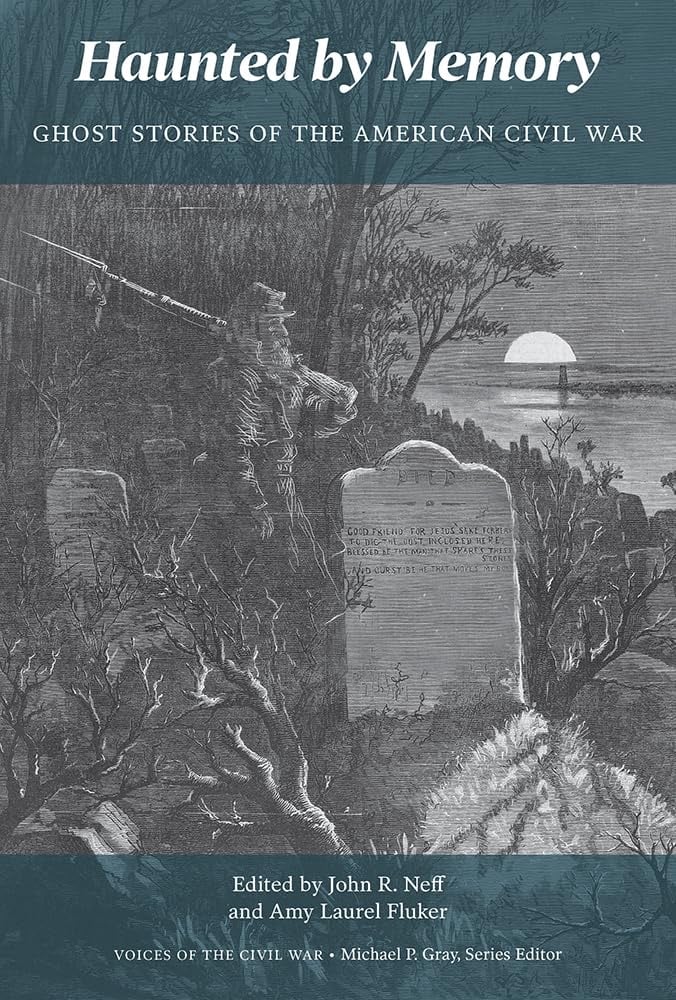
Haunted by Memory: Ghost Stories of the American Civil War. Edited by John R. Neff and Amy Laurel Fluker. Knoxville: University of Tennessee Press, 2026. Softcover, 413 pp. $29.95.
Reviewed by Sean Michael Chick
In January 2020 the University of Mississippi and Civil War historians as a whole lost John R. Neff. He garnered awards for teaching and authored Honoring the Civil War Dead: Commemoration and the Problem of Reconciliation. That book was early to a trend in considering Union war memory, which Neff dubbed the Cause Victorious. I saw him at a panel discussion in 2009 in Louisville, exchanged emails, and at one point thought of studying under him. His book and his talk left a strong impression of an intelligent man, but one who understood the emotional in a way some in academia do not. I can still clearly remember a few of his words he uttered in Louisville, and I took them to heart. I discovered his death much later in unusual circumstances and was much affected despite barely knowing him.
My connection to Neff drew me to this book, but what really compelled me is I am from New Orleans, the self-proclaimed most haunted city in America. While there are no vampire legends here (it is a product of books and TV), there are plenty of stories of ghosts, werewolves, and other monsters and spirits I grew up hearing. I do the occasional ghost tour in New Orleans. I therefore had some interest in looking at Haunted by Memory: Ghost Stories of the American Civil War.
Amy Laurel Fluker, author of Commonwealth of Compromise: Civil War Commemoration in Missouri, finished Haunted by Memory after Neff’s death. Neff was collecting and organizing ghosts for a work he was never able to finish. Fluker did so, and much of the commentary is from her. This is a primary source collection, almost entirely from newspapers; you will not get tales by Ambrose Bierce such as “A Resumed Identity,” which is easy to find anywhere. There are ample end notes, which is good for the reader, as these stories will reference things a person in 1868 would know, but not necessarily even a Civil War scholar would today.
Collected here are not just ghost stories, although those are common enough. The book also considers ghosts as symbols and literary devices in the context of a time when the supernatural was more pervasively taken as fact. Literary and symbolic are important. In one passage Jefferson Davis is visited by the ghost of George Washington, who tells him he would not be considered a traitor if he had won (John Harington would approve). In another P.G.T. Beauregard is haunted by the ghost of a dead Confederate soldier when he visits Bull Run due to his support for civil rights.
Some things I liked were the chapter on African Americans and ghosts. These sadly do not come much from actual former slaves, as their newspapers were few, many are sadly lost, and they were short. These newspapers were concentrating on more practical and social matters. Instead, the chapter reveals how whites, North and South, positioned freedmen in relation to ghosts. It shows the mutual racism that bound the sections together and in turn made reconciliation easier than it otherwise would have been, a point also well made in the last chapter. Indeed, it was these two chapters I liked the most.
One thing I liked was there is no attempt to say “ghosts are not real or they are real.” Fluker splits the difference, but is also respectful. In New Orleans, most natives believe in ghosts. Those who did not were seen as daft, but my mother and her family were Germans from Indiana and thought the New Orleans Irish half was stupid for such beliefs. Haunted by Memory threads the needle admirably for what can be a touchy subject.
I do have some quibbles. In the Lost Cause chapter Flucker makes the case that the Confederates were worried about treason. I find little real worry over accusations of treason outside of how the North might punish them; the Confederates believed they were acting in the tradition of Washington and Jefferson, and many thought the North the true traitors to what America was meant to be. It is said in the text the South wished to overthrow the government when very clearly it was a war for separation. The chapter on African-Americans and ghosts is the shortest (by necessity), but has the most pictures, which was odd. The preface by Deirdre Cooper Owens added little of substance. Lastly, in the Lost Cause chapter, Tiya Miles is liberally quoted, and her words are more distracting than enlightening.
Haunted by Memory might be the most unusual Civil War primary source collection. It is an original work in Civil War memory studies and also something of a synthesis of where this line of research now stands. Its chapters are far ranging in themes, subjects, and the sources themselves. As such, it gets beyond battle maps, biographies of the era’s figures, and even many memory studies. The sources themselves are not dry. They speak to the visceral and the personal. And such is what I found was true of Neff in reading Honoring the Civil War Dead and the panel talk he gave. He will be missed.


