Ironclads, Poetry, and Ramming Attacks at the Mississippi River Delta
One thing I have noticed in recent years is that there is no shortage of poetry written in Civil War era newspapers. Editors (or locals) were often impacted by wartime news and took a pen in hand to commemorate their victory (or loss).
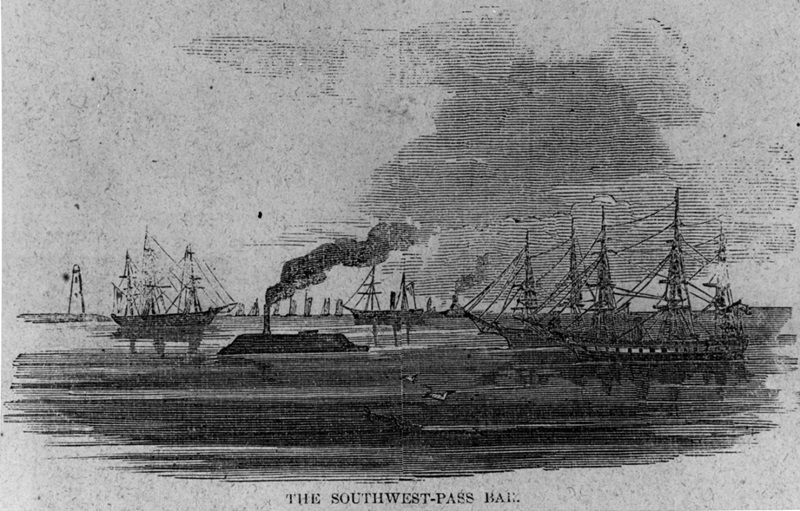
I have previously explored one such instance related to the Panamá route, but that is just one of thousands of such poems that found their way into period newspapers. Just like I could not include that poem in my book Treasure and Empire in the Civil War, I encountered another poem about the October 12, 1861, battle of the Head of Passes that I could not include in my new book Ironclad Ambush. This poem commemorates the October 12 battle of the Head of Passes, where the ironclad Manassas rammed USS Richmond in a surprise attack.
The Battle of the Mississippi
“The tyrant’s broad pennant is floating
in the South, o’er our waters so blue;
On our homes now his foul eye is gloating –
The homes of the brave and true.
Bear our flag at the ‘head of the Passes’
Is borne on by men brave and true:
We will teach them to fear our ‘Manassas’
Three cheers for our red, white and blue.
We will give his proud fleet such a greeting
As the storm-cloud’s shaft to the tree,
As the rock to the wave in their meeting
Is the stroke of the brave and free.
Tho’ his minions may come as the locust,
And out-number the sands of the sea,
Their numbers will serve to provoke us
To dare, to die, or live free.
Every breeze from the ‘Crescent’ is laden
With defiance to the despot on our shore.
Strong men, the child, and each maiden
Join in chorus with the cannon’s loud roar;
And our flag at the head of the Passes
Is borne on by men brave and true;
We will teach them to fear our Manassas;
Three cheers for our red, white and blue.”[1]
***
The poem directly celebrates the successful ramming attack of the ironclad-ram Manassas against the U.S. blockader Richmond. The poem’s first element makes note that the Federal blockade is established and encroaching on the Confederate coastline. The second proudly declares that Confederate forces will make a strike against the blockade. The third freely admits that the blockaders are more numerous, that that Confederate forces are outnumbered.
The poem’s final section is the battle of the Head of Passes itself. Manassas strikes down the Mississippi and, alongside the cannon of other ships and yells of the people of New Orleans itself, bring forth victory and clear the blockade from the Head of Passes. This declaration is pretty typical of the proud jest made by Civil War participants when their side achieved a victory.
Of course, this was just one small victory in the war’s opening year. But since it occurred so early in the war, in a month where there was not much fighting, the victory became overblown. Thus the overjoyed celebration poem, whose author remains lost to history. It does make me wonder though, whether that author would have written a similar poem two or three years later as the war’s slaughter became apparent, and then overwhelming.
Endnotes:
[1] “The Battle of the Mississippi,” Daily True Delta, (New Orleans, LA), October 20, 1861, p 1, col 7.


