Honor, Defeat, and the Devil in “Still Valley”
“For what will it profit a man if he gains the whole world and forfeits his soul?” That moral question lies at the heart of “Still Valley,” a Season 3 episode of The Twilight Zone. Many Civil War buffs are familiar with the episode and its unusual blend of history and magic, but fewer know the short story on which it is based.
“The Valley Was Still” by Manly Wade Wellman (yes, that was his real name) first appeared in Volume 34, Issue 4 of Weird Tales. Rod Serling adapted the story for television, retaining its characters and basic premise while slightly changing the ending.
Set during the Civil War, both versions follow Confederate scout Joseph Paradine, an idealistic and courageous cavalryman, as he investigates Virginia’s fictional Channow Valley. Riding alone into an eerily silent village, he discovers an entire Union division lying in the street—alive but unable to move. The soldiers seem neither dead nor asleep, and Paradine’s fear grows as he realizes that an unnatural force has frozen them in time.
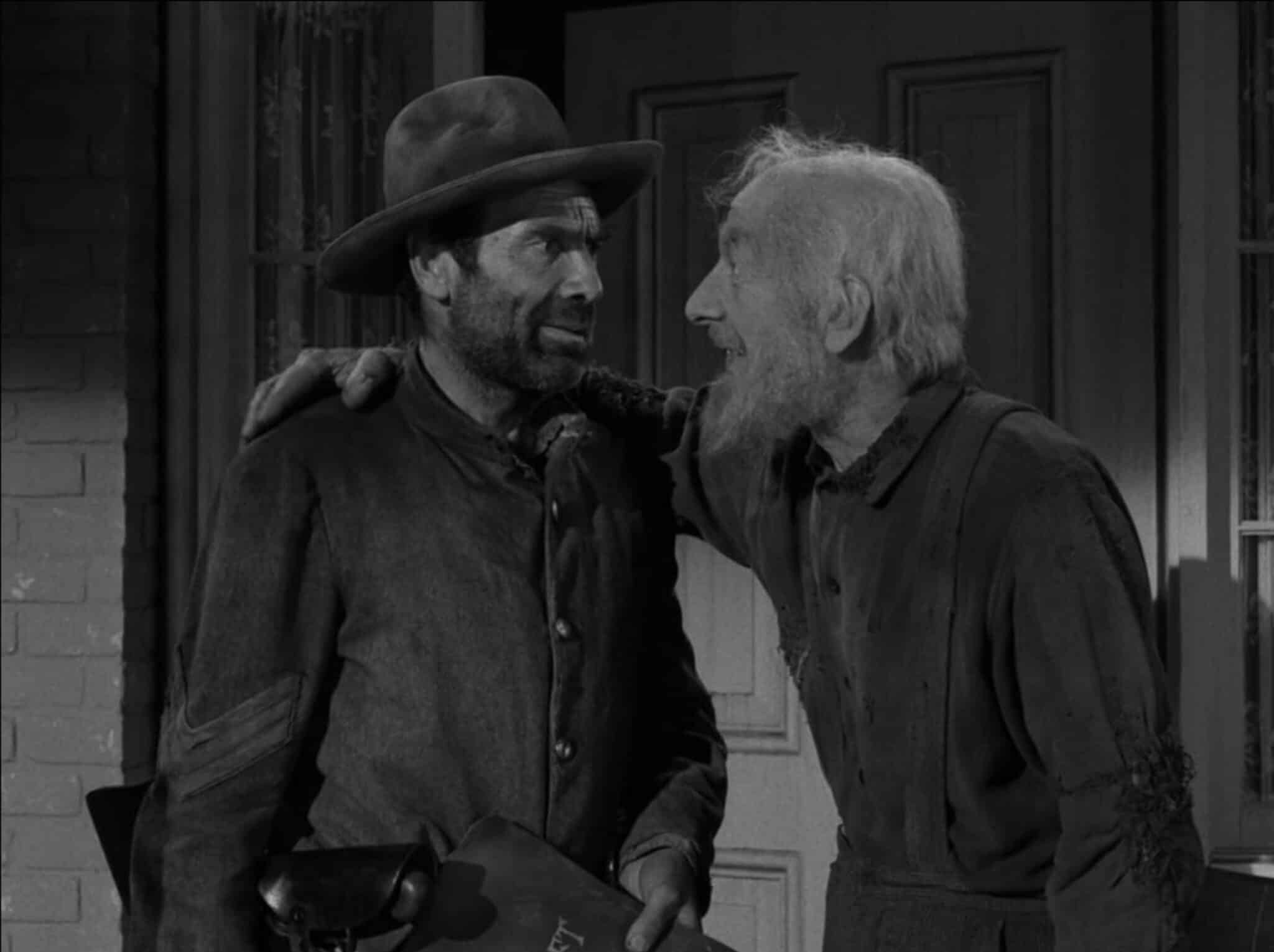
Paradine soon encounters Teague, a resentful local “witch-man” who claims responsibility for the paralysis. Using a book of folk magic whose prayers and invocations he has altered, Teague has called upon a darker power to place the Union army under a spell. He demonstrates that power by freezing Paradine in place, then reveals his larger ambition.
This is where the original story and Rod Serling’s screenplay diverge.[1]
With Paradine’s military knowledge, Teague could use this supernatural power to immobilize every Union army and win the war for the Confederacy, with himself as its leader. He offers Paradine a place as his partner, but makes clear that the bargain involves a dangerous, evil presence, and requires Paradine to sign his name in blood. Paradine wants victory for the South, yet recognizes that no military triumph is worth achieving through dishonorable, corrupt, or evil means.
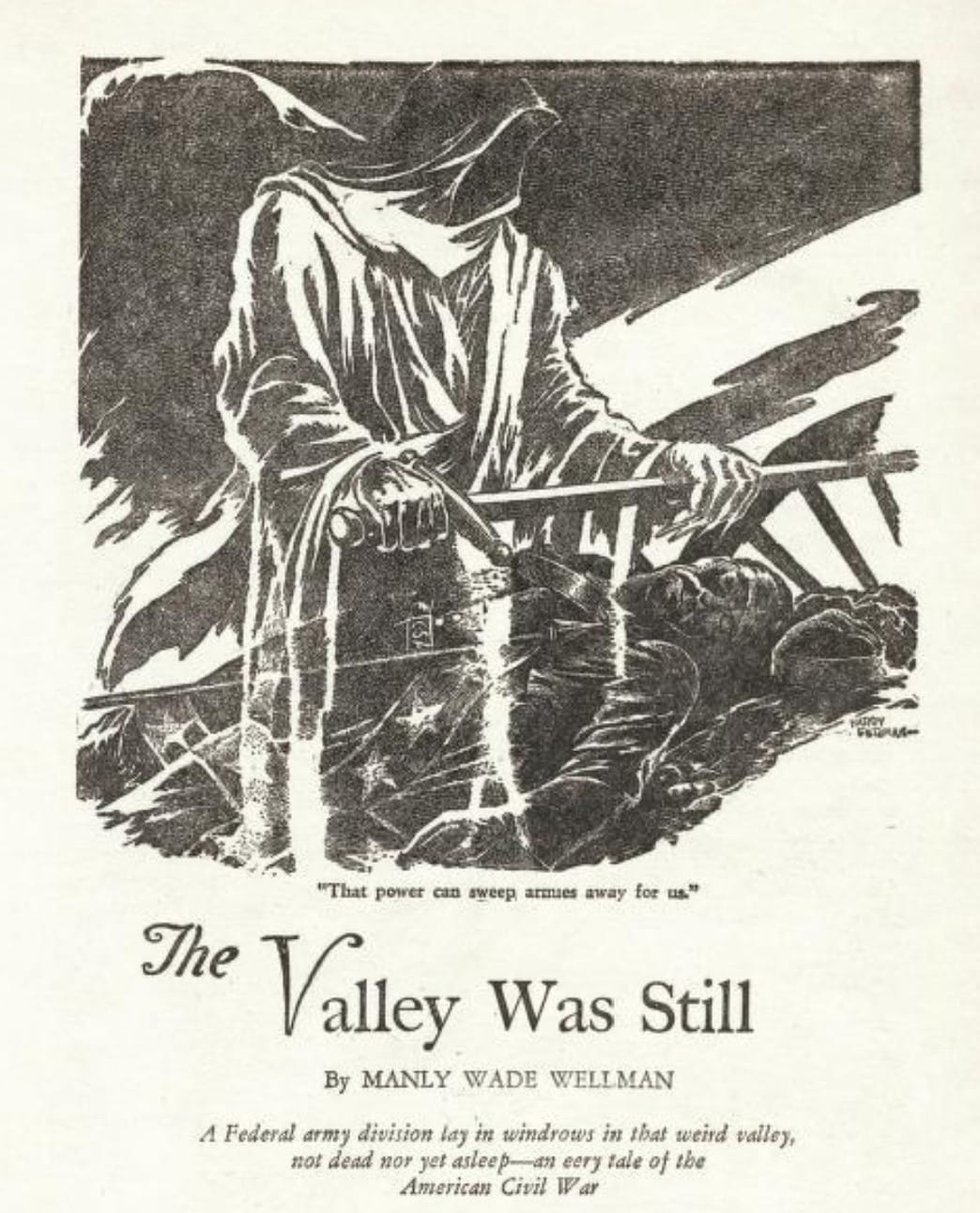
At the story’s climax, Paradine feigns compliance, pricks his finger, and begins signing the pact. Instead, he seizes Teague’s book and kills him with his saber. Paradine then reads the book’s original Christian invocation to release the Union troops and burns it before Confederate reinforcements arrive. The restored Union division quickly regroups and defeats the attacking Confederates, turning what might have been an easy victory into a rout.
In later life, Paradine insists that the Confederacy truly lost the war at Channow because he rejected the dark power Teague had unleashed, causing it to work thereafter against the South. Others dismiss him as merely another “crazy” old veteran.[2]
Manly Wade Wellman was born in 1903 in Portuguese West Africa and moved to the United States as a young man. His father, Frederick Creighton Wellman, was a widely traveled American physician and author. Wellman later settled in North Carolina, where he became an expert on the Civil War and local history. In addition to his pulp-fiction stories, he wrote Rebel Boast, a study of five enlisted men in the Enfield Blues, a company of the 1st North Carolina Infantry “Bethel Regiment.” He also authored Giant in Gray (1949), a biography of Wade Hampton III.[3]
Wellman appears to have been knowledgeable about folklore as well. The book Teague uses to bewitch the Union soldiers references a real text, The Long-Lost Friend (1850), by John George (Johann Georg) Hohman. Hohman immigrated from Germany to the United States in 1802 and settled in Pennsylvania, where he sold chapbooks on folk magic and herbal remedies. He first published Der Lange Verborgene Freund in German in 1820, and English translations soon followed.
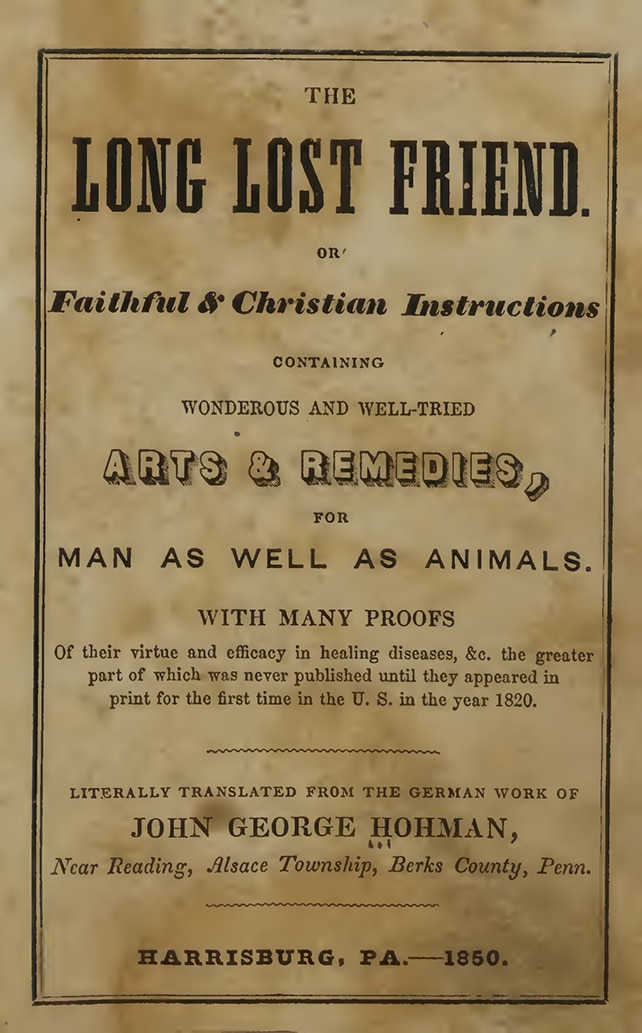
When focusing on the political and military history of the Civil War, it is easy to overlook the strength of supernatural belief at the time, especially in Appalachia. Folk remedies and beliefs in witchcraft were common among the Scots-Irish settlers of the region and among Pennsylvania Dutch communities such as Hohman’s.[4] One edition, titled The Long Hidden Friend, was published in Carlisle, Pennsylvania, in 1863. One wonders whether any of Robert Rodes’ men curiously perused a copy as they marched through town.[5]
Wellman was inducted into the North Carolina Literary Hall of Fame in 1996, ten years after his death.
Though I’m by no means an expert on Wellman’s work, his writing suggests that he was an unapologetic Southerner. His biography of Wade Hampton is full of praise for the former Confederate general, South Carolina governor, and U.S. senator. Summarizing Hampton’s postwar years, Wellman wrote: “During that latter half of life he was to lead Southerners through years of dismay and prosecution, back to freedom.”[6]
This perspective shines through in “The Valley Was Still.” Wellman portrays the Confederate cause sympathetically as a struggle for homeland, honor, courage, and independence, while also subjecting it to a moral test. The character of Paradine later claims that the war was lost at Channow, rather than at Antietam or Gettysburg, because he rejected the supernatural alliance and caused that power to turn against the South. In doing so, the story casts Confederate defeat as the tragic consequence of moral restraint rather than a judgment on its soldiers or their cause.
The war was lost because Paradine would rather choose honorable defeat on the battlefield over success purchased by a pact with evil.
Serling’s screenplay makes this moral dilemma even more explicit. “What do we call ’em? ‘Damn Yankees,’ don’t we, lieutenant?” Paradine says, unable to complete the final conjuration. “That’s the phrase, ain’t it? Damn Yanks! If I read aloud from this book, it’ll be the Confederacy that’s damned. … If this cause is to be buried, let it be put in hallowed ground.”
“The Valley Was Still” and its Twilight Zone adaptation imagine a Confederate defeat that preserves the honor of both the soldier and his cause, an explanation that fits comfortably within the Lost Cause tradition. Wellman’s praise for Wade Hampton’s role in restoring Southern freedom during Reconstruction suggests how deeply he embraced that narrative.
Serling’s adaptation retains the sympathetic Confederate soldier while sharpening the moral question: how far can loyalty to a cause go before it betrays the principles supposedly worth fighting for?
[1] Don Presnell and Marty McGee, A Critical History of Television’s The twilight Zone, 1959-1964 (McFarland & Company, 1998), 109-110; Marc Scott Zicree, The Twilight Zone Companion (Silman-James Press, 1992), 239-40.
[2] Manly Wade Wellman, “The Valley Was Still,” Weird Tales 34, Issue 4 (August 1939): 5-14.
[3] Darrell Schweitzer, “Wellman, Manly Wade” in St. James Guide to Fantasy Writers, edited by David Pringle (St. James Press, 1996), 596-98.
[4] David Hackett Fischer, Albion’s Seed: Four British Folkways in America (Oxford University Press, 1989), 608–9, 710.
[5] Carleton F. Brown, ed., “The Long Hidden Friend,” The Journal of American Folklore 17, Number 65 (April-June 1904): 95-96.
[6] Manly Wade Wellman, Giant in Gray: A Biography of Wade Hampton of South Carolina (Charles Scribner’s Sons, 1949), 8.


Fascinating back story. Thank you for doing the research and sharing.
Thank you for enjoying it!
Fascinating. I watched Twilight Zone religiously but had forgotten this episode. Thanks for the trip down memory lane.
Glad you enjoyed it! As far as Twilight Zone episodes go, this one was mediocre, but as an object of Civil War memory it’s pretty darn interesting.
As far as the theme of the show, IMO its not that “the ends justify the means” it isn’t that the hero would have to do an evil thing to gain his goal: (the Confederacy), as much as an alliance with the powers of darkness would warp the Confederacy it would no longer be what the soldier was fighting for.
Mike,
Your article reminded me of a wonderful experience I had at VaTech’s excellent Civil War Weekend some years back. Purely by accident, my spouse and I found ourselves at at the same dinner table with a host of Civil War academic heavy hitters, including the legendary James “Bud” Robertson, “Jack” Davis, Paul Quigley (respectively the founder, past head, and current head of the Virginia Center for Civil War Studies), and UVa’s Elizabeth Varon. It was wonderful conversation all around, but I recall Dr. Varon talking about teaching her students about the use of Civil War themes in Twilight Zone episodes. We identified five Twilight Zone episodes that had Civil War-related themes or references.
Do you recall all of the five? (Hint: The Civil War reference in one is a bit tangential, but includes a key old photo of a Civil War officer.)
Kevin
Oh wow, that’s a challenge. Just the original series or the revivals as well? There’s the Ambrose Bierce adaptation, of course. There’s one with a guy who time travels and tries to warn everyone about Lincoln’s assassination. What were the five you identified?
Just the original series.
In addition to your “Still Valley” and the other two you identified (the time traveller in the “Back There” episode being the “Professor” from Gilligan’s Island), there is probably the best – “The Passersby” – involving a Southern woman in April 1865 watching an almost endless stream of soldiers passing by her home – and finally, “Long Live Water Jameson.”
The Civil War is a bit tangential in LLWJ, but the main character is a teacher who has an uncanny grasp of history, owns an original Civil War diary with which he is intimately familiar, and whose secret comes out via a Civil War-era Matthew Brady photograph. Close enough to make the list, in my humble opinion.