John Pelham’s Birthplace Gavels
According to the family bible, John Pelham was born on September 7, 1838. A few biographies over the decades have written September 14 for his birthday, but I preferred to rely on the family’s primary source. Destined for Civil War fame through his command of the Stuart Horse Artillery and prominent places on numerous eastern battlefields, Pelham lived just 24 years.
After the war, as veterans and enthusiasts’ interest grew in Pelham’s early life, their curiosity led to an interest in Pelham’s birthplace and the creation of relic gavels. Born in a small wood house near Cane Creek in Benton (later Calhoun) County in Alabama, the details of that dwelling have fascinated researchers.
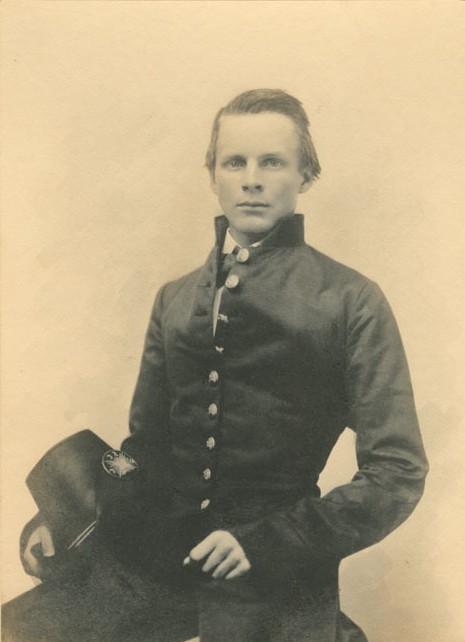
John Pelham was born between family homes (not literally). In spring 1838, the Atkinson Pelham family moved to northeastern Alabama, a semi-frontier area at the time. The Pelham family included Dr. Atkinson Pelham and Martha McGhee Pelham and their two sons Charles (age 3) and William (age 1 ½ ), and Martha was pregnant with their third child. Some of the McGhee family had already settled in this area of Alabama, and the Pelhams took temporary residence in a log house near the creek, living with Martha’s parents and numerous younger siblings. By late summer, Dr. Pelham’s house had been constructed about 3 miles from the log house, though the family delayed moving until after the new baby arrived.
Charles G. Milham conducted most of his research when close family relatives and some Civil War veterans still lived, and his biography of Pelham appeared much later in 1959. He described the log house when it was still standing:
“It was big as log houses go and as sturdy as a fort. The old place is still standing, although clapboarded over and much hidden behind several additions. In 1838 its walls were of huge, squared, hand-hewn timbers, the wider gaps filled with cleverly-shaped wedges of wood, the smaller gaps chinked with mud. There were two rooms, each about twenty-four feet square, with a wide passage, open at both ends, half hall, half runway, between them. Over the two rooms and the passage was an attic which provided part of the living quarters.”[i]
Americans have been interested in birthplaces or homes of favorite hero-figures for centuries, which has led to various preservation efforts. In the post-Civil War years, Confederate veterans and their descendants tracked down sources and places related to “Gallant Pelham”—an idealized martyred officer in the perspective of the era. Two years of Pelham’s life had been in camps or on battlefields, five years at the United States Military Academy at West Point and the rest of the time in Alabama at various family farms and local schools. The Pelham house—the one they moved into in the later autumn 1838—was the family home until 1847 when they moved into the town of Alexandria, Alabama. These homes were either difficult for later researchers to identify or had been destroyed. In the early 20th Century, the McGhee log house still stood and known for being John Pelham’s birthplace.
In 1905, the following excerpt appeared in the Confederate Veteran Magazine—a blending of memory, monumentation, and relics:
“A monument to the memory of ‘The Gallant Pelham’ will be unveiled at Anniston, Ala[bama], on June 3 by Camp John H. Caldwell, U.S.C.V. [United Sons of Confederate Veterans]. For the benefit of the fund for this monument the Camp has for sale gavels made from the wood of the room in which Pelham was born. The price is $2.50, and a certificate is furnished guaranteeing that the gavel is made as claimed. Orders may be sent to W.H. McKlerny, President of the Anniston National Bank and Commander of the local Camp, or to C.J. Owens, President of Anniston College for Young Ladies and Commander of the Fifth Brigade, U.S.C.V.”[ii]
(The fundraising worked successfully, and the Confederate Veteran Camp dedicated the monument in 1905. In 2020, the monument was relocated to Janney Furnace Park, where it stands today.)

If anyone knows the journey or current location of such certified gavels, I’m interested to hear more. From a 21st Century perspective, making gavels from relic wood might seem unique. However, some quick searching through other editions of the Confederate Veteran Magazine show that it was a popular way to create from historic wood. Other gavels mentioned in those pages included wood from First Manassas Battlefield, from the tree that shaded Lee when he gave a farewell address, storm damaged trees from Belvoir (Jefferson Davis’s residence in the final years of his life), and from Fort Sumter and other locations. These gavels were presented as gifts among the Confederate Veterans Camps and also among the chapters of the United Daughters of the Confederacy.
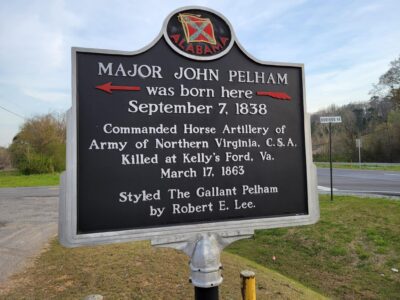
It’s one of the history and memory intersections that show up in the historiography of John Pelham’s life. The log house no longer stands, though a historic marker is at a nearby intersection. While I didn’t spend much time on this story in my recent book, it does get a little mention in the opening two paragraphs of Chapter 1.
A little one in his mother’s arms, blinking and crying at the great world for the first time, has no idea of his future. Neither do his parents. Later, people beyond a family circle may remember the otherwise insignificant details of a child’s birthplace once his place in history is established. On September 7, 1838, in a small wooden house near Cane Creek in Benton County, Alabama, Atkinson and Martha Pelham welcomed their third son and named him John.
One day, John Pelham’s name would be in newspapers on both sides of the Atlantic. Men would enter the room that family stories marked as the place of his birth and hack wood from the walls to make relics connected to their boy-hero.[i] But that would all be in the future, after the baby grew through boyhood, then found his place as a man in the ranks of a Confederate army that few had imagined in the 1830s.
Read more in one of the newest books in the Emerging Civil War Series—Glorious Courage: John Pelham in the Civil War by Sarah Kay Bierle (May 2025).
Notes:
[i] Charles G. Milham, Gallant Pelham: American Extraordinary (District of Columbia: Public Affairs Press, 1959). Page 10.
[ii] Confederate veteran v.13 “Monument to John Pelham,” (1905), page 170. https://babel.hathitrust.org/cgi/pt?id=coo.31924057407243&seq=176


Maybe contact Erik Dorr and ask him to let you know if one is turned in to Gettysburg Museum of History?
My gg-grandfather moved his family to Benton County, Alabama in the 1840s from Hancock County, Georgia. Where did Pelham’s family move to that county from? Thanks for this article, and let us know if you locate one of these memorial gavels!