Book Review: Lincoln’s Lady Spymaster: The Untold Story of the Abolitionist Southern Belle Who Helped Win the Civil War

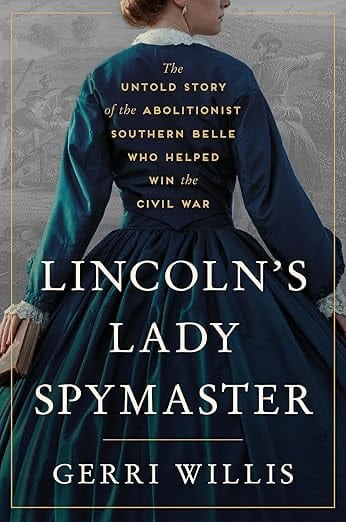 Lincoln’s Lady Spymaster: The Untold Story of the Abolitionist Southern Belle Who Helped Win the Civil War. By Gerri Willis. New York: HarperCollins, 2025. 266 pp. $28.99
Reviewed by: Sheritta Bitikofer
Lincoln’s Lady Spymaster: The Untold Story of the Abolitionist Southern Belle Who Helped Win the Civil War, written by news anchor Gerri Willis, is a simplistic biographical look into the life and wartime espionage efforts of Elizabeth Van Lew. Born in Richmond, Virginia in 1818, Elizabeth was the daughter of a prominent, slave-holding family with Yankee roots. Educated in the North, she adopted anti-slavery views, which contradicted those of her father. Though her father’s will explicitly forbade the manumission of his enslaved property, Elizabeth and her mother acted upon their abolitionist ideals and attempted to provide a level of freedom for their servants.
As secessionist hostilities amplified in the South, Elizabeth and her household (she was unmarried ,but resided at her family’s estate on Church Hill in Richmond) were obliged to be reserved about their political opinions. However, after the commencement of the war and the first Union prisoners were ushered through the gates of Richmond, Elizabeth made daring decisions that would lead her to become one of the most notable women spies during the American Civil War. What began as humanitarian efforts to provide food and comfort for the prisoners evolved into assisting prisoner escapes and providing information to those in the Union high command.
Willis made every attempt to put Elizabeth’s efforts within the greater context of the war’s progression. The final chapter of the book details Elizabeth’s successes and struggles as Richmond’s postmaster during the Grant administration, as well as her numerous financial and sentimental losses. She continued to be unapologetic about her political views regarding equal rights for women and Blacks across the nation, sometimes drawing admiration or scorn from her contemporaries. She died in 1900, remembered as a woman who took innumerable risks to do what she believed was just for the cause of her country and community.
Willis takes a chronological approach to telling Van Lew’s story, only deviating from Elizabeth’s story to focus on other spies and historical figures such as Rose Greenhow, Mary Jane Richards, Ulysses S. Grant, Ulric Dahlgren, and John Wilkes Booth. Sometimes, these long-winded chapters dedicated to alternative topics and characters seem completely unrelated to Elizabeth’s story. In fact, if you took out those chapters in which Elizabeth is not the main focus, about half of the book would be lost.
These endless detours from Elizabeth’s story may be disappointing to readers looking for a more in-depth dive or the “untold story” as the title suggests. But the reader must imagine the book’s structure as a giant tackboard with numerous red strings twisted and stretched to interconnecting points. The extra context Willis provides reveals how, even shallowly, Elizabeth was integrated into certain events that unfolded during the war. Willis goes so far as to make the bold assertion that Elizabeth’s reports to Union officials swayed certain military decisions during the war, and that Elizabeth “wasn’t just an important Union spy,” but had become “its most important spy” by 1864 (183).
At its core, in this reviewer’s opinion, Willis’ book was written for the casual history buff or the layman not looking for a serious academic work. This is evident in the sweeping generalizations about complex historical issues, the narrative-like passages containing conjectures regarding the feelings and actions of historical figures for the sake of dramatization without tangible verification, and the (surprising) lack of primary source citations when compared to other biographical works that have already been written about Elizabeth Van Lew. One such biographer is Elizabeth Varon, whom Willis cites frequently in her work and gives praise to in her acknowledgements as having written the “authoritative and excellent biography of Van Lew,” and could be considered a follow-up read for those looking to learn more or experience a more comprehensive body of research (247).
Lincoln’s Lady Spymaster may not add anything to the historiography of espionage during the Civil War or unveil any new information regarding Elizabeth’s life, but it is an entertaining, light read that can spark an interest for the Civil War in those with only a basic knowledge of this period of American history. The book, most importantly, accomplishes what Willis set out to do during the COVID lockdown of 2020: “to introduce [young women] to women who had beaten back challenges and defied the odds” (xv).


Which military decisions of the Union were impacted by the information she provided?
Willis implies that Van Lew’s insistence on the Federal army assaulting Richmond inspired the failed Kilpatrick-Dahlgren Raid (February 28–March 3, 1864) and sparked the idea for the Overland Campaign in 1864. I think this is a very one-dimensional view of how a single person’s suggestion can drive military and political decisions on a grand scale.
Unless tasked with “active measures,” the role of any spy is to provide information. How the recipient of that information makes use of it may never be fully revealed. In the case of Elizabeth Van Lew, it appears that she provided early warning of the 1864 Arson Attack on New York City. See ECW post “The Richmond Resistance: Elizabeth Van Lew’s Enterprise.”
Thanks to Sheritta Bitikofer for introducing this latest work concerning the under-appreciated efforts of those engaged in intelligence gathering during the Civil War.
Funny enough (thought not surprising), Willis doesn’t even mention this in her biography. Glad ECW is here to fill in the gaps.
Not every history book needs to be packed with footnotes to be valuable — sometimes a more accessible, story-driven approach reaches people who’d never touch a dense biography.
I completely agree that there is a place for the light, casual history books, and those books are valuable in teaching history. If every history book were dense, 500-page tomes, and bogged down with PhD-level language, the average person wouldn’t be turned on to history at all. However, footnotes and a reliable bibliography are the backbone of a well-researched book or paper. Footnotes, in my opinion, build trust between the author and the reader. If an author writes that a certain historical figure said something and provides it in quotations, I expect the author to include where they found this quote in an appropriately placed footnote. Willis does not do this consistently in this particular publication.
Several years back, Kevin Pawlak wrote a short blog about the importance of sourcing quotes. It has stayed with me ever since and influenced my research methods when I earned my BA in American History.
https://emergingcivilwar.com/2019/12/09/the-importance-of-finding-the-original-source/
Thank you for casting a critical eye on this book and referring to Varon’s more comprehensive work on Van Lew. While members of the general public may find the Willis version meets their needs, the lack of footnotes and other issues you mention may important to a large segment of the ECW community. I also appreciate a book reviewer such as yourself who contrasts the book under review with others on the same subject so readers know whether they should spend their hard-earned money on the new book. Nicely done.
In the epilogue Ms Willis says that Dahlgren’s funeral was held in Philadelphia’s Independence Hall, “the same spot where Lincoln’s funeral had been held six months earlier “. Whatever is she talking about??
I haven’t read the book but I am tired of book titles proclaiming an untold or lost story and a war winning contribution that are neither. It may be a book publisher’s requirement but I all but automatically pass those by.