Book Review: The Surgeon’s Battle: How Medicine Won the Vicksburg Campaign and Changed the Civil War

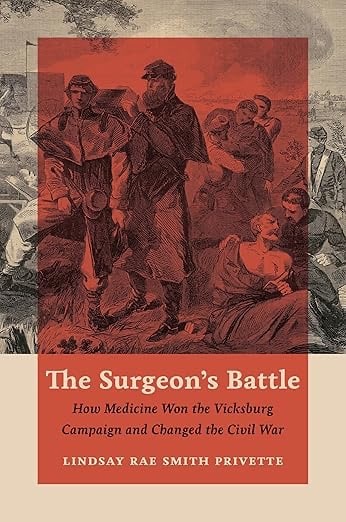 The Surgeon’s Battle: How Medicine Won the Vicksburg Campaign and Changed the Civil War. By Lindsay Rae Smith Privette. Chapel Hill, North Carolina: The University of North Carolina Press, 2025. Softcover, 207 pp. $29.95.
Reviewed by Daniel Brennan
On the morning of July 4, 1863, white flags rose along the Confederate earthworks guarding Vicksburg, Mississippi. The surrender ended a forty-seven-day siege and a months-long Federal effort to seize the vital city on the Mississippi River. Soldiers and scholars have cited many reasons for the U.S. victory, ranging from the depleted condition of John Pemberton’s Confederates to the iron will of Ulysses S. Grant and his Union Army of the Tennessee. Professor Lindsay Rae Smith Privette’s new monograph, The Surgeon’s Battle, adds another important dimension, arguing that “the fall of Vicksburg was as much a medical victory as a tactical one,” a triumph in which “medical officers, and commanders, proved themselves responsible stewards of soldiers’ bodies” (2).
Privette’s book focuses on the health of Union troops as they endured the challenges of the Vicksburg Campaign. During the seven months along the Mississippi, soldiers variably dealt with cold rains and extreme heats; long marches and extended periods of idleness; whizzing bullets and buzzing insects. These conditions produced disease and stress, forcing medical officers to manage a chronically unwell army while navigating tense relations with civilians—especially the United States and Western Sanitary Commissions—and military commanders.
Earlier in the war, such tensions had produced chaos. Battles like First Bull Run, Fort Donelson, and Shiloh suffered from “disorganization, supply mismanagement, and a shortage of reliably trained personnel,” resulting in needless loss (13). After William Hammond became surgeon general of the Army in April 1862, reforms spread west and helped turn the otherwise failed December 1862 battle of Chickasaw Bayou into a medical success. Soon after, the Army of the Tennessee’s medical director, Madison Mills, adopted structured ambulance and division hospital systems that had been pioneered in the East. These reforms left Grant’s army better prepared for the campaign ahead.
The study succeeds in its intention “to integrate the scholarship on Civil War medicine with environmental history” (7). The swamps, bayous, and forests of Louisiana and Mississippi often isolated Grant’s army from outside assistance, complicating supply lines and evacuation routes. Yet isolation also produced unexpected advantages. Soldiers developed greater autonomy in self-care, which Privette argues proved “valuable to soldiers’ physical and emotional endurance” (70). Medical officials, despite supply frustrations, used isolation to “leverag[e] local resources to overcome deficiencies and maximize their effectiveness” (95). This adaptability helped Federal forces mitigate the environmental and pathogenic challenges that plagued both armies. Confederates enjoyed certain defensive advantages, but the Union’s medical superiority ultimately allowed them to seize the “Gibraltar of the Confederacy.”
By emphasizing health and medicine, Privette contributes to a growing body of Civil War scholarship. Her work complements studies such as Sarah Handley-Cousins’s Bodies in Blue (2019), Caroline Adreinne’s Healing a Divided Nation (2022), and Barbara Franco’s Gettysburg Surgeons (2025). Yet as Privette points out, these and other medical histories still focus “mostly on the eastern theater” (5). Vicksburg offers a useful lens to turn attention westward. It was a strategically decisive campaign, and recent studies—most notably Timothy B. Smith’s five-volume work—have renewed interest in its complexity. The Surgeon’s Battle is, therefore, a historiographically relevant work that synthesizes two topical trends.
Privette grounds her narrative in soldiers’ letters, official records, medical reports, and period newspapers, supplemented by scientific analysis of local environmental factors and disease patterns. The book’s chronological structure is clear and concise. Yet that concision has drawbacks. Readers interested in operational details may wish for more explanation of how medical officers established triage systems and field hospitals during the battles in inland Mississippi. Confederate medical practices are little considered other than to say that “disease was ubiquitous” in Southern ranks and that surgeons failed to find any workable solutions (148). Privette could have sustained her case for Federal medical superiority through a more thoughtful comparison between the armies.
Another limitation is the minimal attention paid to formerly-enslaved refugees. Jim Downs’s Sick From Freedom (2012) demonstrates how emancipation can be examined through a medical lens. As the Vicksburg Campaign proved a major emancipation event for thousands of enslaved people, greater attention to how surgeons and soldiers assessed and assisted these refugees would have enriched Privette’s analysis. Similarly, the role of United States Colored Troops receives no substantial coverage. Hospitals at Milliken’s Bend were among the most important in the region, and Black troops helped guard these facilities. Their performance in the June 1863 battle there offered early evidence of Black men’s effectiveness as soldiers and protectors of Union medical infrastructure. How medical officers viewed these men before and after the battle remains a compelling question left unexplored.
Despite these omissions, The Surgeon’s Battle is an effective book with a convincing thesis and respectable evidence. Privette offers readers interested in Civil War medicine and Vicksburg a valuable work that medical adaptability was central to Union success in compelling the Confederates to surrender on that Independence Day morning.
Danny Brennan is a PhD Candidate at West Virginia University who works as a seasonal ranger at Gettysburg National Military Park. He is interested in exploring the culture and experience of Union soldiers in war and memory.


An interesting perspective. I have noticed in my own research that the Union Army was much less prone to sickness than the Confederate, even in 1861.