Blue and Gray: Poco’s Country Rock Civil War Concept Album
ECW welcomes back guest author Keith Moore.
The story of Poco is one of close calls, missed opportunities, and record label mismanagement delivered in equal measure. Early purveyors of the then burgeoning country-rock movement, the band was formed in 1968 by Buffalo Springfield alums Richie Furay (guitar/vocals) and Jim Messina (guitar/vocals). Drummer George Grantham, bassist Randy Meisner, and guitarist Rusty Young rounded out the group’s original lineup.
Despite a lengthy 20-year career that resulted in almost 20 studio albums, Poco never quite achieved headliner status. They ultimately fared better than, say, the Flying Burrito Brothers, but never came close to matching the commercial success of the Eagles, for example.
Oddly, what music fans probably remember most about Poco is what happened to its alumni. Jim Messina teamed with Kenny Loggins to form Loggins & Messina, for instance, while Richie Furay joined forces with J.D. Souther and Chris Hillman of the Byrds to launch the Souther-Hillman-Furay Band. Most notably, bassists Randy Meisner and Timothy B. Schmit both ended up in the Eagles.
Middling is the best way to describe the band’s record sales — only three of their albums landed in Billboard’s Top 40 — but the group’s relentless touring schedule eventually secured them a loyal and dedicated following (although not everyone was a fan; rock critic Robert Christgau called Poco “the most overrated underrated band in America”).
After a decade of slogging it out on the road, however, Poco finally cashed in. “Crazy Love,” the debut single from the band’s 1978 album “Legend,” became the group’s first Top 20 hit (the follow-up, “Heart of the Night,” also cracked the Top 20). The record became the first Poco album to achieve gold certification.
Then, just three years and two records later, Poco took a dramatic career left turn by releasing a 10-song concept album based on the Civil War. Not only were concept albums seemingly a thing of the past — David Bowie’s “The Rise and Fall of Ziggy Stardust and the Spiders from Mars” (1972), Pink Floyd’s “Dark Side of the Moon” (1973) and Yes’s “Tales from Topographic Oceans” (1973) were all nearly a decade old — but the idea of a country-rock band tackling an American event of this magnitude in story song format must have come as a huge surprise to even its most die-hard fans.
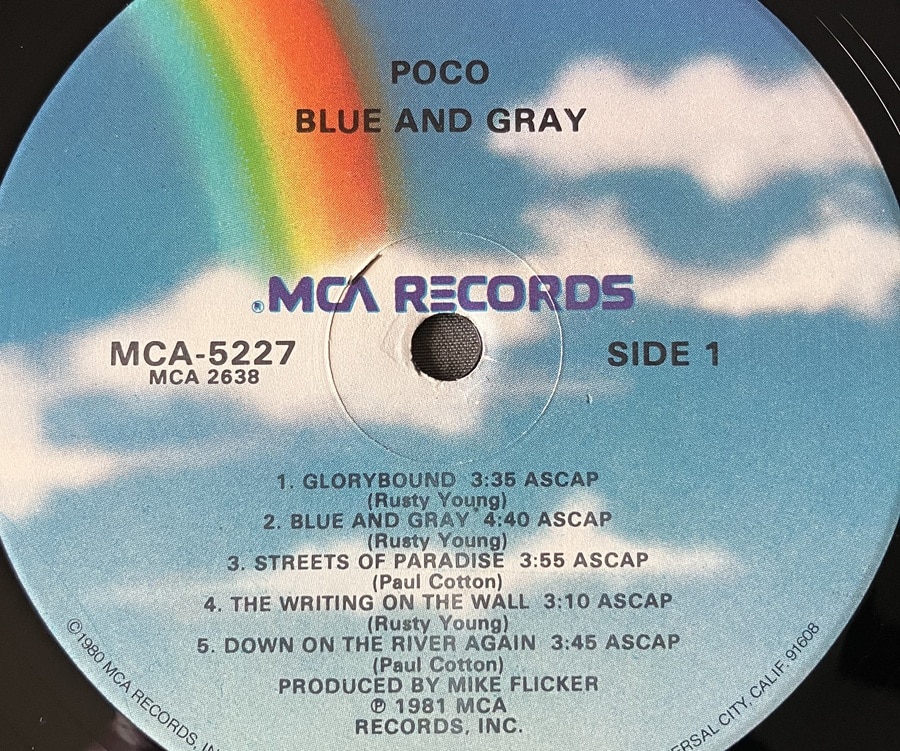
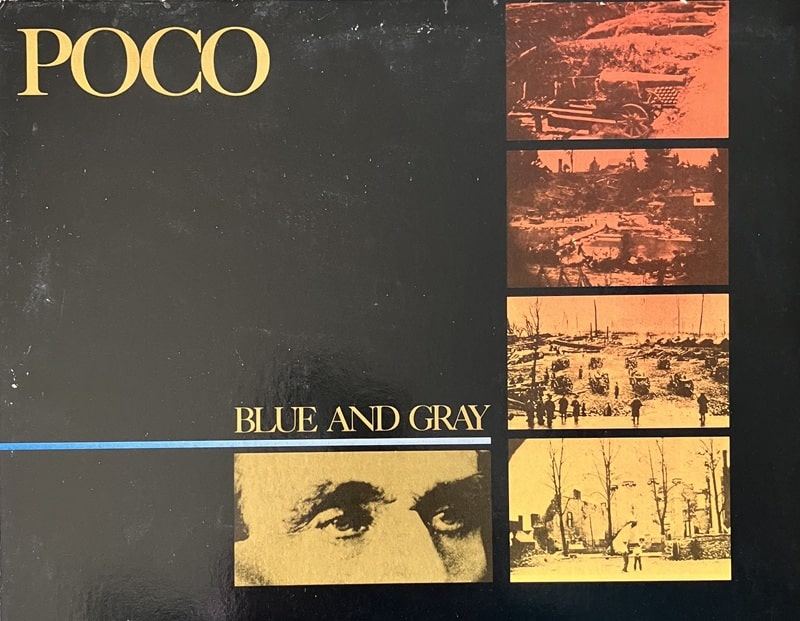
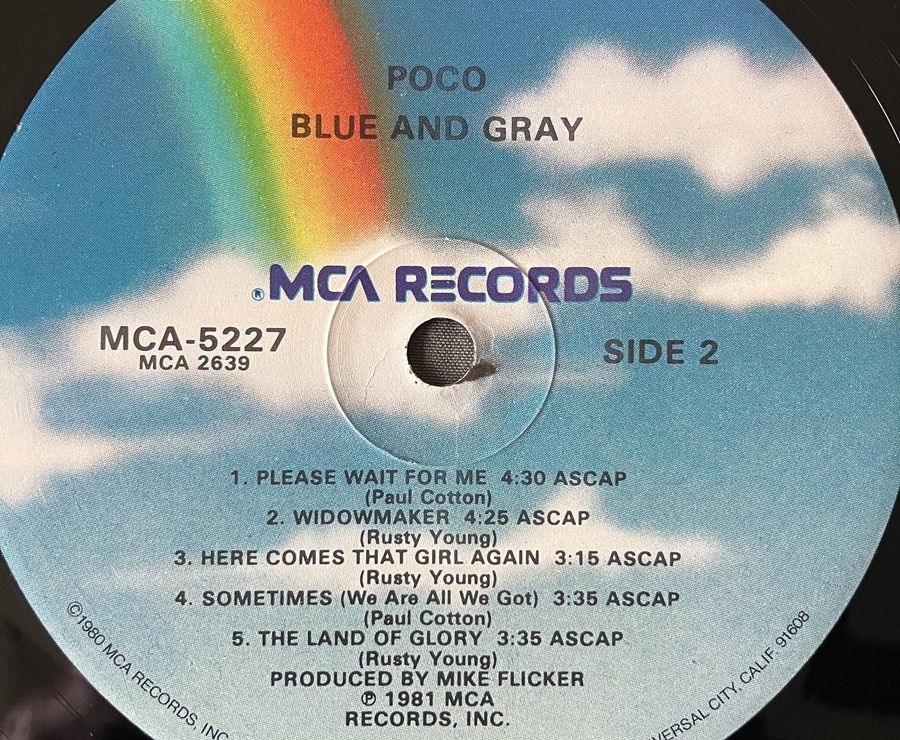
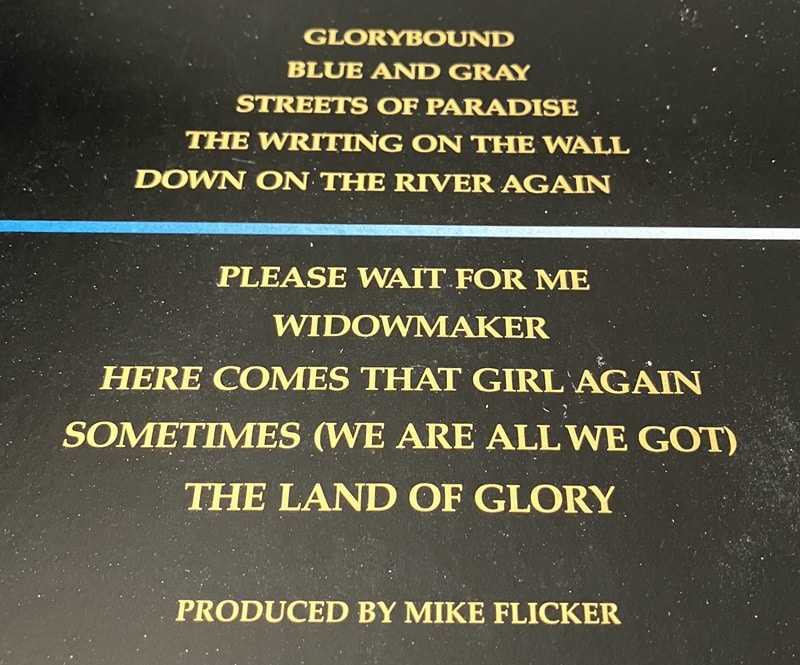
“Blue and Gray” was released in July 1981 on MCA Records. It was the band’s 13th studio album and its second for MCA. Composed entirely by Young and guitarist/vocalist Paul Cotton (who replaced Messina in 1970), the record’s 10 songs loosely form a chronological story built around the Civil War. Although the five images on the album cover (including the portion of Abraham Lincoln’s face) and a handful of the record’s song titles are a clear giveaway as to its concept — “Blue and Gray,” “Glorybound” and “Widowmaker,” for example — others are less obvious, including “Down on the River Again,” “Here Comes That Girl Again,” and “The Writing on the Wall.”
The Poco trademarks that highlight their best work are ever-present: spot-on vocal harmonies, plenty of acoustic and electric guitar fills, and of course a healthy dose of banjo, dobro and mandolin (country-rock staples) all infused with a sprinkling of not-so-heavy southern rock twang.
Unsurprisingly, the band is quick to address directly the grim realities of warfare, as in “Sometimes (We Are All We Got)” (told from the viewpoint of a Confederate soldier):
Sometimes we are all we got
This time I have not forgot
A boy of eighteen and Southern bred
His troops had left him there for dead
Laying up against a big oak tree
It had all come down to either him or me
Just one of those times
Two lives on the line
Is this the last thing I’ll ever see?[1]
The brutality of battle is even more explicit in the rock-oriented “Streets of Paradise:”
Walking around there was a wound in my head
For many long days I was left there for dead
So many miles from the borderline
Only half a man down on the streets tonight[2]
It’s not all gunpowder and lead. In fact, some of the album’s most memorable moments come when the band turns its attention to the conflict’s impact on personal relationships. For example, the romance that’s described in the plaintive ballad “Please Wait for Me:”
Just down the road
Some sixty miles away
There’s smoke in the sky
She’s going down in flames
Please wait for me
Please wait for me
Time will fly like a cannonball
My darlin’ you will see[3]
The relationships affected by soldiers preparing for war are also examined in the somber title track:
Flags flyin’ high
Bright polished brass that dazzles the eye
The hot crowded street
Is covered by feet kicking dust on the sky
She’s standing there
The sun in her hair, she’s wavin’ to me
We’re heroes today
I heard someone say tonight
Home’s where we’d be
The word comes down
The column winds its way from town
Goodbye sweet Anna Lee my love[4]
The album closes with “The Land of Glory,” a rousing, gospel-influenced number that provides a glimmer of hope for the future:
I keep searchin’ for the Land of Glory
One eye open and the other eye closed
Wash my troubles in the River Jordan
River’s deep and the water’s cold
Lord my burdens are too much to carry
And there’s never anywhere to rest
But I keep looking for that holy mountain
To lay my troubles and my sins confess[5]
Clocking in at just under 40 minutes, “Blue and Gray” is a quick listen, a relatively brief journey that musically brings to life the country’s internal struggle as it existed between 1861 and 1865.
“Blue and Gray” failed to capitalize on the success of the band’s pair of hit singles from three years prior. The album stalled at number 76 on the Billboard Top 200 album chart; the record’s lone single — “Widowmaker” — failed to hit the Hot 100 (although it did crack Billboard’s Mainstream Rock Chart).
For Poco, “Blue and Gray” may have simply been a case of “wrong place, wrong time.” Bruce Eder suggests as much in his review for AllMusic: “Talk about bad timing — had Rusty Young and Paul Cotton only brought this concept album out about nine years later, around the time of Ken Burns’ ‘The Civil War,’ it might well have sold a few hundred thousand copies, or at least generated a little press and gotten a shot at some sales. As it was, in 1981, no one really cared that much about a concept album built around the Civil War — or, at least not a country-rock concept album.”
The band recorded one more album for MCA before signing a two-record deal with Atlantic; neither “Ghost Town” (1982) nor “Inamorata” (1984) improved the group’s commercial fortunes. The original lineup — Furay, Grantham, Meisner, Messina and Young — reconvened for one last shot at glory in 1989 when it recorded “Legacy” for RCA Records. Although the album was certified gold and produced a pair of Top 40 hits (“Call It Love” and “Nothin’ to Hide”), the band called it quits shortly thereafter. Poco’s two-decade run had come to an end.
Time flies like a cannonball, as Paul Cotton suggests in his lyrics to “Please Wait for Me.” Years later, music fans and Civil War enthusiasts alike could do worse than revisiting this most unusual but highly worthwhile slice of Civil War-inspired country rock.
Keith Moore is a native New Englander with an advanced degree in literature from the University of Oklahoma. His short fiction has appeared in Bluestem Magazine, Ponder Review and The Raven Review; his writing has also been published in The Boston Globe and the Cape Cod Times.
Endnotes:
[1]Cotton, P. (1981). Sometimes (We Are All We Got). On Blue and Gray. MCA Records.
[2]Cotton, P. (1981). Streets of Paradise. On Blue and Gray. MCA Records
[3]Cotton, P. (1981). Please Wait for Me. On Blue and Gray. MCA Records.
[4]Young, R. (1981). Blue and Gray. On Blue and Gray. MCA Records.
[5]Young, R. (1981). The Land of Glory. On Blue and Gray. MCA Records.


Interesting. And very cool to boot! Poco will always be a great band in my most humble opinion. I got to see them a couple of times back in the day, but before they released this album. I do have this recording in my collection. I reckon I’ll have to dig it out, blow off the dust, and put it on the ol’ turntable. It’s been a long time. Thanks for this article!
I just listened to 2 songs off this album yesterday. About every 2 or 3 years I always do that. It’s a masterpiece of song writing that captures the sad reality of the ups and downs of warfare in that era. I am happy I have that album .I can appreciate it.
Now I need to go find a copy of this album!
Thank you for this. Wonder if Cotton and/or Young had Civil War relatives.