A Stone to Mark the Spot
ECW welcomes guest author Dean W. Chester.
Major General John Sedgwick woke at first light on May 9, 1864. He had slept on the ground, under a woolen blanket or two. His meeting with generals Grant and Meade the previous evening ended after midnight, so it was more nap than restful sleep.
He arose and began moving amongst his troops, issuing orders, checking positions, and encouraging them to be ready for the day’s fight. A little after 9:30 a.m. he observed soldiers ducking as sharpshooters’ bullets flew over them. He chastised the men, telling them repeatedly the sharpshooters “couldn’t hit an elephant at that distance.” Maybe not an elephant, but the next round struck a major general. Sedgwick died with his soldiers, a slight smile on his face.[1]
While the soldiers of Sedgwick’s VI Corps felt his loss and fondly remembered their dear “Uncle John,” the site of his death was largely forgotten until 1874, when retired Maj. Gen. Andrew A. Humphreys visited the Spotsylvania battlefield while researching his book on the Virginia campaigns of 1864 and 1865. Humphreys located and marked the spot of Sedgwick’s death with a large boulder.[2]
This “first marker” sat unattended for another ten years. On May 17, 1884, members of the historical party of the I Corps traveled to the battlefield. Led by Gen. William Rosecrans, the group included Gen. John C. Robinson, who was wounded on May 8 leading his division of Warren’s V Corps, and John B. Batchelder of the Gettysburg Battlefield Memorial Association. This group also identified the death site (it is unclear if it was the same spot) and “erected a stone to mark the spot until the ‘Sixth Corps [could] build a suitable Monument to their gallant commander.’”[3]
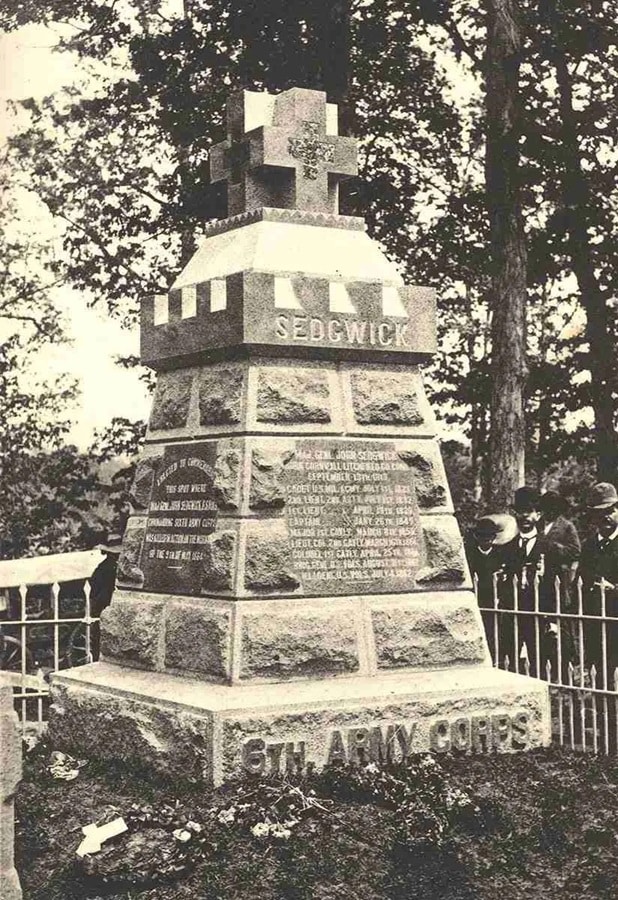
In October 1886 members of the Survivors of the Sixth Army Corps visited the battlefield and were frustrated by the absence of a marker for “Uncle John.” Based on their concerns, the Sedgwick Memorial Association was created in January 1887. The association decided to place “an inexpensive tablet” at the spot of Sedgwick’s death. [4] It authorized $2,000 to “purchase from the Alsop Farm a little less than an acre of ground, to erect a neat and appropriate stone tablet . . . and to enclose it with a suitable guard or railing.”[5]
News of this decision quickly spread beyond VI Corps veterans. and donations were received from other veteran groups. The 1st Veteran Reserve Corps announced their $25 donation in the Philadelphia Times on January 25, 1887.[6]
In February, the association issued another circular with specifics about the monument and plans for a dedication ceremony:
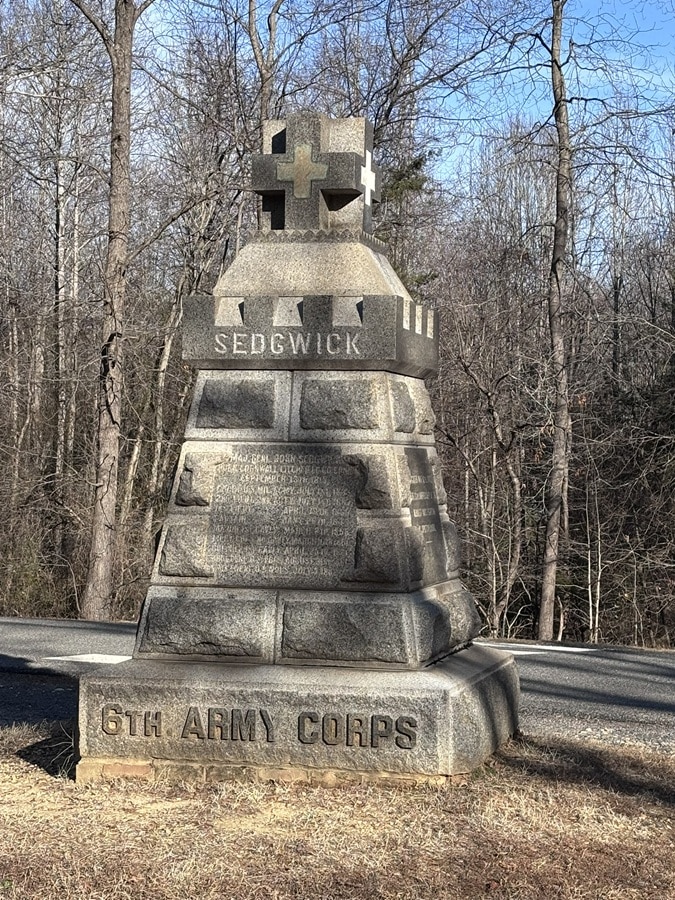
“The monument is of Quincy granite, 9 feet high, 5 feet 5 inches at base, with suitable inscriptions on each of the four sides … The entire work is now in the hands of the contractor and will be completed before May 1,1887.
The Association has purchased the acre of land from the Alsop Estate, which includes the spot where the General fell, and on which the tablet will be erected. [The Association] will shortly arrange for the dedicatory ceremonies for Thursday, May 12, 1887.”[7]
Recognizing the importance of local support, the association reached out to officials and businessmen in Fredericksburg, presenting their plan for the dedication ceremony and the opportunity it offered Fredericksburg and the communities of Spotsylvania County. The Free-Lance endorsed the event, implying 300 to 400 veterans would bring economic benefits to the city. At the very least the paper encouraged the communities to be hospitable and not let the visitors leave disappointed.[8]
To broaden awareness and increase donations, the circular was published in newspapers in states and cities that had provided regiments to the VI Corps.[9] Beginning in March, The National Tribune ran weekly updates on the monument and dedication ceremonies. Virginia papers also provided updates, all positive and supportive of the monument and ceremony.[10] By April 29 the mayor and city council had received and accepted their invitations to participate in the ceremony.
The original estimate of 300-400 attendees turned out to be just one group traveling from Philadelphia. Now the association and Fredericksburg officials were preparing for an “immense crowd.”[11] The material for the monument, 24, 000 pounds of granite stone and timber, was delivered to the Alsop Farm, and two local tradesmen were awarded contracts to lay the foundation and assemble the monument.[12] The citizens of Fredericksburg, demonstrating their support for the event, donated $500 towards entertainment for the veterans and out-of-town visitors.[13]
The train carrying 368 VI Corps veterans departed Philadelphia early on May 11, arriving in Fredericksburg about midday. The veterans visited the battle sites in the city and that night attended a fellowship and remembrance campfire. [14] A letter from Virginia’s Governor Fitzhugh Lee was read by the firelight.[15]
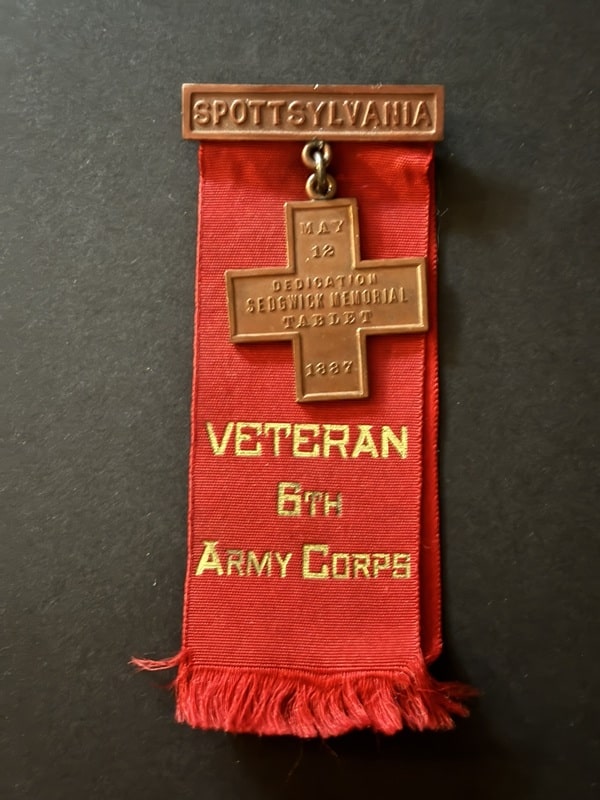
On May 12, the attendees traveled the 13 miles from Fredericksburg to the battlefield by horse, carriage, and wagon. The enormous crowd, estimated to be about 2,500, was composed of 1,000 VI Corps veterans, other veterans from the Army of the Potomac, invited guests, and locals, including many Confederate veterans.[16] Attendees received a handsome badge; a VI Corps Greek Cross “in bronze, hanging from a scroll inscribed ‘Spottsylvania, May 12th—Sedgwick Memorial Dedication, 1887—and rested upon a red ribbon…’ The ribbon was marked ‘Veteran Sixth Army Corps’ in gold.” The guest badge ribbon was unmarked.[17]
The president of the association, Maj. Gen. Horatio Wright, opened the ceremony reading a letter from President Grover Cleveland, who invited the VI Corps veterans to the White House the afternoon of May 13.[18] Speakers regaled the crowd with their recollections of Sedgwick. Others read letters of regret including one from Lt. Gen. Phil Sheridan—he was attending the May 12 monument dedication ceremony for the late president and former general, James A. Garfield, in Washington D.C..[19] The attendees returned to Fredericksburg for a banquet, followed by a second campfire hosted by Confederate veterans.[20]
On May 13, the train departed Fredericksburg, stopping in Washington where the veterans were escorted to the White House and greeted by President Cleveland. The veterans expressed their appreciation to the president by presenting him with his own dedication ceremony badge. Then Cleveland personally thanked and shook hands with each veteran as they left the East Room of the White House.[21] The group boarded the train to Philadelphia and then dispersed to their homes around the country.
During the 125 days from the decision to erect the monument to its dedication, the Sedgwick Monument Association worked hand in glove with two critically important people, Mayor Josiah Hazard and Mr. R. B. Merchant, editor of the Fredericksburg Free Star. Both were Confederate veterans, and Merchant was also the president of the Chancellorsville Stonewall Jackson Monument Association,[22] which had donated funds to the Sedgwick Monument. There was a kindred spirit between the two associations, and $75.00 was donated to the Jackson Association on May 12 for its monument.[23] Unfortunately, there was no VI Corps official representation at the Jackson Monument dedication on June 13, 1888, because the VI Corps survivors were dedicating monuments to four regiments at Gettysburg that same day.[24]
Dean W, Chester is a descendent of soldiers who saw service in the Western, Eastern, and Trans-Mississippi Theaters. He supports battlefield preservation and education through local and national trusts and foundations. Mr. Chester lives in Northern Virginia.
Endnotes:
[1] Chris Mackowski, A Tempest of Iron and Lead Spotsylvania Court House, May 8-21, 1864 (El Dorado Hills, CA: Savas Beatie, 2024), 60-65.
[2] Sedgwick Memorial Association Program (hereafter SMAP), Sedgwick Memorial Association Program, Dunlap & Clarke Printers, 819 & 821 Filbert St., Philadelphia, PA, 1887, p 5.
[3] “John Sedgwick Memorial,” Brooklyn Eagle, May 18, 1884.
[4] SMAP p 106
[5] Ibid
[6] “National Guard Notes,” Philadelphia Times, January 23, 1887.
[7] SMAP p 108
[8] “The Sedgwick Monument,” The Free-Lance, March 4, 1887.
[9] “Monument for General Sedgwick,” The York Dispatch, March 26, 1887; “A Sedgwick Monument,” The Pittsburgh Commercial Gazette (Pittsburgh Post-Gazette), March 30, 1887.
[10] “The Sedgwick Monument,” The News and Advance, Lynchburg, VA, March 27, 1887.
[11] “Invitation Received,” The Free-Lance, April 15, 1887; “Local News: Council Proceedings,” The Free-Lance, April 19, 1887.
[12] “The Sedgwick Monument,” The Free-Lance, April 22, 1887; “Spotsylvania Courthouse Items,” The Free-Lance, April 26, 1887; “Contract Awarded.” The Free-Lance, April 29, 1887.
[13] “The Sedgwick Monument,” The National Tribune, Washington DC, March 24, 1887.
[14] “Virginia Affairs,” The Baltimore Sun, May 12, 1887.
[15] “Sedgwick’s Men,” The Richmond Dispatch, May 12, 1887.
[16] “The Sedwick Monument,” The Philadelphia Times, May 13, 1887.
[17] SMAP p 101
[18] “Where He Fell,” The Richmond Dispatch, May 13, 1887.
[19] SMAP, p 64.
[20] “The Sedwick Monument” The Philadelphia Times, May 13, 1887.
[21] SMAP, p 64.
[22] “The Sedgwick Monument,” The National Tribune, Washington DC, March 31, 1887.
[23] “Where He Fell,” The Richmond Dispatch, May 13, 1887.
[24] “General Shaler’s Brigade,” The Philadelphia Inquirer, June 13, 1888.


I can’t believe I haven’t visited this when I’m in town for the Symposium! I’ll need to fix that this August.
Very interesting and detailed article
Wonderful tribute to Uncle John! Remember the old Sixth Corps!!