Remember Fort Pillow!: A Precedent and Retaliations – Part II
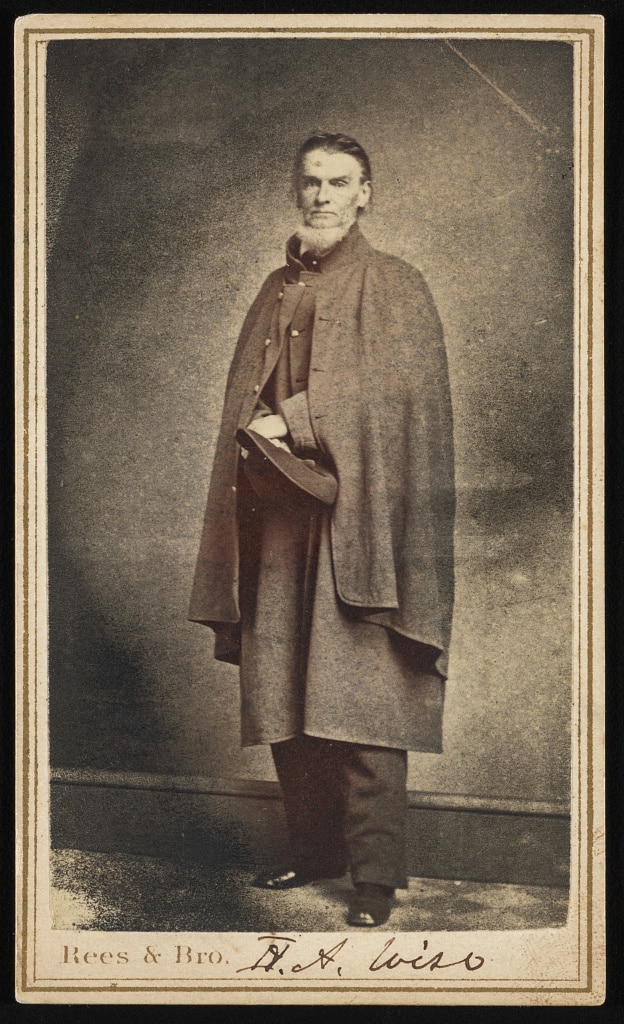
Confederate Gen. Henry Wise apparently knew the motivation that Fort Pillow provided Black soldiers. In a letter to his wife at the end of June he wrote, “The negro soldiers are no doubt incited to give no quarter from the fury with which they are excited by the enemy’s accounts of Fort Pillow.” Pvt. Lorraine Walker Griffin of the 16th North Carolina noted in a letter home the rising stakes that the Fort Pillow example set in motion: “We certainly will show them & their white officers no quarter.”[1] To most Confederates, who did not recognize USCTs as legitimate combatants, but rather as enslaved insurrectionaries—although many were free men of color—this was the proper and traditional way of putting down slave revolts, as had happened with Gabriel’s Rebellion near Richmond in 1800, and more recently with Nat Turner’s Rebellion in Southampton County in 1831.[2]
A reckoning for Fort Pillow also animated USCTs in other departments. In a letter to William Lloyd Garrison’s abolitionist Boston newspaper The Liberator, a Black soldier in the 55th Massachusetts wrote about his unit’s fight on James Island, South Carolina, that occurred in early July 1864. He wrote: “Could you have been on the battle-field on the morning of July [2nd], and seen them under a shower of shot and shell deploy into line of battle when it seemed as though the day was lost by the giving way of two regiments – (one white, and the other colored, both running back discomforted) – I say, could you have seen the old 55th rush in, with the shout of ‘Remember Fort Pillow!’ you would have thought that nothing human could have withstood their impetuosity. We know no defeat.”[3]
On July 30, back at Petersburg during the Battle of the Crater, according to Lt. James Steele of the 43rd USCI, some of his soldiers tried to kill Confederate prisoners. He stated that “there was a half determination on the part of a good many of the black soldiers to kill them as fast as they came to them. They were thinking Fort Pillow, and small blame to them.” Lt. Steele penned that he had to climb over some of the earthworks to jump in and “save them from the group of men in my own company, who in two minutes would have bayoneted the last poor devil of them.” He thought, “It was a queer place for an argument,” but his men contended that “they would kill us, and had killed us wherever they could find us, and we were going to change the game.” Steele instructed the prisoners to immediately go to the rear.[4]
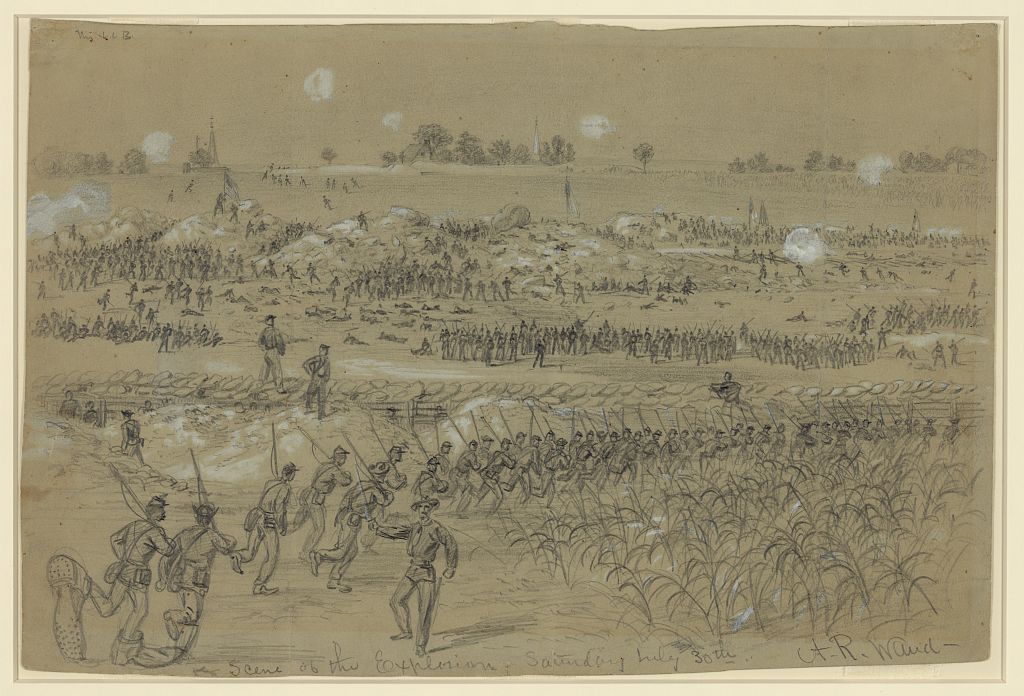
When the Black troops in the Fourth Division of the Ninth Corps went into the battle of the Crater, soldiers on both sides remembered them yelling “Remember Fort Pillow,” and “No quarter to the Rebels,” during fierce maelstrom that raged around them. However, as their part in the attack stalled out, and as the Confederates gained the upper hand in fierce counter attacks by Gen. William Mahone’s brigades, the Confederates reversed the cry of “No quarter” to inflict brutal acts on many of the Black troops, including on some of the wounded. Pvt. George S. Bernard of the 12th Virginia Infantry wrote in his diary the following day that “Yesterday [I] witnessed a bloody drama around Petersburg, perhaps as bloody as any affair of the war, Fort Pillow not excepted.” Later in the entry, Bernard gave a hint of the sights: “The scene now baffles description. But little quarter was shown them. My heart sickened at deeds I saw done. Our brigade [Col. David Weisiger’s] not driving the enemy from the inner portions of the exploded mine, [Gen. John C. C.] Saunders & [Gen. Ambrose] Wright’s brigades finished the work. I have never seen such slaughter in any battlefield.”[5]
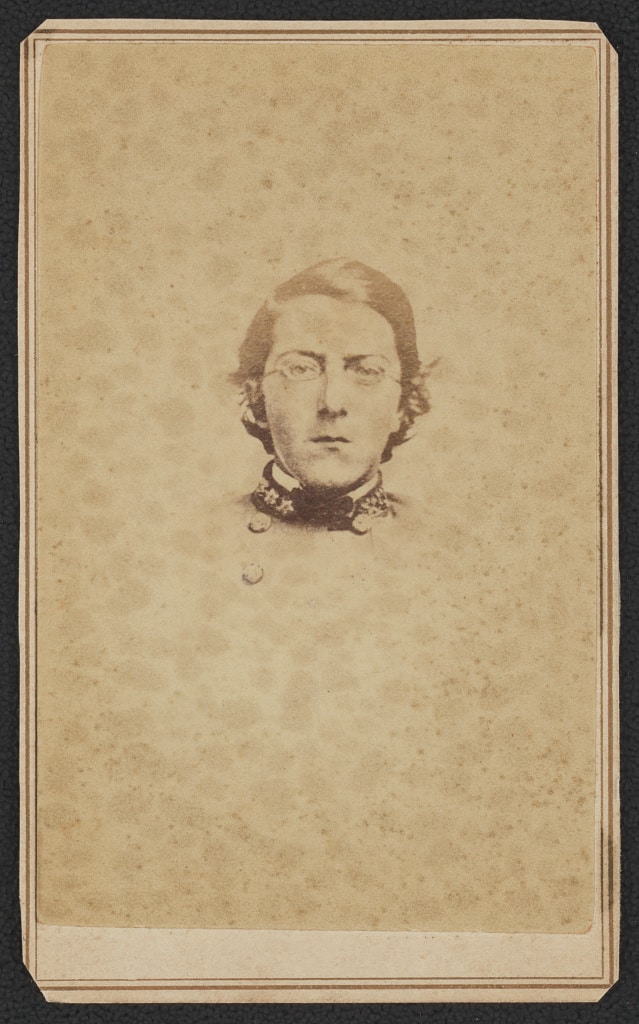
Many Confederates commented on the fierce fighting and tragic ending at the Crater. Noted Army of Northern Virginia artillerist Lt. Col. William “Willie” R. J. Pegram wrote his sister two days after the battle. In his missive, he explained, “Every bomb proof I saw, had one or two dead negroes in it, who had skulked out of the fight, & been found & killed by our men. This was perfectly right, as a matter of policy. I think over two hundred negroes got into our lines, by surrendering & running in, along with the whites, while the fighting was going on. I don’t believe that much over half of these ever reached the rear. You could see them lying dead all along the route to the rear.” Pegram noted one incident he witnessed: “While there was a temporary lull in the fighting, after we had recaptured the first portion of the line, & before we recaptured the second, I was down there, & saw a fight between a negro & one of our men in the trench. I suppose that the Confederate told the negro he was going to kill him, after he had surrendered. This made the negro desperate, & he grabbed up a musket, & they fought quite desperately for a little while with bayonets, until a bystander shot the negro dead.” Pegram summed up his thoughts by writing, “It seems cruel to murder them in cold blood, but I think the men who did it had very good cause for doing so.”[6]
Immediately following the Battle of the Crater, the Richmond Enquirer invoked Fort Pillow’s legacy and even castigated Gen. Mahone for stopping the slaughter. “Grant’s war cry of ‘No Quarter,’ shouted by his negro soldiers, was returned with interest, we regret to hear not so heavily as it ought to have been, since some negroes were captured instead of being shot. Let every salient we are called upon to defend be a Fort Pillow, and butcher every negro that Grant hurls against our brave troops, and permit them not to soil their hands with the capture of one negro,” the newspaper implored.[7]
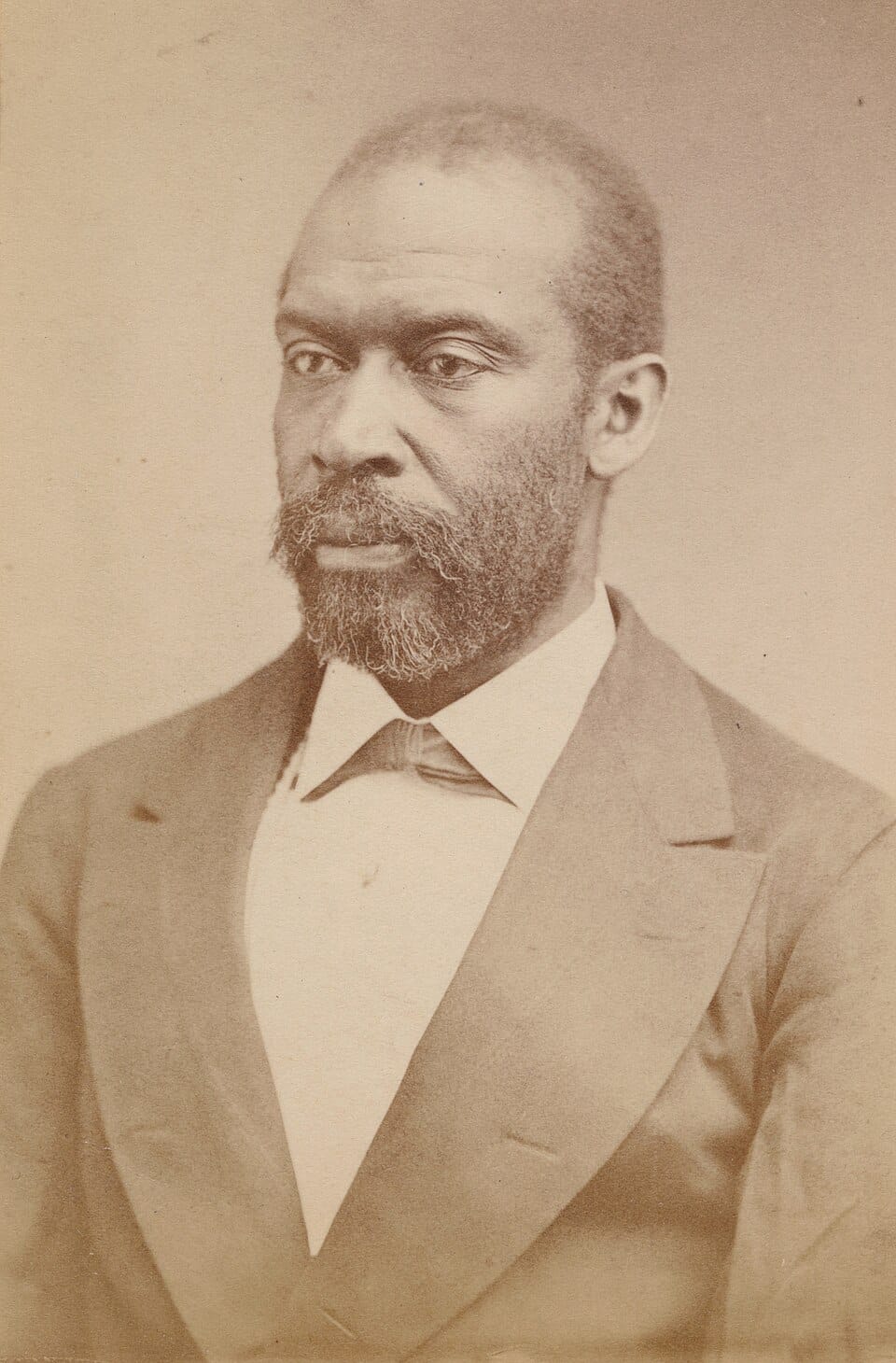
Writing from Petersburg in August 1864 for the Philadelphia Press newspaper, Black correspondent Thomas Morris Chester explained the continued deteriorating situation between USCTs and the Confederates: “Between the negroes and the enemy it is war to the death. The colored troops have cheerfully accepted the conditions of the Confederate Government, that between them no quarter is to be shown. Those here have not the least idea of living after they fall into the hands of the enemy, and the rebels act very much as if they entertained similar sentiments with reference to the blacks.”[8]
To help motivate and encourage the African American soldiers of Gen. Charles J. Paine’s division before the desperate fight at the Battle of New Market Heights, on September 29, 1864, Maj. Gen. Benjamin Franklin Butler implored the men to “Remember Fort Pillow!” In his memoirs, published in 1892, Butler claimed his words to them were: “At half past four o’clock I found the colored division, rising three thousand men, occupying a plain which shelved toward the [James] river, so that they were not observed by the enemy . . . . They were formed in close column of division right in front. I rode through the division, addressed a few words of encouragement and confidence to the troops. I told them to go over and take a work which would be before them after they got over the hill, and that they must take it all hazards, and that when they went over the parapet into it their war cry should be ‘Remember Fort Pillow!'”[9]
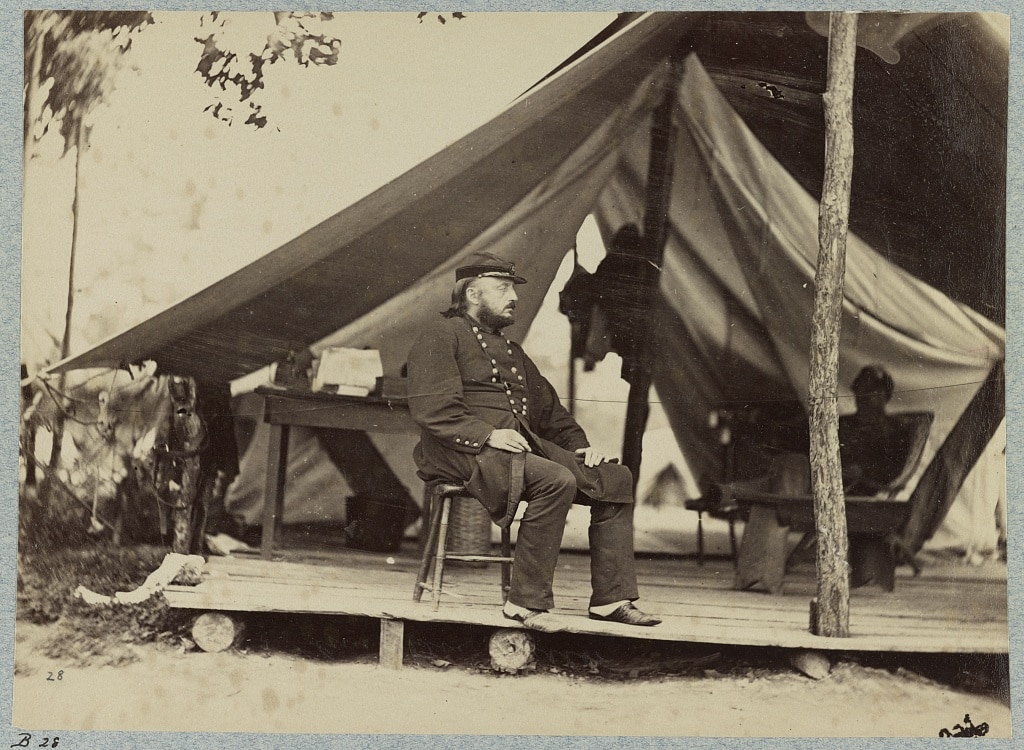
Despite the many tactical advantages that the Confederates had at New Market Heights—earthworks, two lines of abatis, artillery on each flank, and an advantage in numbers at the point of the attacks—the USCTs displayed conspicious courage in their assaults, earning 16 Medals of Honor.[10]
The Southerners, after shattering the attack by Col. Samuel Duncan’s Brigade (4th and 6th USCIs), and just before the next attack wave by Col. Alonzo Draper’s Brigade (5th, 36th, and 38th USCIs), came over the earthworks and killed and robbed some of the wounded Black soldiers. One 6th USCI soldier, Pvt. Benjamin Davis, somehow worked his way into the defender’s earthworks, but was soon captured and killed. The Rebels also took equipment, uniform parts, and especially rifles from the USCT dead and wounded in front of the earthworks, which they used against Draper’s attackers.[11]
The attack by Draper’s three regiment brigade stalled at the abatis. A soldier in the 1st Texas Infantry, Thomas L. McCarty, wrote in his diary, “[A]s they came up they shouted remember ‘Fort Pillow’ & give the Rebels no quarter. This stirred up our men and everybody seemed mad for the first time, & some of the boys on the left jumped over the works, and formed across their flanks line and enfiladed them.” To shorten the attack’s pause, the USCT officers and non-commissioned officers were able to get up a shout that undoubtedly included Remember Fort Pillow! Gaining their momentum again, the resurgent attack powered the Black soldiers over the works, pushing out the defenders.[12]
Lt. Joseph Scoggs of the 5th USCI noted in his diary that day that “The Color bearer was killed on one side of me and my orderly Sergt. wounded on the other, [another] two of my Sergts. killed and my company seemingly annihilated, yet on we went . . . over their works like a whirlwind. The rebels retreated rapidly and we secured but few prisoners.”[13] With the previous precedent set of “No Quarter,” and knowing that the Confederates had killed some of their wounded comrades in the earlier attack, it is not surprising the Southerners made a quick and determined getaway.
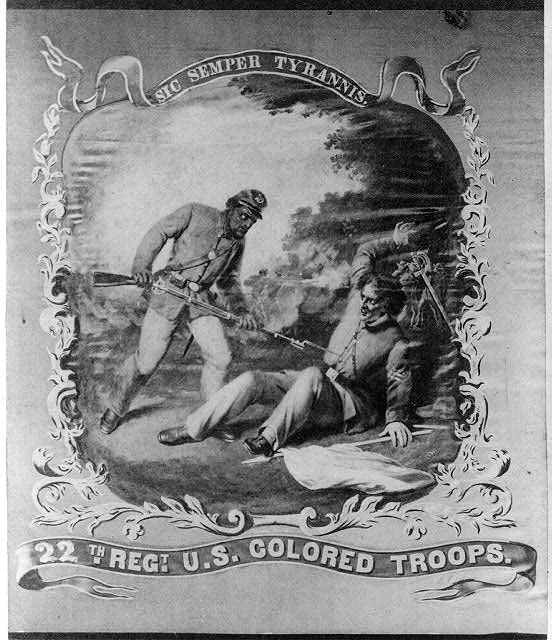
Shouts of “Remember Fort Pillow!” continued to ring from the throats of USCTs virtually wherever they fought—Fort Gilmer, Saltville, Nashville, Honey Hill, Jenkins Ferry, Fort Fisher, Fort Blakely, and others—serving as motivation to see the fight to its end despite the prejudice and many dangers they faced.
Although others preceded it, the violent atrocities committed at Fort Pillow set a deadly precedent that wrought reckonings on battlefields and byroads through the end of the war. Sadly, as it does too often, violence begets violence. Charles Francis Adams, Jr. then serving in the 1st Massachusetts Cavalry, wrote to his father in June 1864: “All admit, however, that the [USCTs] fought ferociously, and, as usual, the cruelty of Fort Pillow is reacting on the rebels, for now they dread [them] more than the white troops; for they know that if they will fight the rebels cannot expect quarter. . . . If they murder prisoners, as I hear they did, it is to be lamented and stopped, but they can hardly be blamed.”[14]
[1] A. Wilson Greene, A Campaign of Giants: The Battle for Petersburg, Volume 1, From the Crossing of the James to the Crater, University of North Carolina Press, 2018, 395-396.
[2] Kevin M. Levin, Remembering the Battle of the Crater: War as Murder, University Press of Kentucky, 2012, 25-26.
[3] Edwin S. Redkey, ed. A Grand Army of Black Men, 68.
[4] H. Seymour Hall, “Mine Run to Petersburg,” in War Talks in Kansas, Franklin Hudson Publishing Co., 1906, 238-239.
[5] Hampton Newsome, John Horn, and John G. Selby, eds., Civil War Talks: Further Reminiscences of George S. Bernard and His Fellow Veterans, University of Virginia Press, 2012, 250-251.
[6] James I. Robertson, Jr., “The Boy Artillerist’: Letters of Colonel William Pegram, C.S.A.,” in The Virginia Magazine of History and Biography, Vol. 98, No. 2 (April 1990): 242–245.
[7] Richmond Enquirer, August 2, 1864.
[8] R. J. M. Blackett, ed., Thomas Morris Chester: Black Civil War Correspondent, His Dispatches from the Virginia Front, Louisiana State University Press, 1989, 109-110.
[9] Butler’s Book: Autobiography and Personal Reminiscences of Maj. Gen. Benjamin F. Butler, A. M. Thayer and Company, 1892, 731.
[10] At New Market Heights, 14 Black enlisted men and non-commissioned officers, and 2 white officers received Medals of Honor.
[11] Southbridge Journal (Massachusetts), October 14, 1864; Pvt. Benjamin Davis pension file, NARA.
[12] James S. Price, The Battle of New Market Heights: Freedom Will Be Theirs By The Sword, The History Press, 2011, 71-76.
[13] Larry Leigh, ed. J. J. Scroggs’ Diary and Letters, 1852-1865, self-published, 1996, 368.
[14] Worthington Chauncy Ford, ed. A Cycle of Adams Letters, 1861-1865, Vol. II, Houghton Mifflin Company, 1920, 154.


Tim, a disturbing but wonderfully researched article showing how action leads to reaction (retaliation).
You mention in part one pre-Ft. Pillow atrocities against African American soldiers in Louisiana. In that regard, in a June 13, 1863 message from Lt. Gen. E. Kirby Smith to Maj. Gen. Richard Taylor (Commanding District of Louisiana), Smith writes that he has been “unofficially informed” that some of Taylor’s troops have captured “negroes in arms.” Smith states that “I hope this may not be so, and that your subordinates who may have been in command of capturing parties may have recognized the proprietary of giving no quarter to armed negroes and their officers.” OR Series II, vol 6, 21-22. That is about as plain a statement of official and high-level policy as one can find.
Kevin, Yes, Kirby Smith’s recommendation is used quite a bit by scholars and is indeed a powerful statement of position.
Thanks, Tim, for the descriptive and thought-provoking piece.