Who Will Go?: Jefferson Buford and the Recruitment of Alabama Emigrants to Oppose Free State Settlement of Kansas – Part I
 The two-line column header read: “To Kansas Emigrants!!! WHO WILL GO TO KANSAS?” Placed by Maj. Jefferson Buford, a Eufaula, Alabama, attorney and former Second Creek War veteran in the November 27, 1855, edition of his town’s Spirit of the South, a newspaper with the motto, “Equality in the Union—Independence out of it,” Buford offered generous incentives in effort to recruit pro-slavery emigrants to Kansas. After all, much was at stake in whether the territory would eventually become a free state or a slave state.[1]
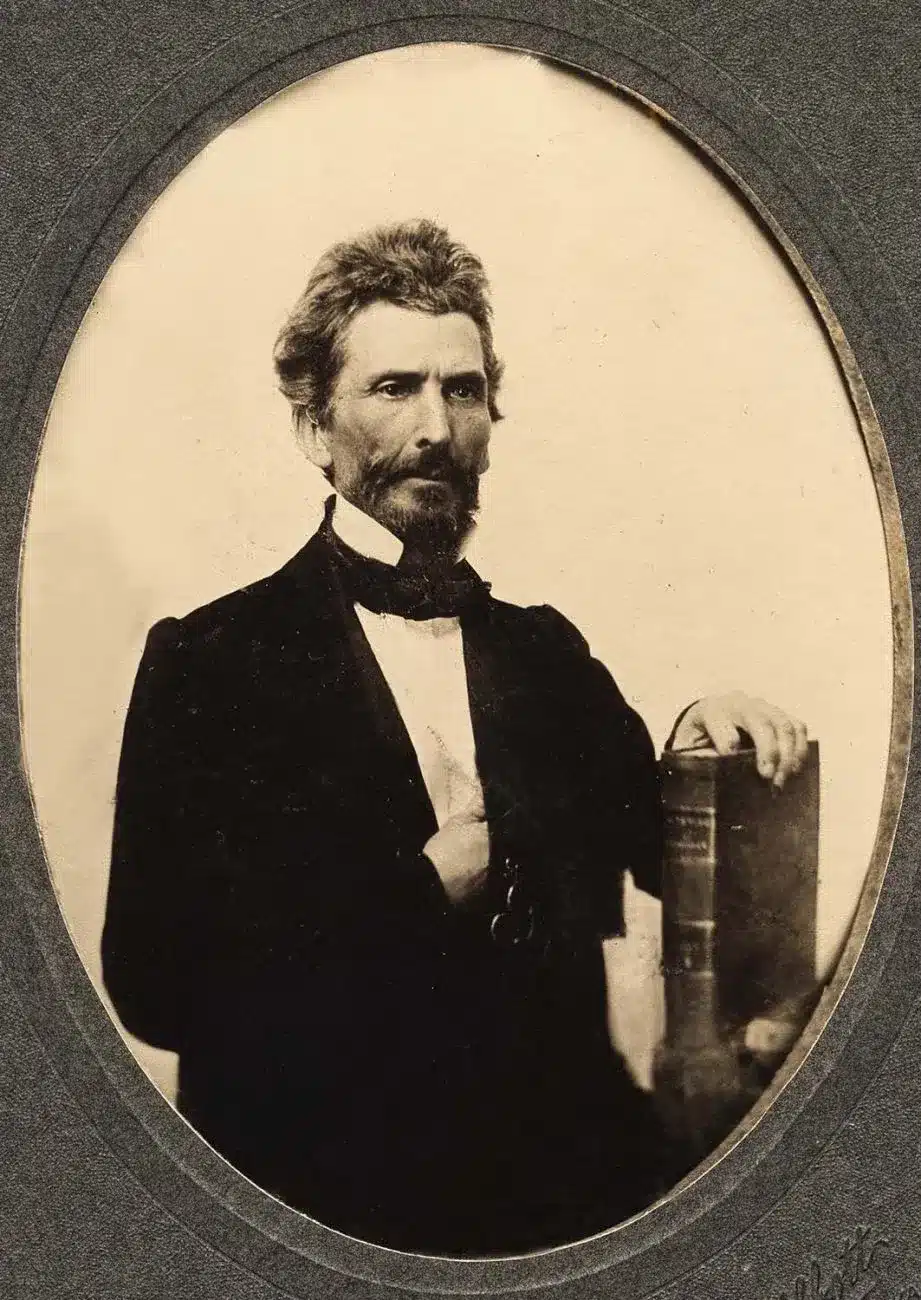
A steady stream of migration into Kansas began not long after Illinois Senator Stephen A. Douglas was able to get his Kansas-Nebraska Act passed the previous year. The act repealed the earlier three-decade-old Missouri Compromise settlement and established the practice of “popular sovereignty.” Popular sovereignty was the idea that a territory itself would decide to be free or allow slavery. With the theory of popular sovereignty decided, the practical practice soon opened a can full of wriggling worms with far reaching implications. Organizations such as the New England Emigrant Aid Company, and individuals such a Buford, soon began their recruiting efforts in attempt to ensure Kansas ended up in their desired camp.[2]
Indeed, in the same newspaper edition in which Buford made his call, another story from St. Louis, claimed “Kansas Filling Up.” The story said that settlers from both the slave states and the free states were constantly arriving. It specifically mentioned a ten-wagon train from Virginia bringing both Black and white occupants, and boats bringing folks from “Ohio, Pennsylvania, Indiana and Illinois. . . .” The concluding paragraph explained: “Kansas is rapidly filling up, notwithstanding the deplorable condition that has for so long a time retarded her progress.” The author estimated that “The population of the Territory will be nearly doubled by the accession this fall, and the Territory will soon make a strike for Statehood. We wish her success. She has been a hobby long enough, and it is time that she should be controlled by prudent and sober citizens, who have the whole interest of the Territory at heart.” The article left unsaid which side was hoped to ultimately control Kansas.[3]
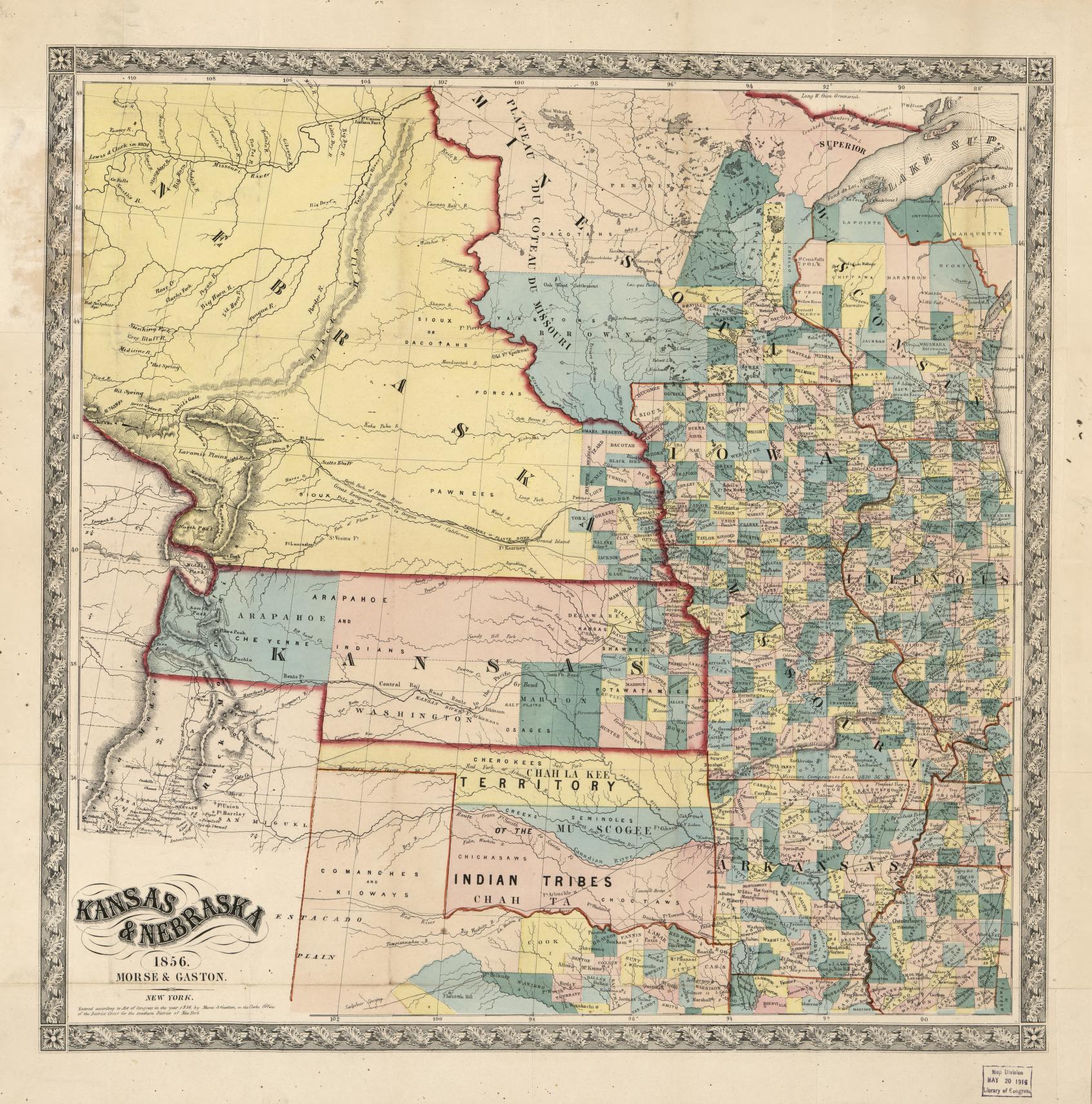
Buford, who was born in 1807, appears in the 1850 U.S. census as a 43-year-old lawyer, who was born in South Carolina. His household included his wife, Mary, who was Buford’s junior by 13 years, and their children. Buford owned $3,500 in real estate and 26 enslaved men, women, and children.[4]
In his November 27, 1855, notice he sought “300 industrious, sober, discreet, reliable men, capable of bearing arms; not prone to use them wickedly, or unnecessarily, but willing to protect their section in every real emergency.” He hoped to head to Kansas on February 20, 1856.[5]
As recruiting incentives, Buford liberally offered “a homestead of forty acres of first rate land, a free passage to Kansas, and the means of support for the first year.” For “Ministers of the Gospel, Mechanics, and those with good military or agricultural outfits,” Buford offered “greater inducements.”[6]
Pledging $20,000 himself toward the venture, Buford hoped that “all those who know and have confidence in me, and who feel an interest in the cause,” would “contribute as much as they are able.” To anyone who pledged $50.00 Buford promised he would bring one settler to Kansas, “able and willing to vote, and fight if need be for our section,” and if he could not deliver on that promise, he would refund the donation including interest.[7]
“Here is your cheapest and surest chance to do something for Kansas,” Buford explained. Prophesying Confederate calls to arms six years later that would ring for waging a civil war, Buford added the need to do “something toward holding against freesoil hordes that great Thermopylae of Southern institutions—in this their day of darkness—nay extreme peril, there ought to be—there needs to be great individual self sacrifice or they cannot be maintained.”[8]
The Spirit of the South heartily endorsed Buford’s Kansas plan. “It will soon be determined whether that immense territory is to furnish another stronghold for the abolitionist hordes of the east,—another resting place for the machinery which is unceasingly at work for your destruction, or whether it shall be a bulwark to your institutions, giving strength and permanence to your system of civilization, and furnishing new guaranties, for the safety and power of your children and your children’s children,” the editor declared.[9]
Among the Alabama newspaper’s pages, an advertisement appeared for a runaway enslaved man named Harkless, offering a $25.00 reward. Another ad sought to promote an estate sale looking to sell “100 Likely Negroes.” Others included notices for land and plantations for sale; one with “twelve framed negro houses.” These everyday ads subtly endorsed Buford’s appeal and emphasized the importance of slavery to Barbour County and the region’s economy, culture, and society.[10]
Buford placed another notice in the December 4 issue of the Spirit of the South. This one increased his land offer: “I will give eighty instead of forty acres as heretofore offered,” Buford claimed. Explaining further, “that is to say I will take the emigrant to Kansas free of charge and pay the Government $200 for his pre-emption of 160 acres—he giving me one half of his quarter section, and providing for himself after getting to Kansas.” This edition also offered an endorsement from an unnamed sponsor pledging financial support, and noting that “Kansas is to be the great battle-field of Southern Rights, a[n]d he who fails to perceive this great fact is willfully blind or unpardonably ignorant.”[11]
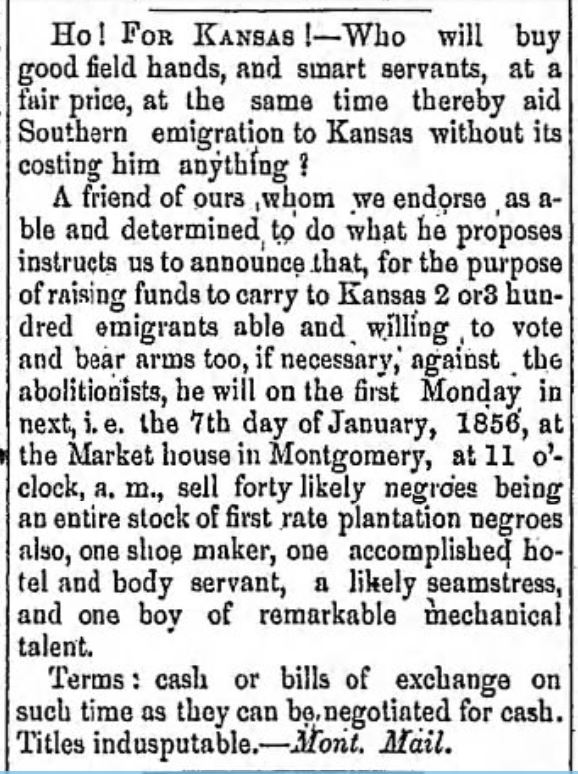
Another notice that appeared in the December 4 Spirit of the South was one that did not specifically name Buford but clearly implied his association in its description. It stated that the individual, “for the purpose of raising funds to carry to Kansas 2 or 3 hundred emigrants able and willing to vote and bear arms too, if necessary, against the abolitionists . . . will on the first Monday next, i.e. the 7th day of January, 1856, at the market house in Montgomery . . . sell forty likely negroes being an entire stock of first rate plantation negroes also, one shoe maker, one accomplished ho[s]t[ler] and body servant, a likely seamstress, and one boy of remarkable mechanical talent.” Similar ads for this specific sale of forty people ran in the December 19 and 26 issues of Montgomery Advertiser.[12]
Buford was not the only one planning to populate Kansas with southerners. In the December 11, 1855, edition of the Spirit of the South, a short notice ran that was copied from the Savannah Georgian describing an effort similar to Buford’s, this one led by Capt. Charles A. Hamilton of Adairsville, Georgia. Under the heading “HELP FOR KANSAS,” it stated that “Capt. Hamilton’s proposition is to remove to Kansas himself, with his family and part of his servants, and 100 Emigrants from Georgia, provided $24,000 will be contributed to the object by the citizens of the state—which will be about $230 to each member of the Emigrant party.” Like Buford, Hamilton and his party would eventually make their way to Kansas.[13]
As Buford neared his initially planned day to head west, reporting on Kansas increased in the newspaper. In the January 22, 1856, Spirit of the South, an article titled “Kansas” noted even more of these additional efforts to recruit southern emigrants. “Of late there has been a most unmistakable stirring of the waters, and the South begins to move like the strong man in his sleep,” the story explained. The paper claimed that the mail had brought news of men from Virginia, Tennessee, South Carolina, Georgia, and Mississippi who were “buckling on their armor for the struggle that is to give Kansas to the South, or surrender her to the vagabond creatures of the Emigrant Aid Societies of Massachusetts.”[14]
[1] Eufaula, Alabama, Spirit of the South, November 27, 1855.
[2] Nicole Etcheson, Bleeding Kansas: Contested Liberty in the Civil War Era (Lawrence, KS, 2004), 9-17.
[3] Spirit of the South, November 27, 1855.
[4] 1850 US Census, accessed via Ancestry.com, March 1, 2026.
[5] Spirit of the South, November 27, 1855.
[6] Ibid.
[7] Ibid.
[8] Ibid.
[9] Ibid.
[10] Ibid.
[11] Spirit of the South, December 4, 1855.
[12] Ibid; Montgomery Advertiser, December 19 and 26, 1855.
[13] Spirit of the South, December 11, 1855. Hamilton would actually remain in Kansas longer than Buford. Hamilton and some of his men were involved in the May 19, 1858, Marais de Cygnes massacre in which five free-state settlers were killed and five wounded in a firing squad-style shooting.
[14] Spirit of the South, January 22, 1856; Etcheson, Bleeding Kansas, 192-195.


In February 2026 we were asked, “What is your favourite type of ECW content?”
For me, THIS is it: delving into an element of the Civil War [including precursors of the Civil War] and “filling in the blanks,” extending knowledge of aspects previously taken for granted through facts backed up by references.
Tim Talbott reveals several under-appreciated elements of the Bloody Kansas contest: the sponsorship of Southerners to “flood the zone” in Kansas Territory; the motto of Buford’s newspaper, “Spirit of the South” [ Equality in the Union—Independence out of it.] And Jefferson Buford adds his number to the “emigrees from South Carolina” who settled in places like Florida and Alabama and agitated for perpetuation of their favourite institution.
The rising horror of citizens residing north of the Mason-Dixon Line during the 1850s, waking up to what was coming, becomes palpable.
Well Done Tim Talbott!
Thank you for the encouraging comment. I’m glad you found the article helpful.