Favorite Passages from Bierce’s “What I Saw of Shiloh”
There is perhaps no finer Civil War battle account than Ambrose Bierce’s “What I Saw of Shiloh.” The story works as good literature and as an account of the battle. The accounts left in The National Tribune and Confederate Veteran are valuable for understanding Shiloh, but often they are too short, lack literary quality, or are arguments over Don Carlos Buell’s contributions to the battle or whether P.G.T. Beauregard lost a golden opportunity. Those can be good reads and good history, but none I have read in those pages equals what Bierce did. To be fair, they were not written by one of the era’s best writers.

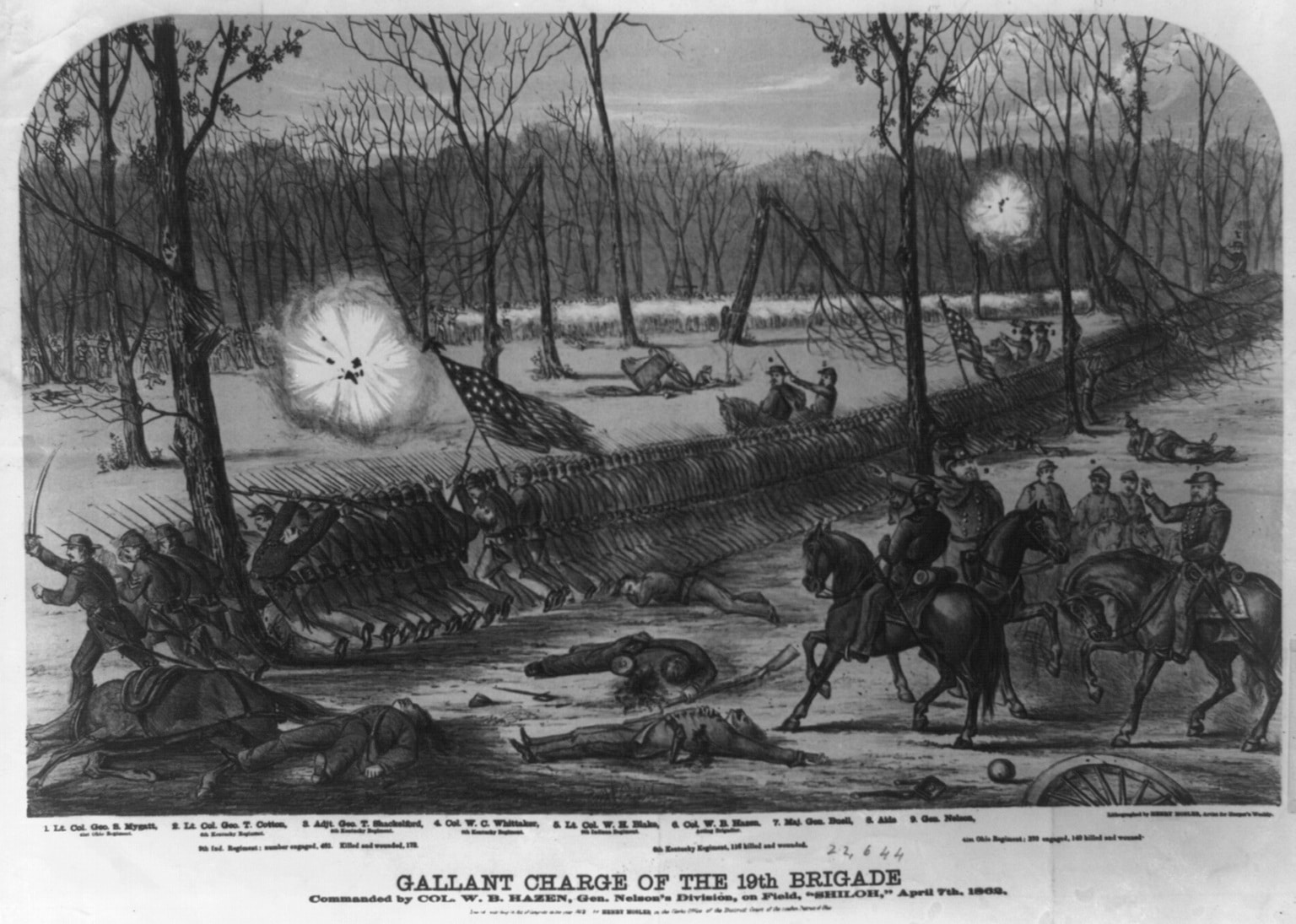
Few postwar accounts were both as accurate, observant, or as flatly entertaining and moving. Bierce was a cynic, but like anyone with blood in his veins, he had a touch for the romantic, too. The story runs the full gamut of emotions and impressions. Also, given his topographical work after Stones River, Bierce offers an excellent sense of terrain. The work is peerless for understanding the actions of William Hazen’s brigade on April 7, 1862.
The opening line reminds me, in a sense, of that in All Quiet on the Western Front. There, “This book is to be neither an accusation nor a confession, and least of all an adventure, for death is not an adventure to those who stand face to face with it. It will try simply to tell of a generation of men who, even though they may have escaped shells, were destroyed by the war.” Bierce is more pithy, but in a sense he starts the same as this and will in time touch on the same themes. “What I Saw of Shiloh” starts with “This is a simple story of a battle; such a tale as may be told by a soldier who is no writer to a reader who is no soldier.” Both declare that this is a tale best understood by soldiers, and it will not be an adventure.
Below are a few choice passages from the classic. These are but a few, though, and choosing the best to fit in less than 2,000 words was hard. The story can be read in full here:
https://americanliterature.com/author/ambrose-bierce/short-story/what-i-saw-of-shiloh
On hearing the first shots of the battle
“I have since seen similar effects produced by earthquakes; I am not sure but the ground was trembling then. The mess-cooks, wise in their generation, lifted the steaming camp-kettles off the fire and stood by to cast out. The mounted orderlies had somehow disappeared. Officers came ducking from beneath their tents and gathered in groups. Headquarters had become a swarming hive. The sound of the great guns now came in regular throbbings–the strong, full pulse of the fever of battle. The flag flapped excitedly, shaking out its blazonry of stars and stripes with a sort of fierce delight. Toward the knot of officers in its shadow dashed from somewhere–he seemed to have burst out of the ground in a cloud of dust–a mounted aide-de-camp, and on the instant rose the sharp, clear notes of a bugle, caught up and repeated, and passed on by other bugles, until the level reaches of brown fields, the line of woods trending away to far hills, and the unseen valleys beyond were ‘telling of the sound,’ the farther, fainter strains half drowned in ringing cheers as the men ran to range themselves behind the stacks of arms. For this call was not the wearisome ‘general’ before which the tents go down; it was the exhilarating ‘assembly,’ which goes to the heart as wine and stirs the blood like the kisses of a beautiful woman. Who that has heard it calling to him above the grumble of great guns can forget the wild intoxication of its music?”
On seeing Grant’s army across the Tennessee River in the last fighting on April 6
“The air was full of noises. To the right and the left the musketry rattled smartly and petulantly; directly in front it sighed and growled. To the experienced ear this meant that the death-line was an arc of which the river was the chord. There were deep, shaking explosions and smart shocks; the whisper of stray bullets and the hurtle of conical shells; the rush of round shot. There were faint, desultory cheers, such as announce a momentary or partial triumph. Occasionally, against the glare behind the trees, could be seen moving black figures, singularly distinct but apparently no longer than a thumb. They seemed to me ludicrously like the figures of demons in old allegorical prints of hell.”
On crossing the Tennessee River with an unlikely passenger
“There was, I remember, no elephant on the boat that passed us across that evening, nor, I think, any hippopotamus. These would have been out of place. We had, however, a woman. Whether the baby was somewhere on board I did not learn. She was a fine creature, this woman; somebody’s wife. Her mission, as she understood it, was to inspire the failing heart with courage; and when she selected mine I felt less flattered by her preference than astonished by her penetration. How did she learn? She stood on the upper deck with the red blaze of battle bathing her beautiful face, the twinkle of a thousand rifles mirrored in her eyes; and displaying a small ivory-handled pistol, she told me in a sentence punctuated by the thunder of great guns that if it came to the worst she would do her duty like a man! I am proud to remember that I took off my hat to this little fool.”
The call to battle on April 7
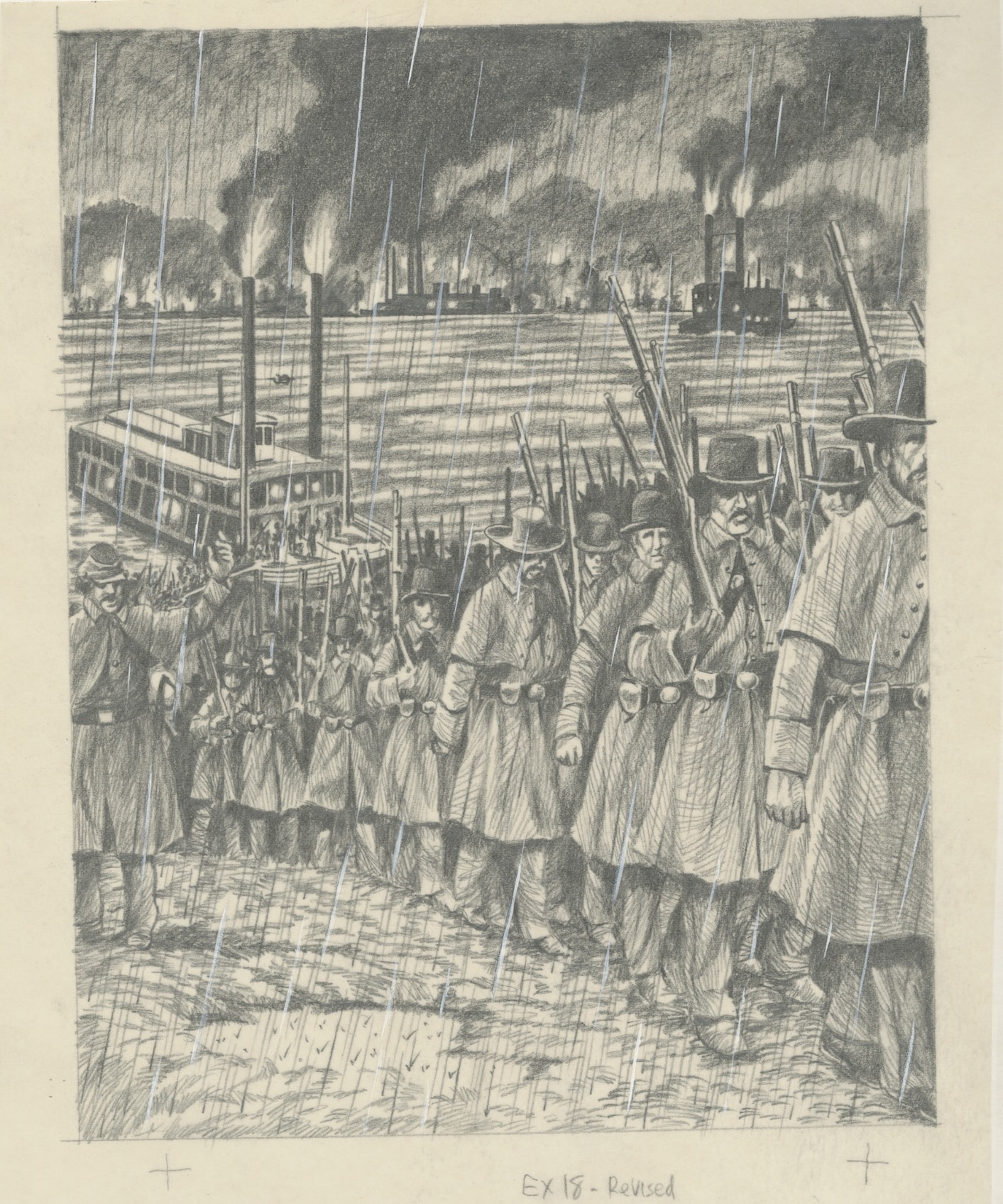
“There came, borne to us on the raw morning air, the long weird note of a bugle. It was directly before us. It rose with a low clear, deliberate warble, and seemed to float in the gray sky like the note of a lark. The bugle calls of the Federal and the Confederate armies were the same: it was the ‘assembly’ ! As it died away I observed that the atmosphere had suffered a change; despite the equilibrium established by the storm, it was electric. Wings were growing on blistered feet. Bruised muscles and jolted bones, shoulders pounded by the cruel knapsack, eyelids leaden from lack of sleep–all were pervaded by the subtle fluid, all were unconscious of their clay. The men thrust forward their heads, expanded their eyes and clenched their teeth. They breathed hard, as if throttled by tugging at the leash. If you had laid your hand in the beard or hair of one of these men it would have crackled and shot sparks.”
First blood at Wicker Field
“Then–I can’t describe it–the forest seemed all at once to flame up and disappear with a crash like that of a great wave upon the beach–a crash that expired in hot hissings, and the sickening “spat” of lead against flesh. A dozen of my brave fellows tumbled over like ten-pins. Some struggled to their feet only to go down again, and yet again. Those who stood fired into the smoking brush and doggedly retired. We had expected to find, at most, a line of skirmishers similar to our own; it was with a view to overcoming them by a sudden coup at the moment of collision that I had thrown forward my little reserve. What we had found was a line of battle, coolly holding its fire till it could count our teeth. There was no more to be done but get back across the open ground, every superficial yard of which was throwing up its little jet of mud provoked by an impinging bullet. We got back, most of us, and I shall never forget the ludicrous incident of a young officer who had taken part in the affair walking up to his colonel, who had been a calm and apparently impartial spectator, and gravely reporting: ‘The enemy is in force just beyond this field, sir.’”
Upon seeing the men who died horribly on April 6
“My regiment having at last been relieved at the guns and moved over to the heights above this ravine for no obvious purpose, I obtained leave to go down into the valley of death and gratify a reprehensible curiosity. Forbidding enough it was in every way. The fire had swept every superficial foot of it, and at every step I sank into ashes to the ankle. It had contained a thick undergrowth of young saplings, every one of which had been severed by a bullet, the foliage of the prostrate tops being afterward burnt and the stumps charred. Death had put his sickle into this thicket and fire had gleaned the field. Along a line which was not that of extreme depression, but was at every point significantly equidistant from the heights on either hand, lay the bodies half buried in ashes; some in the unlovely looseness of attitude denoting sudden death by the bullet, but by far the greater number in postures of agony that told of the tormenting flame. Their clothing was half burnt away–their hair and beard entirely; the rain had come too late to save their nails. Some were swollen to double girth; others shriveled to manikins. According to degree of exposure, their faces were bloated and black or yellow and shrunken. The contraction of muscles which had given them claws for hands had cursed each countenance with a hideous grin. Faugh! I cannot catalogue the charms of these gallant gentlemen who had got what they enlisted for.”
On the bloody attack of William Hazen’s brigade
“The line of blue staggered and gave way; in those two terrific volleys it seemed to have quite poured out its spirit. To this deadly work our reserve regiment now came up with a run. It was surprising to see it spitting fire with never a sound, for such was the infernal din that the ear could take in no more. This fearful scene was enacted within fifty paces of our toes, but we were rooted to the ground as if we had grown there. But now our commanding officer rode from behind us to the front, waved his hand with the courteous gesture that says apres vous, and with a barely audible cheer we sprang into the fight. Again the smoking front of gray receded, and again, as the enemy’s third line emerged from its leafy covert, it pushed forward across the piles of dead and wounded to threaten with protruded steel. Never was seen so striking a proof of the paramount importance of numbers. Within an area of three hundred yards by fifty there struggled for front places no fewer than six regiments; and the accession of each, after the first collision, had it not been immediately counterpoised, would have turned the scale.”
Bierce reflecting back as he closes his account
“O days when all the world was beautiful and strange; when unfamiliar constellations burned in the Southern midnights, and the mocking-bird poured out his heart in the moon-gilded magnolia; when there was something new under a new sun; will your fine, far memories ever cease to lay contrasting pictures athwart the harsher features of this later world, accentuating the ugliness of the longer and tamer life? Is it not strange that the phantoms of a blood-stained period have so airy a grace and look with so tender eyes? – that I recall with difficulty the danger and death and horrors of the time, and without effort all that was gracious and picturesque? Ah, Youth, there is no such wizard as thou! Give me but one touch of thine artist hand upon the dull canvas of the Present; gild for but one moment the drear and somber scenes of to-day, and I will willingly will willingly surrender an other life than the one that I should have thrown away at Shiloh.”


I love Bierce’s writings. Thanks for sharing these.
I was first impressed by The Devil’s Dictionary, and my admiration has only grown from there. I quote him often in my Shiloh books.
I love Bierce as well, a master story teller. One of the highlights of the research and writing of my book, BOUTWELL: Radical Republican and Champion of Democracy, was discovering that George Boutwell’s tenure as Treasury Secretary for Ulysses Grant was mentioned in “Prattle,” the series of Bierce’s columns published in the San Francisco Wasp newspaper in the 1880s. To have a family member mentioned by Ambrose Bierce!
What did Bierce have to say?
An amusing story, which I relate in note 39 on pp. 325-326 of my biography of George. As Treasury Secretary in the early 1870s, Boutwell was responsible for protecting the natural resources of the Seal Islands of Alaska and the abundant northern fur seals, trade in which amounted to millions of dollars, almost enough to pay for Seward’s original purchase of Alaska from Russia. Boutwell appointed Henry Wood Elliott, who became a famed American naturalist, to oversee the sustainable harvesting of the fur seals. In 1888, the company in charge of the fur concession was charged by Bierce with clothing “their worthless entrails with fat belonging to the United States.” Boutwell is mentioned as having set up the original arrangement, which by the 1880s had fallen prey to Gilded Age corruption.