The Founding Moment in Ford’s Theatre: 1776 On Stage
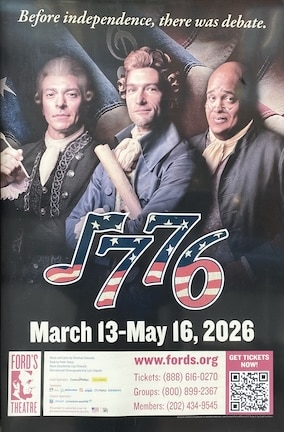
Crowd murmur might be the soundtrack of my excitement. I am seeing a show at Ford Theatre for the first time, and my wife and I have front row seats. I’ve always wanted to see a show at Ford’s, and this one promises to be special: 1776, produced in the 250th anniversary year of America. And even cooler, I have a friend in the show!
I stand between my seat and the orchestra pit and turn around to look behind me. Ford’s feels small as theaters go, although it holds 665 seats. The tiers of seats—ground-floor mezzanine, the balcony, and the third-story balcony, all populated by brick-red upholstered chairs—oddly remind me of the stacks upon stacks of a Big Mac. The top balcony is closed for this production, fronted by racks of lighting that rival any stadium array set up for Friday night gridiron.
As a civil war guy, I’ve been to Ford’s before, of course. It’s the scene of one of America’s great turning points: Lincoln’s assassination in April 1865. That national tragedy ended Ford’s career for more than a century, but it reopened in 1968 and today remains alive and vibrant. (Read its history here.) That it continues to operate as a theater, even as it serves as a historical and memorial space, serves as a wonderful testament to the power of theater and its ability to transform and imagine and inspire.
The presidential box remains solemnly empty, still adorned with red, white, and blue bunting and a portrait of George Washington mounted on its front. Washington’s presence proved especially fitting for this production because Washington’s spirit hung over the proceedings of the Second Continental Congress as it debated independence and tried to figure out how to wage war. Washington’s plaintive words, lifted from his actual correspondence, speak out during the production—someone not there but someone very much there.
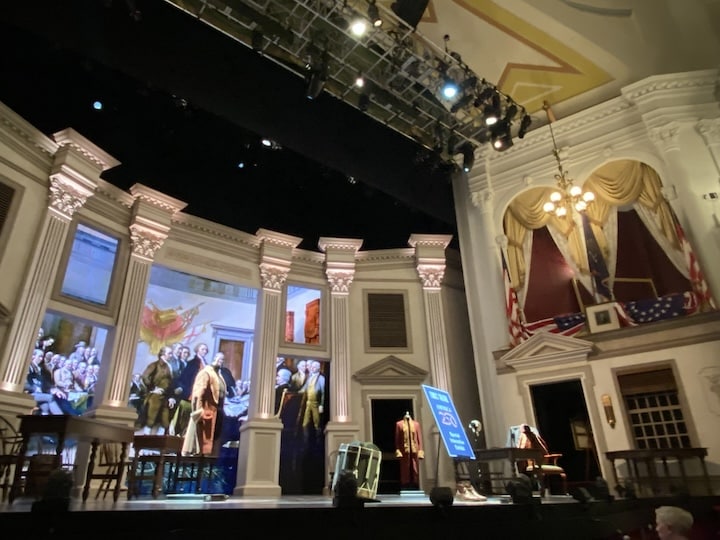
The stage, meanwhile, feels full and interesting. The production designers have set it to look like a museum space, and a placard on a tripod advertises “America 250: special Interactive Exhibit.” A uniform jacket on a stand. A drum. Colonial-era furniture sets. As curtain time approaches, individuals wander down the aisles and out of the wings onto the stage as if they are tourists browsing through the exhibits. The intentionality of it suggests these are not merely audience members, although the staging invites that impression.
A man dressed as an ersatz park ranger comes on to remind us to silence our phones and make a few other announcements, but over the next few minutes, he transforms—along with the rest of the stage —from a modern player in our contemporary space into a historical character in 1776. A bellicose John Adams walks on stage to complain about the Congress, which “won’t grant any of my proposals on Independence even so much as the courtesy of open debate! Good God, what in hell are they waiting for?”
The meandering tourists, meanwhile, have transformed themselves into delegates of the Congress, and they belt out: “Sit down, John ! Sit down, John! For God’s sake, John, sit down!”
And we’re off!
It’s a rousing show, full of enchanting performances. My wife—who had been telling everyone she knows, all week long, “My husband is taking me to a play. A history play. And it’s a musical,” eye rolling all along—is now tapping her toes and smiling.
“Oh,” I whisper, “you’re enjoying this more than you thought you would, huh?”
She smiles at the good-natured ribbing and keeps tapping her toes.
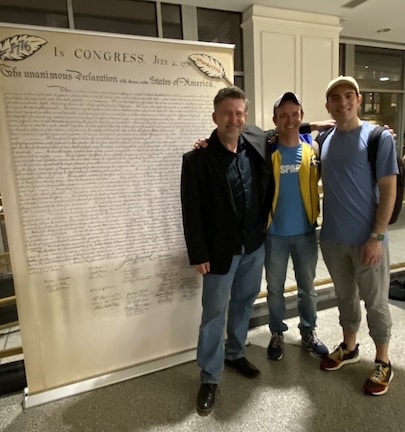
I’m here for all the John Adams I can get, and the actor channeling Adams, Jonathan Atkinson, embodies him well. The musical leans into Adams as “obnoxious and disliked,” played for comic effect in the show but which has unfortunately attached to Adams’s legacy like a tick. Atkinson brings out Adams’s admirable traits as well. Later in the lobby, Atkinson will tell me he feels a special connection to Adams. “I’m 41, which is the same age Adams was while all this was going on,” Atkinson says, referring to events in the play.
Eventually, my friend, Doug Ullman, whom I’ve worked with at the American Battlefield Trust, makes his appearance as Reverend John Witherspoon, a delegate from New Jersey. He sports a long white wig that looks like a mullet on steroids, and he speaks in a wonderful Scottish brogue. Seeing Doug in action on stage—the first time I’ve been privileged to do so—is a remarkable treat.
1776 is a marvelous case study in that old debate about art versus history. The historian in me might cringe at some of the inaccuracies, but the artist in me recognizes how well the production captures the spirit of what happened in “Foul, fetid, fuming, foggy, filthy,
Philadelphia” in the lead-up to July 1776. On occasion, my wife leans over and asks, “Did they really do that? Did he really say that?” I can’t really explain in the middle of the production, but to do so would defeat the purpose anyway. The whole thing feels true, even if it’s not factual.
As one of Act II’s scenes unfolds, members of the Continental Congress line-edit Jefferson’s Declaration. Jefferson agonizes over the changes. Anyone who has toiled through editing-by-committee knows his pain. Jefferson and Adams share a table downstage on the stage-left side, on the far side of the theater from me.
And suddenly I am struck by a tableau that rips me from the scene.
There, at a single table, sit Adams and Jefferson, two future presidents. Above them hovers the portrait of Washington—hovering over the proceedings but also hovering as a future president. And there, behind Washington, hovers the empty Presidential Box. I don’t go so far as to envision Lincoln’s spirit standing watch, but I also can’t not see him there. It is like an alignment of planets, where the farthest on is too far away to see with the naked eye, as an arc of American history lines up.
Not much later, South Carolina delegate Edward Rutledge sings the sinister “Molasses to Rum to Slaves,” the devil’s bargain between North and South that kept Northern industry and Southern slavery alive. With his cane, Rutledge points to the Presidential Box. The gesture is nearly lost on me, but then I realize that, perhaps, Rutledge, the actor, the director—someone—has just punctuated in the most dramatic way possible the arc of history unfolding on the stage. Congress will compromise over slavery in order to ensure the Founding, but a consequence of that decision will unfold in the box that overlooks the stage. The Founders make a decision that will, years later, result in Lincoln’s death.
Adams hits his low point following Rutledge’s song, his faith shaken, his idealism undercut by the realities of the moment. He echoes a nearly despondent call from Washington’s correspondence: “Is anybody there? Does anybody care?” Fortunately, Abigail saves the day, the Declaration, and the Revolution itself by sending barrels of saltpeter for the war effort, rescuing Adams from his slump. He’s soon seeing celebrations and fireworks and “Pageant and pomp and parade.”
Delegates return to the chamber, the votes shift into place, and gravitas settles in as the signatories step forward.
As the delegates sign, the actors begin their transformations back to contemporary figures. We are invited into that Founding moment as it steps out to include us, reaching from history, reaching from the stage. Some of the actors even step off the stage into the audience. We become the history, and history becomes illusion—because it’s still happening, still going on, and we’re a part of it. We are actors in the drama of the Founding because America continues to invent itself around us, every day, and as citizens, we have a role to play.
“Is anybody there?”
Yes. Us.
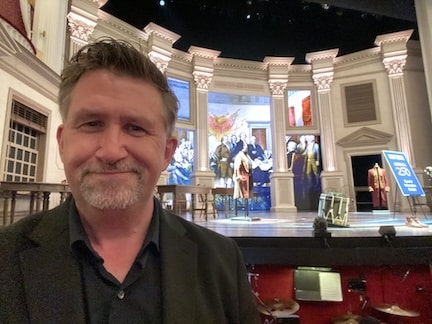


I thoroughly enjoyed the performance here in Va Beach the last weekend in February but I’m jealous you got to see it at Ford’s Theater.