Art, Memory, and the Mystery of a Fallen Color Bearer
Not all Civil War monuments are created equal. While many depict stoic bronze figures perched high on granite pedestals, sculptor Gary Casteel takes a different approach. He brings his subjects down to eye-level, capturing them in moments of intense, life-like action. This is powerfully demonstrated in his monument to a wounded North Carolina color bearer at Fox’s Gap. But what if the stirring story this monument tells, a tale of heroic sacrifice, isn’t the whole truth?
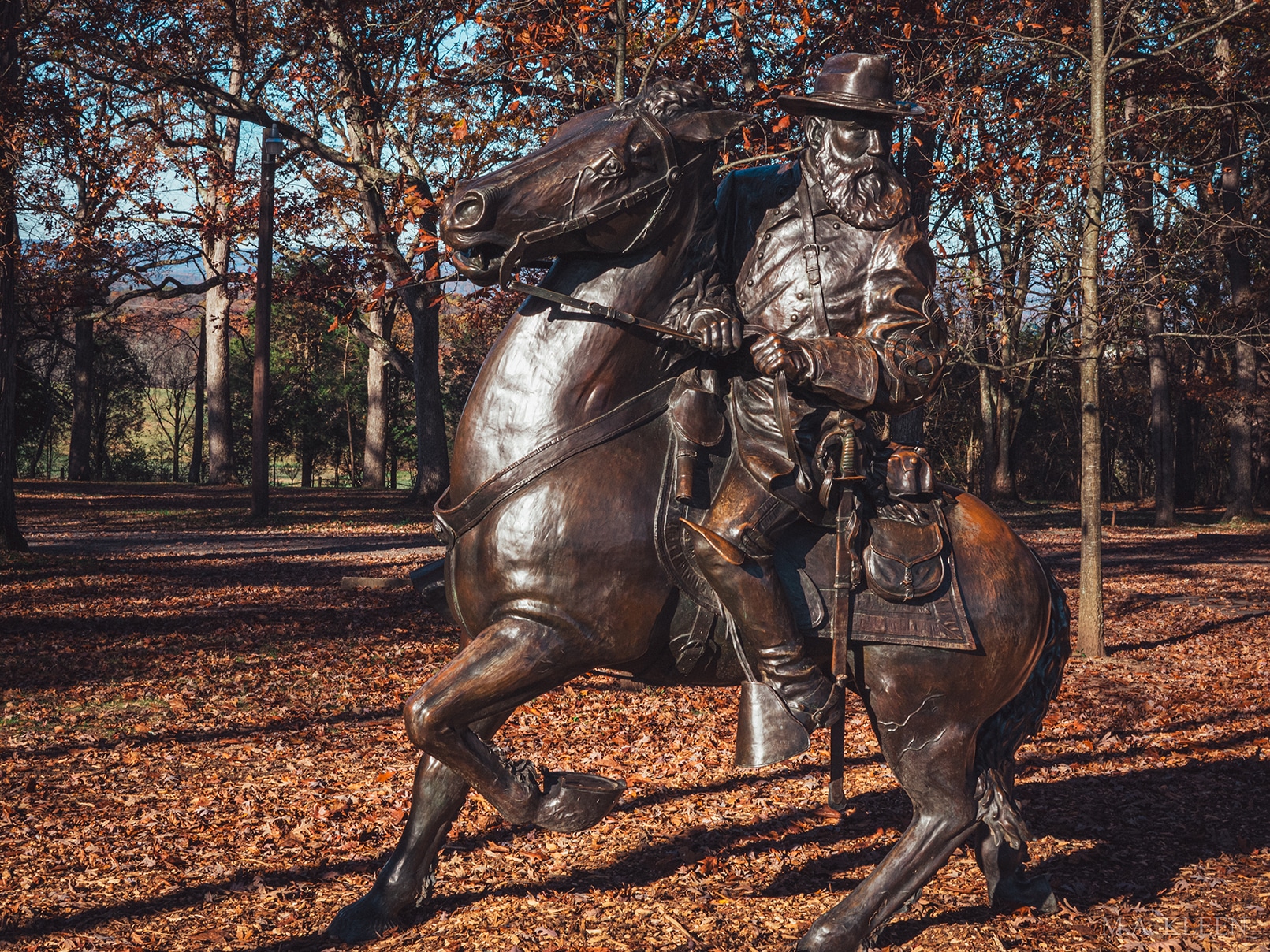
Casteel’s most famous work is the monument to Lt. Gen. James Longstreet in Pitzer’s Woods at Gettysburg. Unlike the battlefield’s other stiff, classically heroic statues, Casteel’s Longstreet is frozen in a moment of action—rearing his Irish Thoroughbred, Hero, to the side, his eyes fixed on something critical in the distance. Every angle tells a different story. You can imagine the dust kicked up, gloved hands tightening on the reins, and a mouth firm but ready to bark orders at a moment’s notice.
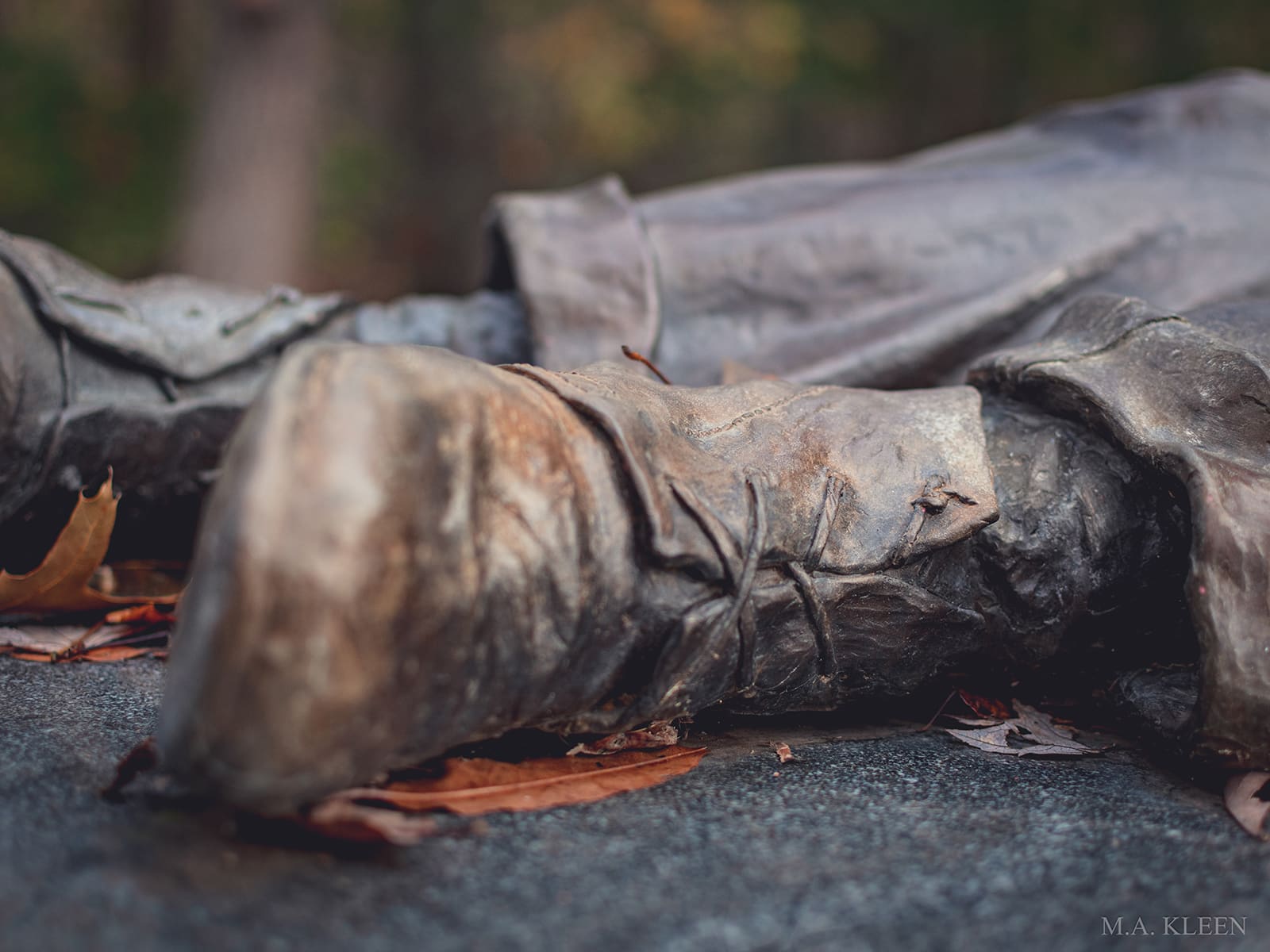
The same is true of the North Carolina Monument at Fox’s Gap on South Mountain, Maryland. Although it sits atop a rectangular, black granite pedestal, the figure’s reclining posture places it at eye level. The monument depicts a wounded color bearer clutching his side and hoisting the battle flag.
It sits on the north side of a low stone wall at the edge of Wise’s Garden, near where Brig. Gen. Samuel Garland was mortally wounded, and is dedicated to all the North Carolinians who fought in the battle of South Mountain on September 14, 1862.
“The memorial is designed to show a Confederate soldier giving his life to protect his family, home, and life of his state and country, the South,” Sculptor Gary Casteel explained.[1]
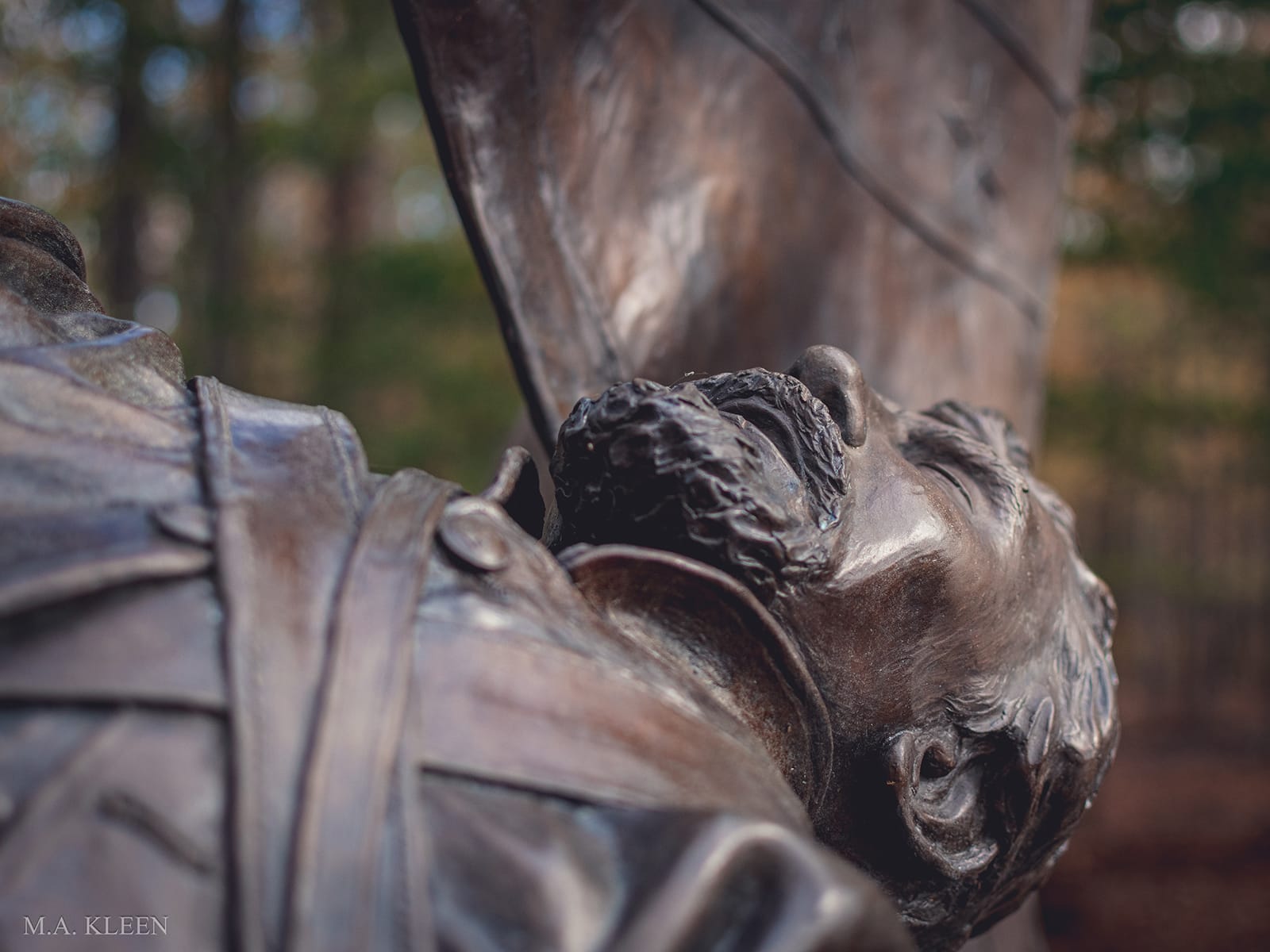
Casteel, whose studio is in Gettysburg, PA, started the project in March 1998 at the behest of the Living History Association of Mecklenburg, Inc. (NC) and the Central Maryland Heritage League. The process, from concept to dedication, unfolded over multiple stages and took years to complete. The North Carolina Monument at Fox’s Gap was installed and dedicated in October 2003.[2]
“Once the piece is completed in clay, approved, it goes to the foundry for molds and bronze casting,” Casteel told me. “Sculpting and foundry time for this particular piece was about 14 months. With stone setting, bronze mounting, etc. You can figure at least 16 months before unveiling!”
“Lots of hand work . . . no button pushing.”[3]
Casteel draws inspiration from his extensive home library, where he dedicates hours of research to perfecting his designs. He feels strongly that sculpture can be a teaching tool to keep history alive and inoculate it against attempts to erase or rewrite the past.
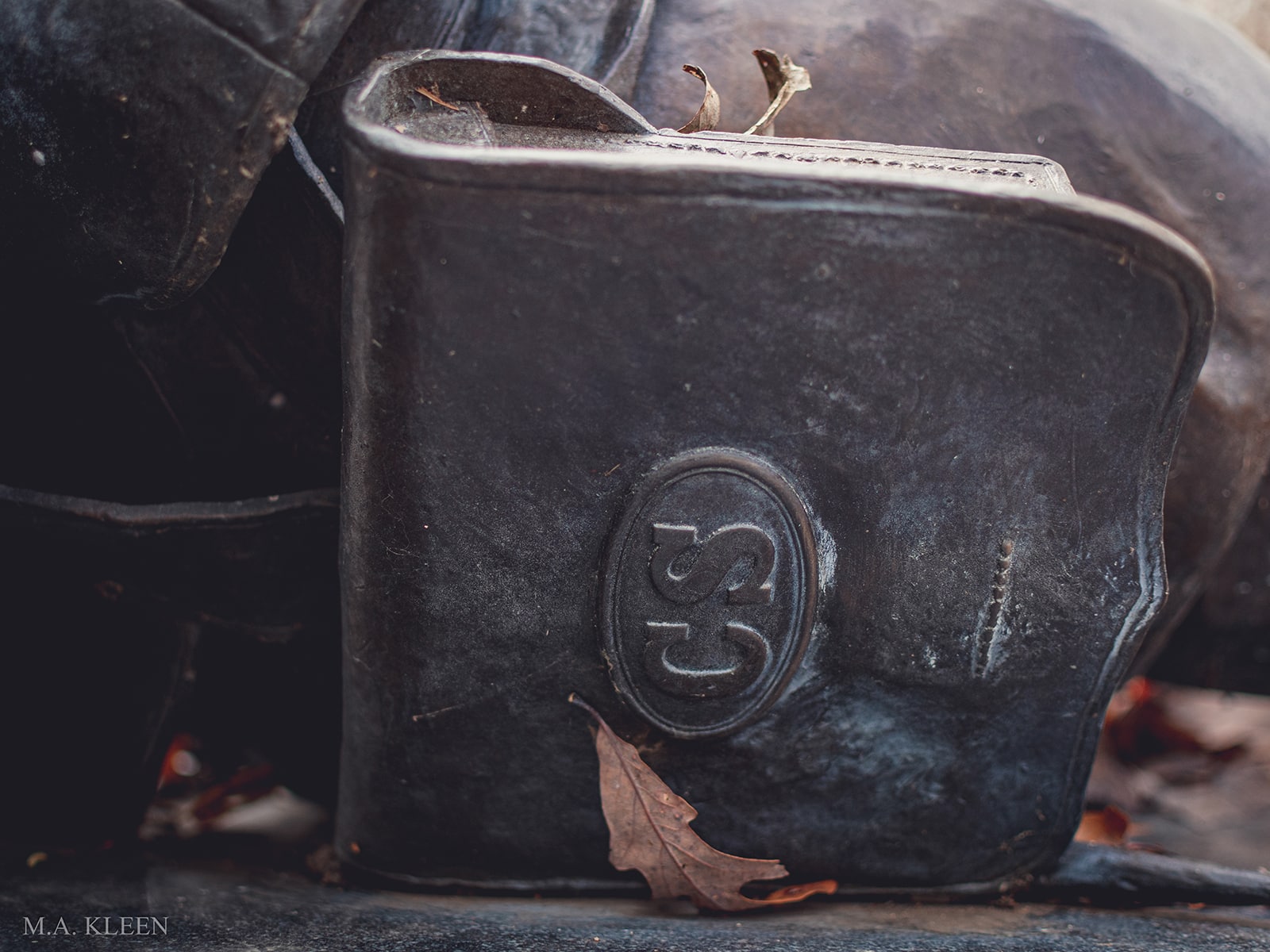
A work of art doesn’t have to be photorealistic, but one thing I appreciate about the North Carolina Monument is its attention to detail. A sculpture, if done correctly, can impact visitors in a profound way that a two-dimensional photo or interpretive sign simply cannot. Everything, from the soldier’s shoes, buttons, and other accoutrements to the stitching and even the veins on his hands, is carefully and accurately rendered. The buttons feature a simple “Block I” design for infantry.
Inscribed on the statue’s pedestal is an excerpt from a letter by Robert B. Wilson of the 12th Ohio Infantry Regiment. He describes a Confederate color bearer who stood on a stone wall, refusing to surrender. After being shot down, Private Henry W. Hoagland jumped over the fence to secure the flag. However, Lt. Col. Augustus H. Coleman of the 11th Ohio took the flag and the credit for its capture. Coleman later died at Antietam.[4]
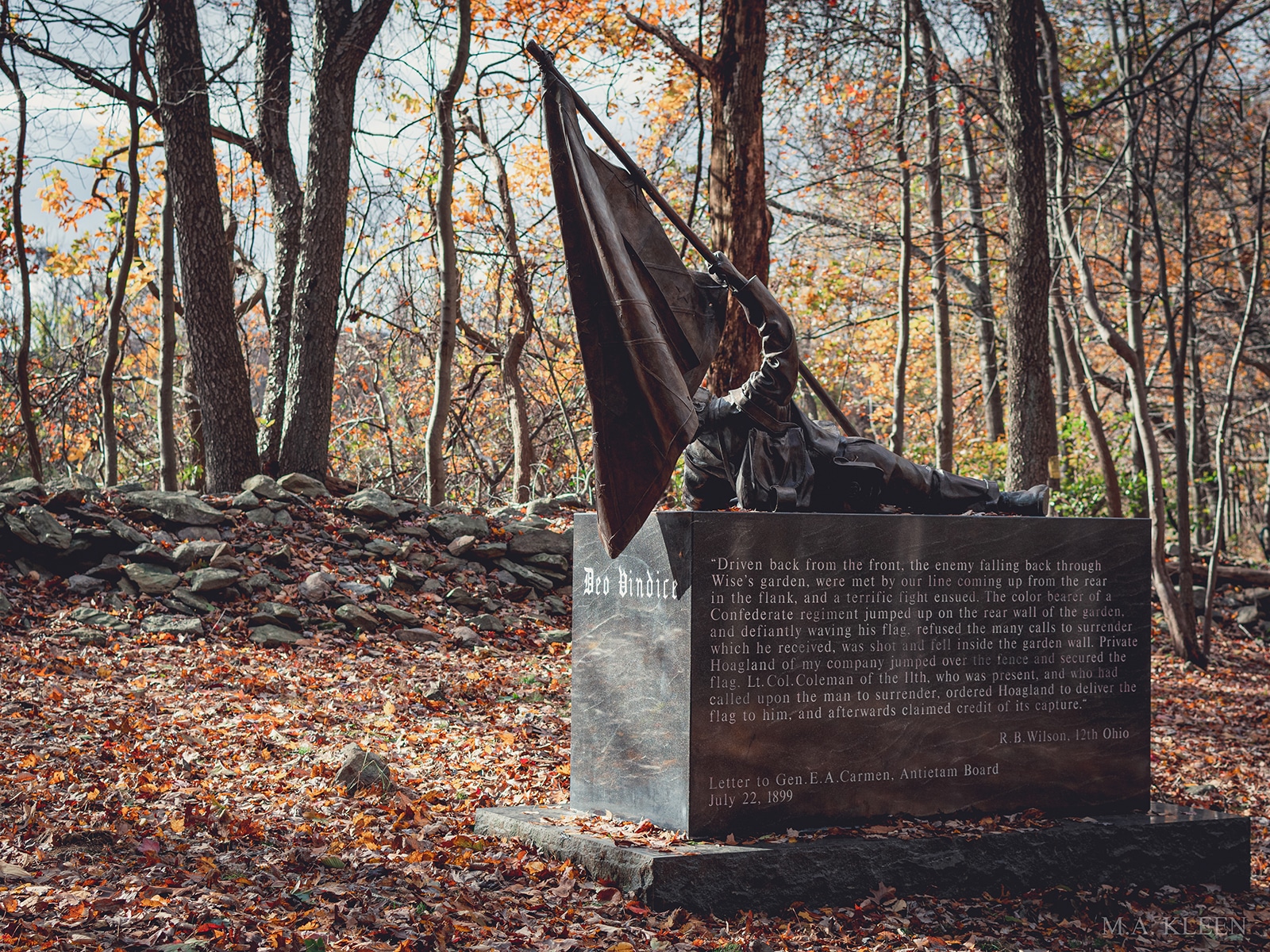
There is a debate over the identity of the anonymous Confederate color bearer, with some believing the monument’s assertion that he was a North Carolinian, and others certain he was not.
In his 2023 book, From Frederick to Sharpsburg: People, Places, and Events of the Maryland Campaign Before Antietam, historian and certified National Park Service Antietam tour guide Steven R. Stotelmyer argues that the evidence indicates it was a South Carolina color bearer who lost his life at the rear wall of Wise’s Garden that day, not a North Carolinian.[5]
“As a historian, I have a problem with the monument because the text on the base is not correct,” he told me.[6]
The controversy centers on the timing of the event Robert B. Wilson described. Many assume the Confederate color bearer was killed during the morning’s fighting near Wise’s Cabin and Garden, where Brig. Gen. Samuel Garland’s Brigade (which included the 13th North Carolina) fought the Federal Ninth Corps’ Kanawha Division. However, the only Confederate source mentioning the loss of a color bearer that morning refers to the 5th North Carolina, which was over 750 yards to the south.[7]
According to Stotelmyer, a careful examination of primary sources points to the afternoon fighting at Wise’s Cabin and Garden. While the Ninth Corps (including the 11th Ohio) was involved in both the morning and afternoon engagements, the 11th Ohio, under Lt. Col. Augustus Coleman, only fought inside the garden wall near Wise’s Cabin in the afternoon, where they clashed with Brig. Gen. Thomas F. Drayton’s Brigade.
Crucially, the 3rd South Carolina Battalion in Drayton’s Brigade did lose its color guard in that afternoon fight, an incident which stuck out in the mind of Private Sam Puckett, even 40 years later. “Simpson, the color bearer, and one of the color-guards was shot down, then the other color guard, R.C. Puckett, was also shot down. The flag was shot to pieces and the staff was broken.”[8]
Based on the historical record, “In short, the text on the base of the monument describes a South Carolina color bearer, not a North Carolina color bearer,” Stotelmyer concluded.[9]
This brings to mind the controversy over one of my favorite Civil War monuments—the Kirkland Monument at Fredericksburg and Spotsylvania National Military Park. To my knowledge, it is the only battlefield monument depicting an act of compassion. Yet historians like Michael Schaffner and Mac Wyckoff have questioned whether Sgt. Richard R. Kirkland ever performed the actions attributed to him.[10]
Is military art meant to serve as a photo-realistic snapshot of events, or to reflect something deeper that other forms of expression cannot quite capture?
The North Carolina Monument at Fox’s Gap still serves as a testament to the sculptor’s artistic ability, even while sparking a deeper investigation into the very history it seeks to commemorate. Gary Casteel set out to capture a universal truth of the Civil War: the courage and sacrifice of the common soldier. In that, the sculpture is a success. The silent, bronze figure forces us to confront the human cost of conflict, a story that elevates it above the individual.
[1] Gary Casteel, email to author, February 26. 2026.
[2] “N. Carolinians dedicate Civil War monument on South Mountain,” The Star-Democrat, October 20, 2003.
[3] Casteel, email to author, February 26. 2026.
[4] The original letter can be found in the Carman Papers at the Library of Congress: Robert E. Wilson to Ezra A. Carman, July 22, 1899.
[5] Steven R. Stotelmyer, From Frederick to Sharpsburg: People, Places, and Events of the Maryland Campaign Before Antietam (Sharpsburg: Antietam Institute, 2023), 440-453.
[6] Steven R. Stotelmyer, e-mail to author, March 6, 2026.
[7] The War of the Rebellion: A Compilation of the Official Records of the Union and Confederate Armies, Series I, Vol. XIX, Part 1 (Washington: Government Printing Office, 1887), 1042.
[8] C. M. Calhoun, Liberty Dethroned (Greenwood: s.n., 1903), 228.
[9] Stotelmyer, e-mail to author, March 6, 2026.
[10] Michael Schaffner, “Is the Richard Kirkland Story True?” Civil War Memory, December 22, 2009. https://cwmemory.com/2009/12/22/is-the-richard-kirkland-story-true/


Excellent post.
Thank you! What is your opinion on the subject?
Ranger Stotelmyer makes a decent but not conclusive case. For example, did the 12th Ohio fight in the morning in the key area? It appears he only addresses where the 11th fought. Also, CSA Private Sam Puckett describes the fate of the two color guards, but does not state that the flag actually was captured. To the contrary, he implies that the bullet-ridden flag could be examined after the battle, suggesting that it was not captured.
As for the 13th North Carolina, the absence of any admission of a loss of their flag is not conclusive. Losing a regimental flag would not be something the soldiers would want to highlight. I also would want to know if, at any time after the battle, did anyone in either the 13th NC or the 3rd South Carolina Battalion mention receiving a new set of colors? Again, a good lawyer could poke holes in the good Ranger’s definitive statement.
But you yourself do a great job of presenting the available evidence. Again, a nice post. Thank you for sharing.
Very interesting analysis! I hadn’t considered that. You are a good lawyer
I am not a Ranger. I am a licensed Antietam tour guide. There is a big difference. As for the scholarship, I will let the primary sources speak for themselves. There are more in the essay than those mentioned in the blog.
Mr. Stotelmyer, my apologies. I stand corrected.
Awesome post. Thank you for the information. I didn’t know much about him.
Thank you!
Excellent piece, excellent photos, beautiful sculpture. It’s entirely perfectly timed, as well. Now that the FBI has confirmed that there was so little racism/white supremacy in America that the SPLC had to invent it – causing murder, amongst other things – the SPLC’s entire $850 million endowment must be seized by the Federal Government and spent resurrecting, in perfect rendition, and replacing on their original pedestals in their original locations on original ground, every single Confederate statue, memorial and monument that was destroyed since the Maoists began attacking America. The very first must be the lovely equestrian statue of Robert Edward Lee on Monument Avenue in Richmond, Virginia – where it stood for over a century before being illegally and ignobly torn down by the 0.000000001% of America that thinks it should be able to tell the rest how to live and think.