The Price of Coal: The Potomac Flotilla in December 1862
ECW welcomes back guest author Dean W. Chester.
When Maj. Gen. Ambrose Burnside reached Falmouth, opposite Fredericksburg, on November 19, 1862, he learned the pontoon bridges needed to cross the Rappahannock River were still days away, upsetting his timetable for a rapid river crossing. Just four days into the latest campaign to capture Richmond, the Army of the Potomac was stalled on the north bank of the Rappahannock.[1]
On November 21, Secretary of the Navy Gideon Welles, in response to requests from Chief of the Army Maj. Gen. Henry Halleck and the Army’s Quartermaster Brig. Gen. Montgomery Meigs, ordered Cmdre. A. A. Harwood’s Potomac Flotilla to assist the army “in the neighborhood of Fredericksburg.”[2] The next day, Burnside telegrammed Welles requesting “two or three gunboats to proceed up the Rappahannock river to cooperate with [his] army.”[3]
Lieutenant Commander E. P. McCrea, commanding the flotilla’s Second Division, received his orders on November 22. His main concern was coal. The flotilla’s coal replenishments were three weeks overdue, and the gunboats and supporting ships were running low.
To keep their gunboats on the Potomac, some captains had resorted to commandeering coal from vessels they intercepted or were escorting, including army vessels. Meigs informed Welles of this practice when he requested the navy’s assistance, and Harwood ordered this activity be stopped.[4] When his five gunboats arrived at the mouth of the Rappahannock, McCrea supplied them with as much coal as possible from two other flotilla vessels and then proceeded upriver to the sister towns of Port Royal and Port Conway, arriving on November 27.[5] At Port Conway, on the northern bank of the river, McCrea and Lt. Cdr. Samuel Magaw established communications with Burnside’s headquarters. Burnside ordered them to remain near Port Royal until he called for them. This was an easy order to obey because the limited coal supplies restricted the gunboats’ movement on the river.
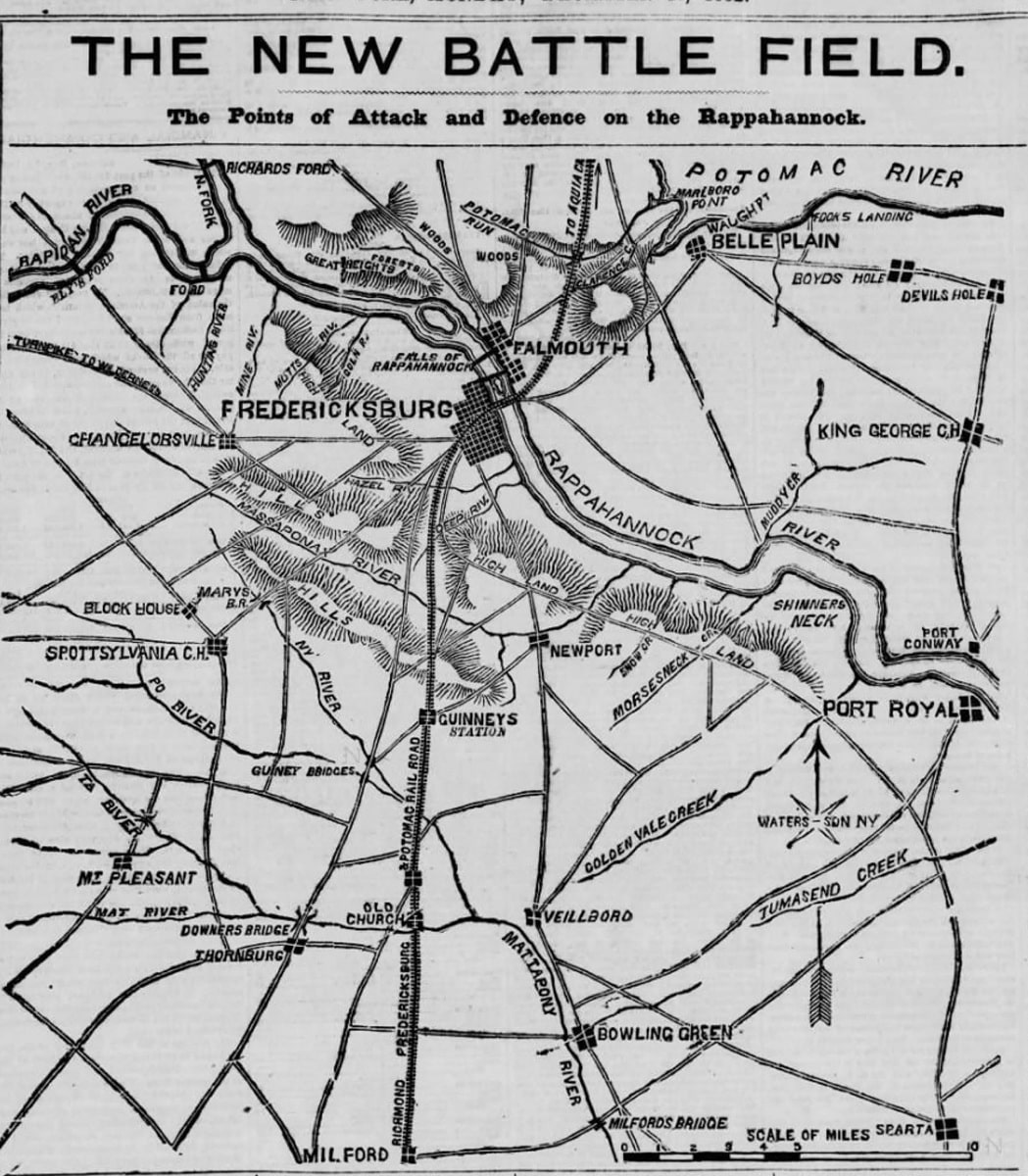
General Robert E. Lee learned of the gunboats’ arrival at Port Royal on November 27. The warships’ presence at Port Royal and the pontoon train near Burnside’s headquarters forced Lee to consider the possibility of a crossing below Fredericksburg.[6] Lee’s concerns forced him to extend his right flank, under Maj. Gen. Thomas Jackson’s control, 22 miles to Port Royal. Jackson placed Maj. Gen. D.H. Hill’s division near Bowling Green and Port Royal.[7]
On December 4, Hill ordered rifle pits dug along the riverbank, and two batteries positioned below and behind Port Royal. A little after 4 p.m. the Confederates began shelling the gunboats. The gunboats exchanged shot, shell, and canister with the Confederates until darkness was descending. Hill reported one dead and one wounded.[8] The Richmond Enquirer later claimed 11 buildings were damaged by the gunboats’ cannonade.[9]
The gunboats anchored below Port Conway and the crews checked their ammunition, powder, and coal supplies. The gunboats had fired at least 63 rounds during the battle, and one gunboat had 1½ tons of coal remaining, barely enough for one more day.[10]
Over the next six days the gunboats were joined by four more, including three small armed steamers. They took turns returning to the mouth of the Rappahannock to obtain coal from supply ships or passing vessels.[11] By December 10 there were six gunboats anchored or patrolling near Port Royal. Their coal had been replenished by two coal schooners that had joined the flotilla and were anchored near-by. Two other gunboats were down river.
About 3:00 p.m. Hill’s guns opened fire on the anchorage. The first vessel struck was the coal schooner Sarah Minge, wounding one person aboard.[12] Teaser went to the aid of the coal schooners and towed them downriver.[13] As the batteries found the range, the Union vessels moved frequently, resulting in a game of chase.
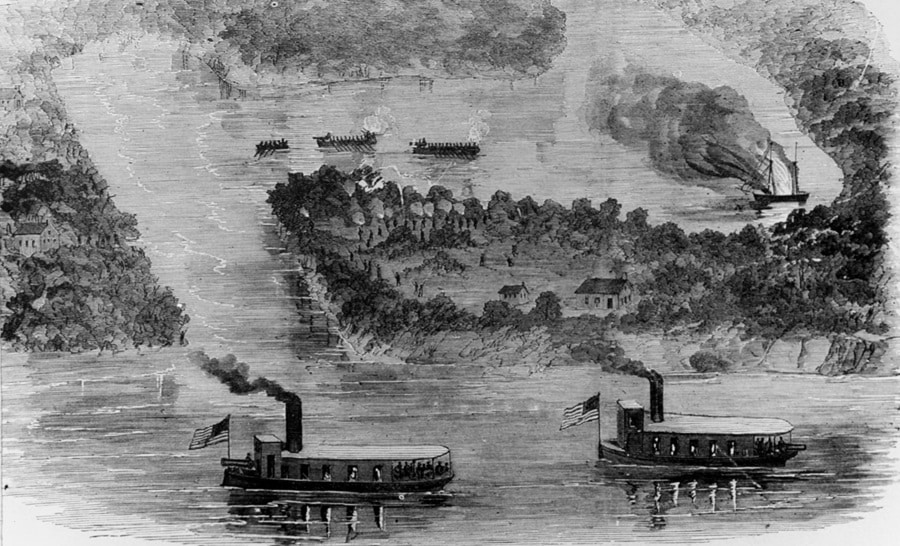
At 4:00 p.m. Currituck was struck by a 30-pounder Parrott shell about two feet below her starboard waterline. The crew quickly plugged the hole while Currituck continued to fight. About 4:30 p.m. the Union boats were ordered to cease fire. Moments later a second shell struck Currituck starboard “aft [of] the main rigging, going through into the fire room and exploded injuring [four] men . . .” and damaging the blower and steampipe gauge.[14] That shot ended the engagement. The gunboats had fired at least 106 rounds and suffered two killed and three wounded or slightly injured.
Currituck started down the Rappahannock early on December 11. Temporary repairs slowed the leak, but didn’t stop it. She was escorted by Satellite and the coal schooners. Jackson recalled Hill’s division late on December 12 and after a 20-mile night march they reached Fredericksburg. Hill served as Jackson’s reserve during the battle on December 13. The remaining gunboats stayed near Port Conway awaiting Burnside’s orders. They learned of his defeat, but did not receive any orders until December 20, which returned them to duties on the Potomac. After twenty-three days on the Rappahannock, cooperation with the army was no longer needed.
The man wounded on Sarah Minge, S.A. Simmons, died. He was master of the other coal schooner, Kadosh.[15] He was not a soldier or a sailor; he was a private coal seller whose vessel and cargo had been seized and towed to the anchorage because he had what the gunboats urgently needed, coal! The price of coal was high on December 10.
Simmons’ death had a profound effect on the officers and men of the flotilla. Commodore Harwood sent a letter to Welles reporting the death and the “liberal subscription” the flotilla had collected for his “indigent family;” he also asked that the case be put before Congress to consider possible assistance.[16] The December 22 edition of the Baltimore Sun reported Simmons’ body was “deposited in the Congressional burying-ground.”[17]
The Potomac Flotilla’s cooperation with the army had no effect on the outcome of the battle of Fredericksburg. However, in the days leading up to the battle, nine vessels at Port Royal—the optimum location to cross the Rappahannock south of Fredericksburg, and reports in the press of pontoon bridges headed for Port Royal forced Jackson to place 17,500 men, 48 percent of his corps, in close proximity to Port Royal, just in case! [18]
————
Dean W, Chester supports battlefield preservation and education through local and national trusts and foundations. Mr. Chester lives in Northern Virginia.
Endnotes:
[1] Francis Augustin O’ Reilly. The Fredericksburg Campaign, Winter War on the Rappahannock (Baton Rouge, LA: Louisiana State University Press; 2003), 21, 32.
[2] Welles to Harwood, Official Records of the Union and Confederate Navies in the War of the Rebellion (ORN hereafter), Series I, Volume 5, 162.
[3] Burnside to Welles, November 22, 1862. ORN Series I, Volume 5, 164.
[4] Report of Commodore Harwood, ORN Series I, Volume 5, 169-170.
[5] Unofficial report of Lieutenant-Commander McCrea, ORN Series I, Volume 5, 172-173.; Report of Lieutenant-Commander McCrea, ORN Series I, Volume 5, 171-172.
[6] Lee to Davis, November 27, 1862.The War of the Rebellion: A Compilation of the Official Records of the Union and Confederate Armies (ORA hereafter), Series I, Volume XXI, 1034.
[7] Lee to Jackson, November 28, 1862. ORA, Series I, Volume XXI, 1037.
[8] Report of Maj. Gen. Daniel H. Hill, December 24, 1862. ORA, Series I, Volume XXI, 642-644.
[9] “The Shelling of Port Royal,” Washington Chronicle (Washington D.C.), December 16, 1862.
[10] Street to Shankland, December 4, 1865. ORN Series I, Volume 5, 183 – 184; Brown to Shankland. ORN Series I, Volume 5, 183–185.
[11] McGraw to Harwood, November 30th, 1862. ORN Series I, Volume 5, 177.
[12] Street to Magaw, December 10, 1862. ORN Series I, Volume 5, 193.
[13] “The Gunboat Engagements on the Rappahannock,” Washington Chronicle (Washington D. C.), December 16, 1862.
[14] Linnekin to Magaw, December 10, 1862. ORN Series I, Volume 5, 192.
[15] Report of Acting Assistant Surgeon Todd, U.S.S Yankee, December 10, 1862. ORN Series I, Volume 5, 194.
[16] Report of Commodore Harwood, U. S. Navy, Commanding Potomac Flotilla, forwarding report of casualties on board U. S. S. Currituck. ORN Series I, Volume 5, 194.
[17] “The Navy Yard,” The Baltimore Sun, December 22, 1862.
[18] Abstract from field return of the Department of Northern Virginia. ORA, Series I, Volume XXI, p-1057.


Fascinating post, Dean! I don’t ever remember reading about a shootout between the ANV and the US Navy before.