“It Killed Him Instantly”: The Death of Pvt. Jerry Finch at Chancellorsville
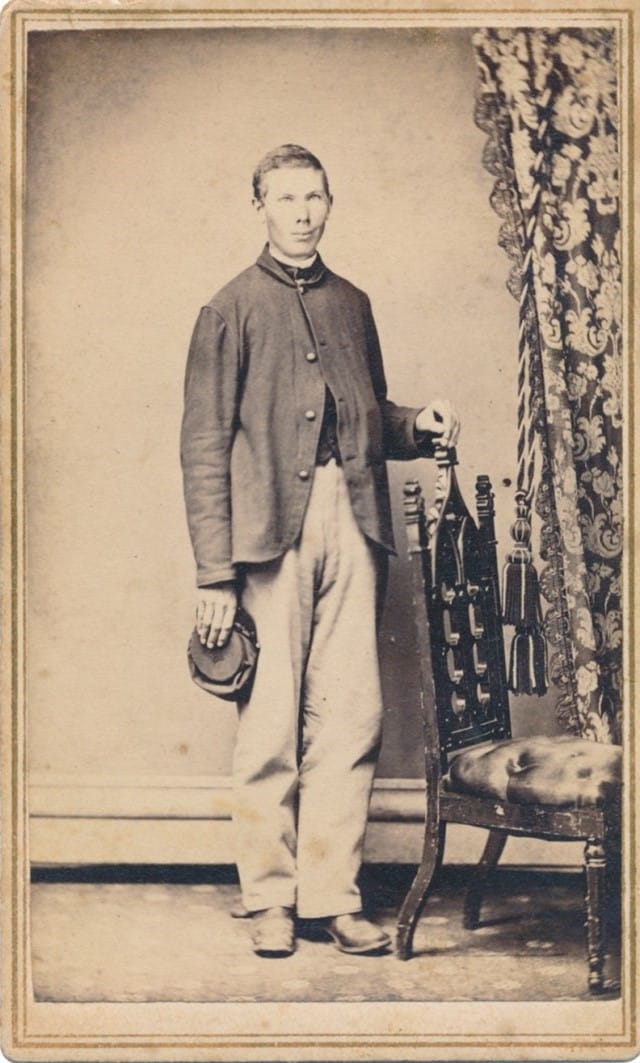
In what was probably his last letter home, the 123rd New York Infantry’s Pvt. Jeremiah “Jerry” Finch wrote to his mother on April 25, 1863, about the kinds of things that thousands of other soldiering young men put into their missives. The 21-year-old soldier talked about his health; he talked about receiving letters from friends; he talked about getting an expressed care box; he talked about a rumor of an expected movement by the army; he talked about receiving his pay; he talked about President Abraham Lincoln’s recent review of the troops; and he closed by reminding her that “I remain your affectionate son.”[1]
The camp rumors of the anticipated move that Jerry Finch heard about proved true. As part of the Army of the Potomac’s XII Corps, the 123rd New York received orders two days after Finch wrote his mother. Describing April 27, the regimental historian vividly wrote that “a brighter morning never shone than on that April morning as each company and regiment filed out of its camp towards the column already en route. The sun’s rays, reflecting from thousands of bayonets and polished gun barrels, resembled a phosphorescent sea, whose brilliancy the beholder can never forget and only faintly describe.”[2]
The XII Corps, along with the V and XI, marched west from their Stafford County camps and crossed the Rappahannock River at Kelly’s Ford. They then moved south to cross the Rapidan River at Germanna Ford on April 29. The next day they traveled east toward Chancellorsville, heading into the Wilderness. Corporal Rice C. Bull, who served in Finch’s Company D, recalled the Wilderness as “a rough, wild, abandoned county, covered with thick growth of scraggly and stunted timber, growing in many places so rank as to be almost impassable to man or beast.”[3]
Later in the day on April 30, the 123rd, along with other regiments in the XII Corps, received orders to move south from Chancellorsville and establish a line of earthworks. “Axes and shovels were furnished and we were soon hard at work,” Corp. Bull remembered.[4]
On the morning of May 1, the XII Corps advanced east along the Orange Plank Road when they ran into Gen. Richard H. Anderson’s Confederate infantry division, accompanied by artillery. This was the first trial by fire for the 123rd New York. The artillery fire impressed Corp. Bull. “The duel between the batteries continued for some time and was exciting to us who had never before seen such action. The enemy’s shots were directed at our battery so mostly fell at our left where they could do us no damage. We could see where the solid shot struck from the dust they threw up when they hit the ground. The shells were more spectacular because they burst in the air and the pieces flew in all directions singing and shrieking,” Bull noted.[5]
The XII Corps moved forward to about the Alrich Farm at the intersection of the Orange Plank Road and Catharpin Road when corps commander Maj. Gen. Henry Slocum received orders from Army of the Potomac commander, Maj. Gen. Joseph Hooker, to fall back to Chancellorsville.
The 123rd’s colonel, Archibald McDougall, reported that he received orders to return to their former place in the earthwork line that they had constructed the day before. Once there, the regiment received additional orders to move further south to the skirmish line that a company of his regiment had occupied the night before. Colonel McDougall explained that “the regiment taking position under cover of a hill, while the company was approaching the picket line left in the morning, the enemy opened a fire of musketry from the woods, where, in our absence, they had established rifle-pits and erected a battery.” The skirmishing company, I, received a boost when Company A was order to join them, while “the regiment was moved rapidly to the brow of a hill [Hazel Grove] in front of the enemy, near a house and within 200 yards of the lines formed by the two companies.”[6]
Corporal Bull wrote about this move as well: “During this time we were standing at rest on top of the hill, which was bare of trees and underbrush, and as it developed later we were in full view of the enemy’s line. Suddenly, without the usual skirmishing that would have warned us to lie down, a volley fired from the enemy’s line and bullets began to whistle and sing.”[7]
It is fairly rare to get several eye-witness accounts about a single private soldier’s death during a Civil War battle, but as this was one of the first casualties for the 123rd New York, it seems to have resonated with the unit. Not only does Bull mention Pvt. Finch’s death, but so do two other soldiers in their Company D.
Bull stated that “I was standing next to Jerry Finch, one of our younger boys. At the first round Jerry’s gun tumbled from his hands and he staggered and fell at my feet. I stooped down and turned him over as he had fallen on his face; when I spoke he gave no answer. He had been instantly killed.”[8]
Writing to Finch’s sister Amanda six days after this fight, Pvt. James F. Wallace explained to her that “we were ordered out to support the pickets where we laid and fought them about an hour. In this battle your brother was killed. He was next to me on my right hand when he was shot. It killed him instantly. He was doing his duty nobely. He did not appear to be the least excited.”[9]
Similarly, Pvt. Ransom Fisher wrote to Finch’s mother, Catherine, on the same day that Wallace wrote to Finch’s sister. Fisher penned that “at noon we were sent on picket and had got the men posted when they were fired upon by the enemy. Then the regiment was ordered by the cursed Brigadier General to attack them and did so and charged out on and open fill [field] and were fired upon. The bullets flew like hail. Jerry was at my side and a ball went by my head and strick [struck] him in the left side. He fell heavily forward on his face. He spoke to me when he was falling and said ‘Oh my god, my god, I am shot!’ That was all he said. He died instantly.”[10]
Bull explained that right after Finch was killed, “We all dropped to the ground but the musketry fire continued and it was brisk with bullets coming fast. Many were hit but we could not return the fire as our skirmishers were in the line between us and the enemy.” Then Confederate artillery joined in, “and shells fell and exploded in the open field about us. We were then ordered back to the woods on our side of the clearing where we formed a new front and remained until Company A was recalled from the skirmish line.” In addition to Finch, Lt. Col. Franklin Norton was also killed.[11]
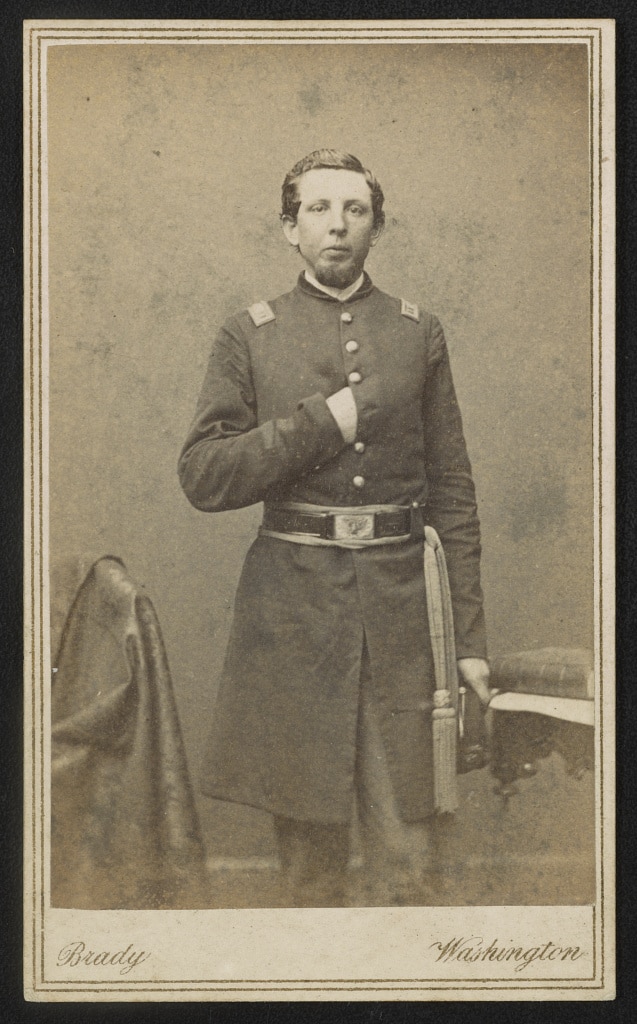
When the 123rd fell back they were unable to take Finch’s body with them. Private Fisher explained to Mrs. Finch, that “I and George Pattison tried to get leave to go and get his body but could not for the rebs held the ground. The next morning our men retook the field, and Jerry was buried by the 20th Conn[ecticut] Vols. in a peach orchard where he fell like a hero. They found papers about him and put a board to mark his grave with his name, Co., and Regt. It is a nice place where he fell; a sunny hill. I tried to get some things that he had to send you but could not—I think the rebels took what things he had.”[12]
James Wallace’s story to Finch’s sister was similar to that provided by Fisher, except Wallace thought the 27th Indiana buried Finch instead of the 20th Connecticut. Wallace, too, noted, “His things were all lost. . . .”[13]
The 123rd saw more fighting on May 2 and May 3. During the sheer bedlam of May 3, Corp. Bull was wounded in the face and side and was captured. He spent about a week and half on the Chancellorsville battlefield as a prisoner of war receiving very little medical attention before the Confederates allowed a Federal ambulance train to gather up the wounded. Transported to Aquia Landing, they went by boat to Washington. Those who were mobile received furloughs to go home and recover.[14]
In his account, Bull referred to Pvt. Finch “a fine young boy of character and a splendid soldier,” while in a May 21 letter, Lt. Edward P. Quinn of Finch’s Company D offered Mrs. Finch “my most heartfelt sympathy to all your family.” Mrs. Finch had apparently corresponded earlier with Lt. Quinn about trying to obtain Jerry’s body. Quinn replied in the missive that “I was in hopes that something would turn up in that I could get the Body. But I find it to be impossible. The ‘Rebs’ are in possession of the field, consequently all communication is cut off.” However he added that “Any possible chance of obtaining Jerry’s remains will be promptly communicated to you by me. . . .”[15]
In May 1865, the 123rd revisited the Chancellorsville battlefield on their way from North Carolina to the Grand Review in Washington D.C. Bull went to the site where he was wounded and the log structure at Fairview where he spent so much time in pain while a prisoner. Lieutenant Quinn had been wounded in Georgia during the Atlanta Campaign and was apparently not with the regiment at that time to see to Pvt. Finch’s remains.[16]
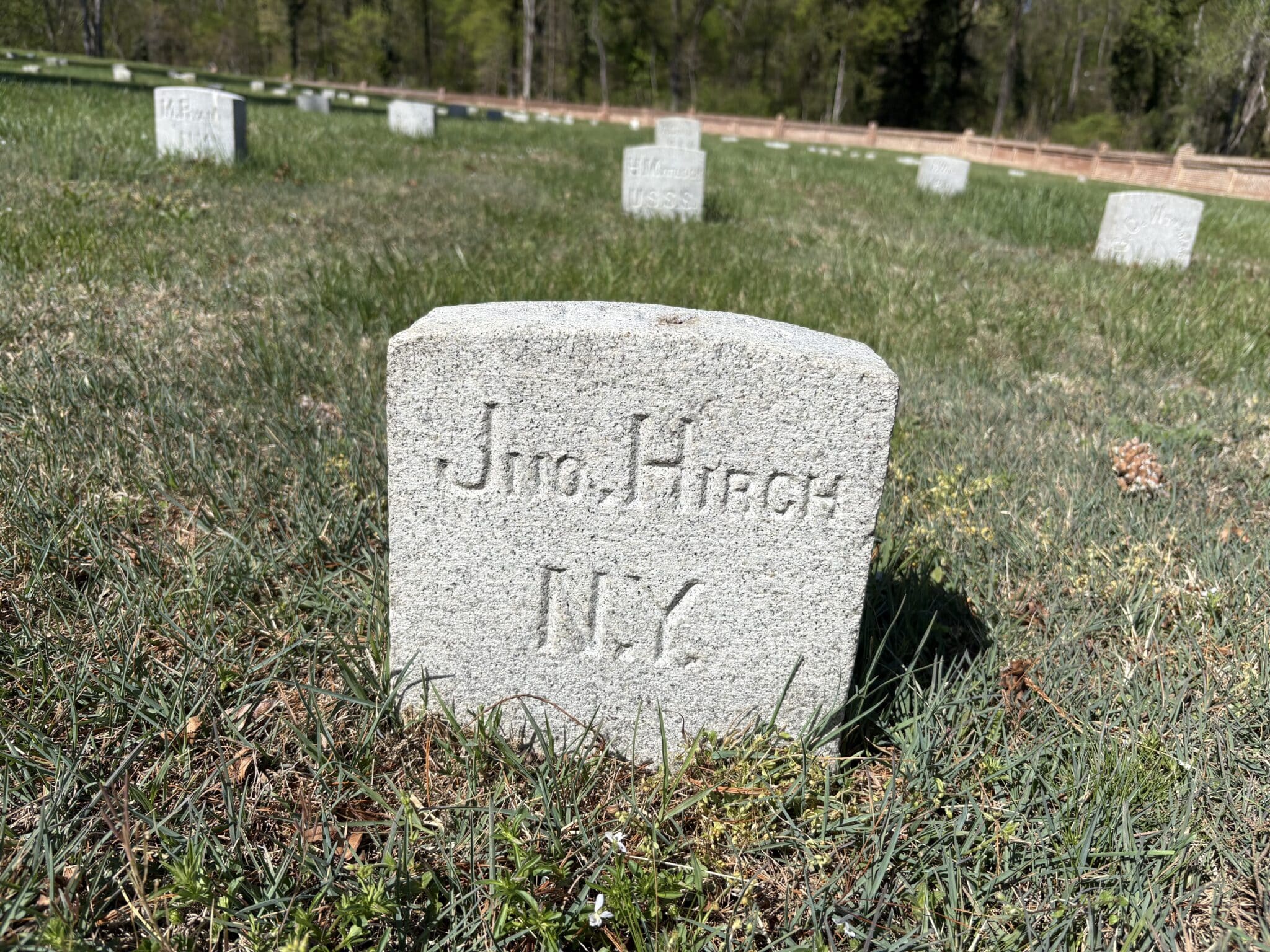
Following the war, Pvt. Jerry Finch was apparently among the soldiers gathered for reburial in the Fredericksburg National Cemetery. At the cemetery, the name John Hirch of New York is designated on grave number 4975. However, there is not a soldier from New York with that name. The National Park Service’s roster of graves notes that Finch is the “likely occupant” of the grave.

Rest in peace, Pvt. Finch, rest in peace.
Sources:
[1] Jerry Finch to Mother, April 25, 1863, in the Fredericksburg and Spotsylvania National Military Park bound manuscript collection, vol. 71.
[2] Henry C. Morhous, Reminiscences of the 123d Regiment, N.Y.S.V., Giving a Complete History of its Three Years in the War (Greenwich, NY: People’s Journal Book and Job Office, 1879), 24.
[3] K. Jack Bauer, ed., Soldiering: The Civil War Diary of Rice C. Bull, 123rd New York Infantry (San Rafael, CA: Presidio Press, 1977), 38-41.
[4] Ibid, 43.
[5] Ibid, 44-46.
[6] OR, Vol. 25, Pt. 1, 704.
[7] Bauer, Soldering, 46.
[8] Ibid, 46-47.
[9] James F. Wallace to Amanda Finch, May 7, 1863, in the Fredericksburg and Spotsylvania National Military Park bound manuscript collection, vol. 71.
[10] Ransom Fisher to Catherine Fisher, May 7, 1863, in the Fredericksburg and Spotsylvania National Military Park bound manuscript collection, vol. 71.
[11] Bauer, Soldiering, 47.
[12] Ransom Fisher to Catherine Fisher, May 7, 1863, in the Fredericksburg and Spotsylvania National Military Park bound manuscript collection, vol. 71.
[13] James F. Wallace to Amanda Finch, May 7, 1863, in the Fredericksburg and Spotsylvania National Military Park bound manuscript collection, vol. 71.
[14] Bauer, Soldiering, 48-87.
[15] Bauer, Soldering, 47; Edward Quinn to Catherine Fisher, May 21, 1863, in in the Fredericksburg and Spotsylvania National Military Park bound manuscript collection, vol. 71.
[16] Bauer, Soldiering, 244-245; Roster of the One Hundred and Twenty Third New York Infantry, https://dmna.ny.gov/historic/reghist/civil/rosters/Infantry/123rd_Infantry_CW_Roster.pdf, accessed April 17, 2026.


What a sad but compelling story. It’s a shame the stone can’t be corrected – he deserves that at the very least
I’m not sure if that is possible or not. It is certainly worth checking into. Thanks!
At this point the stones themselves in the cemetery are considered historic resources, and cannot be changed. There are unfortunately a multitude of stones with provable errors, typos, or wrong names. The best we can do is keep a record of who we think the correct names or occupants are.
A poignant story, Tim. Thank you for sharing it with us. My GG GF’s regiment, the 3rd Maryland Infantry, was part of Bull’s brigade, so I often turn to Bull’s memoir. A classic.
Thanks, John. The Twelfth Corps and Third Corps regiments saw some horrific combat at Chancellorsville.
Ryan, Thank you for the clarification on the grave stones. I believe I remember hearing that policy explained when Poplar Grove National Cemetery at Petersburg replaced all of the old stones with new ones.
Yes, Tim, agreed that it is a sad but compelling story. It is noteworthy that so many of Pvt. Finch’s comrades were able and willing to share their grief with the family.