Superb Spuds: The Friendship of Winfield S. Hancock and Henry Heth
ECW welcomes guest author Brian Burtka, SJ.
Winfield Scott Hancock, a hero of Gettysburg and the Democratic presidential candidate in 1880, entered modern public memory due to the popularity of the book The Killer Angels (1974) and the film Gettysburg (1993). In these, a central part of Hancock’s story is his relationship with Confederate Gen. Lewis A. Armistead. Both portray Hancock and Armistead as intensely personal friends separated by the war.[1] This friendship captivates audiences because it represents the emotional turmoil of the period by “adding a new layer to the friend-versus-friend ethos of the Civil War.”[2]
The connection to the human heart allows the relationship to live in public memory despite being embellished in these fictional works. While not inherently bad, the popularity of the book and film allows artistic license to replace historical reality.
The historical reality is that the two men were indeed close friends, but perhaps not to the depth that the book and movie portray.[3] The irony is that Winfield S. Hancock possessed a close relationship with Confederate Gen. Henry Heth. Their friendship was what the creators of the book and movie wanted Hancock and Armistead to be. Despite fighting on opposing sides during the Civil War, Hancock and Heth’s relationship survived until Hancock’s death.
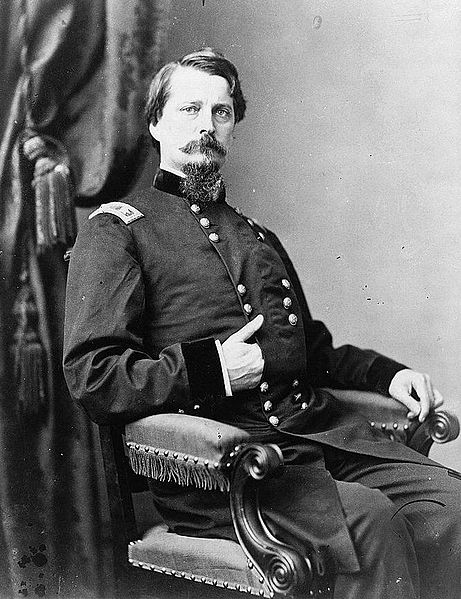
Their lifelong friendship began during the Mexican War. When Heth arrived in Mexico City to join the Army of Occupation, Hancock and Heth became messmates. They spent their free time womanizing around Mexico City. During one such occasion, Heth volunteered to be a lookout while Hancock approached the daughter of their host.[4] Additionally, Hancock showed Heth some battlefields from the Mexican War.[5]
Their friendship solidified in the years after the Mexican War. After leaving Mexico City in mid-1848, they participated in the social life of St. Louis before their regiments were sent to the frontier. On the last night they spent together, they took the regimental band around town to serenade women. Hancock’s future wife, Almira Russell, dropped her glove. Heth handed it to Hancock.[6] Heth was too ill to attend Hancock’s wedding in 1850.[7] When Heth encountered them in St. Louis in 1852, the womanizer of Mexico was gone: Hancock was “happily married and thoroughly domesticated.”[8]
After leaving St. Louis on separate assignments, Heth got deathly sick with dysentery. Hancock voluntarily traveled with Heth from Wisconsin back to Heth’s home in Richmond. On this journey, they detoured to New York City where they called on Hancock’s namesake, Gen. Winfield Scott, who insisted that the two young officers join him for dinner, claiming to serve “the best potatoes in the United States.” Hancock horrified Scott by mashing those potatoes on his plate. This amused Heth, who never let Hancock forget “the potato episode.”[9]
Even the Civil War did not destroy this friendship. The most notable test between them was at the second battle of Ream’s Station on August 25, 1864. Hancock and the II Corps were sent to destroy a portion of the Weldon Railroad near this location. During this battle, Hancock occupied a U-shaped trench from the first battle of Ream’s Station two months prior. In these trenches, Hancock’s force faced off against Heth, who commanded the Confederates in the absence of A.P. Hill, who was sick. During the third Confederate assault, the Union 1st Division crumbled. The rest of the II Corps followed, and Heth handed Hancock a resounding defeat.[10]
This loss deeply embarrassed Hancock and the II Corps, losing twelve regimental flags and nine artillery pieces.[11] Immediately after the battle, the soldiers sought a scapegoat. General John Gibbon, commander of the 2nd Division, approached Hancock and demanded a reorganization of the entire II Corps.
Hancock took this demand as criticism of his leadership and replied that Gibbon should give up command. Gibbon took this personally and applied to be relieved of command. After a heated conversation, Hancock and Gibbon worked out their professional differences on this issue. Gibbon remained with the II Corps until he was transferred less than two weeks later; however the personal rift between the two was never healed. In Gibbon’s words, “there was a soreness of feeling remaining probably on both sides which never entirely disappeared.”[12]
This is notable because both shared intense experiences. On July 3, 1863, at Gettysburg, they shared a meal of rooster stew while awaiting Pickett’s Charge[13] and were both injured during this charge.[14] Despite this, the argument from the second battle of Ream’s Station proved fatal to their personal relationship.

The survival of Hancock’s friendship with Heth is revealed within a year after the war. During a spontaneous meeting in Baltimore, Hancock repaid a $1,000 debt that came from land investment in St. Louis before the Civil War. Heth called this a great kindness because “during the past four years we had been trying our best to kill each other—another commentary upon civil war.”[15]
In 1880, Heth was in New York City when Hancock was notified that he was the Democratic presidential candidate. Heth visited Hancock, and they spent many days reliving the Civil War. Heth wisely avoided the topic of Ream’s Station, stating “that if Hancock’s heart could have been examined there would have been written on it ‘Reams,’ as plainly as the deep scars received at Gettysburg and other fields were visible.”[16] When leaving, Heth could not let Hancock escape the potato episode:
“When taking leave of Hancock I said to him, ‘of course you will be elected President, and I wish you to make a promise.’
He interrupted me and said, ‘Heth, I have made it a rule, by which I shall be governed, to make no promises… I am determined to appoint no man to office that I do not believe qualified to fill it. I have told you that I intended to look out for you and I shall do so.’
I said, ‘I am not after an appointment the promise I wish you to make me is something personal to yourself. When you become President of the United States, you will have a great deal of entertaining to do. You will have to entertain crowned heads possibly, or those that are to wear crowns, the Justices of the Supreme Court, Senators and distinguished people. I want you to promise me at these functions not to mash your potatoes.’
‘To the devil with you and your potatoes,” was his reply.’[17]
This is the last recorded meeting between these two men before Hancock’s death in 1886.[18] Heth outlived Hancock, dying in 1899.[19] What Heth felt or thought at Hancock’s death goes unrecorded in his memoirs. However, given the depth and length of their friendship, Heth probably mourned Hancock’s death.
Hancock and Heth’s friendship is a real historical example of what Hancock and Armistead’s dramatized relationship purports to be. Hancock and Heth developed a close relationship in the pre-war army. They were estranged from each other during the Civil War, yet remained friends despite Heth handing Hancock his most sobering defeat. After the war, their relationship remained strong. They were connected by big and small moments, from battles to potatoes. This friendship connects people to the tragedy of war and should be the one remembered. Truly, Hancock and Heth were good friends, perhaps best described as superb spuds.
Brian Burtka, S.J., is a high school history teacher in Cleveland, OH who portrays Winfield Scott Hancock at reenactments across the Midwest. For more information about Hancock and Brian, visit his website: https://hancockthesuperb.com/.
Endnotes:
[1] Gettysburg, directed by Ronald F. Maxwell (1993; New Line Cinema 1993); Michael Shaara, The Killer Angels (Ballantine Books, 1993, 38th Ed.), 61-62.
[2] Tom McMillan, Armistead and Hancock: Behind the Gettysburg Legend at the Turning Point of the Civil War (Stackpole Books, 2021), 235.
[3] McMillan, 6-10.
[4] David M. Jordan, Winfield Scott Hancock: A Soldier’s Life (Indiana University Press, 1996), 17-18; James L. Morrison, Jr., ed. The Memoirs of Henry Heth (Greenwood Press, 1974), 59-60.
[5] Morrison, 65.
[6] Jordan, 20-23.
[7] Morrison, 110-111.
[8] Jordan, 22-23.
[9] Morrison, 75-77.
[10] Jordan, 159-162; Lawrence A. Kreiser, Jr., Defeating Lee: A History of the Second Corps, Army of the Potomac (Indiana University Press, 2011), 207-208; Ryan Quint, “‘A Hideous Dream’: The Federal Second Corps at the Second Battle of Ream’s Station,” Emerging Civil War, August 25, 2014.
[11] Quint.
[12] Jordan, 163-164; Kreiser, 211-212.
[13] Jordan, 95-96.
[14] Kreiser, 121.
[15] Morrison, 200-202.
[16] Morrison, 205-206.
[17] Emphasis is original to Heth; Morrison, 207.
[18] Jordan, 1.
[19] Morrison, lxiii


To me, Harry Heth is the lost quiet man of the Civil War. Not only was his work at Teams Station, but he had already handled Hancock well on the First Day of the Wilderness. He needs a great biographer.
Nice article, Brian. Really enjoyed your portrayal of Hancock at the CCWRT.
Love this article and the personal anecdotes. Both Heth and Hancock were hardened veterans, I’m sure they knew not to take battlefield reversals personally. After all, Heth’s side ultimately lost. It would have been interesting if Hancock actually became president. I wonder what his administration would’ve been like?
Well done Cleveland, Ohio!
Brian, Cleveland CWRT really enjoyed your talk. What I especially appreciated in your talk was the way you restored human scale to Civil War memory. Sitting in the CCWRT audience, I found the Hancock-Heth friendship especially revealing because it moved beyond the more familiar romance of the Hancock-Armistead story into something earthier and more durable: a friendship that endured embarrassment, defeat, debt, distance, and time. The potato episode worked beautifully, not just as a charming anecdote, but as a small comic proof that affection can outlast the grand machinery of war. ~Don Iannone