“He laid back upon his couch, and breathed back his great Soul to God”: Henry Ward Beecher’s Eulogy for Ulysses Grant
Historians can find primary sources from the strangest rabbit holes. I had just finished listening (for the fifteenth time, most likely) to a radio drama-style podcast titled 1865. It’s two seasons that give a dramatic take on key events following the end of the Civil War, from Lincoln’s assassination and Andrew Johnson’s impeachment to the KKK Act of 1870 and the end of Reconstruction. Although the creators took minor historical liberties for the sake of the story, they prided themselves on using primary sources to build on a character’s dialogue. Season Two ended with Grant’s death shortly after finishing his memoirs, with a voiceover of what at first sounded like a eulogy made by the show’s writers. Once I discovered it was real, I began my search to find it in full and dissect it.
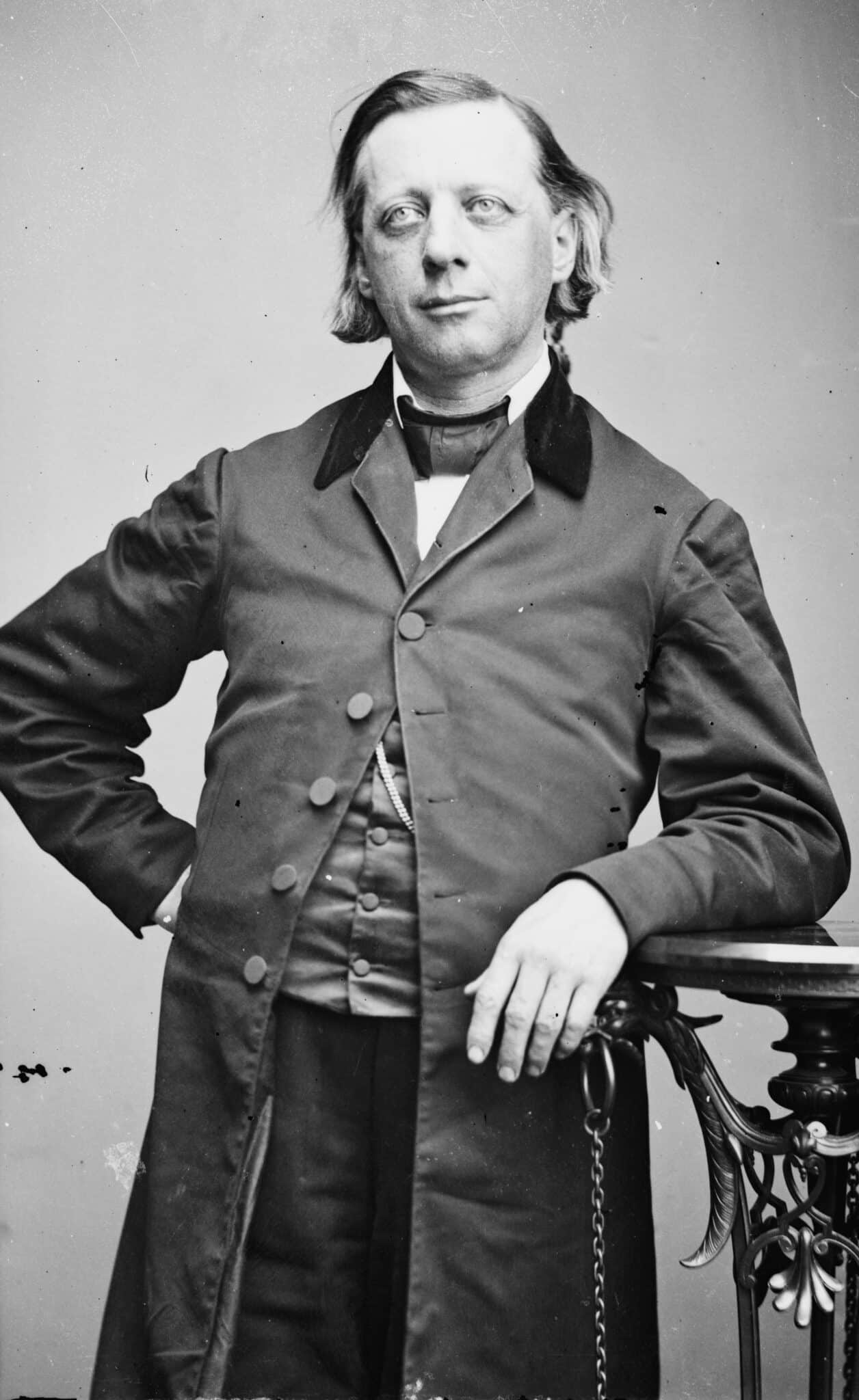
The eulogy was written by Henry Ward Beecher, a well-known abolitionist, clergyman, and social reformer whose sister Harriet was famous in her own right as the author of Uncle Tom’s Cabin. Although Ulysses Grant died on July 23, 1885, Beecher spoke three months later in Boston and examined the legacy of the former general-turned-president. He opened with a broad, nuanced description of Grant and said he was not a man to be seen as a saint. Beecher continued, however, that “Men without faults are apt to be men without force…Light and shadows, hills and valleys, give beauty to the landscape.”
Grant’s relationship with alcohol was a divisive topic when he was alive and continued to haunt his legacy after he was gone. Beecher argued that Grant, through turbulent moments in his military career, “overcame the wish to drink.” Although Beecher acknowledged that his reputation was clouded by this, he argued that the will not to succumb to alcohol was a greater achievement than anything he had done, both on the battlefield and in the White House. Grant’s record as the victor over the Confederacy and defender of the freedmen may seem like the more significant milestones, but sobriety was important to Beecher, considering he was a stanch advocate of the temperance movement and a personal teetotaler himself.
When discussing the war itself, Beecher linked his abolitionist views to Grant’s successes. “The South had builded herself upon the rock of Slavery,” said Beecher in reference to the Secession Crisis. When he referenced Grant as commander of all Union forces, Beecher described him as the best representative of a cause that was “waged for the maintenance of the Union, the suppression of armed resistance, and, at length, for the eradication of Slavery.” The abolitionist preacher also contested the claims that Grant was a butcher of men during the Overland Campaign. Beecher argued Grant disregarded the passiveness of former Union generals to not finish off Lee once and for all, and that “he hammered Lee, with blow to blow, until, at Appomattox, the great, but not greatest, Southern General went to the ground.” Even with praising Grant’s military reputation, he could not help but damage Lee’s own legacy, and by extension, the mascot of the Confederate war effort.
Some of the early histories of Grant’s life typically stopped at Appomattox, and even the general’s own memoirs stopped at 1865. With the war section of his eulogy over, Beecher decided to continue to give a nuanced and balanced depiction of Grant’s presidential service during Reconstruction. Although Grant assumed he would find a peaceful and quiet life after the war, he would instead be “called to the Presidency by universal acclaim, and it fell to him to conduct a campaign of Reconstruction even more burdensome than the war.” Beecher did not exaggerate the severity of the post-war United States, a nation that had, by 1868, been in a death roll over the issues of Black suffrage and equality. The push for voting rights came with violent pushback in the form of organized terror, such as the Ku Klux Klan. In Beecher’s own words, it was to be considered “a political necessity to arm [Blacks] with the ballot as a means of self-defense.” Although Grant’s war with the Klan and political violence revered him and helped him win reelection in 1872, Beecher also touched on the controversies surrounding the administration.
The possibility of a third term, according to Beecher, was snuffed out not by Grant himself but by objections “against the staff which would come with him.” He warned that although the nation owed a great debt to Grant for his efforts, the providence of historical record would tarnish Grant’s legacy. Never considered a corrupt man himself, Beecher considered Grant too trusting of men like Orville Babcock, who took advantage of both their political station and personal relationship with the president and enriched themselves in the process. To that end, Beecher believed that Grant’s “loyalty to friendship must be set down as a fault — a fault rarely found among public men.”
Beecher concluded by detailing Grant’s final months as he was diagnosed with throat cancer. He said that when wealth had vanished from the Grant family, Ulysses began work on his personal memoirs to provide financial protection for those he left behind. This required all of Grant’s energy to write and talk about his reputation, a task that, by all accounts, pained him physically. Poetically, Beecher stated, “when the last lines were written, he laid back upon his couch and breathed back his great Soul to God…He rests in peace. No drum or cannon shall disturb his rest.”[1]
Had it not been known that this eulogy was vocalized in 1885, Henry Ward Beecher’s words on Ulysses S. Grant could have been said in recent years. The abolitionist countered the Lost Cause accusations that Grant was a careless butcher of men and a meager drunkard, and instead offered a more nuanced interpretation of the man’s legacy. For Beecher, General Grant was responsible not only for the end of the Civil War, but also the metaphorical David to slavery’s Goliath. But Beecher did not hold back on criticisms of Grant either, arguing that the eighteenth president’s trust in those around him not only led to his political downfall, but also consequently ended Reconstruction, which ushered the freedmen into a new kind of slavery. For all intents and purposes, Grant was just an ordinary man who was able to do unordinary things, but also fell short, as everyone does.
[1] Henry Ward Beecher, Eulogy on General Grant, by Henry Ward Beecher. Delivered at Tremont Temple, Boston …Oct. 22, 1885. (Jenkins & McCowan, 1885).


What an interesting eulogy, and it is so true that ” men without faults are apt to be men without force.”
Where can one find the two-part podcast?
https://podcasts.apple.com/us/podcast/1865/id1467256065
many thanks for this.
Excellent piece. Thanks for this.