Comedy, Satire, and the Civil War
Like most wars, the American Civil War was an enormous tragedy, marked by incalculable loss of life and property. Yet out of that death and destruction, people have also found room for humor. In our own lifetimes, television shows like M*A*S*H and Hogan’s Heroes used gallows humor to highlight the absurdities and contradictions of war, humanize the participants, and help audiences process real-life trauma.
Just as filmmakers and television writers used modern wars to lampoon the absurdities of military life, they occasionally turned the same comedic lens on the Civil War. One memorable example appears in The Simpsons Season Six episode “The PTA Disbands,” in which Springfield Elementary visits Fort Springfield for a Civil War reenactment.[1]
A group of Confederates waving white flags attempts to surrender, pleading, “We’re sick. We need leeches and hacksaws to saw off our gangrenous limbs!” But the 9th Bearded Infantry is “too brave to accept the surrender.” The Union side routs the unarmed enemy while the narrator proudly declares, “And the Springfielders heroically slaughtered their enemies as they prayed for mercy.”
The scene pokes fun at 19th-century battlefield medicine and the human tendency to sanitize or glorify horrific events.
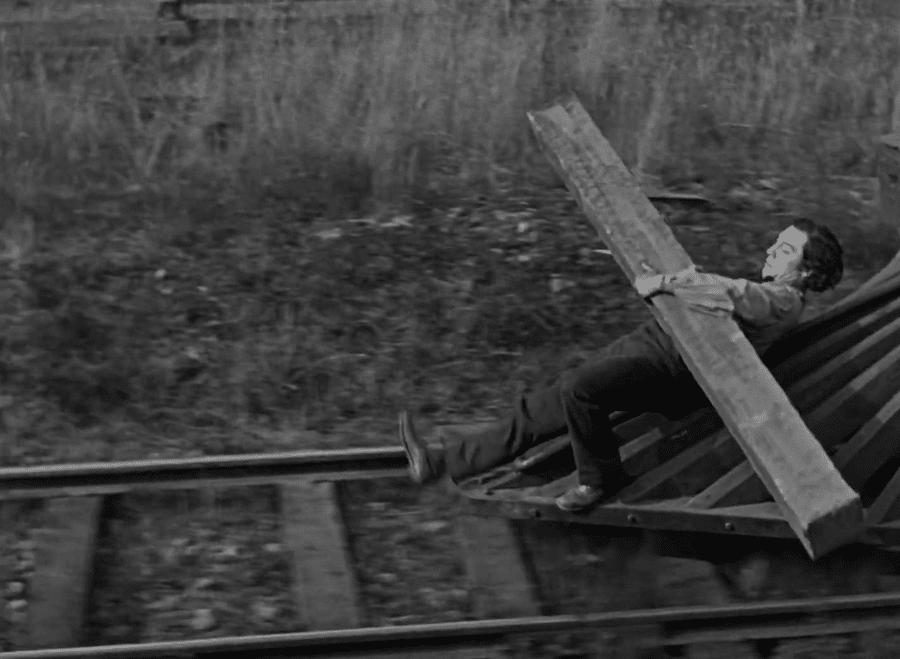
One early attempt at a Civil War comedy film was Buster Keaton’s The General (1926), a movie panned in its day, but now widely regarded as a classic of the silent era. It is loosely based on the real-life 1862 “Great Locomotive Chase” through northern Georgia. Much of the humor comes from Keaton’s picaresque protagonist, who relies on quick thinking and ingenuity to survive a series of dangerous and increasingly absurd situations.[2]
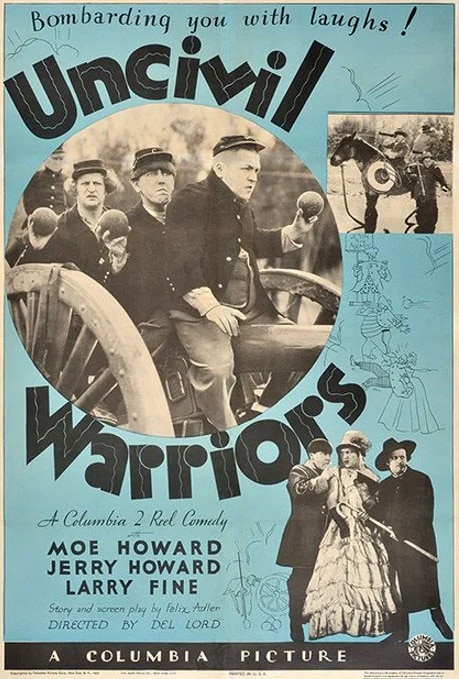
In 1935, seventy years after the Civil War ended, Moe Howard, Larry Fine, and Jerry “Curly” Howard of The Three Stooges starred in a short film titled Uncivil Warriors, promoted with the tagline “Bombarding you with laughs.” The 19-minute comedy spoofed MGM’s Operator 13, released the previous year, in which Curly had appeared in a small role as a Confederate soldier.[3] Civil War spies and secret agents were popular subjects in novels and films of the era.
In Uncivil Warriors, a Union general tasks Larry, Moe, and Curly, otherwise known as Operators 12, 14, and 15, with infiltrating the headquarters of Confederate Colonel “Buttz” and stealing his battle plans. The trio dons captured Confederate uniforms and assumes the tongue-in-cheek identities of “Lieutenant Duck,” “Captain Dodge,” and “Major Hyde.”[4]
The Stooges’ trademark slapstick and physical comedy runs throughout the film. Once inside the colonel’s mansion, they become smitten with his lovely daughters, Judith and Clementine (played by Phyllis Crane and Celeste Edwards), along with Judith’s friend, portrayed by Jenifer Gray. Curly tries to help Judith bake a “Southern Comfort” cake, but accidentally bakes a torn potholder into it, causing the trio to vomit feathers. “Tastes like Southern comforter.”
Before long, Major “Bloodhound” Filbert (Theodore Lorch) arrives to sniff out suspected Yankee spies. Fearing discovery, Larry and Curly disguise themselves as Captain Dodge’s father and wife, but Filbert knows something they do not: The real Captain Dodge and his wife recently had a baby. When Filbert asks where the infant is, Moe dashes off and grabs the first baby he can find, which happens to be black. The blunder immediately exposes their ruse, and the trio flees the mansion.
Uncivil Warriors ends with the Stooges accidentally hiding inside a large cannon, which promptly fires them back toward their commanding officer.
Beneath the sight gags and physical comedy lies a sharp mockery of military culture: the obsession with titles and uniforms, the incompetence of authority figures, and the farcical pomp and self-aggrandizement surrounding war. It is no coincidence the film appeared in the 1930s, as militaristic regimes were rising across Europe and Asia. In the hands of the Stooges, the American Civil War became a vehicle for subtly satirizing contemporary events.
In the early 1960s, public interest in the Civil War surged alongside the conflict’s centennial anniversary, and Civil War comedy evolved from visual slapstick into more pointed satire. Like Fort Springfield’s distorted portrayal of the 9th Bearded Infantry, Americans had begun to mythologize the war and its personalities. Comedy was one way to disarm the myths.
Following the Korean War and on the eve of American involvement in Vietnam, MGM released the feature-length comedy Advance to the Rear (1964), another story centered on a group of military misfits. The characters, court-martialed for cowardice during the Civil War, are shipped west, making the film less a traditional war movie than a Western comedy set against the backdrop of the conflict.[5]
Union Col. Claude Brackenbury (Melvyn Douglas, himself a World War I veteran) and Capt. Jared Heath (Glenn Ford) land in trouble after Brackenbury’s gentleman’s agreement with his Confederate counterpart to “keep our generals happy” without “anyone getting hurt” ends disastrously for the Union. At one point, Brackenbury snaps at Heath: “I’ll tell you what the purpose of this war is, captain. The purpose of this war is for you to shut up and do as you’re told! Not go around disturbing the status quo all the time.”
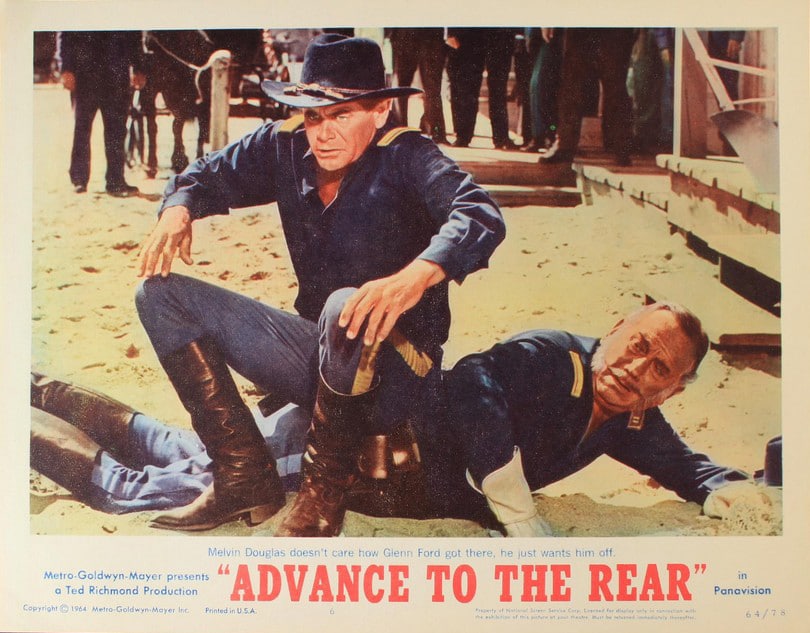
The pair are demoted and sent to a remote outpost in the western territories alongside a collection of cowards, criminals, and other sad sacks.
The Confederates dispatch a spy, Martha Lou Williams (played by actress and Playboy Playmate Stella Stevens), to investigate, but Heath falls in love with her. The film reaches its climax when the misfits uncover a Confederate plot to seize a shipment of gold moving through the region. The scheme is orchestrated by Confederate agent Hugo Zattig (James Griffith) and his ally Charlie Thin Elk (Michael Pate).[6]
While confronting Brackenbury, however, Thin Elk discovers the two men both graduated from the United States Military Academy at West Point and later releases them, though without their weapons or uniforms.[7] Heath, now a lieutenant, eventually turns the tables on the Confederates, captures the villains, and gets both the girl and the gold. A classic Hollywood ending.
Advance to the Rear is based on Jack Schaefer’s 1957 novel Company of Cowards, which was itself inspired by William Chamberlain’s 1956 short story of the same name published in the Saturday Evening Post. Chamberlain’s version was set during World War II, while Schaefer shifted the story to the Civil War. Both works referenced “Company Q,” Civil War-era slang for soldiers in hospitals, the sick, malingerers, deserters, and other men considered unfit for duty. Neither was intended as comedy; both were serious dramatic works.[8]
In the fiction of Schaefer and Chamberlain, as in most war films, the “coward” is either a villain or a tragic figure who must redeem himself through death. Advance to the Rear turns that idea upside down by making the cowards its protagonists and military bureaucracy the true villain. Beneath the humor is the suggestion that wanting to survive and avoid senseless death may be the only rational response to an irrational war.
War films, especially satirical comedies like Uncivil Warriors and Advance to the Rear, are rarely just about a particular conflict. These films offer viewers something beyond a rote reenactment of historical events. Through comedy, the war itself, in this case the Civil War, becomes a vehicle for the filmmakers’ critique of militarism, authority, conformity, and the loss of individuality.
[1] Jennifer Crittenden, “The PTA Disbands,” The Simpsons, FOX, April 16, 1995; Matt Groening and Ray Richmond, ed., The Simpsons: A Complete Guide to Our Favorite Family (Harper Perennial, 1997), 172.
[2] John M. Cassidy, Civil War Cinema: A Pictorial History of Hollywood and the War Between the States (Pictorial Histories Publishing Company, 1986), 17-28.
[3] “Uncivil Warriors (1935),” The Three Stooges Online Filmography, https://web.archive.org/web/20250123164941/https://threestooges.net/filmography/view/8/
[4] Jon Solomon, The Complete Three Stooges: The Definitive Source Book for the Three Stooges (C3 Entertainment, Inc., 2001), 62-4.
[5] Cassidy, Civil War Cinema, 31-2.
[6] Roy Kinnard, The Blue and the Gray on the Silver Screen: More than Eighty Years of Civil War Movies (Birch Lane Press, 1996), 199-202.
[7] West Point’s first Native American graduate was David Moniac, a Muscogee, in 1822.
[8] William Chamberlain, “The Company of Cowards,” Saturday Evening Post, March 10, 1956, 34-5, 127-8, 130-1; Jack Schaefer, Company of Cowards (The Riverside Press, 1957). For a Civil War veteran’s perspective on “Company Q,” see Luther W. Hopkins, From Bull Run to Appomattox: A Boy’s View (Fleet-McGinley Co., 1908), 69-70.


I remember the opening of the TV program “F-Troop” that had the ‘hero’ charging Confederate lines because his sneezing fit scared his horse. His men followed, the Confederates were routed, and that hero was given command of ‘Fort Courage’!
I almost included “F-Troop” but from what I read, it seemed like more of a Western. Is that the case? I haven’t seen it.
You are right, it was indeed a comedic “US Cavalry vs. the Indians”. But the premise was the ‘new’ commanding officer of Fort Courage had “proven” his bravery in the sneezing incident during the Civil War. In other words, he “made his bones” in the CW. Man I loved that show! LOL.
Red Skelton- “A Southern Yankee” 1948
Clem Kadiddlehopper – Red Skeleton was absolutely hilarious back in the day (when television was actually worth watching).
Film, and later, television, play an enormous role in our culture – they are a mirror, they are a history book, they are an influencer and trend-setter, and on the downside, they often change great incidents or great books for some rather inexplicable commercial reasons and thus leave many people believing myths or outright falsehoods. ‘Gettysburg’ is a prime example, as is the novel it sprang from, ‘The Killer Angels’ – both are excellent works in many ways, but both perpetuate myths, misunderstandings, and enormous biases that, regretfully, were given stronger roots in people’s consciousness about the Civil War, making them even harder to debunk.
As for ‘The General,’ it is a mind-bendingly brilliant piece of filmmaking and humor, much of it unmatched a century later. Its production history is just as compelling as the film. Amongst countless great stories about it, it is interesting to note that Buster Keaton, who was a huge history and locomotive fan, worked very hard on the script, because, sensitive to how people perceived films, Keaton did not believe that the audience would accept Confederates as villains.
Also, each day as they worked on the film, whenever the locomotive (“The General” of the title) would reach a place where an appropriate patch of field stood, Keaton, cast and crew would immediately abandon filming and play baseball, much to the dismay of Assistant Director Clyde Bruckman. Witnesses said Keaton was such a phenomenal athlete that he could have played major league baseball.