Gaming Gettysburg
History is most often consumed passively, through the turning of a page or the contemplation of a granite monument or interpretive marker on a battlefield. But for those captivated by the battle of Gettysburg, the three days of July 1863 present an almost irresistible invitation to ask, “What if?” The desire to pull apart the mechanics of the battle and better understand the terrain has fueled a unique genre of simulation devoted to recreating the conflict on dining room tables and computer screens. My own initiation into this world of tabletop generalship began with a simple cardboard box.
The purchase came after hours spent browsing the shelves at Games Plus in the Chicago suburb of Mount Prospect, Illinois. The film Gettysburg (1993), along with a trip to the actual battlefield, sparked an interest in that battle that has stayed with me ever since. At the time, though, without a computer, I wanted something that could simulate it without forcing me to spend hundreds of dollars on miniatures. Avalon Hill’s game Gettysburg seemed like the perfect choice.
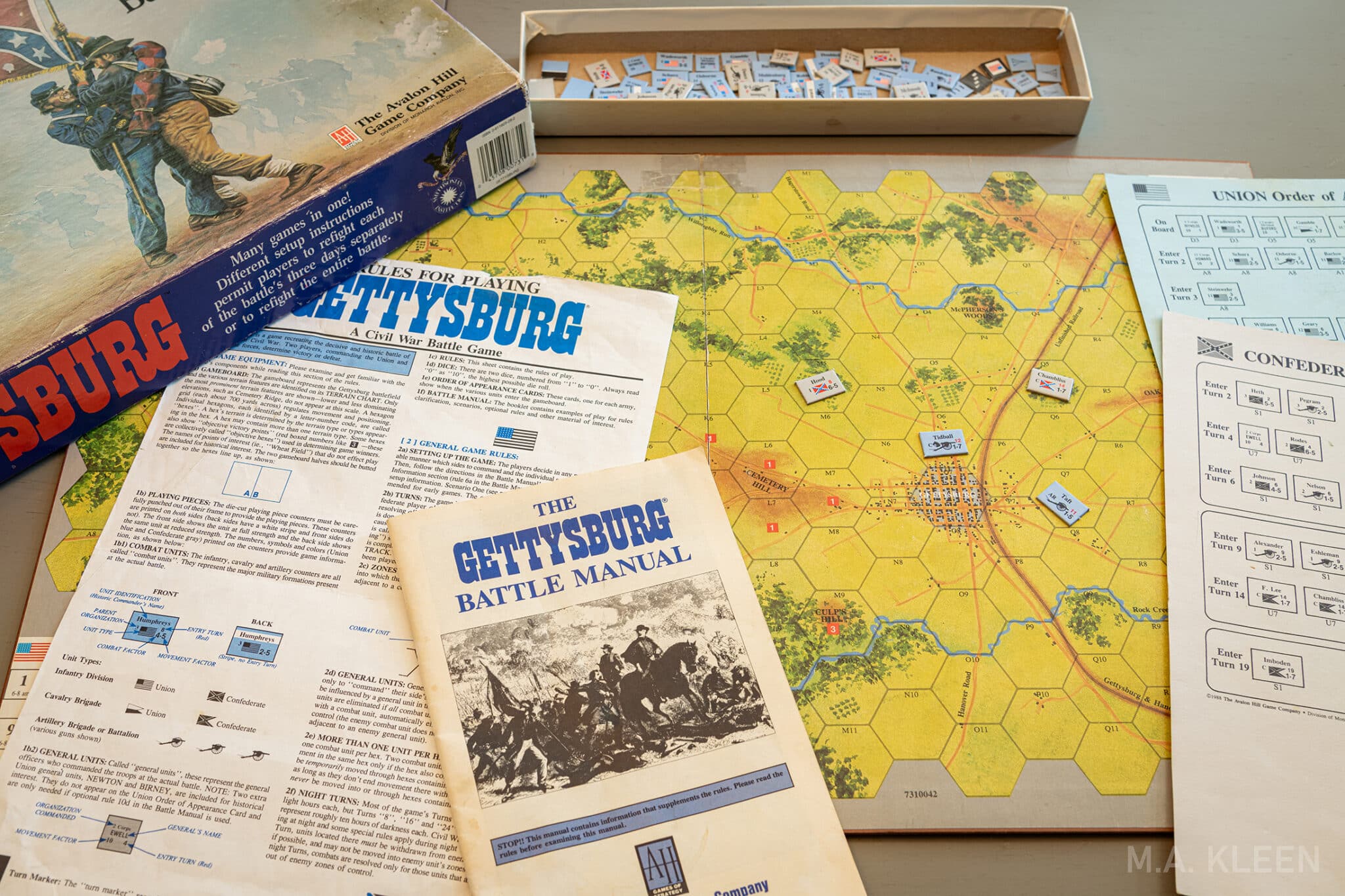
Designed by Charles S. Roberts and released in 1958, Gettysburg was the first board wargame based on a historical battle.[1] Its original incarnation, played with cardboard counters on a square-grid map, was clunkier than later editions, relying on division-level units, range cards, and combat tables. Roberts himself later admitted the game had been released without any playtesting, leading to what he called “numerous futile redesigns” with each new edition.[2] Even the divisions’ strengths failed to match their historical counterparts.
I bought the 1992 Smithsonian Edition, which came in a larger box than the battle’s 125th anniversary edition released four years earlier. Redesigned by S. Craig Taylor Jr., the game featured a beautifully illustrated hex map by Charles Kibler, and a battle manual with historical background, advanced rules, and five scenarios. This version used division-scale for infantry and brigade-scale for cavalry and artillery, with strengths that roughly approximated their historical counterparts. The map, scale, and overall balance marked a major improvement over the earlier editions.
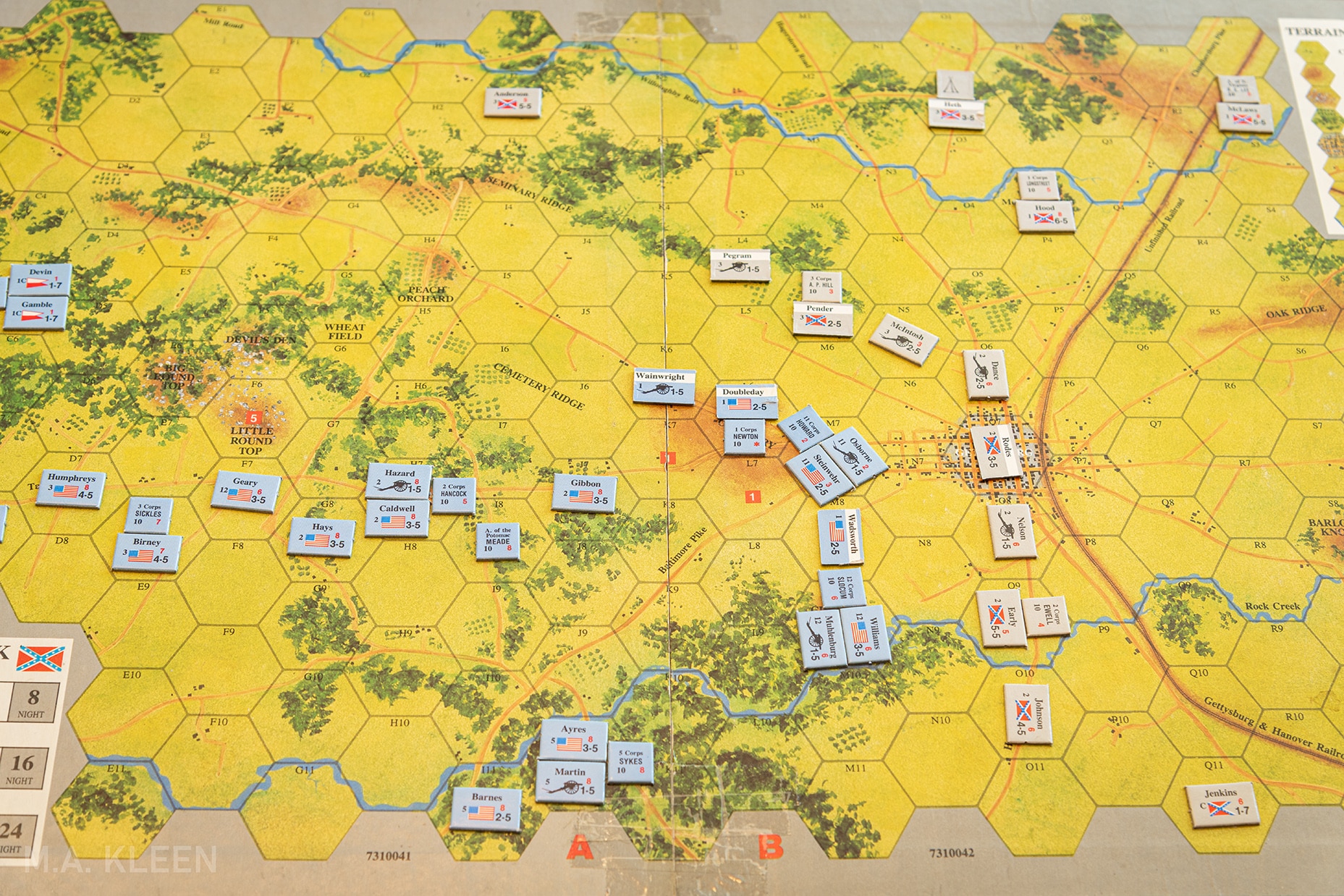
To briefly summarize the rules, each unit has a strength and movement value, with a reduced-strength side representing battle damage. Both movement and combat are modified by terrain. Combat is resolved by each player rolling a single six-sided die and applying modifiers. The defender holds a slight advantage because the attacker must roll a higher total to win. If both sides end with the same combat value, the defender prevails.
Units are not all placed on the map at once, but enter in the order they historically arrived on the battlefield. Each turn represents two hours, except during nighttime. Every hex covers roughly 500 yards, meaning Big Round Top occupies a single hex. I have seen a map extension that adds East Cavalry Field, though it was not included in my edition.
When it comes to scale, I think brigade level is ideal for a battle this size. It works especially well for the cavalry and artillery, and it would have suited the infantry better too. There is something a bit unrealistic about entire infantry divisions being potentially wiped out in a single round of combat. Battle Hymn Vol. 1: Gettysburg and Pea Ridge (2018) allows you to play at the brigade level.[3]
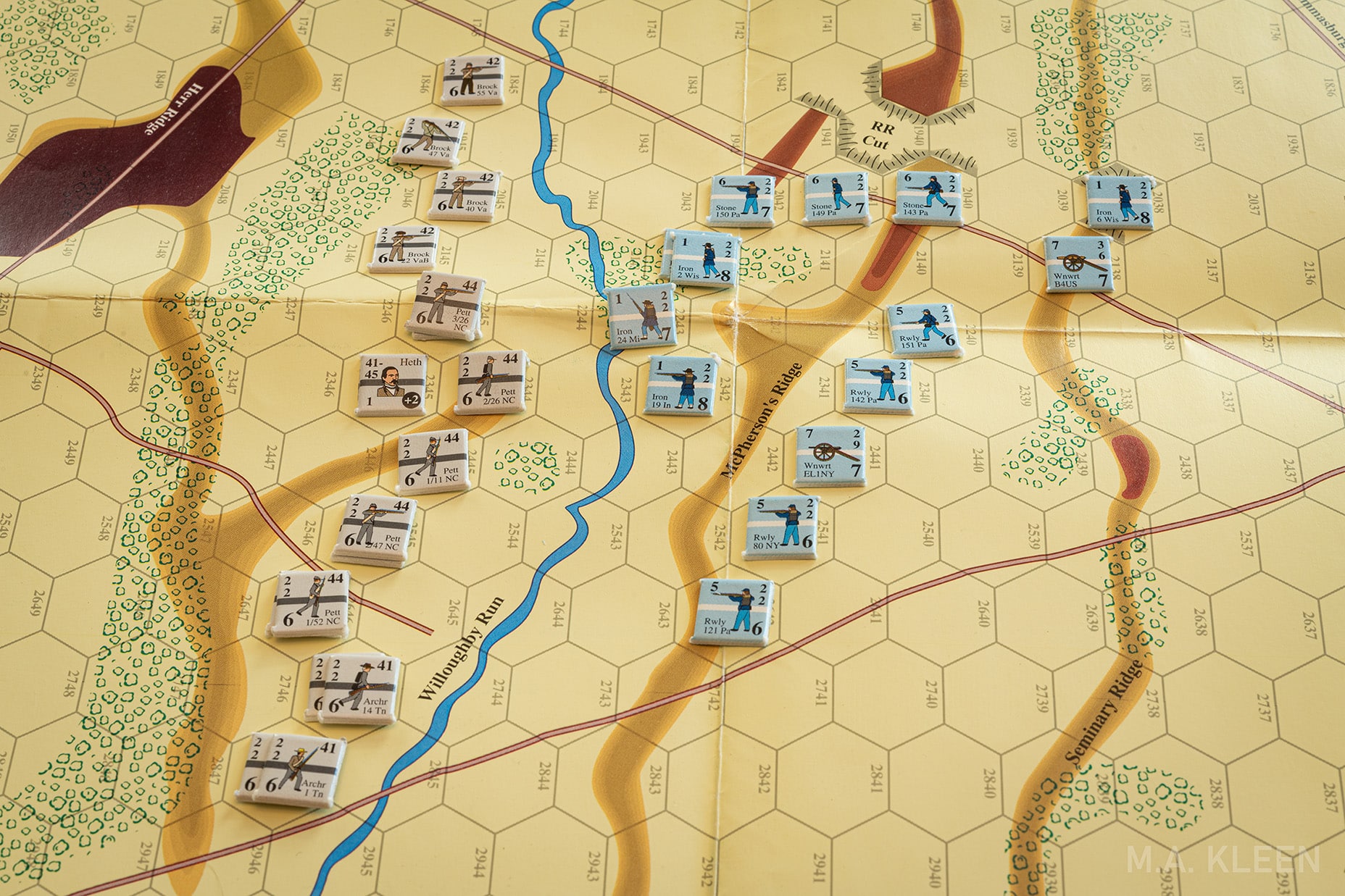
At the opposite end of the scale are games like Terrible Swift Sword (1976) and Fateful Lightning (1994), where every regiment and artillery battery is individually represented. What should be a beer-and-pretzels game becomes an agonizing slog, with the full three-day Terrible Swift Sword scenario requiring around 50 hours to complete.[4] To me, regimental scale works best in tactical games like Devil’s Den (1980), where the focus is limited to a single section of the battlefield over a specific span of time.
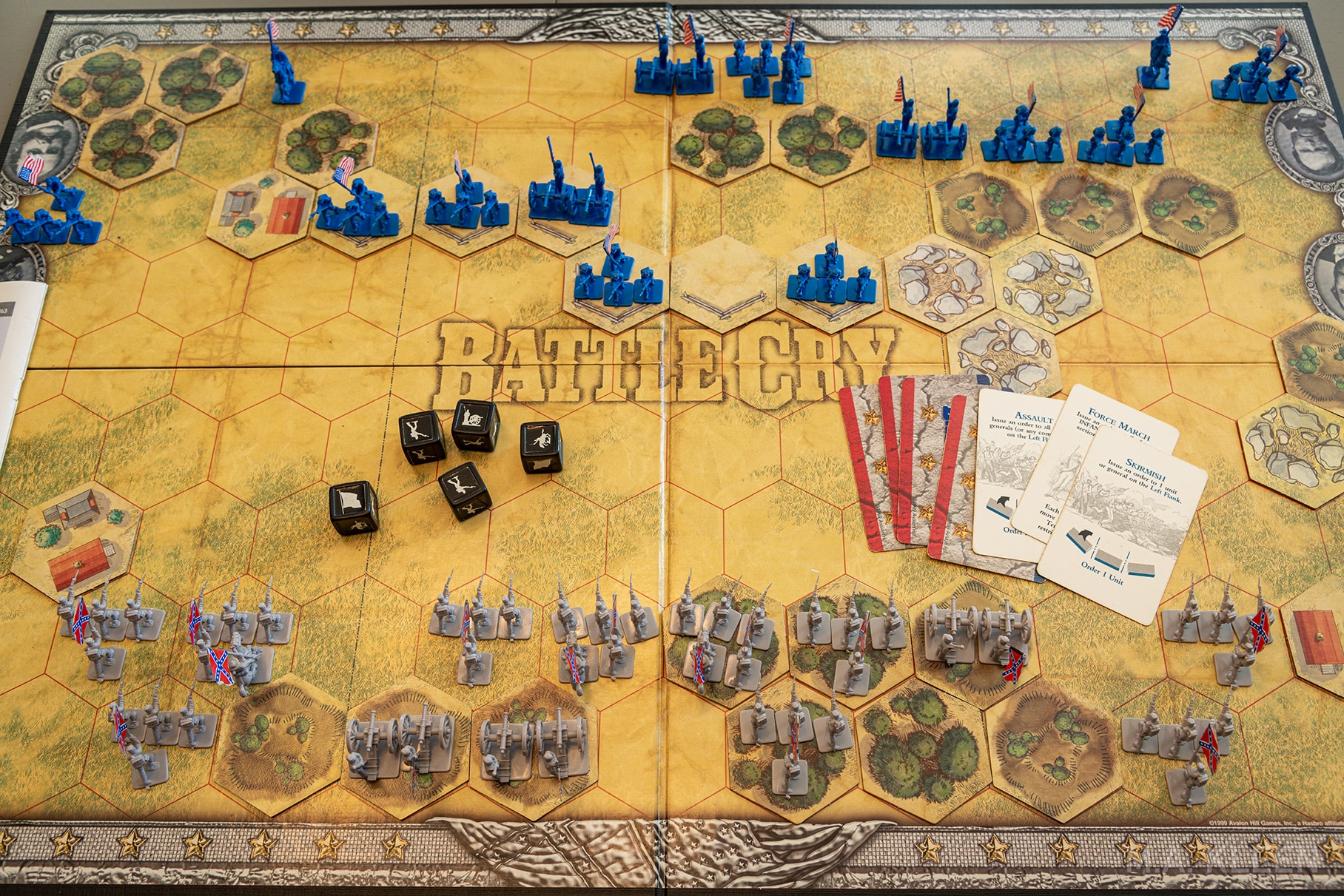
Another Avalon Hill game, Battle Cry (2000), designed by Richard Borg, includes two Gettysburg scenarios, but the scale is so abstract that the battle is barely recognizable. The game uses generic plastic miniatures and terrain tiles arranged on a blank map to approximate woods, hills, rivers, and other features. Players issue orders through cards and resolve combat with specially designed “battle dice.” It is a fun and accessible game, though not a particularly realistic one.[5]
The greatest allure of historical wargaming is the chance to test the enduring “what ifs” that have fascinated historians for more than a century. What if Richard Ewell had pressed the attack on Cemetery Hill on the evening of July 1? What if Meade had launched a counterattack on July 3? A well-designed war game becomes a kind of historical laboratory, allowing players to explore these counterfactuals while reminding us that Gettysburg’s outcome ultimately hinged on split-second decisions, human error, and sheer chance, variables a simple roll of the dice can easily rewrite on the tabletop.
I would be remiss if I didn’t mention some of the Gettysburg-based computer games over the past 40-plus years. One of the earliest was Paul Murray’s The Road to Gettysburg, released for the Apple II in 1982. It included a physical hex map and cardboard counters to track unit movement, creating a unique hybrid experience.[6] Another early title was Gettysburg: The Turning Point (1986) for the Apple II, Atari 8-bit, and Commodore 64. Its color graphics were an improvement, though still primitive by modern standards.
Sid Meier’s Gettysburg! arrived in 1997, and its graphics and animations were a huge leap forward from anything that had come before.[7] Its spiritual successor was Ultimate General: Gettysburg (2014), which also featured real-time action and three-dimensional units and terrain. Despite beginning to show its age, I still think Ultimate General remains the best Gettysburg computer game on the market today. It strikes a strong balance between complexity and accessibility, convincingly simulating mid-19th century warfare while keeping the mechanics simple enough to learn quickly and enjoy.[8]
Historical wargaming is a fun and challenging way for history buffs to don a general’s coat and explore different tactics, strategies, and scenarios. For Gettysburg enthusiasts, there is no shortage of games to choose from, whether on the tabletop or the computer screen. Decades after first unfolding that Avalon Hill map board on my bedroom floor, I still find myself drawn back to Gettysburg’s endless possibilities and enduring “what ifs.”
[1] Rick Britton, “How Gettysburg Inspired Modern War Gaming,” Historynet, October 20, 2022, https://historynet.com/how-gettysburg-inspired-modern-war-gaming/
[2] Charles S. Roberts, “Charles S. Roberts: In His Own Words,” CSR Awards, originally published in 1983, https://web.archive.org/web/20081006202444/http://www.alanemrich.com/CSR_pages/Articles/CSRspeaks.htm
[3] Grant, “The Beautiful Boards of Wargaming! – Battle Hymn Volume 1: Gettysburg and Pea Ridge from Compass Games,” The Players’ Aid, October 14, 2022, https://theplayersaid.com/2022/10/14/the-beautiful-boards-of-wargaming-battle-hymn-volume-1-gettysburg-and-pea-ridge-from-compass-games/
[4] Bill Thomson, “TSS–Terrible Swift Sword,” War Game Academy, April 11, 2003, http://www.wargameacademy.org/TSS/
[5] “Battle Cry!” Tame the Board Game, October 3, 2014, https://tametheboardgame.com/2014/03/10/battle-cry/
[6] “Game #45 : The Road to Gettysburg (1982),” The Wargaming Scribe, December 24, 2021, https://zeitgame.net/archives/3740
[7] Tim Stone, “Heavily Engaged: Sid Meier’s Gettysburg!” Rock, Paper, Shotgun, April 25, 2011, https://www.rockpapershotgun.com/heavily-engaged-sid-meiers-gettysburg
[8] Quinn Levandoski, “Ultimate General: Gettysburg,” Hooked Gamers, July 27, 2014, https://www.hookedgamers.com/pc/ultimate_general_gettysburg/review/article-1297.html


I have Ultimate General: Gettysburg for iPad and enjoy it for the reasons you stated. it’s sophisticated enough without being overly complicated to play. I had the Avalon Hill Gettysburg board game as a teenager in the late 1970s and early 1980s. That time period used brigade strength for infantry too. I didn’t know it ever use division level. I also had their Chancellorsville game which was division level and I didn’t like that way nearly as much.
Brigade level is definitely the way to go. I’ve considered buying Battle Hymn Vol 1 but it’s pretty pricey.
There was a giant Gettysburg game titled “Hallowed Ground”. It was detailed to regiments. It was rather daunting.
You may find unpunched copies online. It can be pricey.
I haven’t heard of that one, but there are so many different Gettysburg games out there it’s wild.
https://boardgamegeek.com/boardgame/12134/this-hallowed-ground.
In the 1960s my brother and I played a simple board game called Civil War. The board was a map of the Eastern US. We had grey and blue plastic figures; infantry, cavalry, canon. Other than that I dont remember much other than I usually beat my brother no matter what color I was.
I recognized Fateful Lightning from the picture before I got to the caption confirming it, a lot of great memories playing that one. My favorite counter art was the 7th TN, who are depicted with no shoes, hence the need for the battle.
In the early 1960’s, I grew up near Mt. Prospect, Ill., and my friend owned the Avalon Hill Gettysburg game, which provided hours of fun even if we did not fully understand the battle. You brought back fond memories.
Glad I could shake out some great memories! I grew up in Des Plaines but would go up to Games Plus in MP every once in a while. I remember when it was at its old location on the other side of the railroad tracks.
I too lived in DesPlaines(more specifically, Cumberland along the C&NW tracks with steam engines), between 1955-67. I don’t remember the MP store that you mentioned.