“Your Little Entertainment in Front”: A Cavalryman’s View of Pickett’s Charge
ECW welcomes guest author Gerald J. Murray.
On March 4, 1886, Gen. Francis Amasa Walker, formerly of the II Corps, Army of the Potomac, delivered an address on the battle of Gettysburg at the Lowell Institute in Boston which The Globe published the following day. The address offered a dramatic overview of the three-day battle that resulted in Union victory.
Covering the action from Willoughby Run to Cemetery Hill, Devil’s Den to Little Round Top and Culp’s Hill, it all built toward that climactic July 3 charge up the slopes of Cemetery Ridge called “Pickett’s Charge.” Reading this list of Gettysburg landmarks, Lt. Col. William Brooke Rawle of Philadelphia noticed a conspicuous absence: East Cavalry Field.[1]
On July 3, 1863, at the same time that Hancock’s II Corps readied itself to receive Pickett’s Charge, several other charges were happening a few miles to the east on the Union right flank. At around 3:00 pm, Brig. Gen. George Armstrong Custer’s 1st Michigan Cavalry Regiment smacked head-on into a Confederate column comprised of regiments from the commands of generals Fitzhugh Lee and Wade Hampton and Col. John Chambliss.[2] The resulting collision produced a “crash, like the falling of timber,” according to Capt. William E. Miller of the 3rd Pennsylvania Cavalry.[3] Miller’s squadron occupied an area of Lott’s woods not far from the where the Gregg Cavalry Shaft now stands.[4]
Seeing that Custer needed assistance, Miller turned to William Rawle, at that time a lieutenant with less than two months of service, and said, “I have been ordered to hold this position, but, if you will back me up in case I am court-martialed for disobedience, I will order a charge.”[5] Rawle readily endorsed his captain’s plan, and together they rallied Miller’s squadron and “sailed in” to the Confederate column about two-thirds of the length back.[6]
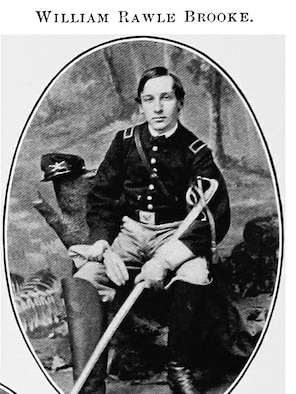
Other charges occurred simultaneously, and together the Federal cavalrymen beat the Confederates back towards the John Rummel farm buildings, thwarting Maj. Gen. J.E.B. Stuart’s attempt to gain the Federal rear to position his division in anticipation of harassing the retreating Union army following their hoped-for dislodgement as a result of Pickett’s Charge.[7] For his initiative that day, Congress awarded Miller the Medal of Honor in 1897.[8]
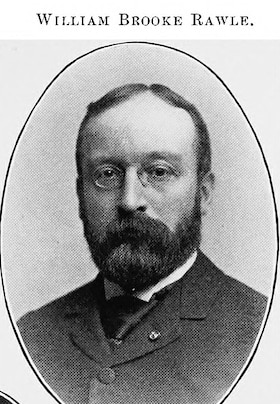
In Lt. Rawle’s diary entry for July 4, 1863, he likened his understanding of what happened the previous day to that of Kaspar from Robert Southey’s 1796 poem, “After Blenheim.”[9] When one of Kaspar’s grandchildren asked him what good came from all the death at the 1704 battle of Blenheim during the War of Spanish Succession, the old man remarked, “‘Why that I cannot tell…but ‘twas a famous victory.’”[10] Rawle spent much of his postwar life cementing his regiment’s contributions to that victory in various articles and speeches. Rawle convinced himself that Stuart intended to assault the Union line on Cemetery Ridge from the rear at the same time that the divisions of Confederate generals George Pickett, James Pettigrew, and Isaac Trimble attacked their front.[11] In Rawle’s mind, the Federal cavalrymen stopped the other half of Pickett’s Charge.
So when Rawle read Walker’s speech on Union victory at Gettysburg and saw no mention of East Cavalry Field, he promptly wrote Walker to correct that oversight. “You, like most infantrymen,” Rawle wrote Walker, “do us troopers much injustice” in not acknowledging the importance of the cavalry fight on the right flank to Union victory.[12] Were it not for the cavalry’s diligence in protecting the right flank, the army would have met with “almost certain disaster,” as Stuart had “timed his movement so as to strike the rear of our line of battle simultaneously with Pickett’s assault in front.”[13] Had Stuart merely “gotten near enough to throw a few shells onto the ridge, it would most probably have unnerved the infantrymen, who had about all they could do to hold on to the line of Cemetery Ridge.”[14] In Rawle’s mind, stopping Stuart’s cavalry assured the failure of the infantry assault, though Stuart never claimed he planned his attack to coincide with Pickett’s. Indeed, Stuart wrote in his report that his cavalry’s charges arose from the need to prevent the capture of his dismounted skirmishers when Brig. Gen. Albert Jenkins’ men fell back after exhausting the meagre 10 rounds of ammunition they brought into battle.[15]
Rawle ended by giving full vent to his frustration: “[T]he next time you go to Gettysburg, when you stand upon East Cemetery Hill, kindly look in an easterly direction, and when you see the Shaft, which is plainly visible, think to yourself what effect the bursting in of 6,000 cavalrymen and their batteries of artillery, while Pickett’s assault was going on would have had upon your little entertainment in front.”[16]
Although Rawle was remembering with advantages when he made those bold claims about the purpose of Stuart’s July 3 attack, this letter offers a fascinating insight into the frustrations of the Union cavalrymen who fought at Gettysburg and never thought they received the credit they deserved. Originally not included on Col. John B. Bachelder’s maps of the battle, the cavalrymen fought constantly to have their contributions recognized.[17] None felt the threat of being forgotten more than troopers like Rawle and Miller, who served in Brig. Gen. David McMurtrie Gregg’s Second Cavalry Division. In addition to worrying about East Cavalry Field’s place in history, these men fretted that the exploits of Custer’s Michiganders might overshadow their contributions.[18]
Rawle’s harsh words only make sense within this context. Faced with being forgotten or minimized, Rawle deliberately downplayed both the severity of Pickett’s Charge and the resolve of the Union infantrymen to make a point. “Surely, in that fight,” Rawle wrote, “there was plenty of [credit] for all who were engaged, and plenty to spare.”[19] If Walker did not want to share that credit, Rawle saw no reason not to take from Walker’s portion and leave him the scraps. It was indeed “‘a famous victory,’” as Rawle noted in his diary, and as long as he lived he made sure people remembered the cavalry’s contribution to it. While he overstated the extent of that contribution, he still brought attention to a much-neglected part of the battle.
————
Gerald J. Murray graduated from Temple University with a BA in history in 2018. He has a forthcoming article in Gettysburg Magazine tentatively titled “‘An Indecent Valentine’: Honor, Class, and Memory in the 3rd Pennsylvania Cavalry.” He currently teaches US history at a private school outside Philadelphia.
Endnotes:
[1] Francis A. Walker, “Gettysburg: General Walker Tells of Its Glory,” Boston Globe, March 5, 1886.
[2] William Brooke Rawle, diary dated July 3, 1863, James S. Schoff Civil War Collection, William L. Clements Library, The University of Michigan.
[3] William E. Miller, “The Cavalry Battle Near Gettysburg,” Battles & Leaders of the Civil War (New York: Century Co., 1884), 3:404.
[4] Miller, “The Cavalry Battle Near Gettysburg,” 402.
[5] Miller, “The Cavalry Battle Near Gettysburg,” 404-5.
[6] Miller, “The Cavalry Battle Near Gettysburg,” 405.
[7] The War of the Rebellion: A Compilation of the Official Records of the Union and Confederate Armies, (Washington D.C., Government Printing Office 1880-1901), Ser. I, vol. 27, pt. 2. 698.
[8] William Brooke Rawle, History of the Third Pennsylvania Cavalry, Sixtieth Regiment Pennsylvania Volunteers, in the American Civil War, 1861-1865 (Pennsylvania: Franklin Printing Company, 1905), 308.
[9] Robert Southey, “After Blenheim,” The Poetry Archive, https://poetryarchive.org/poem/after-blenheim/; Rawle, diary dated July 4, 1863, University of Michigan.
[10] Rawle, diary dated July 4, 1863, University of Michigan.
[11] William Brooke Rawle, With Gregg in the Gettysburg Campaign: reprinted from Chapters of Unwritten History in the Annals of the War, Philadelphia Weekly Times, February 2, 1884 (Philadelphia: McLaughlin Bros. Co’s Job Printing Establishment, 1884), 18.
[12] William Brooke Rawle to Francis A. Walker, March 26, 1886, Robert Blake Collection, Box 14, Folder 6, US Army Heritage and Education Center, Carlisle, PA.
[13] Rawle to Walker, March 26, 1886, Robert Blake Collection.
[14] Rawle to Walker, March 26, 1886, Robert Blake Collection.
[15] O.R., Ser. I, vol. 27, pt. 2, 697-698.
[16] Rawle to Walker, March 26, 1886, Robert Blake Collection.
[17] William Brooke Rawle, The Right Flank at Gettysburg: An account of the operations of General Gregg’s cavalry command, showing their important bearing upon the results of the battle (Philadelphia: Allen, Lane & Scott Printing House, 1878), 7-8.
[18] Rawle, The Right Flank at Gettysburg, 8.
[19] Rawle to Walker, March 26, 1886, Robert Blake Collection.


Bully for the cavalry!
A lot of the surrounding cavalry actions tend to get left out of Gettysburg narratives (thinking of Hunterstown on July 2 and Fairfield on July 3) but I think historians are starting to correct this oversight.
I fully agree with you about overlooked calvary engagements, including Hanover on June 30 and Brinkerhoff’s Ridge on July 2 as well, among others.
The late Eric Wittenberg contributed several books that underscore the significant, critical role of the Cavalry @ Gettysburg.
Hello Gerald,
It’s your student (Grace). Mary found this website and I am very happy for you. Just wondering why you make this so difficult to learn in class. (this is all jokes) So happy for you.
One of your favorite students,
Grace