An Apple of Gold: Lincoln and the Declaration of Independence
Few documents compare to the Declaration of Independence. In 250 years, its words and ideas have rippled across the world, inspiring the likes of Mahatma Gandhi, Simón Bolívar, and, yes, even Ho Chi Minh. But perhaps the greatest fan of the Declaration of Independence was the sixteenth president of the United States: Abraham Lincoln.
Like nearly every American reared in the nineteenth century, Lincoln grew up learning about the Revolution, and he knew he was living in the shadow of the august founders.[1] However, unlike others of his time, who believed the Constitution to be the country’s premier founding document, Lincoln claimed a special affection for the Declaration of Independence.

He harkened to the Declaration in his first major political speech, the Lyceum Address, and again in his response to the Dred Scott decision in 1857.[2] In fact, some of Lincoln’s most famous words reference the Declaration itself: “Four score and seven years ago our fathers brought forth upon this continent, a new nation, conceived in liberty and dedicated to the proposition that all men are created equal.”
As Lincoln faced the greatest Constitutional crisis in American history—secession—he looked to the Declaration of Independence for wisdom and guidance. In early 1861, the president-elect received a letter from his one-time friend from Congress, Alexander Stephens. Stephens was destined to become vice president of the fledgling Confederacy, but in 1861 he had merely resigned his Congressional seat when Georgia seceded.
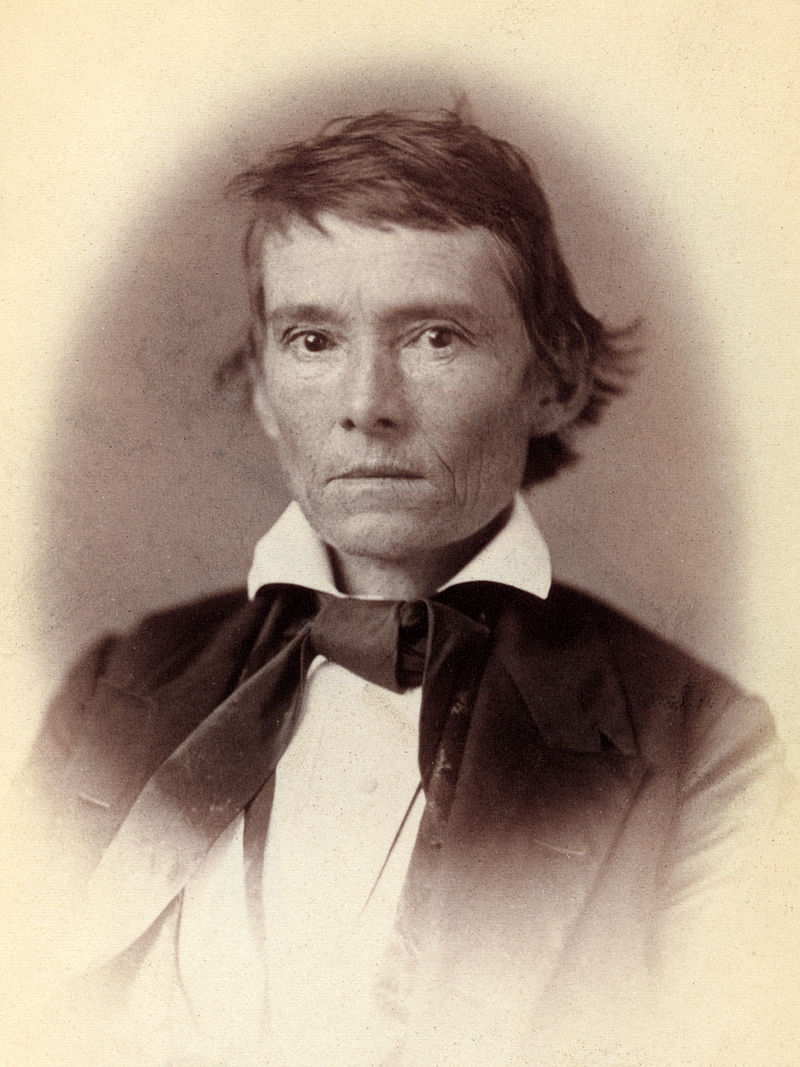
Thus, Stephens wrote to Lincoln on the eve of war, asking the president-elect to offer some words that might diffuse the growing hostility between North and South. “A word fitly spoken by you now would be like ‘apples of gold in pictures of silver,” Stephens urged. The Georgian was almost directly quoting Proverbs 25:11, which states, “A word fitly spoken is like apples of gold in pictures of silver.” The phrase compares graceful speech to the treasures of gold and silver.
Of course, Stephens thought that “words fitly spoken” by president-elect Lincoln could yield the reunification of the Union and prevent war. But Lincoln saw the “apple of gold” and “picture of silver” differently within the context of the secession crisis. He replied directly to his friend Stephens, but he privately expounded upon his thoughts on the “apples of gold in pictures of silver” in what historians call Lincoln’s “Fragment on the Constitution and the Union.”
Throughout his presidency, Lincoln often scribbled thoughts to himself as he navigated the difficulty of prosecuting the war and defending the Constitution. This note, likely written in response to Alexander Stephens in January 1861, offers insight into Lincoln’s musings on the relationship between the Declaration of Independence and the Constitution.[3]
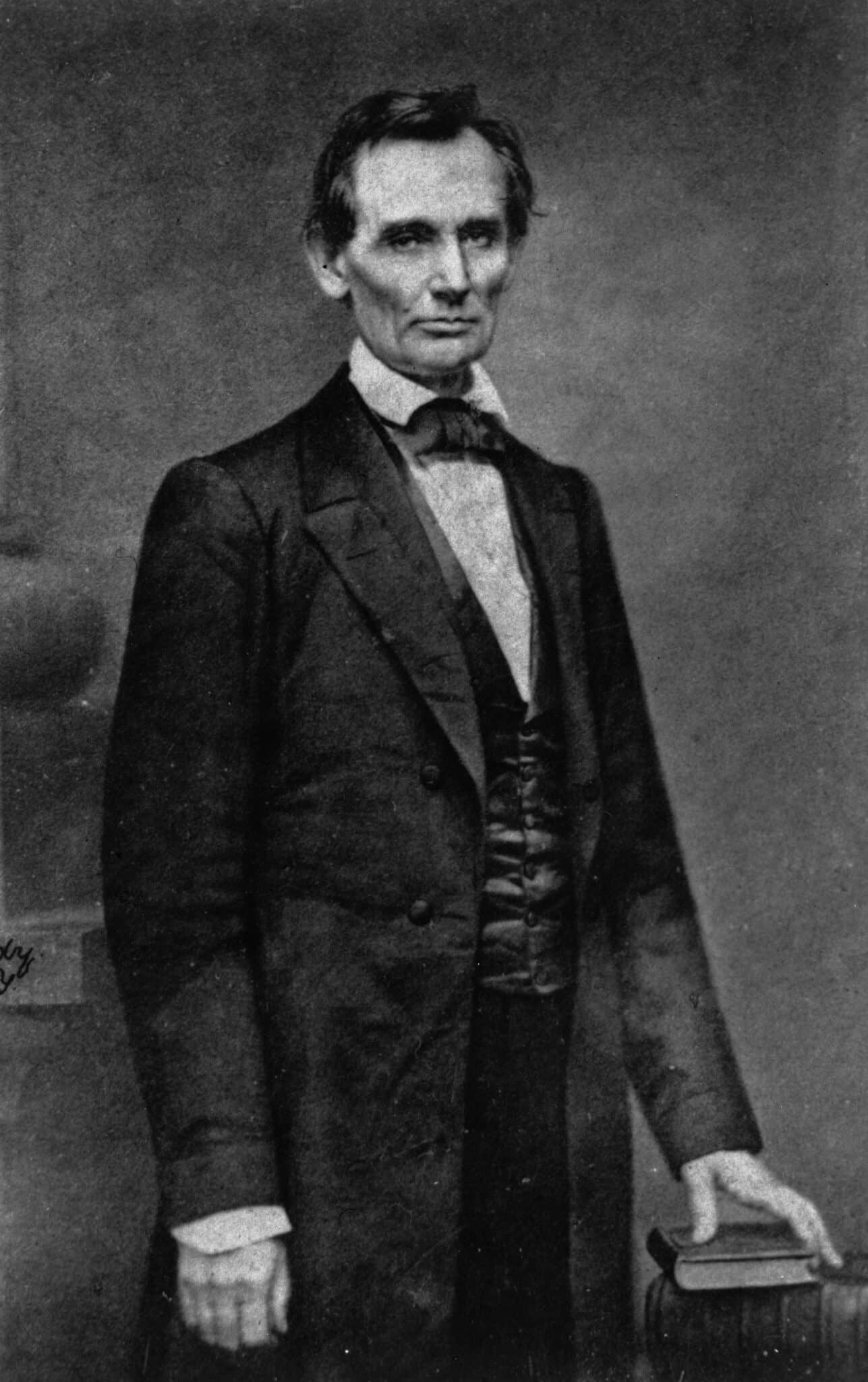
“Without the Constitution and the Union, we could not have attained the result; but even these, are not the primary cause of our great prosperity,” Lincoln mused. “There is something back of these, entwining itself more closely about the human heart. That something, is the principle of ‘Liberty to all’ – the principle that clears the path for all – gives hope to all – and, by consequence, enterprize [sic], and industry to all.” That principle of “Liberty to all,” so coveted by Lincoln, appears in the Declaration.
Lincoln believed that the thirteen colonies might have been able to declare independence without the Declaration, “but without it,” he mused, “we could not, I think, have secured our free government, and consequent prosperity.” He believed that the Founding Fathers were idealists, writing that “no oppressed, people will fight, and endure, as our fathers did, without the promise of something better, than a mere change of masters.”
Then he pondered over Stephens’s remarks by invoking the “apples of gold in pictures of silver” phrase. “The assertion of that principle, at that time, was the word, ‘fitly spoken,’ which has proved an ‘apple of gold’ to us. The Union, and the Constitution, are the picture of silver, subsequently framed around it.” In Lincoln’s view, the Declaration of Independence—and its “proposition” that “all men are created equal”—is the ideal, while the Constitution is the practical and imperfect framing of that ideal. Therefore, the Declaration is the “apple of gold” and the Constitution is the “picture of silver.”
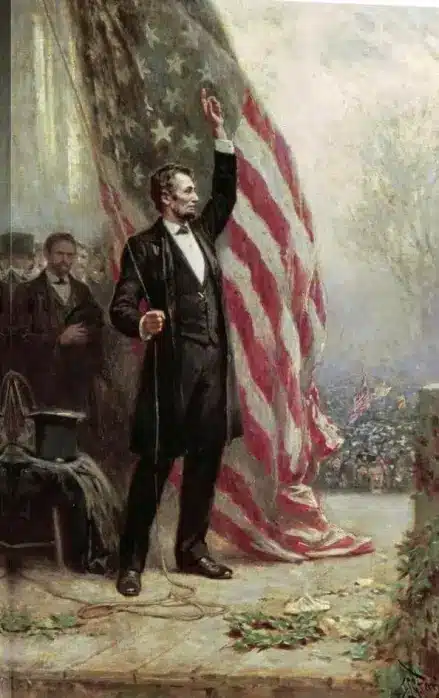
Lincoln went on. “The picture was made, not to conceal, or destroy the apple; but to adorn, and preserve it. The picture was made for the apple – not the apple for the picture,” he wrote. This line is key, as Lincoln inferred that the Constitution was framed to protect the Declaration’s assertion that “all men are created equal,” not to “destroy” it as secession and slavery threatened to do.
“So let us act, that neither picture, or apple shall ever be blurred, or bruised or broken,” he resolved to himself. “That we may so act, we must study, and understand the points of danger.”[4]
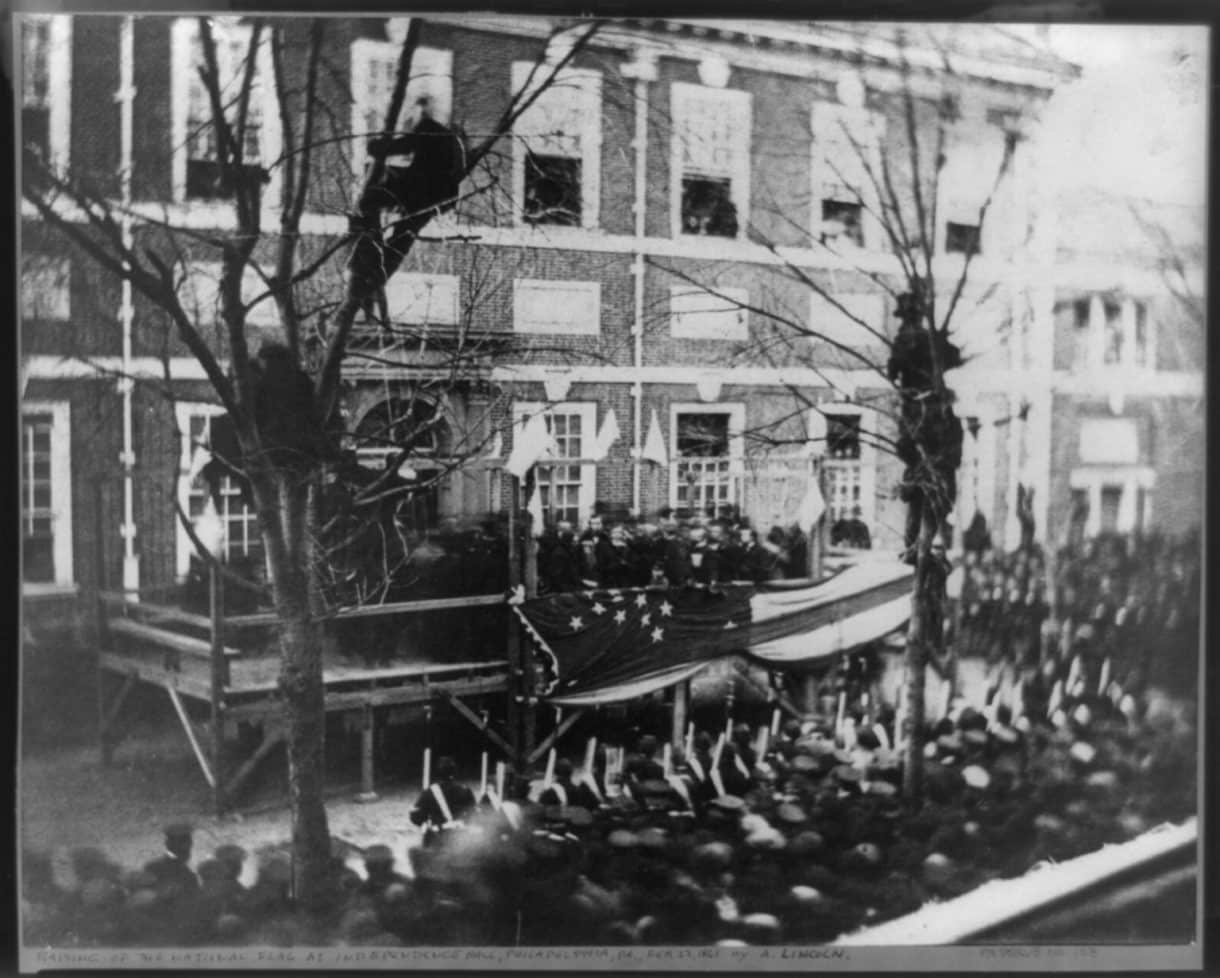
One month later, Lincoln stood on the steps of Independence Hall on his way to his inauguration in Washington, D.C. He addressed a crowd and professed that he had “never had a feeling politically that did not spring from the sentiments embodied in the Declaration of Independence.” The Declaration, Lincoln believed, promised “that in due time the weight [of oppression] would be lifted from the shoulders of all men”, not just Americans. Then, the president-elect eerily admitted that he would rather be assassinated than forsake the ideals of the Declaration.[5]
In the end, Lincoln’s reverence for the Declaration of Independence reveals the moral foundation beneath his leadership during the nation’s greatest crucible. By elevating the Declaration as the “apple of gold” and the Constitution as its protective “frame,” Lincoln affirmed that the survival of the Union depended not only on legal structures, but on fidelity to the enduring principle of human equality. It was this conviction that guided him through the Civil War and ultimately redefined the nation.
During this semiquincentennial anniversary of independence, let us embody Lincoln’s great respect and defense of our founding moment.
Notes:
[1] Allen C. Guelzo, Our Ancient Faith: Lincoln, Democracy, and the American Experiment (New York: Alfred A. Knopf, 2024), 24.
[2] Jonathan W. White, “‘All Should Have an Equal Chance’: Abraham Lincoln and the Declaration of Independence,” History Now, issue 67, (Summer 2023), https://www.gilderlehrman.org/history-resources/essays/all-should-have-equal-chance-abraham-lincoln-and-declaration-independence.
[3] Ronald C. White, Lincoln in Private: What His Most Personal Reflections Tell Us about Our Greatest President (New York: Random House, 2021), 131–132.
[4] Roy P. Basler, ed. Collected Works of Abraham Lincoln, Volume 4, Mar. 5, 1860-Oct. 24, 1861, (New Brunswick, NJ: Rutgers University Press, 1953), 169.
[5] Basler, Collected Works, 241-242.


Very interesting! Golden apple and silver frame is a image I hadn’t read about before.
A more expressive, dramatic and enduring image of what we stand for as a Nation and as a People, I do not think I’ve ever seen; a golden apple surrounded and protected by an unbroken, solid frame of silver.
This image and Lincoln’s cherish for it, clearly
represent the life preserver he used to survive the mitigated storm around him.
As should we, amidst our storms, foreign or domestic.