John Henry Stover Funk and Stonewall Jackson’s Name
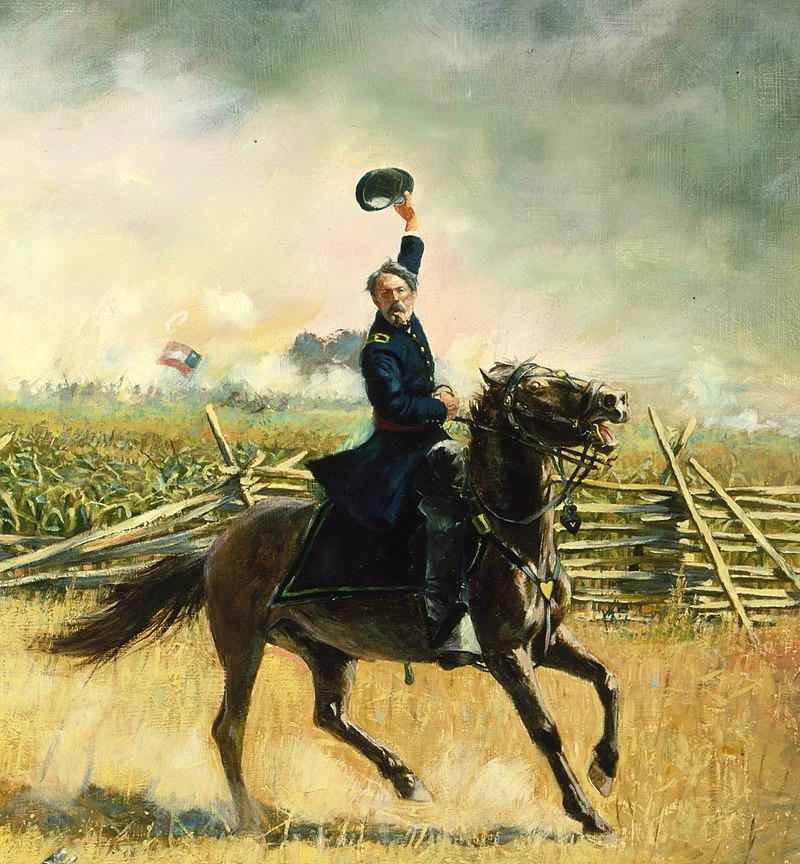
Or “There is Jackson standing like a stone wall.”
Or “Come with me and go yonder where Jackson stands like a stone wall.”
Or “Yonder stands Jackson like a stone wall. Let us go to his assistance.”
Or something along those lines, depending on which account you read.
Historian John Hennessy has pretty definitively established that Bee uttered his famous line to the Alabamians, and that only about 40 of them or so were close enough the hear Bee over the din of battle. For a deep dive, see John’s excellent essay, “Stonewall Jackson’s Nickname,” reprinted on Harry Smeltzer’s Bull Runnings (click here).
I’ve spent some time over the past two years doing some additional work on this topic, building on John’s research. I published some of it in 2025 in The Journal of the Shenandoah Valley During the Civil War Era, Vol. 8, published by Shenandoah University’s McCormick Civil War Institute. (Get a copy here.) I brought some of it to the field with me in June when I did the tour for the Trust. Next year, when Rob Orrison and Kevin Pawlak publish their First Manassas book for the Emerging Civil War Series, it will include an appendix in which I flesh the story out even more.
The research included some fun rabbit holes, one of which I’d like to share with you to today to commemorate the 165th anniversary of Stonewall’s nickname.
Once Jackson became successful and “Stonewall” became a household name, a host of witnesses suddenly sprung up, including a number of Virginians in Jackson’s own brigade. Of course, how could any of the Virginians have heard Bee rally his men without being out of position themselves? That bit of logistics alone discounts most of the accounts.
One of the most challenging accounts I found, though, came from John Henry Stover Funk, later a colonel but, at the time of First Manassas, a member of the 5th Virginia. Funk not only claimed to have heard the naming with his own ears, but he attributed it to Brig. Gen. Francis Bartow, not Bernard Bee. Funk wrote:
General Bartow came riding up and when interrogated by General Beauregard ‘How was the day?’ he replied whispering, ‘Like hell,’” Funk wrote. “Then pointing to our brigade, he remarked, ‘Look at Jackson. He stands like a stone wall.’ General Bartow reeled his horse and tried to really his troops, when he fell mortally wounded.”[1]
Bartow did die during the afternoon attacks, just as Bee did, but his presence in Funk’s story otherwise doesn’t jive with nearly everything else we’ve come to know about the incident.
Funk’s regiment, the 5th Virginia, anchored the extreme right flank of Jackson’s brigade, and they saw action sooner in the battle than the rest of the brigade because of advances by the 2nd Maine and 3rd Connecticut. It’s possible, as a result of that fighting, Funk might have somehow come dislodged from his unit and fallen back to the rear a few hundred yards into the area where Bee’s scattered brigade had also fallen. Leaderless, the men milled about until Bee showed up to rally them.
This scenario only holds, though, if Funk misidentified the general who rallied the men. As a member of Jackson’s brigade, it’s possible Funk did not know Bee from Bartow and so simply confused the two in his account.
Funk’s account seems to be written contemporaneously, but some structural issues exist in the narrative that suggest he may have written his diary—or at least parts of it—a few months after the fact rather than in the moment. If so, that would also explain why he misremembered some details.
Two published versions of Funk’s diary exist. The first, which appeared in 2022 from Shotwell Published, was edited by Joe D. Haines Jr. The second will be forthcoming this October from the University of Tennessee Press’s “Voices of the Civil War Series”: Fighting with Stonewall in the Valley: The Diary of John Henry Stover Funk, edited by Buckley T. Foster and Christoper R. Mortenson. Haines’s edition, unfortunately, doesn’t contain a lot of critical analysis in its introduction or scant footnotes, so it wasn’t much help as I tried to sort out the diary’s difficulties.
Mortenson’s and Foster’s work proved much more illuminating. I reached out to see if they could help me make sense of the structural inconsistencies I found in Funk’s diary, and Chris Mortenson happily obliged me. “We’ve noticed some inconsistencies, as well, and try our best to explain them,” he told me. He was kind enough to share the page proofs of the relevant sections, and we swapped ideas about the Bee/Bartow mixup. “[W]e come to a conclusion that jives with yours,” Chris added, “but think the confusion has more to do with Funk’s writing style and use of abbreviations.”
Indeed, looking at the page proofs, the editors had to do a little reconstruction from the original manuscript. Brackets abound for clarity. I can imagine, for as much time as they spent with Funk’s diary—and his handwriting—they gained a “feel” for his writing that helped them service the manuscript to its advantage. I can’t wait to see their final published version!
I don’t know that I have a satisfactory answer for how Funk’s story fits in with what we know, but at least I can envision a possible way. He’s a credible witness on other counts, so I want to give him the benefit of the doubt here. As John Hennessey told me as we batted around ideas, “I suppose if any Virginians were likely to have witnessed Bee doing his thing, it would have been members of the 5th. But still. . . .”
So much legend and “fog of war” surrounds the incident, and so many men wanted to ride the story’s coattails, that it’s impossible to parse things out exactly. That said, puzzling the pieces together is a lot of fun! Previous research provides a frame, but it’s important to also be open to new evidence even while maintaining a healthy skepticism toward that new evidence. That makes every rabbit hole worthwhile.
————
P.S.: The mere mention of the origin of Stonewall’s nickname is certain to invite at least one person in the comments to declare that the nickname was really probably meant as an insult. I’ll nip that nonsense in the bud right now: The men of the Stonewall Brigade never would have adopted that as a nickname if it had been flung at them as an insult. It’s also worth noting that the name appeared in print in a newspaper obituary laudatory toward Bee. Recounting an insult hardly underscores the noble character of a young martyr.
————
[1] Joe D. Haines, Jr., ed. The Diary of Col. John Henry Stover Funk of the Stonewall Brigade, 1861–1862 (Columbia, SC: Shotwell Publishing, 2022), 35.


Chris-at the risk of spouting nonsense, is it possible that Bee meant it as an insult, but it was interpreted as a compliment? Since Bee was immediately killed and couldn’t explain himself, the chaos of battle may have caused his words to be misinterpreted. You obviously know a lot more about this subject than I do, but history is full of quotations that are taken out of context. To cite one example, Leo Durocher never said “nice guys finish last.” He was asked about another baseball team and said “they’re nice guys, they finish last.” He meant the two things to be separate, not that they finished last because they were nice guys. His quote was misinterpreted and Durocher was still alive to explain himself.