Civil War Combat – Gettysburg’s Wheatfield: The Show that Left me Wanting More
ECW welcomes guest author Colton Pikovsky.
The 1990s played host to some of the best-known pieces of Civil War media, from Gettysburg to The Civil War Journal. The decade was a Civil War buff’s dream, and riding this wave into 2000 was the History Channel, which produced the 12-episode series Civil War Combat. Each episode featured historians, such as Ed Bearss and D. Scott Hartwig, discussing some of the war’s bloodiest battles, with actors recreating those moments on screen. As a young student in the suburbs of Pittsburgh, who cannot remember a time when I wasn’t interested in the Civil War, the series made history come to life.
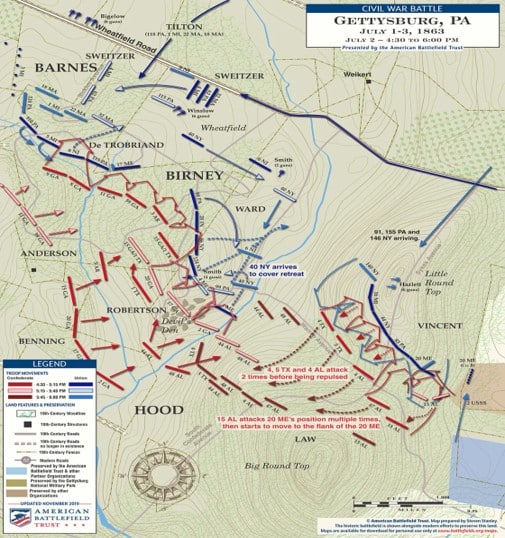
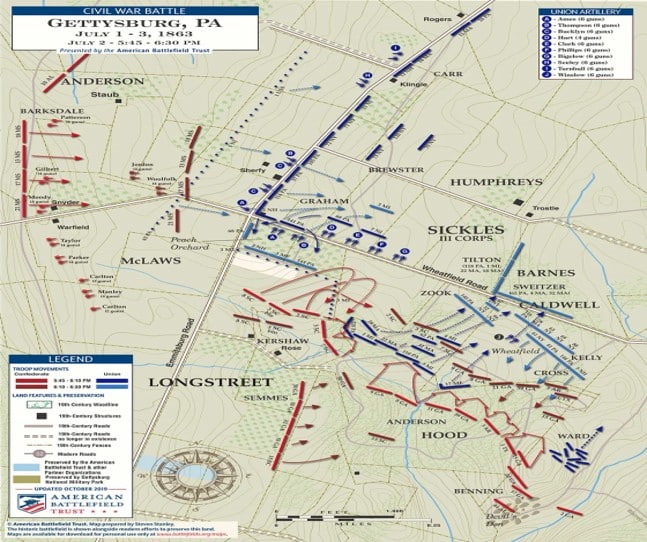
However, the 45-minute runtime of the episodes, all now posted on YouTube, left the series with the issue that all short-form media faces: what gets in and what gets left on the cutting room floor?[1] The Wheatfield is often considered to be one of the most complex actions of the Civil War with more than 20,000 soldiers of four Union corps and the Confederate First Corps pulled into a 20-acre whirlpool of death, resulting in over 6,100 casualties.[2] It is critical to note that it is impossible to tell the full story of the Wheatfield in 45 minutes, and because of that reality the showrunners almost exclusively discuss the actions of Brig. Gen. John C. Caldwell’s division of the Federal II Corps. However, the episode left me wanting more on multiple fronts.
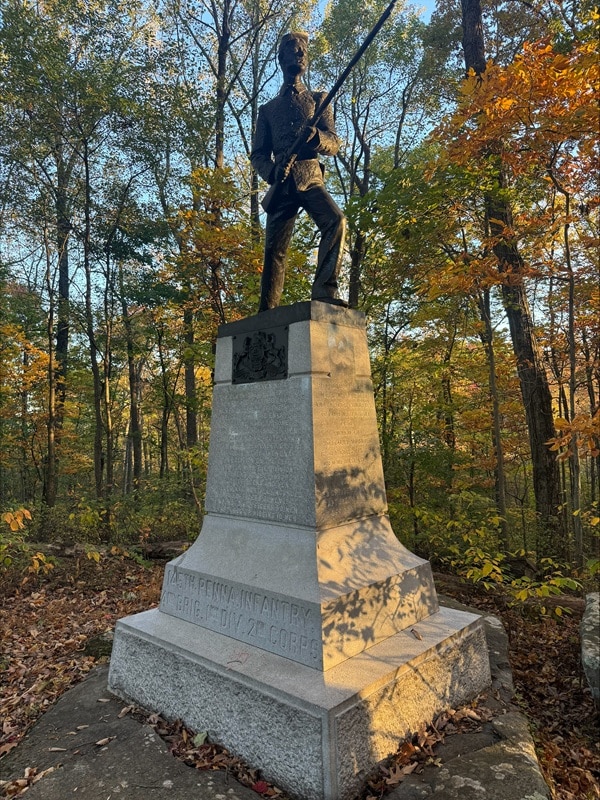
First was the history itself, which at times struggled to tell the story coherently and correctly. The most glaring issue with the episode is the maps used. Of these, the most egregious showed men of Maj. Gen. Daniel Sickles’ Union III Corps marching into a Confederate-occupied Wheatfield where they are seemingly ambushed, as is shown in an interceding battle sequence. In reality, the men of the III Corps occupied the field without any resistance during Sickles’ insubordinate advance towards the Emmitsburg Road. The men in the Wheatfield, of colonels Regis de Trobriand’s and George Burling’s brigades, were unengaged long enough for elements of the V Corps division of Brig. Gen. James Barnes to reinforce them before the Confederates attacked. While this is just one example of an inaccurate map, it is an issue that persists throughout the entire episode.
Another concern is the inaccurate battle scenes. The first comes when Sickles’ men move into the Wheatfield, where the Rebels near Stony Hill ambush his men as they walk through the field in a column. Historically, men of the III and V Corps stubbornly held the area until a blunder by Union leadership saw the line accidentally crumble.[3] Another scene that erred in interpretation comes with the episode’s discussion of the Irish Brigade.
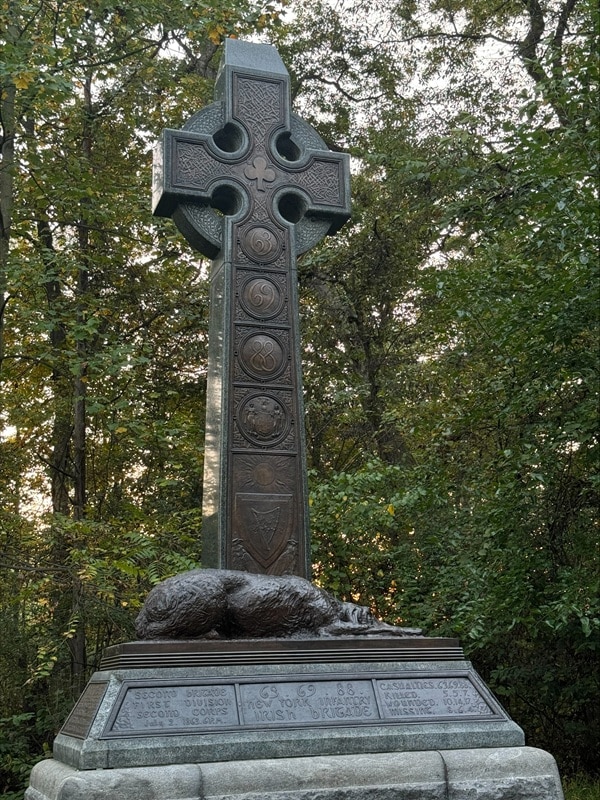
Historically, the Irish Brigade entered the field between the brigades of Col. Edward Cross and Brig. Gen. Samuel Zook.[4] Upon cresting a small knoll in the field, the men sighted Brig. Gen. Joseph Kershaw’s South Carolinians in the woods of Stony Hill.[5] After a short firefight, they rushed towards the woods, dislodging the men of Kershaw’s and Brig. Gen. Paul Semmes’ brigades, and capturing numerous prisoners.[6] In the episode, however, viewers are never shown the brigade’s attack through the Wheatfield. Instead, the men march in column through the woods around Stony Hill. Upon spotting the Rebels, the column quickly shifts into line of battle, and we witness a firefight underscored by an account from Maj. St. Clair Mulholland commanding the 116th Pennsylvania.
Yet some sequences are effective, such as a running set of scenes throughout the episode that show the plight of memoirist Lt. Charles Fuller of the 61st New York. Fuller, having been wounded in the leg and shoulder early in the fight, was trapped in the field until being found by a comrade after the major fighting had ceased. Another scene shows how confusing fighting in the woods can be, where the canopy traps smoke, making it difficult to see, let alone navigate regiments. These smaller vignettes tend to outshine the larger action scenes, especially in accuracy.
The last issue with the history deals with the balancing of the episode. Commentary on and from the Confederates is minimal, relying solely on the post-war recollections of Cpt. George Hillyer of the 9th Georgia. While Hillyer’s account is one of the most complete Rebel accounts from the engagement, it is not enough to tell a full story of the Confederate experience in that sector of the battlefield. Furthermore, we only hear from Hillyer in brief interludes, used to juxtapose what is happening with Caldwell’s men and how the Rebels are faring. While not an accuracy issue, having both sides of a story allows viewers to gain a firmer grasp on the history the series tries to tell.
The show also left me wanting more in a different and positive way. The constraints of short-form media forced the showrunners to take a narrow view of the fight. Because of this, there is little discussion aside from Caldwell’s men. There are mentions of Col. Jacob Sweitzer’s V Corps brigade entering the field to support Caldwell’s faltering line and a recreation of the mortal wounding of Col. Harrison Jeffords, who was shot and bayoneted as he attempted to save the flag of the 4th Michigan, becoming the highest-ranking officer of the conflict to die to a bayonet.[7]
One victim of the runtime is the U.S. Regulars, the army’s professional soldiers. The Regulars engaged in brutal fighting, nearly being surrounded as they attempted to reinforce Caldwell’s men. One Union volunteer later recalled, “[F]or two years the U.S. Regulars taught us how to be soldiers. In the Wheatfield at Gettysburg, they taught us how to die like soldiers.”[8] Supposedly, their divisional commander, Brig. Gen. Romeyn Ayres, stated when asked about his Regulars after the war, “I buried half of them at Gettysburg and the other half in the Wilderness. There’s no regulars left.”[9]
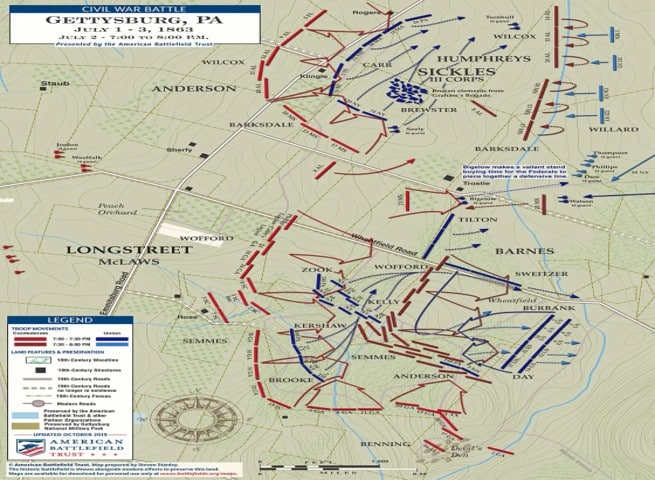
No discussion exists of the final counterattack against the Wheatfield, which pushed the Rebels to the western edge of the field, creating a no-man’s land. This attack featured men of Co. K of the 1st Pennsylvania Reserves, many of whom were natives of Gettysburg fighting to defend their homes.[10] Additionally, the charge led to six Medal of Honor recipients, all from the 6th Pennsylvania Reserves. These men split from their regiment to clear a farm of Confederate sharpshooters, capturing several in the process.[11]
As a child, seeing the history I read about played out on television was incredible. The next time my family visited Gettysburg I wanted to do more than just climb up the castle-like monument to the 12th and 44th New York or play in the rocks of Devil’s Den. I can still remember watching this show whenever I was home sick from school, or how one history teacher would play episodes at the end of class. To this day, I still watch episodes on YouTube when I am feeling a little bored. And while no piece of Civil War media will ever make everyone happy, the show still makes viewers think about the Civil War, its horrors, and its lasting impacts on America, and that is what matters most.
Colton Pikovsky is a recent JD graduate from American University in Washington, DC, where he similarly received a BA in political science in 2023. As a fellow with the Marshall-Brennan Constitutional Literacy Project, Mr. Pikovsky taught constitutional law at Capital City Public Charter School. In November 2025, Mr. Pikovsky won the American Battlefield Trust’s Ultimate GettysNerd 2.0 Competition.
Endnotes:
[1] History, “Civil War Combat: The Wheatfield at Gettysburg (S1, E1) | Full Episode,” YouTube, October 6, 2022, https://www.youtube.com/watch?v=AtNbQnBWGa0.
[2]American Battlefield Trust. “Gettysburg – the Wheatfield and Peach Orchard – July 2, 1863 – 7pm to 8pm,” https://www.battlefields.org/learn/maps/gettysburg-wheatfield-and-peach-orchard-july-2-1863-7pm-8pm.
[3] Pfanz, Gettysburg – the Second Day. 242-54.
[4] Smith, Storming the Wheatfield, 83-85.
[5] Smith, Storming the Wheatfield, 84
[6] Smith, Storming the Wheatfield, 86-87.
[7] Pfanz, Gettysburg – the Second Day, 293-94.
[8] Daniel Davis. “‘They Taught Us How to Die like Soldiers’: The U.S. Regulars at Gettysburg.” Emerging Civil War, July 2, 2016.
[9] This quote is attributed to Ayres but has no direct support from Ayres’ post-war writings.
[10] Henry Minnigh, History of Company K., 1st; (Inft,) Penn’a Reserves (Gettysburg, PA: Thomas Publications, 1998).
[11] American Battlefield Trust. Medal of Honor Database, 2026.


Civil War Combat was a fun show but you’re right about the limitations of a series like this. They should have focused on intense immersion / accuracy at a single critical moment on the battlefield. These shows always have problems with accuracy. I remember watching some episode of an old TV show on YouTube about Pickett’s Charge and there were very clearly mountains in the background during the reenactment scenes. At least make an effort to film somewhere that resembles the actual battlefield.
That is one thing I think Civil War Combat could never nail down. A few episodes focus on entire battles, some have distinct parts of the field they look at but still tell the entire story of the battle, but the Gettysburg episodes seem to focus solely on the smaller moments within the larger fight. I believe that you are referencing the 2011 History Channel production of “Gettysburg.” That would be another great piece to do an analysis of, especially when it comes to the portrayal of the Pickett-Pettigrew-Trimble attack.
I remember watching a very good video a while back done by Eric Campbell. It provided a good picture of what happened in the Wheatfield.
Good article. Congrats on your ECW debut, Colton.
Nicely done. I recall attending a classroom discussion and then a group tour of the Wheatfield a few years ago led by Carol Reardon. One of the very first things she said was that if anyone tells you they understand everything that happened in the Wheatfield, don’t believe them.
The Wheatfield was a staggering maelstrom of death that, in many ways, reminds me of various incidents in the Battle of Verdun half a century later. Boiled down, the truth of it can be laid to incompetence. There was a lot of bad handling of troops on both sides that day, so it was rather like a twenty-car pile up on a freeway, death coming from all sides as “bad drivers” crashed into each other. So much of Gettysburg, not just the opening of the battle, was a meeting engagement – men running head on into each other in surprise, mostly due to poor leadership and management.
If I remember correctly, this is also the one that kept referring to Sickles as “Major” instead of “Major General”. That always bugged me…
In their defense, that’s about the rank he was qualified for.