The Explosive Opposition to Lee in Statuary Hall
As I slowly begin writing the final chapter of my manuscript, which covers Civil War memory and Statuary Hall, I would be remiss if I did not share an interesting section that shows how the lengths of opinion mirror those seen today.
By the turn of the 20th century, Southern states began to erect effigies in National Statuary Hall, almost all of them former Confederates or supporters of Jim Crow segregation. Although not the first Confederate to grace the halls of the nation’s capital, Robert E. Lee raised debate and controversy even before he arrived. With it came contested interpretations of who Lee represented and the fight over what the Civil War was fought over.
Voices against the statue of Lee began in January 1903, shortly after the Washington Post reported that Virginia State Senator Don P. Halsey had proposed a statue of the former Confederate general and urged his fellow members of the state legislature to pass the legislation quickly.[1] Although Halsey did not serve in the Confederate military, his uncle John Warwick Daniel had, and they collaborated to get support in the Virginia legislature to pass the proposal. In a lengthy speech given by Halsey, he concluded that, despite some likely pushback, he and his state legislature were within their legal rights to use one of their two slots in the collection to honor Lee and that moment in their state’s history. [2]
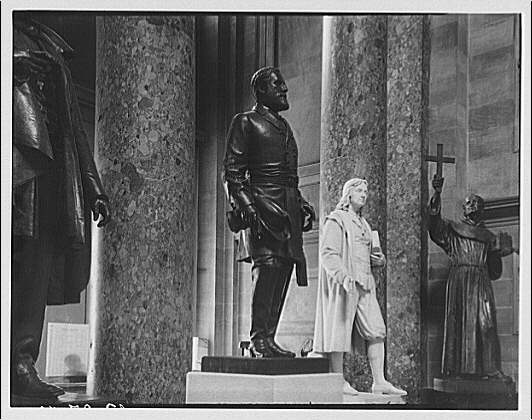
Opposition to the Lee statue, however, was going to be stronger and louder than Halsey or Daniel possibly anticipated. From the time that Virginia approved of the statue in March 1903 and beyond when it was finally emplaced in the halls of Congress in 1909, Union veterans railed against the effigy. One member of the Grand Army of the Republic wrote to the New York Times that Confederates were “conspirators,” and that “any proposition to honor them…should be discountenanced instead of being encouraged by the Government.”[3]
John Q. Evans, a veteran of the 5th Wisconsin Infantry Regiment, sent a question to the National Tribune that squarely cast Lee as a treasonous rebel. “If the statue of Gen. Robert E. Lee is placed in the National Capitol,” queried Evans, “would it be appropriate to place two others – one of Benedict Arnold, the other of Judas Iscariot?”[4] After Lee was emplaced, G.A.R. members from Nebraska acknowledged that although they could forgive their Confederate enemies, they refused to “forget that love of country is a blessed heritage” and that Statuary Hall was to be renamed “the Hall of Horrors” for its emplacement of Lee.[5] For some veterans, the animosity toward their former foe was marrow-deep. Even with time to reconcile and possibly forgive, they did not forget.
Black newspapers also recognized the dangers posed by Lee in the nation’s capital. The Richmond Planet, a black-owned and -operated newspaper, argued that a statue of Lee was just as egregious as the racially charged rhetoric of men like South Carolina’s Benjamin Tillman. It said that “the acme of political folly has been reached.”[6] James H. Hayes, an African American lawyer, gave a speech in late January 1903 at the aptly named Lincoln Memorial Church. In his speech, Hayes pondered the idea that the years since the Civil War had allowed some form of reconciliation via Lee’s statue, but it “had not been sufficient for the negro to advance one inch beyond the place he held when liberated from slavery.” [7]
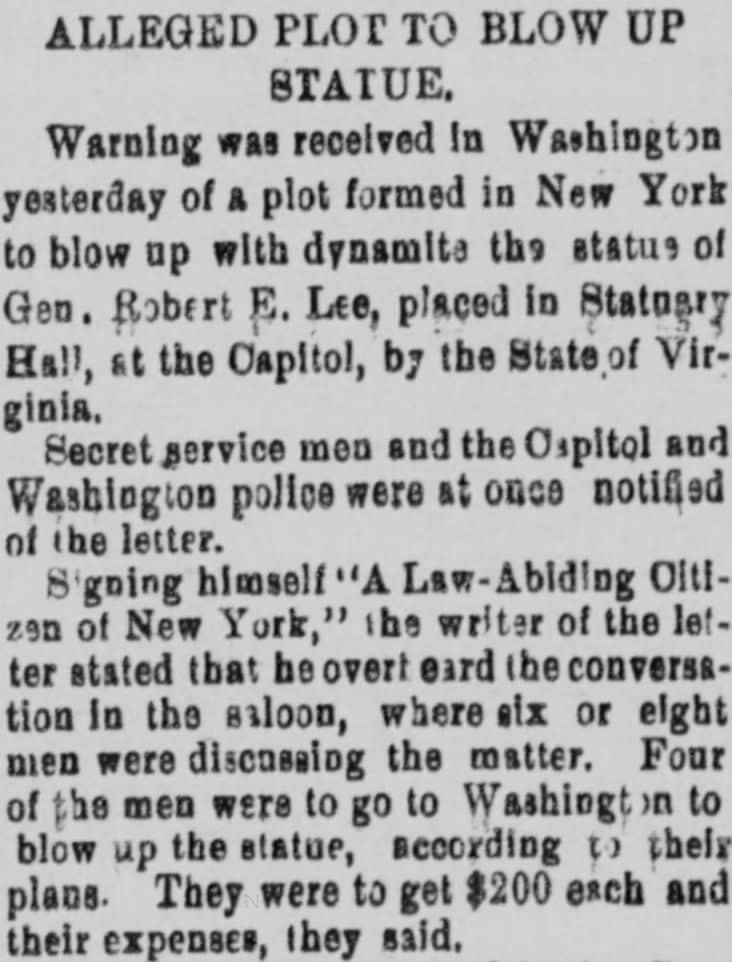
At one point, words from a newspaper or speeches in places of worship were not enough for some. The Alexandria Gazette reported in spring 1910 that disgust and disdain for Lee’s statue was so widespread that Secret Service and Capitol Police were notified of an alleged plot to blow it up with dynamite. The plans were discovered when an unidentified man from New York threatened the statue in a letter and arrested four men who confessed they were paid to cause the explosion.[8] It can be speculated that those who were arrested had some familial ties to aging Union veterans, or otherwise staunch Republicans.
Outrage over Lee’s statue had become so loud by 1910, especially over the issue of Lee in Confederate military uniform rather than civilian clothing. It got to the point where petitions for its removal had concerned President William Howard Taft enough to consult the statue’s legality with Attorney General George Wickersham. Wickersham eventually sided with Virginia and its pick. In a published letter to Taft, the attorney general argued the points of reconciliation and proclaimed that Lee was “all that was best in the [Confederate] cause,” and that acceptance into Statuary Hall would bring a “renewed loyalty.”[9]
Despite a delayed dedication of the statue in 1934, Lee would overlook Statuary Hall until the statue’s removal in 2020, when it was replaced by the statue of civil rights activist Barbara Rose Johns. The key theme to take away from the opposition is that it is eerily familiar to the opposition to Confederate memory now. Just think about the quotes from the era:
“He betrayed his country.”
“He is no better than a Benedict Arnold.”
“Lee and the Confederacy fought for slavery.”
“We need to get rid of it one way or another.”
Without context, it could be easily mistaken to conclude that those sentiments came from modern-day protesters or academics high atop the ivory tower, but that was not the case then. Opposition, and even the call for destruction, came from Union veterans and their descendants, along with the children of freedmen who only earned that title after a four-year bloody war. While common ground can be found in condoning illegal actions, it still provides an opportunity to ask ourselves, in the words of Statuary Hall’s founder Justin Morrill, who is worthy of national commemoration?
[1] Washington Post, January 18, 1903.
[2] The Speech of Hon. Don P. Halsey on the Bill to Provide a Statue of Robert Edward Lee to Be Placed in Statuary Hall in the Capitol at Washington, D. C., Delivered in the Senate of Virginia, Feb. 6, 1903 (Southern Historical Society Papers; WM. Ellis Jones and Job Printer, 1904), 4- 8.
[3] New York Times, January 27, 1903; Robert Colby, “Lee Returns to the Capitol: A Case Study in Reconciliation and Its Limits,” Reconciliation after Civil Wars: A Global Perspective, 118.
[4] National Tribune, April 16, 1903.
[5] Washington National Tribune, November 4, 1909.
[6] Richmond Planet, March 28, 1903.
[7] Baltimore Sun, January 28, 1903.
[8] Alexandria Gazette, April 14, 1910.
[9] New York Tribune, August 1, 1910.


Sounds like the Lost Cause did not “win the peace” but always had some very vocal opposition!
It’s appalling that so much of the “treason” hokum is still being peddled.
Very simply, secession was legal – like it or not. Proof: No Southern state or its leaders were found guilty of breaking any law barring secession; they weren’t even put on trial. Why? The prosecutors would have lost – and they knew it. Even Lincoln voiced his conflicting thoughts over whether secession had occurred or not.
Next, no Southern political or military leader was ever tried for treason – not even President Davis. Same reason – the prosecutors would have lost. And no, from Lee and Johnston on downward, no military officer committed treason. It is not treason to resign your commission – every single one was accepted, and not challenged, thereby debunking any ridiculous charges of treason – and emigrated to another country, which they defended in warfare. Had an American resigned his commission and emigrated to, say, England, and took English citizenship, and then joined the British army in a war with the United States, would he have been charged with treason? Absolutely not; the same applies to the men serving the Southern Confederacy.
Last, the enduring, recently invented lie to rationalize BLM/ANTIFA acts of flat-out treason, murder, mob behavior and felonious theft, destruction and extortion in the billions of dollars, that “Statues and memorials to Confederate leaders were raised to scare the shit out of the Negroes and reinforce Jim Crow!” – clearly coined not just by a liar but someone who, typically, has never read a history book. The real truth, and brutal it is, is that the Southern states were so impoverished by the war that it took nearly forty years before they had the money to spend on the statues and memorials…and at the same time, the North, which invented “The Black Codes” that were now called “Jim Crow” still had many of them in place, including segregation.
Statues don’t hurt people – unconstitutional laws do.
Hokum – it rots the brain and is especially harmful to children.
Section 3 – Treason defined. Proof of. Punishment of.
1. Treason against the United States shall consist only in levying war against them, or in adhering to their enemies, giving them aid and comfort. No person shall be convicted of treason unless on the testimony of two witnesses to the same overt act, or on confession in open court.
2. The Congress shall have power to declare the punishment of treason, but no attainder of treason shall work corruption of blood, or forfeiture, except during the life of the person attainted.
“Buzzwords” are fun. Can’t wait for your books!
As far as the legality of secession goes, check out the Supreme Court decision Texas v. White. I think that pretty clearly defines secession as an illegal act, whether that was the right decision by the court, or not.
And, in fact, there was an American that left the U.S. Army, took up arms against the United States, and eventually emigrated to England: Benedict Arnold. I don’t think there are too many Americans that would say what he did was anything less than treason.
Except it doesn’t do that well – and probably not at all. Texas v.. White is a very weak decision. It points to no language in the Constitution itself to argue that secession is wrong or is somehow prohibited. Indeed, it actually points to language that was in the Articles of Confederation and not retained in the Constitution. See the decision here:
https://scholar.google.com/scholar_case?case=1134912565671891096&q=%22texas+v+white%22&hl=en&as_sdt=3,44
When the statue was first proposed, an Iowa congressman threatened to introduce a bill to place a statue of John Brown on the grounds of the post office in Richmond.
Hey Steve,
Yes, they do in fact! What it is interesting about that is Don Halsey gave a speech in the state senate in response to some of the criticism, citing that he would not be mad if someone emplaced John Brown. The irony there is that although Halsey alleged he would be fine with it, the bill for John Brown still died on the floor of Congress. Thanks for reading!
Attorney General Wickersham got it right. Every meeting of the Richmond Civil War Round Table begins with the Pledge of Allegiance. What is remarkable about that is how unremarkable it is. We take national unity for granted. We shouldn’t. There are worse people to honor than Lee and a statue is a small price to pay to avoid sectional violence that could have lasted for generations.
Thanks Samuel — great piece … and thanks for noting how true the echoes of GAR Veteran’s protests would ring today … those old soldiers had it exactly right in 1903 — R.E. Lee did not belong in Statutory Hall … he belongs a lot of places — Gettysburg, museums, Washington and Lee University … there is no place for him, however, in the nation’s capitol.
We can argue whether or not Lee was guilty of treason … what is not up for debate is Lee violated his oath of office when he took up arms against the United States … upon his commissioning, Lee swore: to “bear true allegiance to the United States of America” and to “observe and obey the orders of the President of the United States” … while resigning from the Army in 1861 legally released him from the requirement to obey the President, it did not absolve him of his pledge of “true allegiance to the United States” … that is a lifetime promise and there is no mechanism to “unswear” that moral obligation.
I believe Mr. Morrill would agree … especially since the president signed The National Statutory Hall Act into law in July 1864.
PS — While the statue of Lee is gone (due to action by the Virginia legislature to remove it), I was surprised to see other southern luminaries in the Hall and on the public tour — Jefferson Davis, Alexander Stephens, Wade Hampton and Joe Wheeler.
I agree with you often, but I have to disagree on this point. An oath of office isn’t some mystical bond that follows you to the grave. It applies only while you hold the office for which you took that oath. Every citizen should have an inherent allegiance to the country to which he or she belongs, of course, but I don’t think someone who once held office carries any greater obligation than any other citizen after leaving that position.
To Mark & M.A., here are certain interesting, little-known, and undisputed facts regarding R.E. Lee resigning his commission and its impact on his duties to the U.S.
The conventional wisdom is that on April 20, 1861 Lee resigned his commission as a newly-promoted Colonel in the U.S. Army (ironically, a promotion he accepted from Abraham Lincoln).
On April 22 Lee accepted a commission as major general in command of Virginia’s forces. At that time, Lee still was an active duty U.S. Army officer.
On May 14, Lee accepted a commission as a brigadier general in the regular Confederate States Army. At that time, Lee (almost certainly) still was an active duty U.S. Army officer.
Impossible, you might say? Not if you read the U.S. Army Articles of War, which governed when Lee’s resignation became effective. As a “recovering” (retired) lawyer, if Lee had been my client, I would have advised him that he was at serious risk of a post-war court martial on capital offenses.
Perhaps this topic will be the subject of a future ECW Symposium talk.
thanks M.A. … that’s an interesting view, and one that civilians typically hold … but it conflates administrative employment with a constitutional covenant … in military jurisprudence, an officer’s oath carries two distinct obligations: obedience to orders, and allegiance to the United States.
Resigning legally ends your duty of obedience—you hand in your gear and you’re no longer subject to the chain of command … but resignation does not grant legal or moral amnesty to violate your sworn oath of allegiance … swearing true faith to the Constitution isn’t a temporary workplace policy that expires when you leave the office … it’s a solemn pledge to the sovereign nation, a pledge that civilians don’t take.
Lee didn’t just quit a job … he took four decades of military trust, institutional authority, and professional mastery, and turned it around to wage war against the government he had repeatedly sworn to defend …. that’s not a “mystical bond”— it’s a blatant violation of the core ethical and legal obligation that defined his entire life.
P.S. The Lincoln administration held this view … in late April 1861, the Secretary of War and General Scott stopped accepting resignations from southern officers who intended to join the Confederacy … instead, the War Department formally rejected their tenders and dismissed them from the service via a series of General Orders, treating them as deserting defectors rather than honorably discharged veterans … Lee only avoided that fate because his resignation cleared bureaucratic channels a few days before the gate slammed shut.
No disrespect intended, but that is just silly. Swearing an oath to the US Constitution does not mean an officer cannot resign that oath and swear a new oath to a new country. What is your authority for that premise? Officers quit all the time and join a foreign force, often with the intent to live there forever. Swearing a oath is not life servitude. I took the same oath, with a few words changed. There is no legal or moral reason I could not resign my commission and accept a commission in the military of Mexico or Israel. That becomes even more true if the country of the 1st oath decides to invade my new country and attack my neighbors and family.
Tom
Mark, I did serve in the Army as an enlisted soldier, not an officer, just so you’re aware of some of my background. I’m not an expert on military jurisprudence by any means, I guess I don’t see a distinction here between someone who leaves the service and every other citizen who holds an allegiance to the country. I’d hope that we all support the Constitution and remain loyal to the government and its laws. Why is it any different for a resigned officer? Does their obligation somehow goes beyond that of everyone else?
Thanks for sharing your background, M.A.— good on you for serving … in answer to your question, the reason a resigned military officer carries a heavier burden than a private citizen comes down to two simple realities:
Passive Civic Duty vs Active Executive Trust: For a civilian, allegiance is primarily a passive duty to follow the law of the land. For a commissioned officer, allegiance is an active executive trust— a sworn appointment by the President and Senate to exercise ‘special trust and confidence’ on behalf of the republic.
Weaponizing Federal Expertise: Lee didn’t just walk away … he took 40 years of federally funded military mastery, strategic insight, and command authority — built entirely by and for the republic—and weaponized them to destroy that same republic.
Southern officers like Winfield Scott, George Thomas, and Montgomery Meigs understood this exact distinction … they recognized that an oath to the Constitution meant national fidelity always superseded state loyalty — no matter what papers you filed.
Lee resigned his commission before the state of Virginia voted to approve secession. Granted that approval was a foregone conclusion, statewide the vote was about 6 to 1 in favor of secession, including what is now West Virginia, which was more pro-union than the rest of the state.
Lee’s words on the subject in a letter to his brother: “I wished to wait till the Ordinance of Secession should be acted on by the people of Virginia; but war seems to have commenced, and before I could see you again on the subject, as I had wished. I am now a private citizen, and have no other ambition than to remain at home. Save in the defense of my native State, I have no desire ever again to draw my sword.” Lee, Fitzhugh, “General Lee,” copyright 1892
On one hand he couldn’t wait for the people’s vote even though he was a private citizen, and on the other he says war has already started but I won’t draw my sword…
For Kevin Donovan: thanks Kevin, i wasn’t aware of this overlap … but you’re right — Lee cut it pretty darn close and missed by a few days … he mailed his resignation on the 20th (doesn’t count as official resignation) and three days later accepted a Confederate commission in Richmond … and all prior to his resignation being accepted.
And yet by 1920, Confederate and Union veterans were helping raise money for each other’s statues and attending each other’s unveilings.
Tom