The Nameless and the Faceless Women of the Civil War: My Henry
ECW welcomes back guest author Lisa G. Samia.
The poem My Henry is from The Nameless and the Faceless Women of the Civil War. The unknown woman in the poem has heard that President Lincoln is coming to Gettysburg on November 19, 1863, to dedicate the new National Cemetery for the Union Civil War dead. The Battle of Gettysburg was just months before, July 1-3, and this woman’s husband, Henry, was one of the thousands who died during the battle. She is still suffering from her husband’s death yet resolves to come to the cemetery hoping to find some comfort in his words.
When she arrives at the cemetery, she finds the crowd is too much for her to get through; then, in an instant, the president raises his head, and their eyes meet. In that instant, she sees death in his eyes, almost as if he too knows of his fate. It binds them together for this one moment in time.
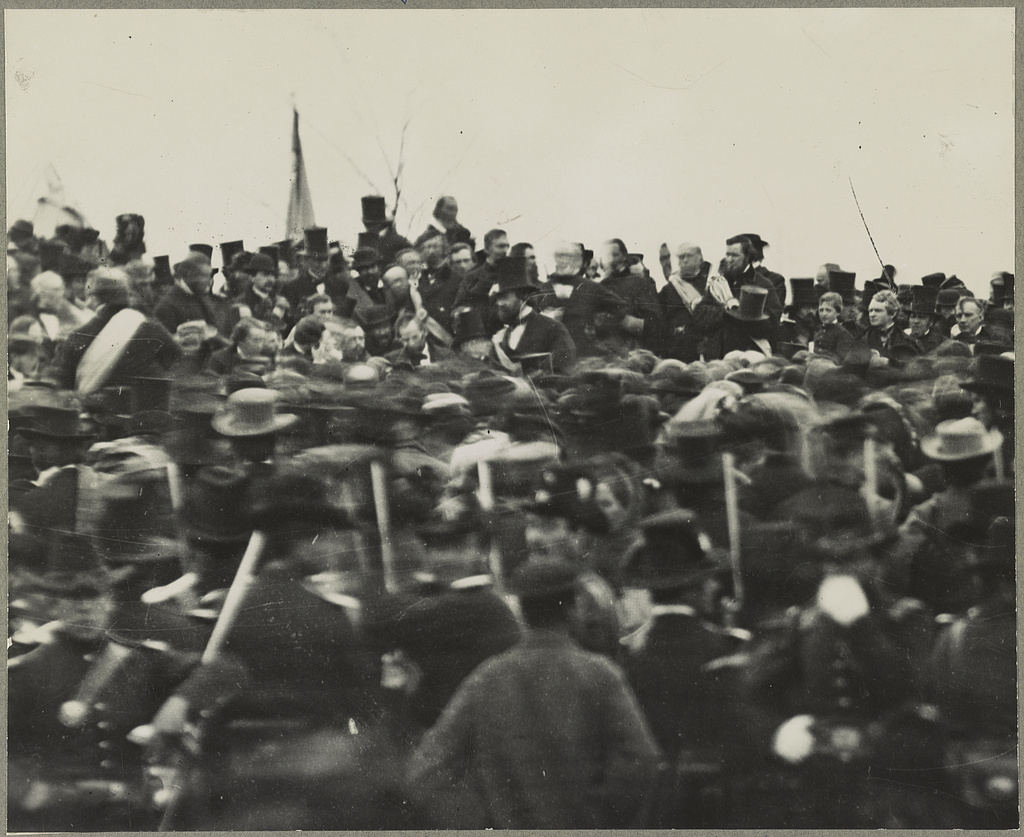
It was the description of that look in President Lincoln’s eyes by our great American poet Walt Whitman that inspired this poem.
Walt Whitman made his presence known after the Battle of Fredericksburg, which brought him to Chatham Manor, the Union headquarters, in December 1862 after he “traveled to Fredericksburg in search of his brother” who was wounded.[1]
After Fredericksburg, Walt Whitman traveled to Washington, D.C., where he continued to work in the hospitals, giving aid by reciting his poems and writing letters on the soldiers’ behalf.
It was during his time in Washington that Walt Whitman had the opportunity to observe President Lincoln. While they never officially met, it was Walt’s description of the President’s face, especially when he describes, “a deep latent sadness,” that inspired the poem My Henry.
Walt Whitman stated: “I saw very plainly the President’s dark brown face, with the deep cut lines, the eyes, &c., always to me with a deep latent sadness in the expression. Earlier in the Summer you might have seen the President and his wife, toward the latter part of the afternoon, out in barouche, on a pleasure ride through the city. Mrs. LINCOLN was dressed in complete black, with a long crape veil. The equipage is of the plainest kind, only two horses, and they nothing extra. They passed me once very close, and I saw the President in the face fully, as they were moving slow, and his look, though abstracted, happened, to be directed steadily in my eye. I noticed well the expression I have alluded to. None of the artists or pictures have caught the deep, though subtle and indirect expression of this man’s face. They have only caught the surface. There is something else there. One of the great portrait painters of two or three centuries ago is needed.”[2]
***
My Henry[3]
I walked past the patch of earth that housed my Henry now gone
Silenced forever from my sight
God help me I am so forlorn
Is Gettysburg I tell you now
Whose battle he so valiantly did fight
for our union, he did say
I still love him with all my might
“Tis November now five months have passed since then
So now our President is here, to dedicate our fallen men
And so, I heard his words quite beautifully I do say
Like poetry from God above, I bowed my head to pray
It took him just two minutes or so
As the words flowed ever so divine
Like manna from heaven touched the soul
I know that they did mine
Yet as much as I tried to be near him, the crowd in between too great
I wanted to tell our President of my Henry’s fate
I had to try to reach him to tell him of my heart
It was the look in his eyes that haunted me, careworn that gave me a start
For in those eyes, it seemed to me he too knew of his fate
And would come to rest, I am sure in the glory of heaven’s gate
***
It is to wonder at the comfort this unknown woman took away from the President in his brief speech, just 272 words, that would describe his compassion and resolution in faith, the words that defined what was happening to his nation. And just like her Henry, the President would end up sacrificing his own life for the freedom and liberty of all his people.
Lisa G. Samia is an award-winning poet and author. She was selected as the National Parks Artist in Residence for Stones River, Murfreesboro, Tennessee, in 2025, and the National Parks Service Artist in Residence for Manassas National Battlefield Park in 2021, and the National Park Service Artist in Residence for Gettysburg National Battlefield Park in 2020, all for poetry.
Endnotes:
[1] “Walt Whitman at Chatham Manor,” Fredericksburg and Spotsylvania National Military Park, National Park Service, https://www.nps.gov/articles/000/walt-whitman-at-chatham-manor.htm, accessed July 23, 2026.
[2] Walt Whitman. “Washington in the Hot Season.” The Walt Whitman Archive. Gen. ed. Matt Cohen, Ed Folsom, & Kenneth M. Price. Accessed 22 July 2026. <http://www.whitmanarchive.org>. Published August 12, 1863.
[3] Lisa G. Samia, “My Henry,” The Nameless and the Faceless Women of the Civil War, Destiny Whispers Publishing, LLC, April 21, 2021, 85.


The idea that this unknown woman and Lincoln shared a moment through eye contact at Gettysburg is so moving. That look she describes says everything.
Walt Whitman’s description of Lincoln’s eyes is haunting on its own—but seeing it woven into this woman’s grief makes it even more powerful. Beautiful poem, Lisa.
Excellent article and beautiful poem, Lisa. Well done!
It is always my pleasure to read Lisa’s works and leave a comment. When I first connected with Lisa, I can’t tell you how great it was to know about her work and what we have in common, telling the untold stories of WOMEN! I am a huge fan Lisa! I really appreciate what you do, I admire your talent!