Weaving the Threads of History: Fred Kiger Brings the Civil War to Life
The Civil War has sometimes been called America’s Iliad, and its study has produced some of our greatest storytellers. Bruce Catton, Shelby Foote, and Ed Bearss all possessed the rare ability to make the war feel present. Few can transport listeners from the quiet fields of Antietam or the deck of the CSS Shenandoah to the crowded streets of wartime New York or the parlor of a Southern home, all within the span of a single lecture.
For nearly half a century, Fred W. Kiger has done exactly that. Through his lectures, battlefield study programs, and now his popular podcast, Threads from the National Tapestry, Kiger has become one of the Civil War’s most accomplished storytellers, blending meticulous scholarship with an engaging narrative style that reminds audiences that history is, above all else, about people.
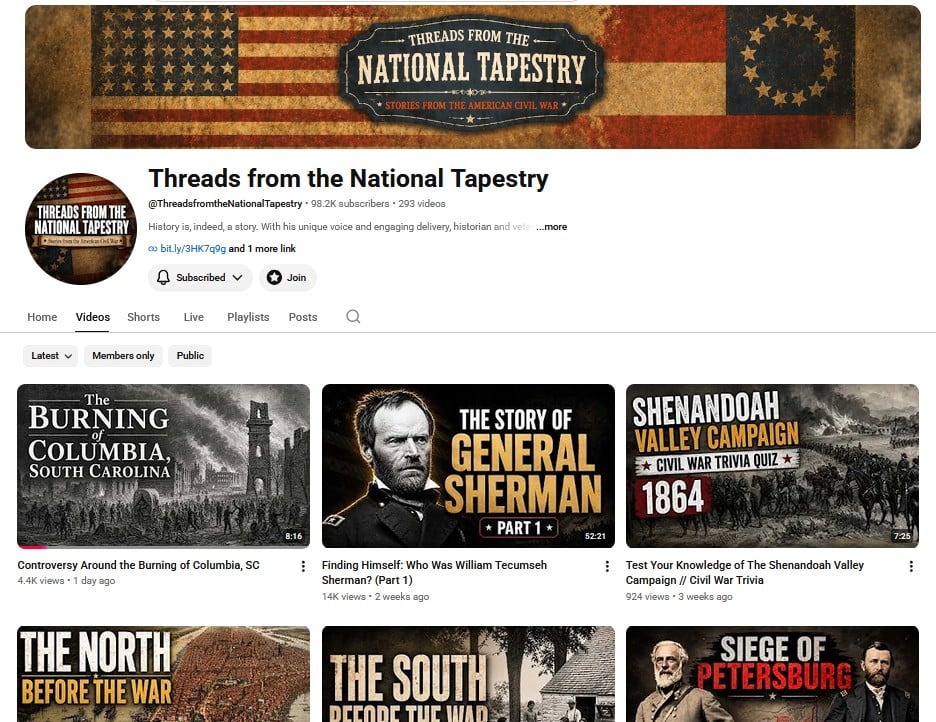
I first discovered his podcast on YouTube, where Kiger pairs his signature narrative style with a rich presentation of historical photographs. From the first episode, I was hooked. Non-military topics like the election of 1860, science and technology, and even sex sit comfortably alongside the major battles. Kiger promises “to make you feel as if you were there,” and he more than delivers. I recently had the opportunity to speak with him about his background, his approach to history, and the vision behind Threads from the National Tapestry.
Ironically, Kiger would probably resist being the focus of attention. Early in our conversation, he remarked that he preferred “the less about me and the more about the subject.” That humility helps explain why his work resonates with so many listeners. His goal has never been to showcase his own knowledge. Instead, he strives to make Civil War personalities come alive.
That passion began long before he stepped into a classroom. Growing up in rural North Carolina, Kiger accompanied his father, a decorated World War II veteran, to Army reunions across the country. While the adults swapped stories of combat, sacrifice, and lifelong friendships forged under fire, a young Fred listened from the back of banquet halls, captivated by what he heard. At the same time, the Civil War Centennial was unfolding, and his mother encouraged his growing interest with books, magazines, and newspaper articles. Together, those experiences ignited a fascination that would shape the rest of his life.
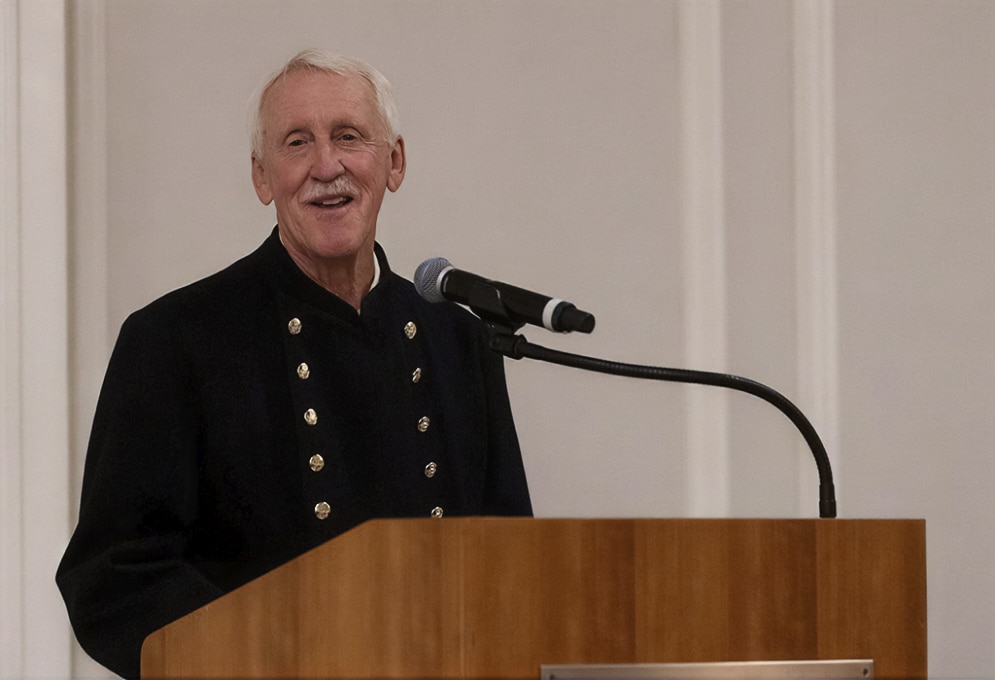
What struck Kiger then, and continues to shape his work today, is the timelessness of the soldier’s experience. Whether describing Civil War diaries, his father’s wartime journal, or conversations with veterans of more recent conflicts, he sees the same emotional thread running through every generation. “Remove the technology, change the names,” he observed. “The experiences, the horror, the boredom, it’s all the same.” It is a perspective that keeps his work firmly rooted in the human experience rather than military statistics alone.
After earning undergraduate and master’s degrees from the University of North Carolina, Kiger spent sixteen years teaching Civil War and Reconstruction at Chapel Hill High School before bringing those lectures to the University of North Carolina’s Carolina Alumni Association. Over the next several decades, he delivered hundreds of presentations, eventually building what he jokingly calls his “vast arsenal” of lectures covering every aspect of the conflict, from major campaigns and battlefield tactics to music, diplomacy, politics, medicine, and life on the home front.
Those years of teaching ultimately became the foundation for Threads from the National Tapestry, produced and distributed by North Carolina-based Third Wheel Media. Far from being a collection of casual conversations, each episode draws from lectures refined over decades before thousands of students and lifelong learners. Podcasting offered Kiger something equally important: permanence. Rather than allowing years of research and presentation materials to disappear into filing cabinets, the series preserves them in a format accessible to listeners around the world.
The podcast’s remarkable success suggests that approach has struck a chord. With millions of YouTube views and tens of thousands of subscribers, Threads from the National Tapestry has attracted an audience well beyond traditional Civil War enthusiasts. That broad appeal stems largely from Kiger’s conviction that history should be experienced rather than merely recited.
“What separates a good story from a great one?” he asked during our interview before answering his own question. Battles alone are only “the original layer of paint.” The real artistry lies in adding the colors that bring those events to life.
Those colors are often found in the small, unexpected details. Listeners might discover that Ulysses S. Grant spent the first weeks of his life without a name, that Stonewall Jackson was famously tone-deaf, or that William T. Sherman once served as president of what would become Louisiana State University. Individually, these facts may seem trivial. Collectively, they transform iconic figures into recognizable human beings.
Kiger returns repeatedly to the importance of “humanizing” history. Dates, troop movements, and casualty figures certainly matter, but they are only part of the story. The weather, the relationships between commanders, the experiences of civilians, or the music soldiers sang around campfires all contribute to a richer understanding of the conflict. As he explained, simply stating that Confederate guns opened fire on Fort Sumter conveys the event, but “there’s no soul there.”
His ability to weave together those details owes much to decades of careful research, but Kiger is equally adamant that compelling storytelling must never come at the expense of historical accuracy. Asked how he balances entertainment with scholarship, his answer was immediate.
“My primary goal is to be accurate,” he said. “If you’re not accurate, you’ve lost credibility.”
That commitment extends beyond consulting primary sources. Kiger readily acknowledges that memoirs, diaries, and recollections often carry their own biases and limitations. When evidence is uncertain, he deliberately qualifies stories with phrases such as “as the story goes” or “it has been told,” making clear the distinction between documented fact and historical tradition. It is a small habit, but one that reflects a deep respect for both the historical record and his audience.
Perhaps the most striking aspect of Kiger’s work is his refusal to embrace simplistic narratives. He argues that Americans too often consume what he calls “fast-food history”—short, tidy versions of the past that leave little room for contradiction or complexity.
Instead, he encourages listeners to recognize that neither the Union nor the Confederacy was monolithic. Northern opposition to the war, Southern unionism, political rivalries, civilian dissent, and conflicting motivations all deserve a place in the broader story. Even his own understanding has evolved over time. Raised in the South, Kiger initially accepted many traditional interpretations of the conflict. Years of reading and research led him to reconsider those assumptions. For Kiger, changing one’s mind in light of evidence is not a weakness but a hallmark of honest scholarship.
That openness extends to his continuing work as a historian. Despite decades spent researching and teaching the Civil War, Kiger insists he still has much to learn. “Every day I am reminded,” he reflected, “how I know enough about the American Civil War to know that I don’t know far enough.”
It is an unusually humble sentiment from someone who has lectured alongside Shelby Foote, led battlefield tours across the country, and devoted much of his life to understanding America’s defining conflict. Yet it may also explain why Threads from the National Tapestry continues to resonate with listeners. Kiger approaches history not as a collection of settled facts, but as an ongoing conversation.
Near the end of our interview, he offered perhaps the best description of both the Civil War and his life’s work. History, he said, resembles a quilt: “thick,” “multi-layered,” and stitched together from countless individual patches. It is a fitting metaphor. Through Threads from the National Tapestry, Fred Kiger invites listeners to examine those individual threads one by one, discovering that the deeper they look, the richer and more human the story becomes.Threads from the National Tapestry is available on Spotify, Apple Podcasts, and other platforms, as well as YouTube.


