“Spoons” Butler and the Twiggs Swords
ECW welcomes back guest author Katy Berman.
In November 1869, Massachusetts congressman and former Union general Benjamin F. Butler was sued in a New York Superior Court by Rowena Florance, native to New Orleans. Miss Florance claimed that Butler had unlawfully seized three presentation swords and a box of silver left her by Confederate Maj. Gen. David E. Twiggs, when the city fell to Union forces in April, 1862.[1]
Unquestionably, Miss Florance had the swords in her possession at that time: a note signed by Twiggs is proof of that. Equally verifiable is that Butler had taken the swords: he subsequently sent them to President Abraham Lincoln with suggestions as to their future use. The president referred the matter to Congress, and the valuable swords were eventually stored in a vault at the Treasury Department.[2]
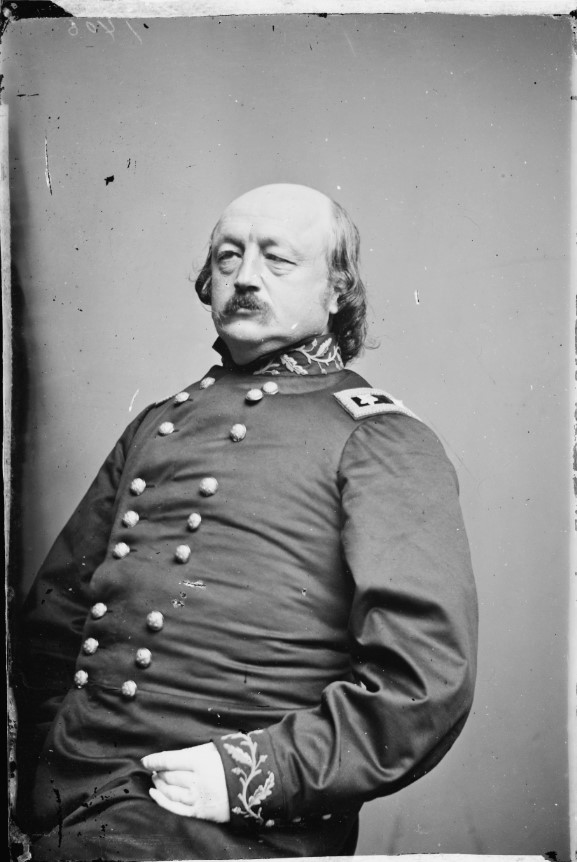
Mr. C. Rodney May, representing Miss Florance in the New York Superior Court, insisted that hers was a lawsuit instituted “in good faith” and the events described “were matters of public notoriety in New Orleans.” Florance described the swords as family heirlooms, and affirmed she had not been an “aider or abetter (sic) of people in arms, against the United States government.”[3]
The three swords were and are immensely valuable, particularly one that had been presented to Twiggs by Congress in 1847 in honor of his heroism during the Mexican-American War. Mounted and hilted in solid gold, festooned with two white sapphires, a topaz, and rose-colored diamond, the sword also features a solid gold eagle, two inches long, atop its pommel, overlooking engraved scenes of battle. The inscription reads, “Presented by the President of the United States (James Polk) agreeable to a Resolution of Congress to Brig. Genl David E. Twiggs in testimony to the high sense entertained by Congress of his Gallantry & Good Conduct in storming Monterey. Resolution Approved March 2, 1847.” The second and third swords were presented by the Georgia Legislature, and Twiggs’ native city of Augusta, Georgia in the same year.[4]
Butler recounted to Lincoln how he obtained the swords in his letter: “Genl. Twiggs left these swords with a young woman in the evening before he fled from New Orleans and his flight on the day of the approach of the fleet, he wrote in his carriage while enroute extraordinary paper: “I leave my swords to Miss Rowena Florence and Box of Silver (Signed) D. E. Twiggs N. O. 25th April 1862” This paper was claimed as a deed of gift of these very valuable weapons by the young woman named, but as she had neglected to inform her father of this singular donation Causa fugae, and as the girls’ mother caused them to be given to a negro to be sent back to Gen. Twiggs’ house, I ventured to interfere with this testamentary disposition. A more lamentable instance of the degradation to which this rebellion has reduced its votarie.”[5]
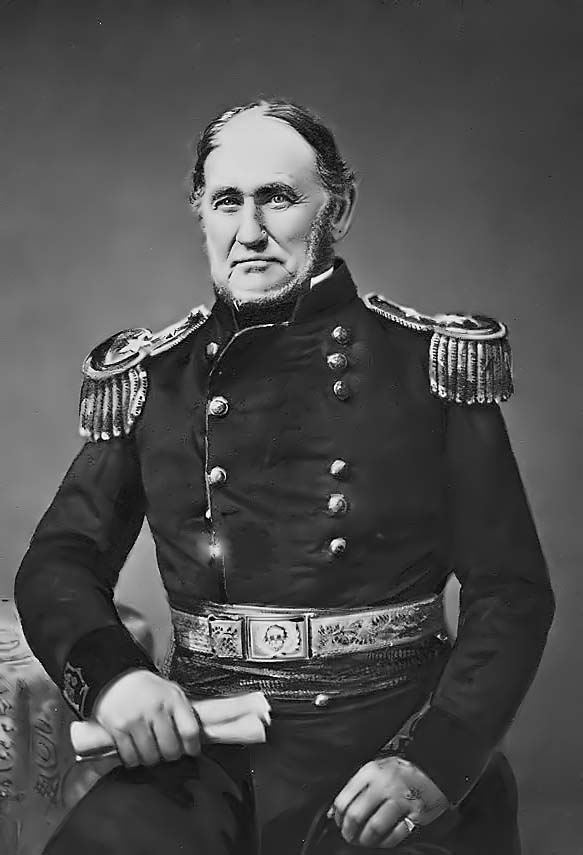
Later, Butler stated that he had taken the swords from a bank. A nephew of Gen. Twiggs, Judge Hansford D.D. Twiggs, offered a third narrative, years later, when ownership of the swords was in dispute. He claimed that Butler had threatened Rowena and her mother with imprisonment if they did not give up the swords.[6]
Butler dismissed Florance’s suit as politically motivated and refused to appear in court. Superior Court Judge Jones of New York ordered his arrest, charging him with stealing “silverware and table furnishings” worth $2,000 from Mrs. (sic) Rowena Florance. Butler posted the bail of $15,000.[7]
Newspapers across the country, admittedly quite partisan, were quick to cover the scandal. Philadelphia’s Daily Evening Telegraph, in its November 24, 1869 edition, devoted most of its coverage to a long rant recalling the sins of Twiggs, “a doubly disgraced and dishonored individual” who had been called (by President Lincoln) the Benedict Arnold of the Civil War. The writer dismissed Florance’s claim to the swords, declaring that “this deed of gift was so manifestly a mere trick of a fugitive scoundrel that General Butler properly paid no regard to it.” It argued that even if her claims had merit, “it is high time the prosecutions of all Union officers for anything they may have done amiss during the war should cease.”[8]
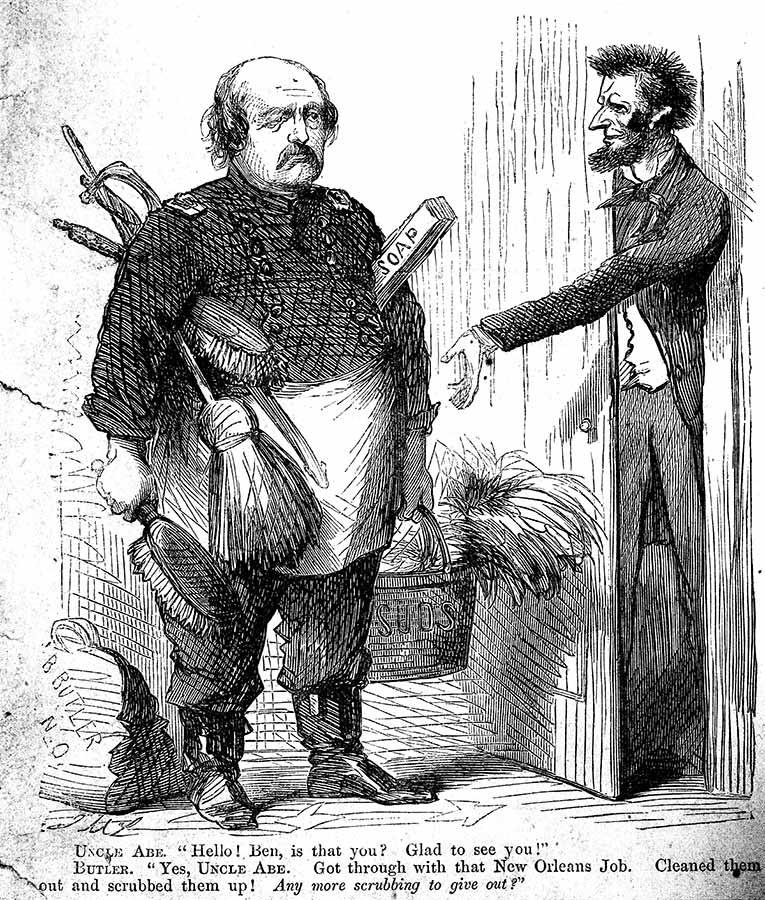
The Charleston Daily News, in its November 20, 1869 edition, took a different stance. Its column was headed “After the Spoons: Beast Butler in Hot Water.” “Spoons” referred to a nickname Butler had acquired during the eight months he had spent in New Orleans during which he allegedly pocketed silver spoons when going to dine. [9]
The Democratic Enquirer of Vinton County, Ohio, on November 24, 1869 took aim at Republicans: “It is not often that a Radical paper will tell the truth or acknowledge that there any (sic) thieves, robbers, or plunderers in that party.”[10]
Florance was unable to retrieve the swords and silver in 1869, despite President Andrew Johnson declaring that they should be returned to her. However, in 1878, after marrying Joseph Guedalla and moving to London, she tried a different tactic: she appealed directly to Congress. The “Twiggs’ plate” had probably been “sold for silver,” but she wanted the swords.[11]
She was not the only claimant. Twiggs daughter, Marion and her husband, former Confederate Quartermaster Gen. Abraham Charles Myers, had just returned from a long sojourn in Germany. As executor of General Twiggs’ estate, Myers claimed his wife had a legal right to the swords. Rendering them legal assistance was, reportedly, none other than Butler![12]
A bitter correspondence ensued between Ernest T. Florance, a lawyer practicing in New Orleans, who defended his sister Rowena’s right to the swords, and Judge Twiggs, who suggested that Florance/ Guedalla’s sole interest in the heirlooms was to turn their gemstones into jewelry. Both sides hired attorneys to argue their cases before the United States Court of Claims.
On May 13, 1889, the court decided in favor of the Twiggs family.[13]
The Florances and Guedallas exited the public stage, but not so Benjamin F. Butler. He entered politics, and in that field of endeavor, old scandals are golden. The general gave a credible accounting of the silver that had come into his possession in New Orleans; however, the accusations-and the nickname- persisted. A newspaper article published in February 1868 contains this amusing story: Butler was in attendance at the Carroll Hall Theater in Washington, D.C when Charles Dickens was reading excerpts from several of his popular works. Butler had arrived late and made the audience aware of his presence. After an intermission, Dickens commenced reading the following passage from The Pickwick Papers:
‘I request that you’ll favor me with your card, sir.”
“I’ll do nothing of the kind, sir.”
“Why not, sir?”
“Because you’ll stick it over your chimney-piece, and delude your visitors into the false belief that a gentleman has been to see you, sir.”
“Sir, a friend of mine shall wait on you in the morning.”
“Sir, I am very much obliged to you for the caution; and I’ll leave particular directions with the servants to lock up the spoons.”[14]
Mr. Dickens appeared perplexed by a roar of laughter that arose from the audience. Butler’s reaction is not recorded.[15]
Katy Berman is a retired elementary-school teacher residing in New Jersey. She earned her Bachelor’s Degree in English at the University of California, Berkeley and her Master’s in American History through American Military University. For several years, she has reviewed books for The Civil War Courier.
Endnotes:
[1] The Worcester Daily Spy, Worcester, MA, Jan. 15, 1870; The New York Times, Saturday, Jan. 15, 1870.
[2] Benjamin F. Butler to Abraham Lincoln, Abraham Lincoln Papers: Series 1. General Correspondence, 1833-1916, Library of Congress.
[3] Charleston Daily News, Nov. 20, 1869; Daily National Intelligencer and Washington Express, November 18, 1869 Vol. I, #52.
[4] Butler to Lincoln, Abraham Lincoln Papers; Morphy Auctions. https://www.jamesdjulia.com. (Accessed July 6, 2026).
[5] Butler to Lincoln, Abraham Lincoln Papers: Series 1. General Correspondence, 1833-1916.
[6] New York Times, Tuesday, July 23, 1878, and Sunday, September 1878.
[7] The Wheeling Intelligencer, Wheeling, WV, November, 1869.
[8] The Evening Telegraph, Philadelphia. November 24, 1869.
[9] The Charleston Daily News, Nov. 20, 1869; Holzman, Robert S. “Ben Butler in the Civil War,” The New England Quarterly,” Vol. 30, #3, Sept., 1957), 338.
[10] “The Beast Sued,” The Democratic Enquirer, Vinton Co., OH, Nov. 24, 1869.
[11] My Heritage Database. https://www.myheritage.co.il. (Accessed July 6, 2026).
[12] The Somerset Herald, Somerset, PA, August 13, 1884, vol.23, #9.
[13] The Alexandria Gazette, May 13, 1889, vol.90, # 113.
[14] “Charles Dickens and the Unintended Joke,” St. Joseph Herald, St Joseph, MI, Feb. 22, 1868.
[15] Orcutt, William Dana. “Benjamin F. Butler and the ‘“Stolen Spoons”’: The Documents in the Case from His Unpublished ‘Private and Unpublished Correspondence.” North American Review Vol. 207, #746 (Jan., 1918), 76-80; Willis, Nathaniel. “Charles Dickens and the Unintended Joke,” (Excerpted from the St. Joseph Herald, St Joseph, MI, Feb. 22, 1868, https://yesteryearsnews.wordpress.com.( Accessed June 25, 2026.)


Excellent vignette on the Lightfingers Louie of the Civil War Era. Whatever his virtues in other areas, he never was adverse to the main chance. But where are these swords today?
I wish I knew! One can find records (with photos) of presentation swords awarded to General Grant and Meade that were sold at auction. I imagine they go to collectors.
Yes, “fugae” means flight or fleeing and causa means what it sounds like.
Really enjoyed your story. I too wonder where the swords are?
Great postbellum high society aside, Katy!
A great story. Butler should have stayed with spoons.
Butler used the phrase “donation Causa fugae.” Does that mean something done in ignoble flight?
Oops. I responded to you above.
It’s endlessly fascinating to read yet another tale of robbery and rapine by the noble crusaders who fought the war to end slavery. The accounts are endless…with little to none by the White Supremacists. Hmm…
You seem to be woefully misinformed. Despite his many flaws, Ben Butler did quite a bit to end slavery and expand the rights of Black people. In 1863, he had a death warrant issued on him by Jeff Davis for the leading role that he took in the recruitment and employment of Black soldiers. Black troops under his command were treated as equal to white ones and given competent leadership and chances to prove themselves in battle. In fact, he worked hard to collect up all the black troops in the army into the Army of the James because he felt like they were not being given a fair shake by professional soldiers. All but a few of the Medals of Honor issued to Black soldiers during the Civil War were awarded to troops under his command and at his insistence. After the War he sponsored the first Civil Rights bill in American history, support for which, he said, was based on his experiences with Black soldiers during the war. I wrote an article about this very subject titled, “Ben Butler’s Black Battalions.” I hope you can find a copy!
I wouldn’t be surprised if some of those spoons, and possibly a few forks, may have been melted into medals issued to USCT troops, created to honor their HEROISM, particularly after the Battle of New Market Heights.