“Down This Way Boy’s” Patrick Henry O’Rorke at Gettysburg
ECW welcomes guest author Patrick Schubert.
Nestled in the Hudson River Valley, the United States Military Academy is among the world’s premier military education centers. More than 100 officers from both sides at the battle of Gettysburg spent their formative years at West Point. The military academy formed many officers who gained experience in the American West and the Mexican-American War. The Civil War brought challenges to West Point, expediting the graduation of the class of 1862 to June of 1861. Cadets were appointed from across the United States, and as the Union fractured, many Southern students swore allegiance to the Confederacy. The Civil War called for more trained officers, and the armies found them at West Point. By 1863, many of them found themselves leading men into battle. New Yorker Patrick Henry O’Rorke soon found himself at the top of his class of thirty-five at the academy.
O’Rorke was born in Ireland on March 28, 1836, but his family soon immigrated to the Western Hemisphere. After a few years of hopping between homes, the O’Rorkes settled in Rochester, New York, in an Irish community known as “Dublin.”
Although a strong student, O’Rorke had to provide for his family after his father died in a railroad accident. He quickly picked up masonry and became a skilled stone-cutter. His academic reputation never faded as he was offered an appointment to the United States Military Academy. Entering West Point on July 1, 1857, his abilities prevailed enough for him to finish top of the class. The Civil War quickly called the green officers from the expedited class of 1861. The newly-minted Lt. O’Rorke began his war as a staff officer.[1]
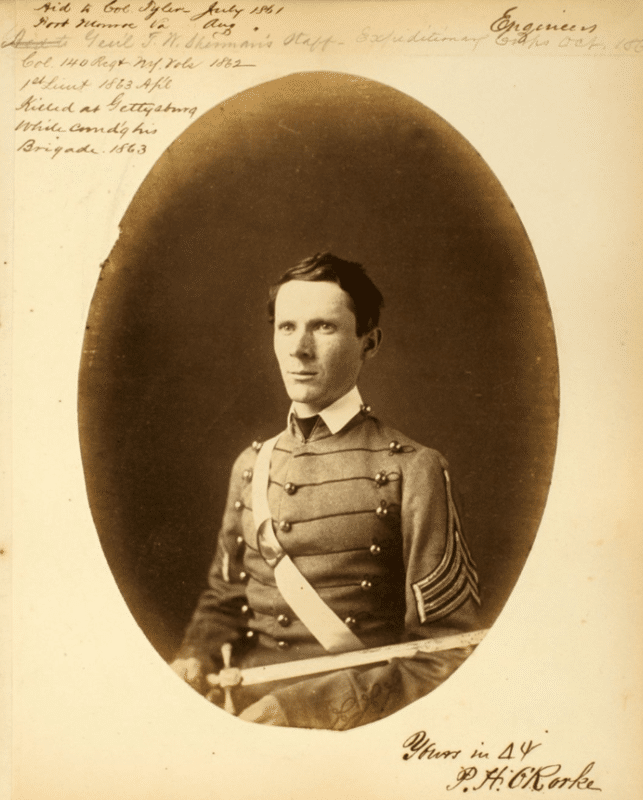
At First Bull Run, O’Rorke received his baptism of fire, exposing him to the realities of war and preparing him for future service. He wrote to his brother, “I don’t think I shall ever be shot. I never expect to get into a hotter fire than I was under last Sunday.”[2] O’Rorke’s experience on the battlefront helped build his reputation back home. He was offered the position of colonel in the new Rochester Regiment, which mustered in September of 1862.
The 140th New York, as the unit was designated, saw action for the first time just two months later at the battle of Fredericksburg in a brigade commanded by Brig. Gen. Gouverneur K. Warren.[3] Warren shared with O’Rorke a West Point pedigree, having graduated second in the class of 1850. O’Rorke acted as the brigade commander at Chancellorsville, the Union defeat which opened the door for Lee to invade Pennsylvania. Back in command of the 140th, Col. O’Rorke led his upstate New Yorkers as they began their march north.
On July 1, 1863, six years after O’Rorke entered the academy, Confederate forces under West Point graduate A.P. Hill advanced on Gettysburg, but were delayed by Union cavalry commanded by John Buford and infantry led by Maj. Gen. John F. Reynolds, allowing the Union army to secure the vital high ground as the V Corps rushed to the battlefield.
On the afternoon of July 2nd, both armies received reinforcements as the high sun blazed above Gettysburg. West Point alumnus Robert E. Lee, determined to be aggressive, attacked the flanks of the Union line. In the early afternoon, III Corps commander Daniel Sickles, the only Union corps commander not trained at West Point, moved his corps without orders one mile to a rise of ground to his front.[4] There was no opportunity to fill the gaps which the untrained officer created before the battle began, and the III Corps needed support on the Union left to defend key strong points. With the movement of the III Corps, Brig. Gen. Gouverneur K. Warren, the chief topographical engineer, rushed to find support for Little Round Top.[5] Colonel Strong Vincent climbed the slopes of Little Round Top to anchor and extend the Union flank. Almost as soon as he deployed, the Confederates pressed his right. He was able to hold, but in turn Vincent fell mortally wounded.
Warren found Patrick Henry O’Rorke and his 140th New York Volunteer Infantry. General Warren, still searching for more men, found the ranks of his old brigade, and Patrick O’Rorke led it toward the fight. Looking at the Irish native, Warren demanded he bring up his regiment. O’Rorke replied, “General Weed is ahead and expects me to follow him…” Warren, in dire need of help, replied, “Never mind that…bring me your regiment and I will take responsibility.”
The 140th New York, as one soldier reported, went “fly[ing] up the hill.” Speeding past them were the cannons and caissons of a fellow West Point graduate. Lieutenant Charles Hazlett, in command of Battery D, 5th United States Artillery, graduated in the scheduled class of May 1861. Hazlett’s battery could not fire effectively due to the slope’s grade. Hazlett was not concerned, exclaiming, “The sound of my guns will be encouraging to our troops and disheartening to the others…my battery is of no use if this hill is lost” as they rushed to the top.[6] The men of the 140th “had to make lively moves to avoid getting run over.”[7]
The 140th New York rushed to the top of the hill with O’Rorke at the head of his regiment, drawing his sword. There was no time to form into line as O’Rorke called out to his men, “Down this way boys.” As the Rochester regiment attacked in column, they went down the hill, and one soldier remembered “bullets came flying among us.” The 140th charged in support of the outflanked 16th Michigan.
Within moments, the esteemed officer called out, “Here they are, men, commence firing.” In a second, the “Valiant Officer” was fatally hit in the neck and “drop[ped] without a sound.”[8] The 140th New York turned the tide, and Vincent’s right flank and the southern face of Little Round Top were secure. It came at a cost. The young, bright, and gallant “Beau of an ideal soldier… had cut short the chapter of that fair life.”[9]
Patrick Henry O’Rorke lost his life on the field of battle. However, he led his men, strengthened defenses, drove off the enemy, and contributed to the victory at Gettysburg. He was one of the many West Point-trained officers who clashed on the fields of the small town of Gettysburg.
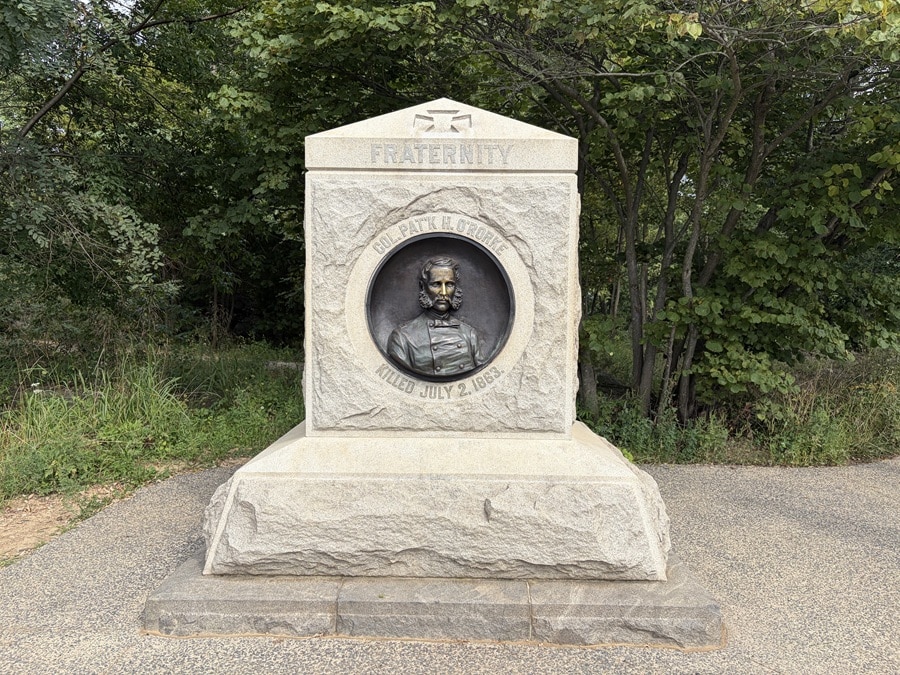
His life of promise, skill, and training was cut short while defending the rocky slopes of Little Round Top. In 1889, the veterans of O’Rorke’s regiment erected a monument and placed the likeness of the Irish commander on the front face of the granite memorial. His men felt the most for their fallen commander and stated, “His place cannot be filled.”[10] The 140th New York’s monument stands as a living reminder of O’Rorke’s influence on the regiment and the lasting legacy he left after his death. O’Rorke was dedicated to his duty, embodied patriotism, and valor on the battlefield through his selfless sacrifice. His youth and inexperience were overshadowed by his training at West Point, which allowed him to perform his duties in battle. Patrick O’Rorke’s experience at Gettysburg was both chaotic and tragic. His actions were crucial to the Union defense and victory at Gettysburg, Pennsylvania.
Patrick Schubert is an undergraduate student at Gettysburg College who is currently a seasonal Park Guide at Gettysburg National Military Park. He is interested in the lives of young soldiers, their education, and their memory.
Endnotes:
[1]Brian A. Bennett, Sons of Old Monroe: A Regimental History of Patrick O’Rorke’s 140th New York Volunteer Infantry, 2nd ed., rev. (Dayton, OH: Morningside, 1999), 44-45.
[2]Ibid.
[3]Kent Masterson Brown, Cushing of Gettysburg: The Story of a Union Artillery Commander (Lexington, KY: University Press of Kentucky, 1993), 154.
[4]Harry W. Pfanz, Gettysburg, the Second Day (Chapel Hill: University of North Carolina Press, 1987), 151–153.
[5]Brian A. Bennett, Sons of Old Monroe: A Regimental History of Patrick O’Rorke’s 140th New York Volunteer Infantry, 2nd ed., rev. (Dayton, OH: Morningside, 1999), 44-45.
[6]Ralph J. Kirshner, The Class of 1861: Custer, Ames, and Their Classmates after West Point (Carbondale: Southern Illinois University Press, 1999), 54.
[7]Bennett, Sons of Old Monroe: 232.
[8]The War of the Rebellion: A Compilation of the Official Records of the Union and Confederate Armies, Series I, vol. 27, pt. 3, 635; Glenn W. LaFantasie, Twilight at Little Round Top: July 2, 1863—The Tide Turns at Gettysburg (Hoboken, NJ: John Wiley & Sons, 2005), 151.
[9]Bennett, Sons of Old Monroe: 219.
[10]“From the 140th—The Battle of Gettysburg,” Rochester Journal and the Post Express, July 8, 1863, 3.


A true “Faugh a ballagh” moment!
Congrats on your ECW debut, Patrick!
Nicely done.
Excellent read, thanks