Book Review: Managing the Union Army: Scott, McClellan, Halleck & Grant as General-in-Chief

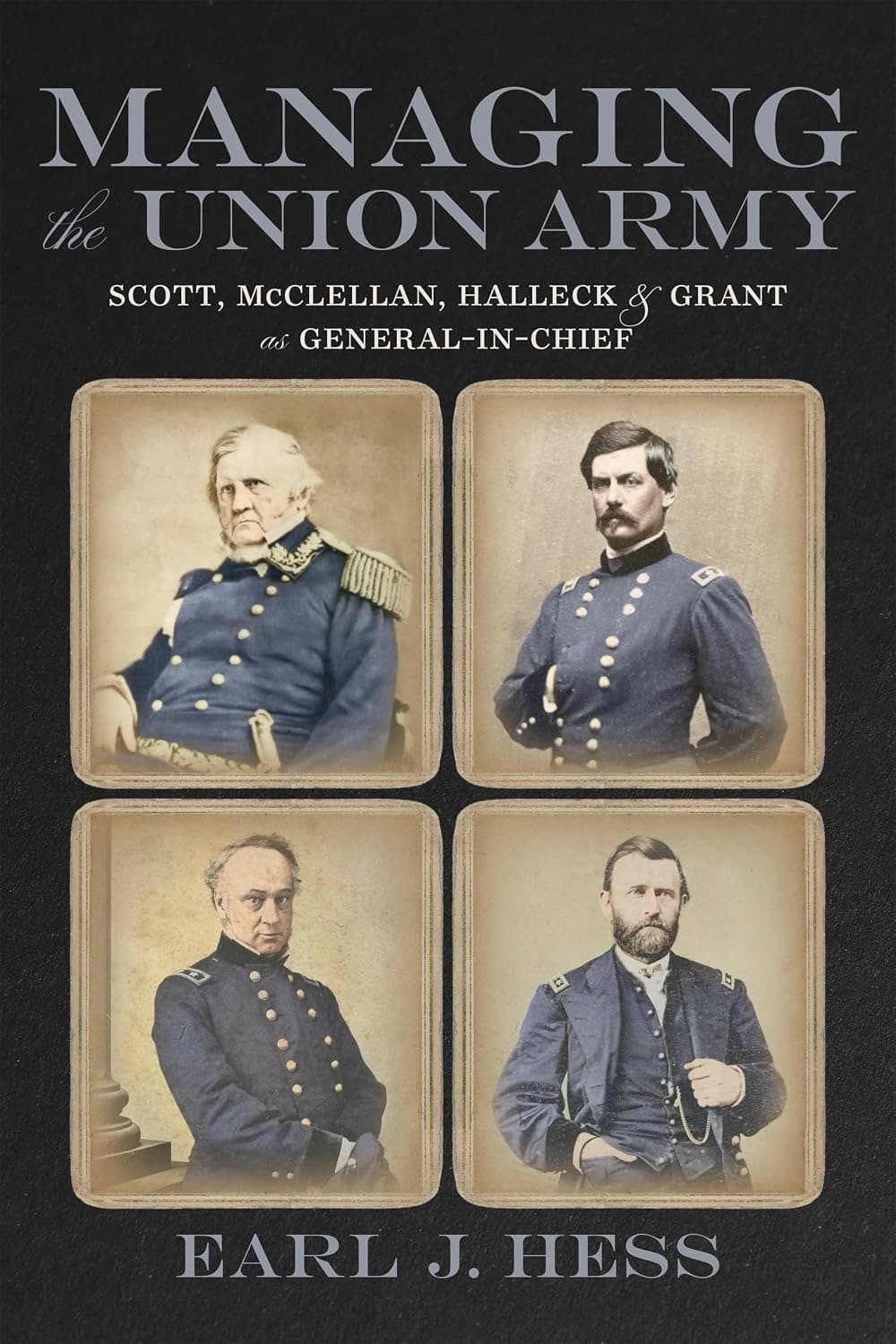
Managing the Union Army: Scott, McClellan, Halleck & Grant as General-in-Chief. By Earl J. Hess. Baton Rouge: Louisianna State University Press, 2026. Hardcover, 468 pp. $55.95.
Reviewed by Greg M. Romaneck
At the outset of the Civil War, the Union possessed a number of clearcut material advantages over its Confederate opponents. However, one area where the Union lagged behind was that of military leadership. Both at the field and staff levels, early war Federal leadership typically failed to meet the moment. One such leadership deficit was embodied by the post of general-in-chief and the men who held it during the early years of the war. It is the critical post of Union general-in-chief, and the four men who filled that position during the war, that Earl Hess addresses in his most recent book.
Typically, Hess is a historian who combines a deep factual assessment of his selected Civil War topics with a deft psychological analysis of the men who fought that bloody war. In this case, the focus is on the four commanders who filled the role of general-in-chief of all Federal ground forces. In order, those commanders were Winfield Scott, George B. McClellan, Henry Halleck, and Ulysses S. Grant. As readers will quickly learn, the first two men to be named general-in-chief were terribly unsuited for the post. Hess presents Scott as a worthy man who had offered great service to his nation during the Mexican War and as the pre-war general-in-chief. Sadly, by 1861, Scott was an elderly man, plagued by health concerns, who could not understand the need for a speedy defeat of the emerging Confederate forces. These deficits, plus the undermining of Scott by his successor, led to his departure from military service approximately a half-year into the Civil War.
It is in describing George B. McCellan, Scott’s successor, that Hess produces some of the most interesting chapters in this excellent leadership study. For Hess, McCellan was a man driven by self-importance to an extent that endangered the Union cause. In Hess’s words, “No Civil War general exceeded McClellan in viewing his work through the lens of his ego. He did not seem capable of envisioning personal relations, command relations, or strategic goals without filtering them through that lens.” (407) This egotistical leadership style alienated McClellan not only from his military staff, but also President Abraham Lincoln. Over time, as Hess notes, “his huge ego was a constant stumbling block to his every move as general-in-chief.” (10) McClellan was eventually fired by President Lincoln, leaving behind “an eddy of confusion instead of a steady hand at the helm.” (89)
McClellan’s successor was Henry Wager Halleck, an officer of mixed talents. Hess does an excellent job of offering a balanced approach to Halleck during his time as first general-in-chief and then as army-chief-of staff. Traditionally, Halleck is presented by historians as sort a fuss-budget, who nagged more than led. For Hess, Halleck is a much more nuanced leader. Hess concedes that Halleck did not possess the prerequisite skills to command armies in the field. However, as an administrator, Halleck was very skillful. During his tenure, the distribution of supplies, mobilization of new volunteer units, and logistics were reasonably handled. Eventually, when Gen. Grant superseded Halleck, he inherited a well-organized central staff. Often maligned by biographers and historians, Hess views Halleck as a capable man who was “far better suited for the position than was his immediate predecessor.” (114)
In his final chapters, Hess presents Gen. Grant as both a field commander and then as the army general-in-chief. In Grant, Hess sees a skillful commander who could face the arithmetic of battle in ways that forged victory. In describing Grant’s talents as a tactician, Hess notes, “His skills as a commander were natural, shaped by hard and repeated experience in the field. He was a good learner pragmatically assessing what he had to do differently to keep one step ahead of events.” (196) Grant was not a self-pandering man such as McClellan nor a bureaucratic figure like Halleck. While Grant always had superior numbers of troops on hand, he used those forces in ways his predecessors did not. As Hess writes, “Superiority of numbers means nothing unless a commander knows how to use them to his advantage.” (17) Fortunately, for the Federal cause, Grant was able to leverage the might of the North and, by so doing, led the Union to victory.
In Managing the Union Army, Earl Hess offers his readers a fine study in wartime leadership. The position of general-in-chef remained in place until 1903, when the title was dropped and the position became a chief-of-staff role. However, during the Civil War this role was critical and influential. Hess, as always, tackles his subject with topflight scholarship linked to a fine narrative style. As a result, Hess produces a book about wartime leadership that is fair, balanced, informative, and enjoyable to read.
Greg M. Romaneck is retired after working for 34 years as a professional educator and consultant. During those years he held positions such as special education teacher, assistant principal, elementary principal, adjunct professor, director of special education, student teaching supervisor, and associate superintendent. Mr. Romaneck has also trained as a counselor and worked in areas such as crisis intervention, mediation, problem solving, and conflict resolution. Greg has had several books and numerous articles published on a variety of subjects such as Education, Psychology, Self-Improvement, Backpacking, Eastern Philosophy, Civil War history, Poetry, and Bible studies. Greg has also had nearly 3,500 book reviews published by Childrenslit.com, a popular source of information for educators, librarians, and parents regarding books for younger readers and has reviewed Civil War books for four decades for a variety of publications and magazines. Most recently Greg was the featured book reviewer for more than a decade with the Civil War Courier. Greg resides in DeKalb, Illinois and enjoys spending time with his family & friends, hiking, kayaking, backpacking, reading, and writing.


Good review of what appears to be a very interesting and informative book. Earl Hess is one of the finest living Civil War historians and his books are uniformly good. I only wish the reviewer had commented on the continued high prices of the LSU Press. Thank goodness for Ted Savas and other publishers who understand that most of us cannot afford a $56 book.