Lost Civil War Films of the Silent Era
Although primitive animations and minutes-long motion pictures emerged in the decades following the American Civil War, silent films did not hit their stride until the second decade of the 20th century. The war, sometimes described as the American Iliad, provided endless fodder for the silver screen.
Coincidentally, 1911–1915 marked the Civil War’s semicentennial and coincided with the film industry’s explosive growth. The 1913 Gettysburg reunion was the largest gathering of Civil War veterans in American history, while hundreds of monuments and memorials rose across the North and South. Aging veterans, entering their twilight years, wanted their accomplishments and battlefield exploits immortalized for posterity.
Filmmakers capitalized on this nostalgia, bringing the Civil War to nickelodeons and movie palaces across the country. D. W. Griffith’s 1915 The Birth of a Nation is perhaps the best known, but hundreds of Civil War-related titles were released between 1910 and 1929—at least that we know of. By some counts, 75 were copyrighted in 1911 alone. Many drew on popular plays and novels.[1]
For the first time, Civil War veterans, their children, and their grandchildren could watch battles from distant memory come to life before their eyes. What I wouldn’t give to sit beside one of those veterans. Would they watch with tears in their eyes, remembering fallen comrades? Would they shake their heads and grumble, “It didn’t happen that way,” or launch into a post-movie tirade about “how it really was”? Those reactions, like many of the films themselves, have been mostly lost to history.
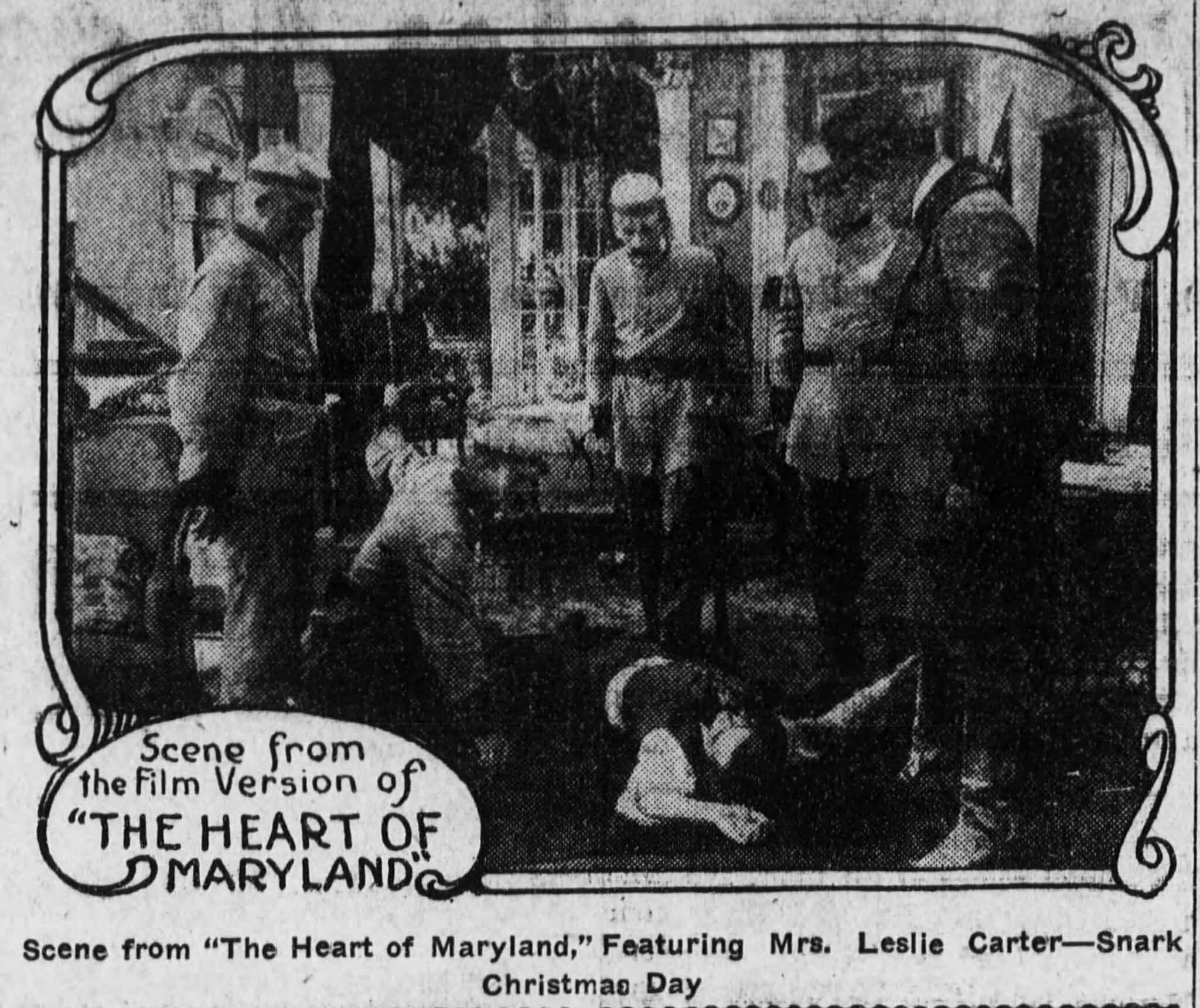
Of the thousands of silent films released during that brief period, only 14 percent survive in their original format. Many exist only as fragments or in degraded condition. Most were recorded on highly combustible nitrate film. Reels that did not burn were often discarded after their theatrical runs or thrown out to free storage space.[2]
The 1915 silent film The Heart of Maryland, starring Mrs. Leslie Carter, was a 60-minute adaptation of David Belasco’s play. Reportedly made with a cast of more than 5,000 and a budget exceeding $100,000 (roughly $3.3 million today), it is one of three film versions. Both the 1915 and 1921 versions do not survive.
A large percentage of early Civil War films are considered lost. We know they existed only because of newspaper advertisements and trade magazines such as The Motion Picture Story Magazine and Moving Picture World, which sometimes preserve movie stills, cast lists, and other tantalizing glimpses of their contents. Thankfully, a few have been rediscovered in recent years.
As recently as 2024, an intern at a film archive in New York found a copy of The Heart of Lincoln, starring and directed by Francis Ford. The 65-minute film was made in 1915 and recut in 1922, then disappeared. These five reels of 16-millimeter film are the only copy known to exist.[3]
It would be impossible to review every lost Civil War film within the limits of this space, but a few noteworthy examples will suffice. Many of the earliest Civil War narratives ran only one reel, or roughly 16 to 20 minutes. Films grew longer over time, but several of these early epics can no longer be viewed. Chattanooga (1912), The Battle of Gettysburg, and The Battle of Shiloh, both released in 1913 and featuring dramatic battle reenactments, are considered lost. Scenes from The Battle of Gettysburg, however, were reused in Cohen Saves the Flag, filmed at the same time and still extant.
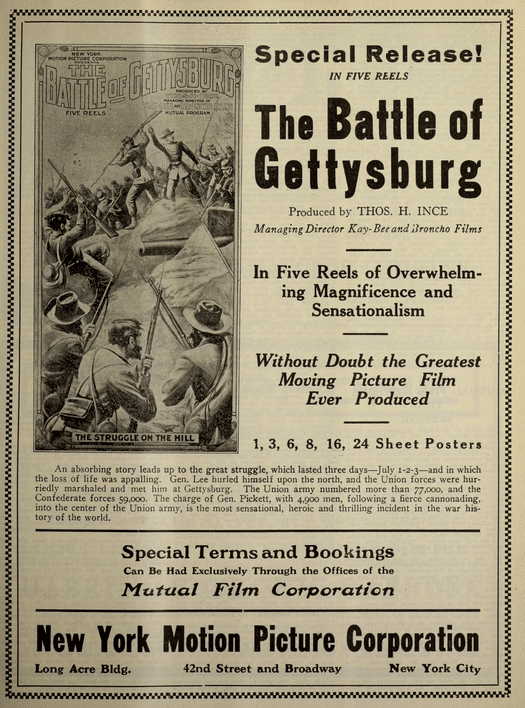
A newspaper advertisement described New York Motion Picture Company’s five-reel, 90-minute The Battle of Gettysburg as “The greatest war picture ever conceived.” It promised “an accurate reproduction of the greatest battle of the Civil War” featuring “booming cannon, bursting shells, thrilling cavalry and infantry charges, hand-to-hand encounters and thrilling deeds of valor.”
“Sensational—Spectacular—Thrilling.”[4]
The movie centered on a boilerplate love story involving a young woman whose sweetheart fights for the North while her brother fights for the South. Upon its release, Rev. E. Boudinot Stockton did not recommend it as suitable for Memorial Day viewing, labeling it as belonging to a class of films that “has very little if any pretense to historical accuracy…”[5]
Others disagreed. In July 1913, for the 50th anniversary of the battle, about fifty Union veterans from the Chelsea, Massachusetts Soldiers’ Home attended a showing at the National Theater in Boston and were reportedly “most enthusiastic upon their return home.” Captain DeWitt C. Coffman, commandant of the Boston Navy Yard, said, “Every student of history, as well as every person with a spark of patriotism in him, should see it.”[6]
It seems incredible that not a single surviving copy of this film remains available to the public. Rumor holds that a screening was held in France in 1973, but aside from the brief scenes in Cohen Saves the Flag and a few grainy screen stills, no one has seen it in decades. It’s a pity, since the battle cinematography often credited to D. W. Griffith may have been pioneered by Gettysburg’s director, Thomas H. Ince, two years earlier.
Another lost Civil War film from the silent era was The Battle of Shiloh, written by Emmett C. Hall and directed by Joseph W. Smiley. Despite its title, the film was a spy drama set during the battle rather than focused on the fighting itself. If newspaper advertisements can be believed, however, it was filmed on the battlefield, adding an element of realism.[7]
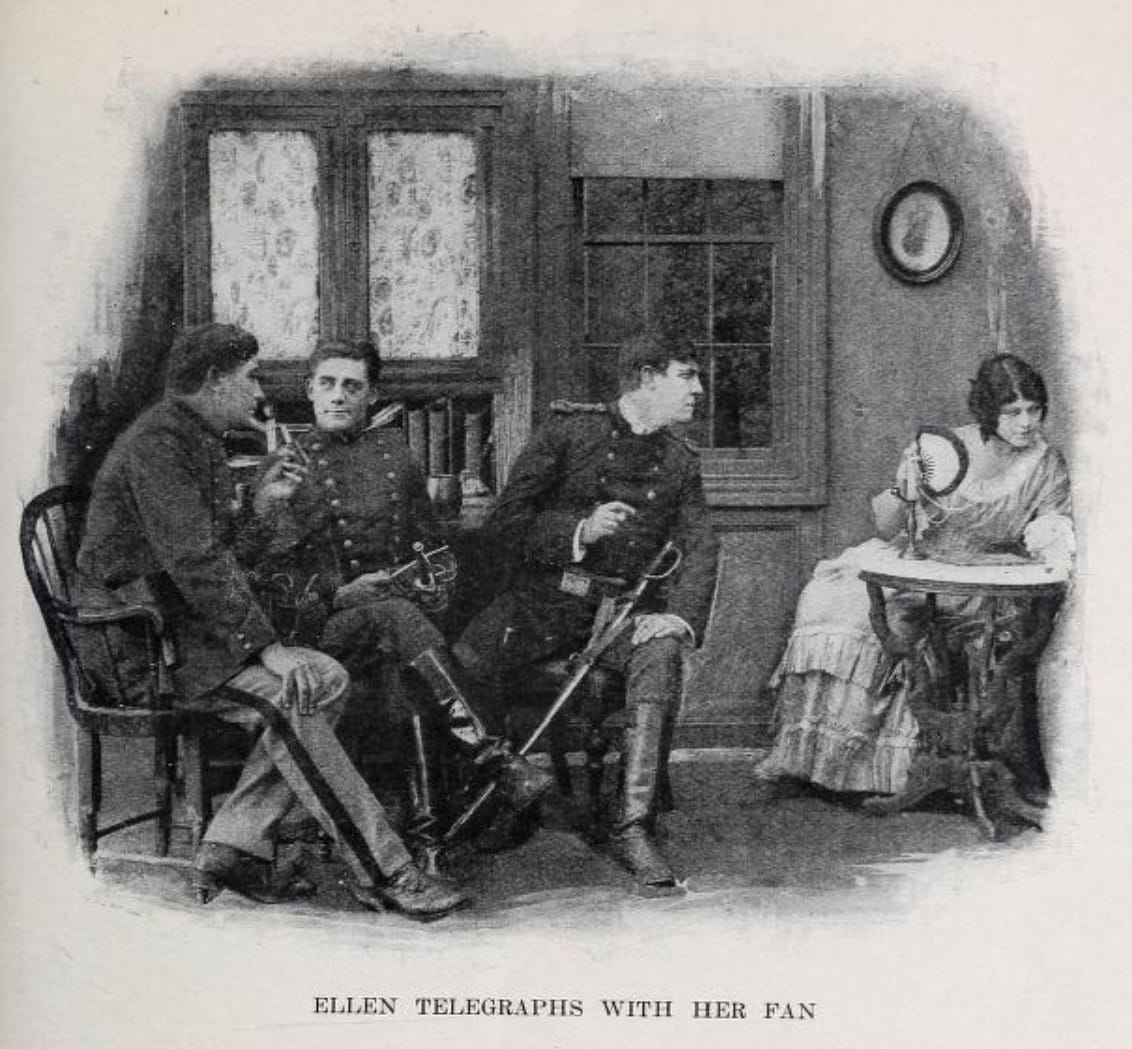
The 22-minute film His Brother, also released in 1913, opened with a scene from the battle of Shiloh described as “full of stir, excitement and smoke. The battle scenes are realistic in the extreme and there are many scenes as thrilling as any shown in pictures.” It is also considered lost, and little information about it is available online.[8]
According to an article in the New Orleans Daily Picayune, a large movie poster promising an accurate depiction of the battle of Shiloh enticed one veteran into a theater. What he saw left him outraged. Dr. Yves Reni LeMonnier had served as a private in the 24th Louisiana Infantry “Crescent Regiment” and fought at Shiloh in Pond’s Brigade. The article did not identify the film, stating only that “the fighting blood of the veteran physician was raised to fever heat when upon entering the place he found that the historic battle of Shiloh was, according to his view, being mutilated and misrepresented in a most sacreligious [sic] manner.”
On leaving, LeMonnier voiced his displeasure to everyone within shouting distance, delivering an impromptu lecture on the film’s inaccuracies and even giving the ticket salesman a piece of his mind. “The whole show is absolutely erroneous,” he said, “and should not be permitted to be exhibited before children of the present generation, because it will give them a wrong conception …”[9] LeMonnier was apparently so outraged that, later that year, he wrote a refutation of what he considered popular misconceptions about Shiloh published in Illinois Central Magazine in 1914.[10]
So the tension between historical accuracy, sensationalism, and storytelling has been part of filmmaking from the beginning. It’s a shame so many of these films are lost, leaving us unable to judge for ourselves.
In the age of digitization, home media, and film archives, it’s almost inconceivable that movies were once treated as disposable entertainment. But that attitude is a major reason hundreds of early silent films are inaccessible to us today. Aside from its pioneering cinematography, The Birth of a Nation owes much of its enduring fame to being one of the few surviving Civil War films of that era. We can only speculate whether others lived up to the hype.
[1] Eileen Bowser, The Transformation of Cinema, 1907-1915, History of the American Cinema, vol. 2 (University of California Press, 1994), 177; Lea Stans, “Silents are Golden: Early Civil War Films Of The Silent Screen,” Classic Movie Hub Blog, August 25, 2026. https://www.classicmoviehub.com/blog/silents-are-golden-early-civil-war-films-of-the-silent-screen/
[2] Mike Barnes, “‘Alarming’ Study Shows Just How Few Silent Films Have Survived,” The Hollywood Reporter, December 4, 2013, https://www.hollywoodreporter.com/news/general-news/alarming-study-shows-just-how-661810/
[3] Sonja Anderson, “Intern Finds Only Known Surviving Copy of ‘The Heart of Lincoln,’ a Silent Film Thought to Be Lost to History,” Smithsonian Magazine, February 14, 2025, https://www.smithsonianmag.com/smart-news/intern-finds-only-known-surviving-copy-of-the-heart-of-lincoln-a-silent-film-thought-to-be-lost-to-history-180986041/
[4] The Rockford Morning Star, August 10, 1913.
[5] E. Boudinot Stockton, “The Educational Picture,” The Moving Picture World, May 24, 1913, 794.
[6] Henry, “Correspondence,” The Moving Picture World, July 26, 1913, 439.
[7] Henry Albert Phillis, “The Battle of Shiloh,” The Motion Picture Story Magazine (January 1914): 46-53, 162.
[8] The Anaconda Standard, April 1, 1913.
[9] The Daily Picayune, July 6, 1913.
[10] Y. R. LeMonnier, MD, “General Beauregard at Shiloh, Sunday, April 6, 1862,” The Story of the Illinois Central Lines during the Civil Conflict 1861-5, Illinois Central Magazine 3 (July 1914): 9-19.


This is a fascinating discussion.
Thanks!