A Page from History: The Flight to Cheesedom
One of the defining elements of politics of the era of the American Civil War was virulence and frequent violence. The most obvious manifestation of this was the war itself, which started over a presidential election. This violence also took place at the interpersonal level, ranging from the caning of Charles Sumner to the assassination of Abraham Lincoln. These famous incidents were not the only instances, however. The combination of pervasive virulence and violence also appeared at the local, intra-party level, as can be seen in the 1864 Republican primary election in Indiana’s 5th congressional district.
In the primary, incumbent representative George W. Julian faced a primary challenge from Brig. Gen. Solomon Meredith, formerly of the Iron Brigade. The contest was one battle in a statewide war in Indiana between Radicals led by Julian against Moderates led by Governor Oliver P. Morton.[1] Beyond this, the primary had a personal dimension. Julian and Meredith had long been simmering political rivals, but an outright rupture between the two men emerged in 1861 over disagreements over recruitment for Meredith’s 19th Indiana Infantry Regiment.[2] Consequently, neither side was disposed to hold back from mud-slinging.
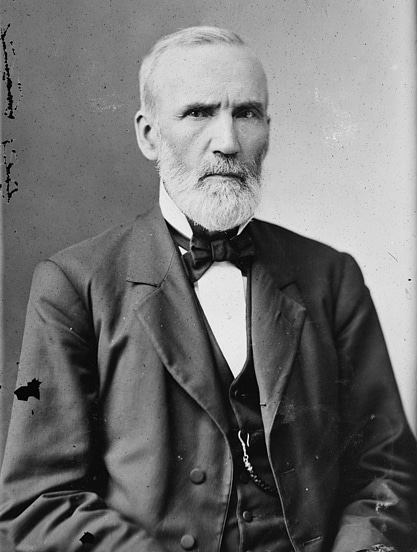
As could be expected from the nature of their divide, accusations of excess radicalism or moderation were frequent. The Indiana True Republican, which was edited by Julian’s brother Isaac, declared that Meredith’s moderation was unfit for the times: “we want men for Congress that are known to be right [emphasis original] – men who oppose the evil from principle, and not for the sake of the office – men who have experience and influence in our national councils, and who will not swerve in the time of trial, or compromise an inch with the conservatives.”[3] In contrast, The Richmond Palladium, which aligned with Meredith, accused Julian of being too much of an idealist for practical politics, charging that he had “no practical business talent – he is a theorist – a dreamer – he might make a poet, but never a legislator.”[4]
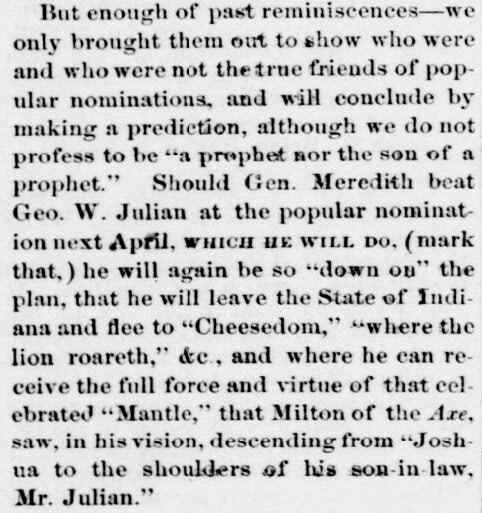
Perhaps the most pointed and memorable barb of the primary, however, was a personal rather than political jab. In a February 24 article in The Richmond Palladium entitled “Popular Nominations,” the paper’s editor David P. Holloway rebutted the claim that Meredith opposed popular vote primaries. Holloway then turned the tables, claiming that Julian’s defection from the Whig to Free Soil Party resulted from the latter losing a primary-selected state senate nomination to the former.
Jabbing at Julian as “the Great Mogul,” Holloway declared, “Should Gen. Meredith beat Geo. W. Julian at the popular nomination next April, WHICH HE WILL DO [emphasis original], (mark that,) he will again be so “down on” the plan [of popular vote primaries], that he will leave the State of Indiana and flee to “Cheesedom”.”[5]
Unfortunately, Holloway’s mention of “Cheesedom” did not refer to a kingdom of dairy delights. Rather, Cheesedom was the nickname for the 20th congressional district in northeast Ohio covering what was then called the Western Reserve. That seat had long been held by Joshua R. Giddings, the famously fearsome anti-slavery representative as well as George W. Julian’s father-in-law. By 1864, the district’s territory had mostly been subsumed into the 19th congressional district, then represented by future president James A. Garfield. Holloway’s taunt was meant to portray Julian as a career politician more interested in office-holding for its own sake rather than principles or constituents.
Despite these and other attacks lobbed at Julian by Meredith, Holloway, and their allies, the incumbent representative managed to win the primary for another term by 600 votes.[6] This result laid the seeds for a shocking outburst of violence.
The primary campaign had already been marred by shed blood and the threats of it. On February 10, 1864, a street brawl broke out between William S.T. Morton and Jacob B. Julian in Centreville, Indiana. William was Oliver Morton’s older brother and a prominent Meredith surrogate, while Jacob was George’s older brother. After the two exchanged “some words of a belligerent character,” Morton struck Julian with a brass knuckle. Julian recovered, threw Morton into a gutter, and proceeded to ruthlessly beat him until bystanders intervened.[7]
A little over a month later, Meredith addressed a crowd of pro-Julian hecklers by threatening that “he would ‘whip the whole infernal squad, by God!’”[8] The final and most brutal violent occurrence related to the contest, however, happened over a year after the primary’s conclusion.
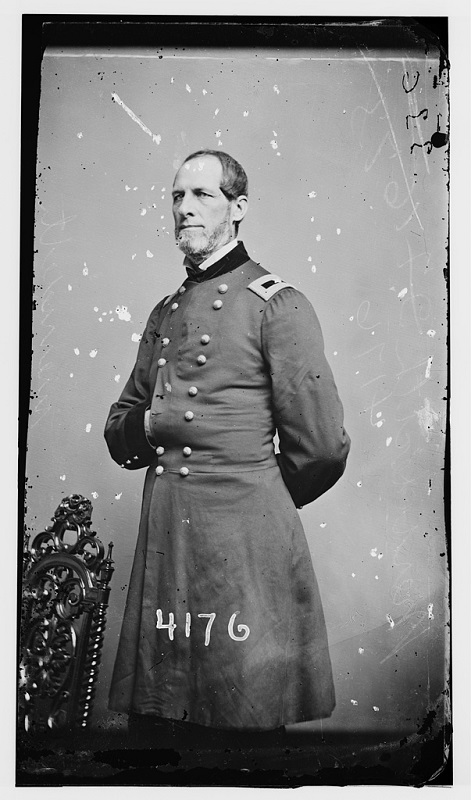
Following his defeat, Meredith’s military career failed to bring him the same glory and accolades it had before the primary. Indeed, a malicious rumor even spread that he sympathized with the rebels during his time commanding Paducah, Kentucky. Meredith attributed the source of his stagnation and slander to a vengeful Julian, so he decided to exact revenge.
Stalking down the congressman to a train station in Richmond, Indiana, on November 27, 1865, Meredith and six companions described as “fellows of the baser sort” cornered Julian in the gentlemen’s parlor. When Julian denied responsibility for the Paducah slander, Meredith’s wrath exploded. He punched Julian across the face. Julian, who was already enfeebled by illness, collapsed to the ground as Meredith continued to pummel him. With Julian prone, Meredith used a rawhide whip to strike him dozens more times until he was unconscious in a pool of blood. Only the intervention of Meredith’s companions prevented the general from murdering the congressman.[9]
Much like Preston Brooks, Meredith suffered no legal repercussions for his near fatal assault of Julian. His political connections ensured that no prosecution occurred.[10] There was, however, significant public backlash. Newspapers across the country covered his assault in an almost unanimously negative light. In the Northern states, comparisons of Meredith to Brooks were common. Southern accounts, meanwhile, pointed to the whole affair as exemplifying the wicked nature of the Yankees.[11]
Ultimately, Meredith’s assault on Julian was only one element in the broader mosaic of mid-century American political violence. While they could feature such light-hearted jibes as allegations of a flight to Cheesedom, the rhetoric and not infrequently the actions of these contests often revealed a more brutish, brutal hue.
Endnotes:
[1] Kenneth M. Stampp, Indiana Politics During the Civil War (Bloomington: Indiana University Press, 1978), 226-227.
[2] Solomon Meredith, “”Truth is Mighty and Will Prevail.”: Defense of General Sol. Meredith Against the False Charges and Infamous Slanders of George W. Julian” (Indianapolis: Douglass & Conner, 1866).
[3] The Indiana True Republican, February 11, 1864.
[4] The Richmond Palladium, March 30, 1864.
[5] The Richmond Palladium, February 24, 1864.
[6] Chicago Daily Tribune, April 8, 1864.
[7] Indiana State Sentinel, February 15, 1864.
[8] Randolph County Journal, April 1, 1864.
[9] Cleveland Daily Leader, December 4, 1865.; Evansville Daily Journal, December 4, 1865.; Chicago Tribune, December 5, 1865.
[10] Craig L. Dunn, Iron Men, Iron Will: The Nineteenth Indiana Regiment of the Iron Brigade (Indianapolis: Guild Press of Indiana, 1995), 302.
[11] Cleveland Daily Leader, December 4, 1865.; Chicago Tribune, December 5, 1865.; The Daily Phoenix, January 7, 1866.; The Indiana True Republican, December 21, 1865.


What a wild time to be alive