From Confederate Cavalier to Hermit of the Wabash: The Incredible Life of Robert A. Caskie
Of the estimated 3 million men who served in the American Civil War, nearly half a million were wounded. While those who survived their wounds often bore visible scars for the rest of their lives, untold numbers also carried hidden psychological scars. Some found it impossible to adjust to the postwar world.
This is the story of one such man: Robert Alexander Caskie, a Virginia aristocrat and battle-hardened veteran who spent his twilight years spinning yarns for children from a makeshift cabin along Indiana’s Wabash River. His former life was known only to himself and the stray cats that kept him company. His neighbors knew him as Roland B. Smythe—the Hermit of the Wabash.
His century-long journey took him from Virginia’s battlefields to Europe, St. Louis, then to an isolated riverside cabin he called “Solitude,” back to Europe, and finally to suburban Philadelphia. While his wife and children lived comfortably, he traded fish with local farmers for sustenance and gave thanks for nature’s blessings: “the moon that beautifies the night and makes my river a bath of shimmering silver tipped with gold …”[1]
Robert A. Caskie was born in 1830 to a wealthy merchant family. His father, John Caskie, a Scottish immigrant, made a fortune in tobacco and served as president of the Richmond Tobacco Exchange. On his mother’s side, the Norvell family traced its roots to the earliest days of the Virginia Colony.
With his devilish goatee and slim, angular features, Robert Caskie cut a dashing figure. He graduated from the University of Virginia and married Amanda Wallace Gregory, daughter of prominent jurist John Munford Gregory, Virginia’s acting governor in 1842. They did not have their first child until 1862.[2]
The couple settled in Richmond, where Caskie served as quartermaster of the Richmond Grays, an antebellum militia company. Actor and future Lincoln assassin John Wilkes Booth frequently attended the company’s gatherings, though he was not a member. Caskie and Amanda were theater aficionados and likely watched Booth perform at Richmond’s Marshall Theatre. Booth briefly served under Caskie in the quartermaster’s department during John Brown’s imprisonment.[3]
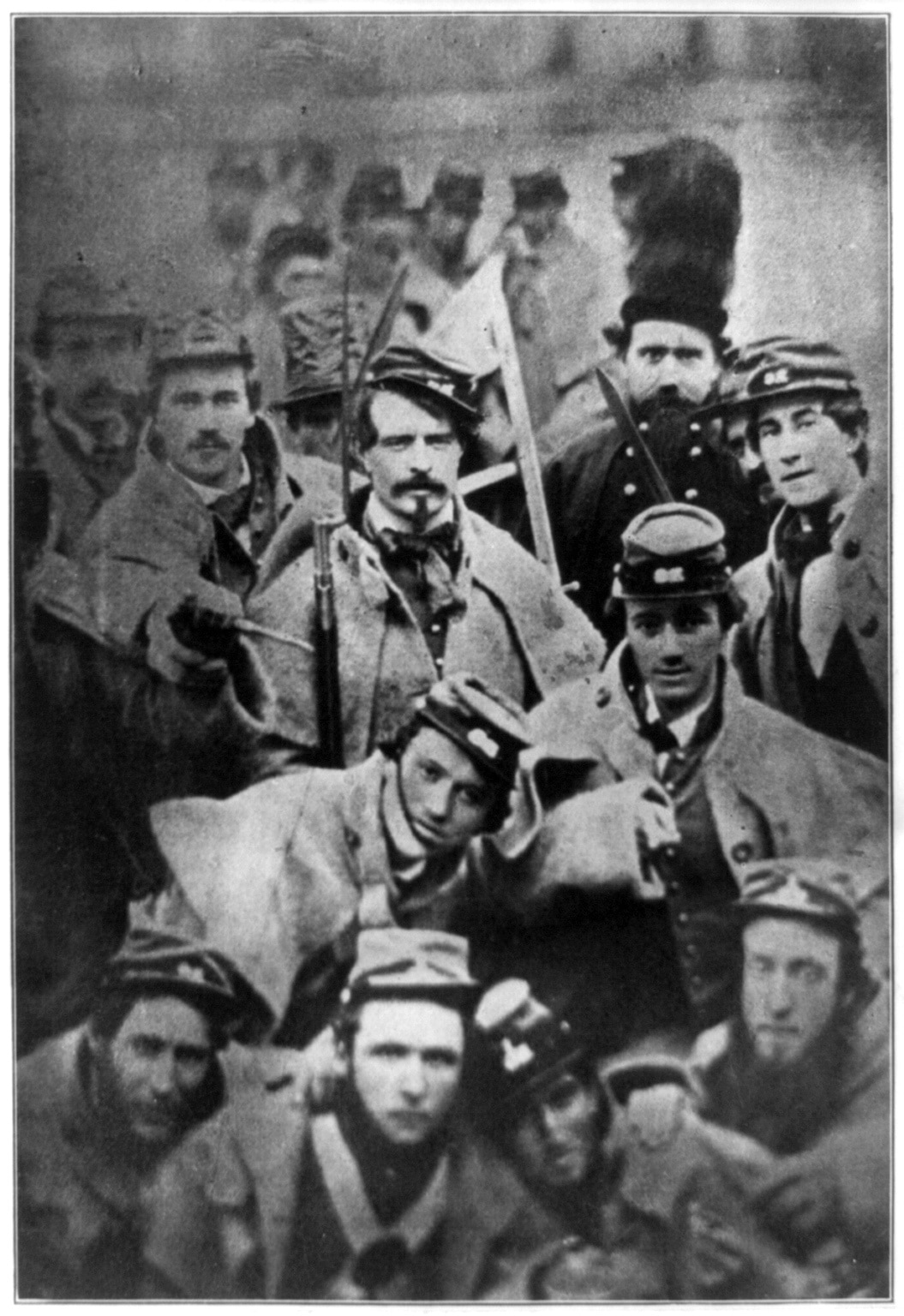
Caskie was more than a witness to these historic events. He later claimed to have struck up a friendship of sorts with the failed revolutionary as he awaited execution, bringing Brown newspapers and fruit and even persuading him to send for his wife to settle his earthly affairs. Caskie also accompanied the wagon that carried Brown to the gallows. Decades later, he dismissed the popular story that the abolitionist had kissed a baby along the way as “absolutely without foundation.”[4]
Shortly after the outbreak of the Civil War, in May 1861, Caskie replaced John J. Fry, superintendent of the Richmond City Gas Works, as captain of a cavalry company. Caskie’s Mounted Rangers (as they came to be known) were mustered into Confederate service on June 9, 1861, as part of the Wise Legion and headed into Virginia’s Kanawha Valley. Caskie’s younger brother, William, himself a talented artist, enlisted in an artillery battery and won his own laurels during the war.[5]
Caskie and his rangers fought in western Virginia until the winter of 1861–62. As part of the 8th Battalion, Virginia Cavalry, under Lt. Col. James Lucius Davis, they transferred to the Virginia Peninsula and were soon reorganized as Company A of the 10th Virginia Cavalry. They fought in most of the Army of Northern Virginia’s major campaigns. Caskie was promoted to lieutenant colonel in September 1863 and assumed command of the regiment.
Later claims that Caskie had served on General Robert E. Lee’s staff were erroneous. I’ve found no evidence that he knew Lee personally, although his eldest brother, James Kerr Caskie, James’ wife, Ellen, and their daughter, Martha Norvell, were close friends of the Lees. Mary Lee and her daughter, Eleanor Agnes, stayed at the family’s home at Eleventh and Clay streets in Richmond for several months in 1863.[6]
In April of 1864, the officers and men of Caskie’s old company presented him with a cavalry sabre made by the Richmond firm of Boyle & Gamble. It bore the inscription “Presented to Col. Caskie by the officers and men of the Caskie Rangers” and, on the reverse, the Latin motto “Audaces fortuna Juvat” (Fortune favors the bold).[7]
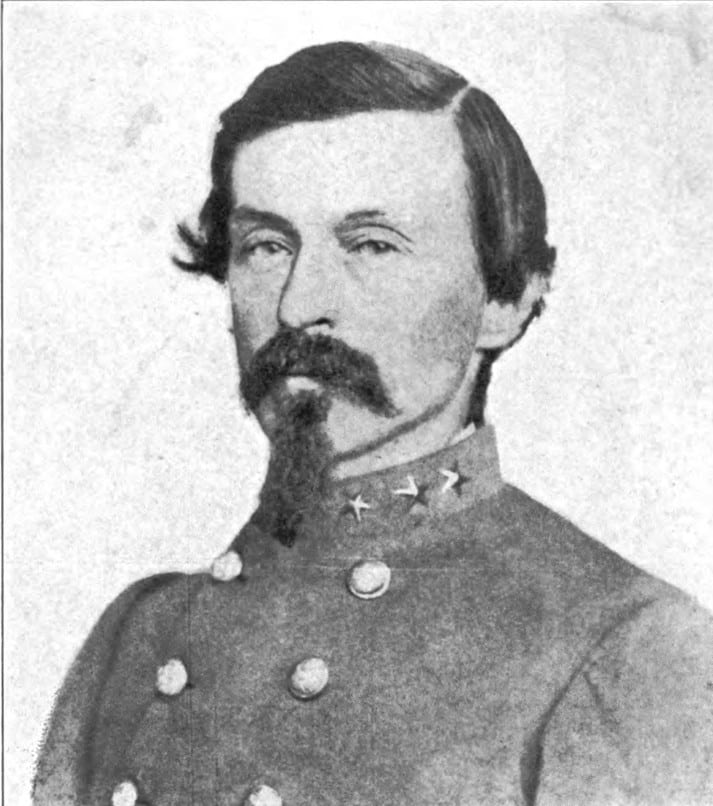
Fortune did indeed favor Caskie for most of the war. He survived numerous battles and brushes with the enemy with only superficial wounds. On Tuesday, August 23, 1864, however, his luck ran out. He suffered a serious leg wound during a skirmish at Tillotson’s farm on the extreme right of the Confederate line near Ream’s Station, just two days before the battle there. He did not return to the saddle until late that fall.[8]
Through the winter of 1864–65, things grew increasingly desperate for Petersburg’s defenders. While the 10th Virginia Cavalry rounded up deserters, Caskie was laid up in Richmond hospitals with acute dyspepsia. He returned to command just in time for the retreat to Appomattox. Most of the regiment rode off, but Caskie and sixteen of his men surrendered and were paroled.[9]
Caskie returned to his wife in Richmond, a city devastated by fire and war, with the cause he’d fought for over the past four years defeated. In September, tragedy struck again when their third child died at birth. Whether to escape prosecution or these sad memories, Caskie and his family spent several years in Europe before settling in Rocheport, Missouri by 1870, where he resumed the tobacco business. The couple had four more children there, one of whom died of whooping cough in infancy.[10]
For several years, his business thrived, and he even entered the Democratic primary for state representative before withdrawing. The U.S. experienced an unexpected economic downturn in the early 1880s that culminated in the Panic of 1884. That year, the Caskie family moved to St. Louis.[11] Shortly thereafter, at about age 54 or 55, he disappeared. Later newspaper accounts cited financial trouble as the impetus for his self-imposed exile. Perhaps he was facing bankruptcy or fleeing creditors.[12] But plenty of people face financial hardship without turning into Grizzly Adams.
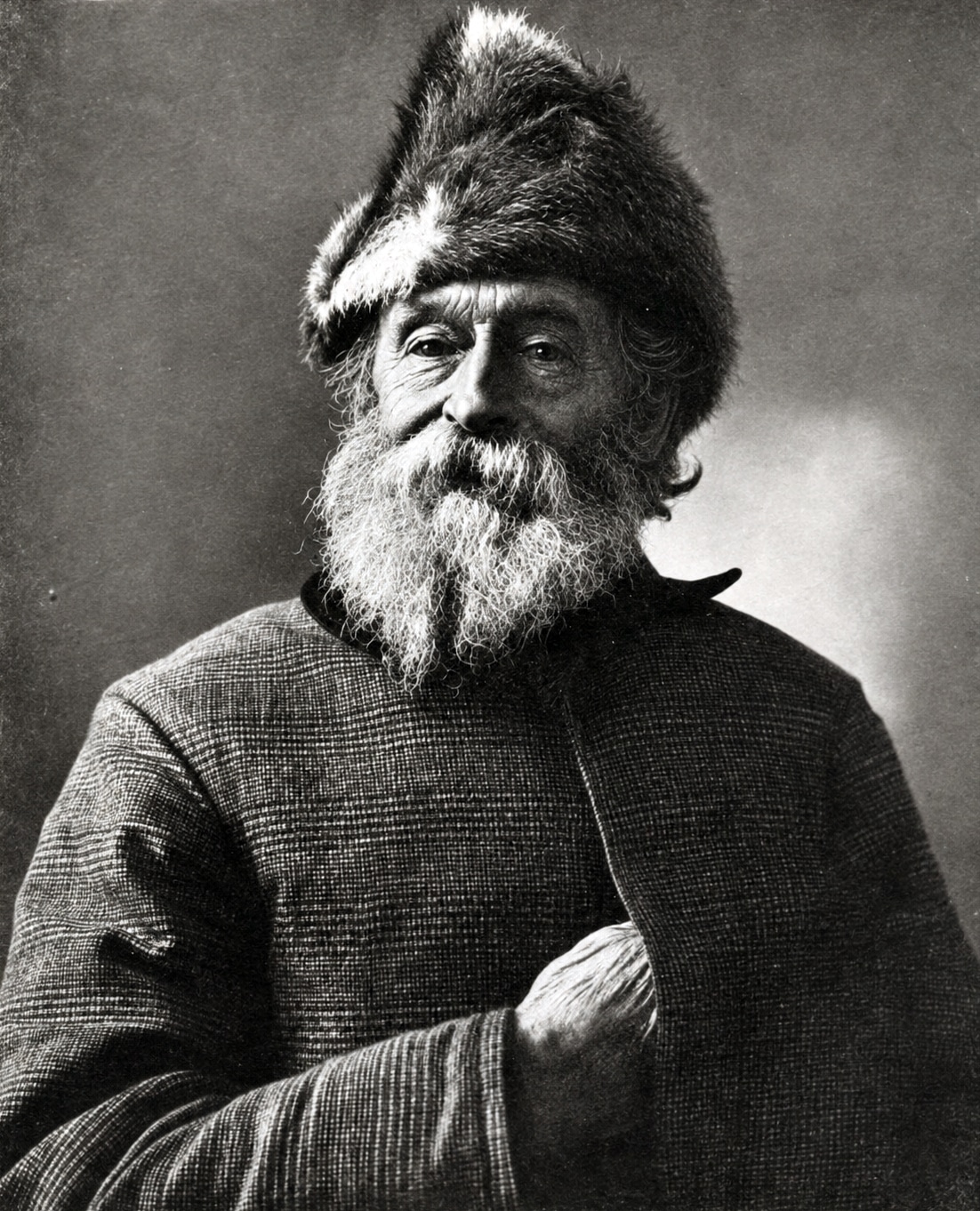
According to a profile in The Indianapolis News, Caskie first settled on the Illinois side of the Wabash River. After a flood forced him onto a raft, he made his way to the mouth of Turman Creek in Sullivan County, Indiana. The land belonged to Dr. John and Mary Durham, who allowed him to remain after he introduced himself as Captain Roland Smythe. He built a small cabin and a dinner table, then spent years in solitude—fishing, trapping, and trading for supplies. Gradually, curious locals came calling and found a man of unusual eloquence and refinement.[13]
While Caskie waxed poetic about the virtues of living in nature, his family moved on. When his wife died in September 1902, never knowing what happened to him, her obituary described her as “the widow of the late Robert A. Caskie …” Not long afterward, his daughter Amanda, a chorus girl married to Herbert Thomas of New York, tracked him down through an insurance policy he was still paying. By then, unkempt hair, a thick white beard, and soft wrinkles had transformed his once-dashing countenance so completely that it is a wonder she recognized him. Though she tried to persuade him to leave, he refused.[14]
About two years later (although the exact timeline is hazy at best) Caskie learned that his son, Robert Alexander, was performing in Terre Haute, Indiana. Robert had taken the name Carter and was part of the vaudeville comedy act Carter and Waters. The visit must have been disorienting. Much had changed since Caskie plunged into the wilderness: he had never seen electric streetcars, electric lights, or motion pictures. Yet another emotional reunion failed to persuade him to return to civilization.[15]
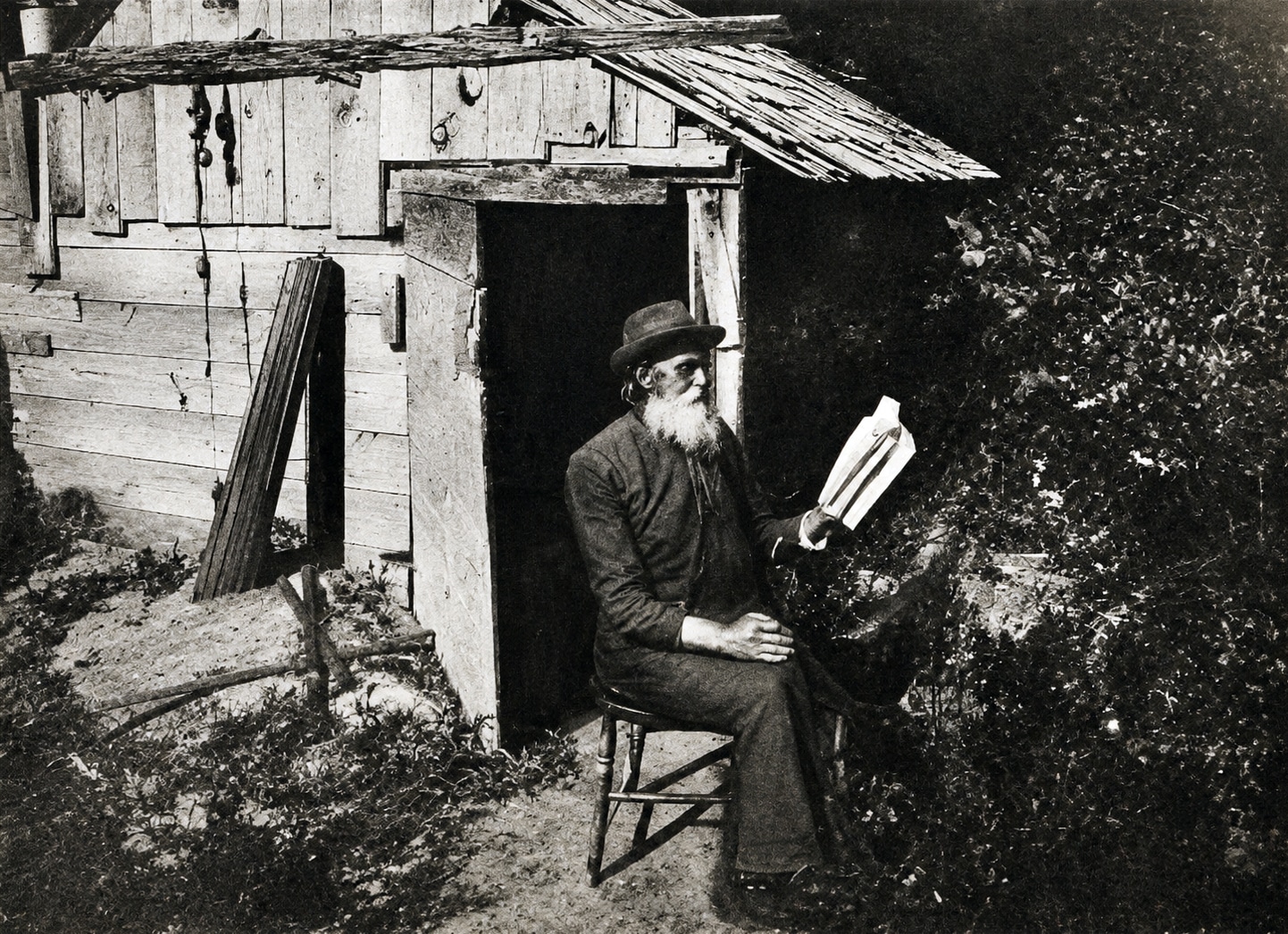
By the fall of 1910, however, Caskie was 80, and the prospect of another winter was daunting. After 25 years, the Hermit of the Wabash left Solitude to live with friends in Indianapolis. He later traveled to Europe with his daughter before returning to the States, where he died at 98 in a Philadelphia suburb at the home of his son, John J. Kerr Caskie. His remains were cremated and buried locally, then later reinterred beneath a humble gravestone in Richmond, Virginia’s Hollywood Cemetery.[16]
Robert Caskie’s life read like a movie script, yet despite being highly literate and an eyewitness to some of the nation’s most consequential events, he wrote only poetry, preferring to “live his song.” We can only speculate why he chose self-imposed exile for a quarter of his long life. While gazing across the Wabash on quiet evenings, did his mind fill with visions of gore, flashing sabers, and fallen comrades? Did his old war wounds ache with the changing seasons? Like so much of Caskie’s life, the answers went with him to the grave.
[1] The Ashville Citizen, April 29, 1906.
[2] Jaquelin A. Caskie, The Caskie Family of Virginia (By the author, 1928), 28-29.
[3] Terry Alford, Fortune’s Fool: The Life of John Wilkes Booth (Oxford University Press, 2015), 66, 72.
[4] John Brown had many visitors to his jail cell, but I haven’t been able to independently verify that Caskie was among them. George Bicknell, “The Quiet Philosopher of the Wabash,” The Craftsman 16 (September 1909), 656-663; The Ashville Citizen, April 29, 1906; Stephen B. Oates, To Purge This Land with Blood: A Biography of John Brown (Harper & Row, 1970), 337.
[5] Robert J. Driver Jr., 10th Virginia Cavalry (H. E. Howard, Inc., 1992), 2; Caskie, The Caskie Family of Virginia, 30-31; M.A. Kleen, “Caskie’s Mounted Rangers in the 1861 Kanawha Campaign,” Spirit of ’61, September 22, 2026, https://spirit61.info/2026/09/22/caskies-mounted-rangers-in-the-1861-kanawha-campaign/
[6] Douglas Freeman, “Lee and the Ladies: Unpublished Letters of Robert E. Lee,” Scribner’s Magazine 78 (November 1925): 467-468.
[7] Richmond Whig, April 23, 1864.
[8] Richmond Daily Dispatch, August 27, 1864; Driver, 10th Virginia Cavalry, 100.
[9] Driver, 10th Virginia Cavalry, 73-74.
[10] Columbia Missouri Statesman, February 11, 1870; Richmond Daily Dispatch, August 8, 1870; Richmond Daily Dispatch, May 2, 1871.
[11] Centralia Fireside Guard, September 18, 1880; Weekly Missouri Statesman, September 24, 1880; The Topic, November 7, 1884.
[12] Stephen J. Taylor, “The Hermit on the Banks of the Wabash,” Hoosier State Chronicles, February 3, 2015, https://blog.newspapers.library.in.gov/the-hermit-on-the-banks-of-the-wabash/
[13] The Indianapolis News, April 21, 1906; Randy Harrison, “Hermit of the Wabash still fascinates,” Daily News, September 5, 2026, https://www.hometownregister.com/rob_daily_news/local_news/hermit-of-the-wabash-still-fascinates/article_d4b8a3c2-64a8-52da-aa31-b2480bc25ebc.html
[14] The Times (Richmond), September 30, 1902; The Indianapolis News, April 21, 1906; The Buffalo Sunday Times Feature Magazine, March 7, 1920.
[15] The Indianapolis News, April 21, 1906; Buffalo Evening News, January 14, 1927.
[16] Mt. Carmel Morning Register, November 6, 1910; Taylor, “The Hermit on the Banks of the Wabash”; Buffalo Courier Express, September 02, 1928; The Richmond News Leader, September 01, 1928.


