Leonidas Polk’s Finest Hour
The “Hornet’s Nest” at Shiloh achieved its fame in part because the Union held the position when so many units were chewed up. After repelling several attacks, Andrew Hickenlooper of the 5th Ohio Battery said, “Again and again, through long and trying hours, this dance of death went on…” By 2:30 p.m., two Confederate brigades had already been chewed up in ferocious, but doomed attacks. The next in was a brigade led by Robert G. Shaver. Major James T. Martin of the 7th Arkansas recalled that “the brave boys…never wavered, but moved with steady tread, led by our brave and gallant commander, into the arms of death.” Shaver called Federal fire “terrific and murderous.” It compelled him to either retreat “or have my men all shot down.”
The man responsible for the ravaging of Shaver’s men was Braxton Bragg. Whatever his strengths, Bragg was a poor tactician given to frontal assaults, and at Shiloh, he failed to use artillery, which was odd considering he won fame leading a battery at Buena Vista. Upon hearing of the death of Albert Sidney Johnston, he left the Hornet’s Nest to command the Rebel right. Even so, more regiments were being drawn to the area of Duncan Field and the Hornet’s Nest, and another round of slaughter was sure to come.
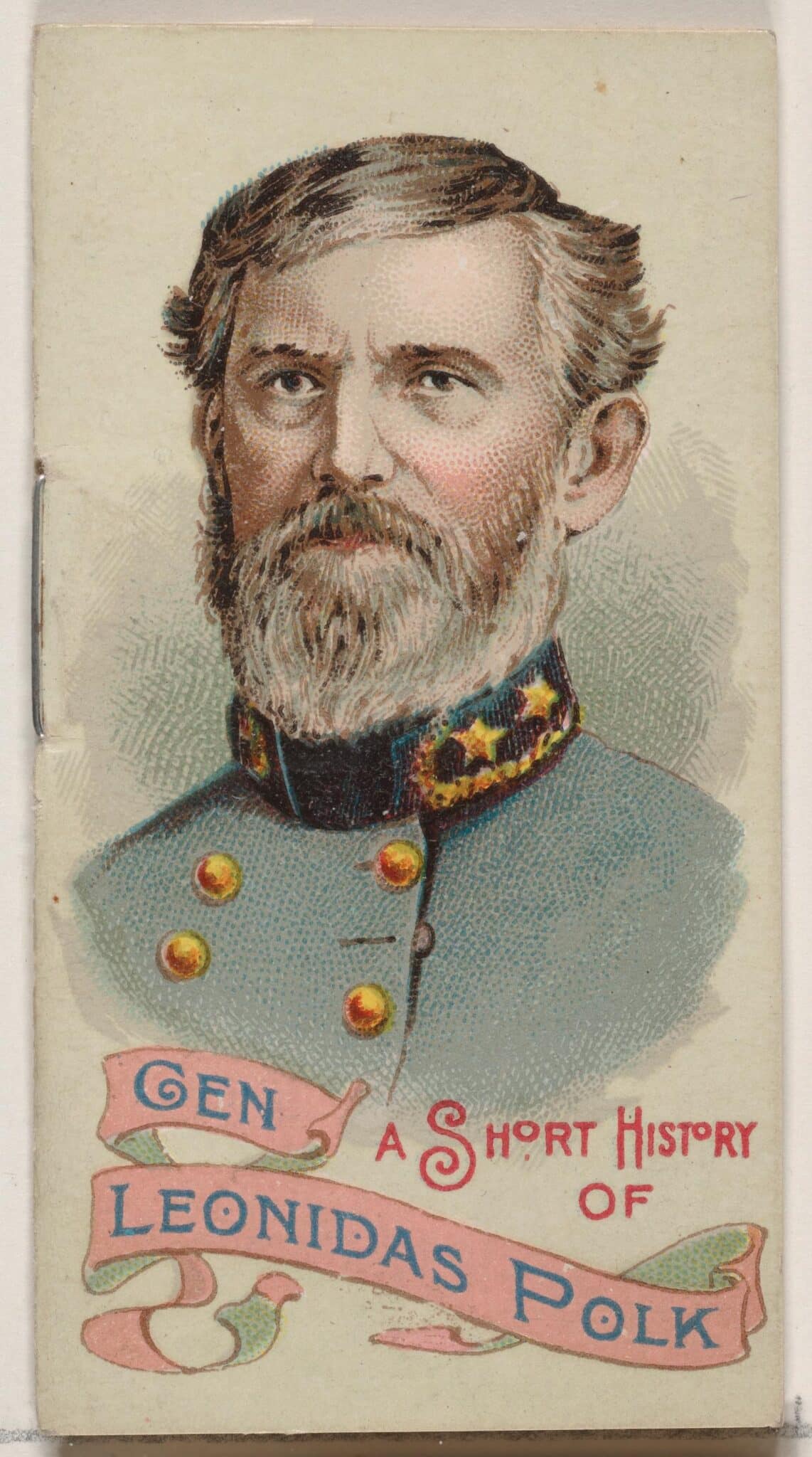
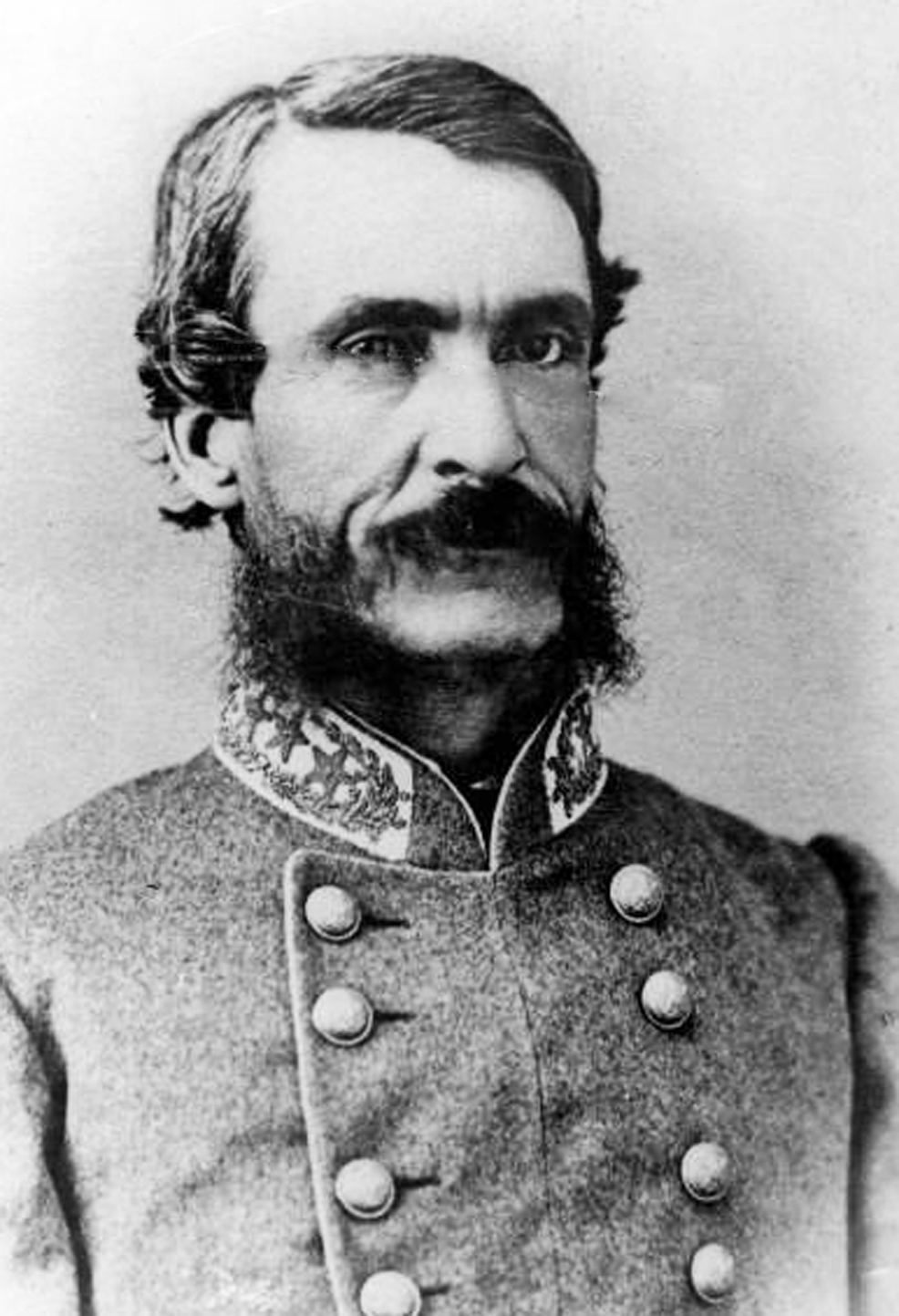
Among the men to arrive were a dissimilar pair, Leonidas Polk and Daniel Ruggles. Polk was charming and popular. Ruggles was a superb administrator, but one of the most despised officers in the army, often described as a brute. Both men, though, were about to experience their finest hour of the war.
Ruggles assembled several batteries for a grand barrage that was among the greatest artillery concentrations of the war. Only ten of the Army of the Mississippi’s twenty-one total batteries were not involved. Ruggles did not act alone; some were brought forward by James Trudeau and Francis Shoup, who both deserve credit. While his achievement has been rightly, if at times overly, lauded, Polk’s has gone unnoticed.
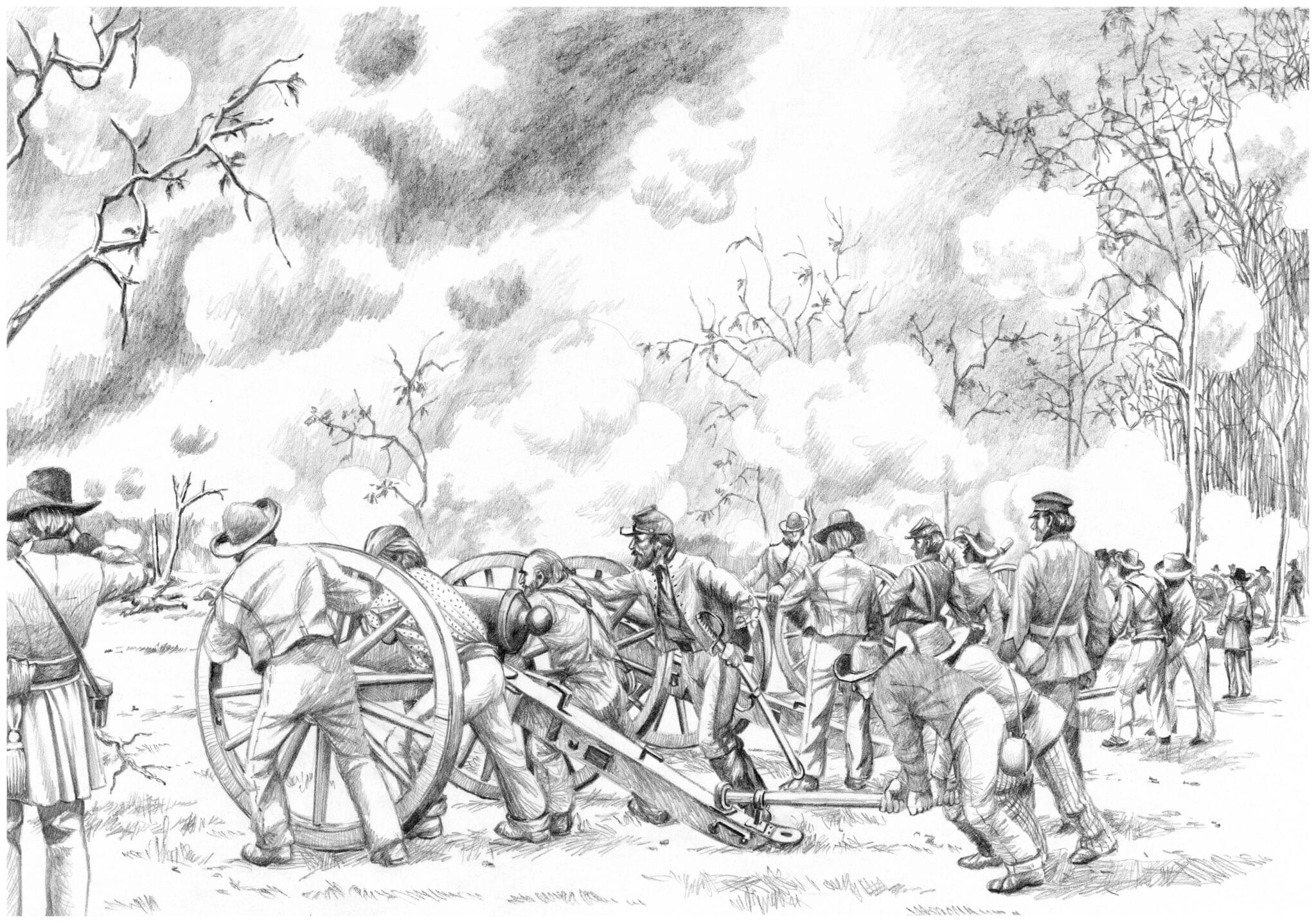
Polk had disparate regiments at his command and faced an enemy well placed to defend. W.H.L. Wallace and Benjamin Prentiss led two understrength divisions, but each man was determined to hold. Thomas Sweeny, who commanded a brigade on the eastern edge of Duncan Field, even sent the 7th and 58th Illinois and part of the 2nd Iowa into Duncan Field to probe the lines. They were driven back, but the Union regiments used cotton bales, swales, and buildings as cover to hold the center of the field.
Polk first attacked, but with two brigades. J. Patton Anderson would strike where Shaver was repulsed. The Crescent Regiment and 38th Tennessee would advance across Duncan Field in an ad hoc brigade under the command of Marshall Smith. Smith thought the attack was doomed and held back. Instead, Smith placed his regiments in the woods north of Duncan Field, threatening the flank. Anderson thus attacked unsupported in an underbrush that made it “Impossible for a company officer to be seen at platoon distance. Federal fire was “well calculated to test the pluck of the sternest,” and the attack failed.
In Anderson’s place came S.A.M. Wood’s brigade. Wood wisely did not attack the Hornet’s Nest, but instead skirmished and kept the Federals there pinned down. The Rebel artillery also opened up as Ruggles and Trudeau massed their cannon (Shoup’s guns would come up a little later). James C. Parrott, commander of the 7th Iowa, described “a galling fire of canister, grape, and shell, which did considerable execution in our ranks.” D. Leib Ambrose of the 7th Illinois recalled that “The harsh, fierce barking of the dogs of war made the earth tremble, as if in the midst of a convulsion.” Although not every regiment was affected, the fire caused chaos and demoralization, particularly as Federal batteries were outnumbered and low on ammunition and forced to pull back.
Over on the right, Bragg and John C. Breckinridge ordered several attacks that turned Stephen Hurlbut’s left flank, causing his division to collapse. In doing so, the retreat path for Wallace and Prentiss was compromised. According to Prentiss, both he and Wallace decided to stand and fight.
Polk, meanwhile, changed his tactics. He would turn Wallace’s right flank at Duncan Field. While the artillery did its work, the Confederate infantry slowly forced out Sweeny’s forward line. Polk selected the Crescent Regiment to strike the flank. To their left, various regiments were brought forward by brigade commanders Alexander P. Stewart and Robert Russell, the latter coordinating his attack with Robert Trabue’s brigade, which was marching through the woods between Duncan and Cavalry Field. Polk encouraged the men in the advance and personally ordered the 5th Tennessee to attack.

The Rebels were lucky. Sweeny and the 52nd Illinois left the front. At the same time, Patrick Cleburne turned John McClernand’s left flank at Cavalry Field, widening the gap between McClernand’s division and Wallace. Robert F. Looney of the 38th Tennessee decided to attack across Duncan Field at the double-quick rather than make a steady march. At roughly the same time, Shoup’s cannon, gathered at the southwestern corner of Duncan Field. Shoup recalled that the firing “was beautiful,” and he felt “a royal barbaric joy.”
The 58th Illinois unraveled, and the 38th Tennessee rounded up scores of prisoners. Wallace, meanwhile, directed Tuttle to escape with his men. They barely did so, coming under heavy fire from Stewart, Russell, and Trabue. The 2nd and 7th Iowa made it out in a run. As they fled past the Confederates, the 7th Iowa heard shouts of “Bull Run!” The 81st Ohio was the only unit in a position to at least slow down the encirclement. Yet, they were under heavy cannon fire. The 1st Alabama Cavalry, on Bragg’s extreme right flank, came upon their rear, and the regiment withdrew.
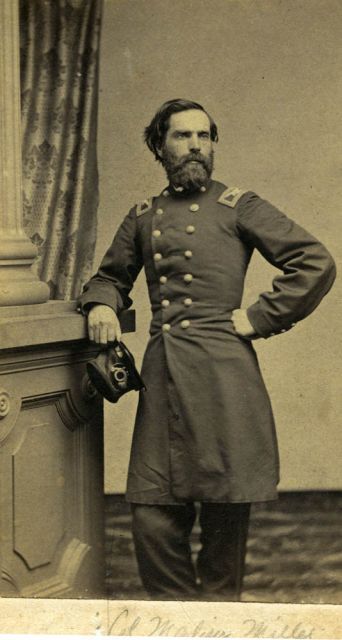
The Federals met galling crossfire in what became known as “Hell’s Hollow.” Madison Miller, Prentiss’ brigade commander, recalled, “Some of my brave men came to me with tears in their eyes, begging me only to give the order, and they would break the rebel lines or die in the effort.” In the chaos, Wallace was mortally wounded, and Jacob T. Tindall was killed leading his 23rd Missouri. Joseph J. Woods and William F. Lynch, commanders of the 12th Iowa and 58th Illinois, respectively, were each wounded. The mass of men in Hell’s Hollow surrendered. Prentiss, who was still holding with part of his command, concluded, “It is useless to fight longer. I must stop this slaughter.” He stepped forward onto a stump and waved his handkerchief to signal the rest of his command to surrender.
Polk ordered Andrew J. Lindsay, commander of the 1st Mississippi Cavalry, to give chase with his regiment and any other cavalry he could find nearby. The horsemen managed to capture the 2nd Michigan Artillery as it tried to retreat to Pittsburg Landing; it was the best showing by cavalry on either side in the battle. Other elements of the 1st Mississippi Cavalry chased the Federals to the landing, taking a caisson until driven off by Union infantry. Don Carlos Buell said the Confederates charged “like dare-devils” and “was surprised the volley had not killed every Rebel.” Lindsay next swung part of his cavalry to the river, where the men watered their horses in the Tennessee.
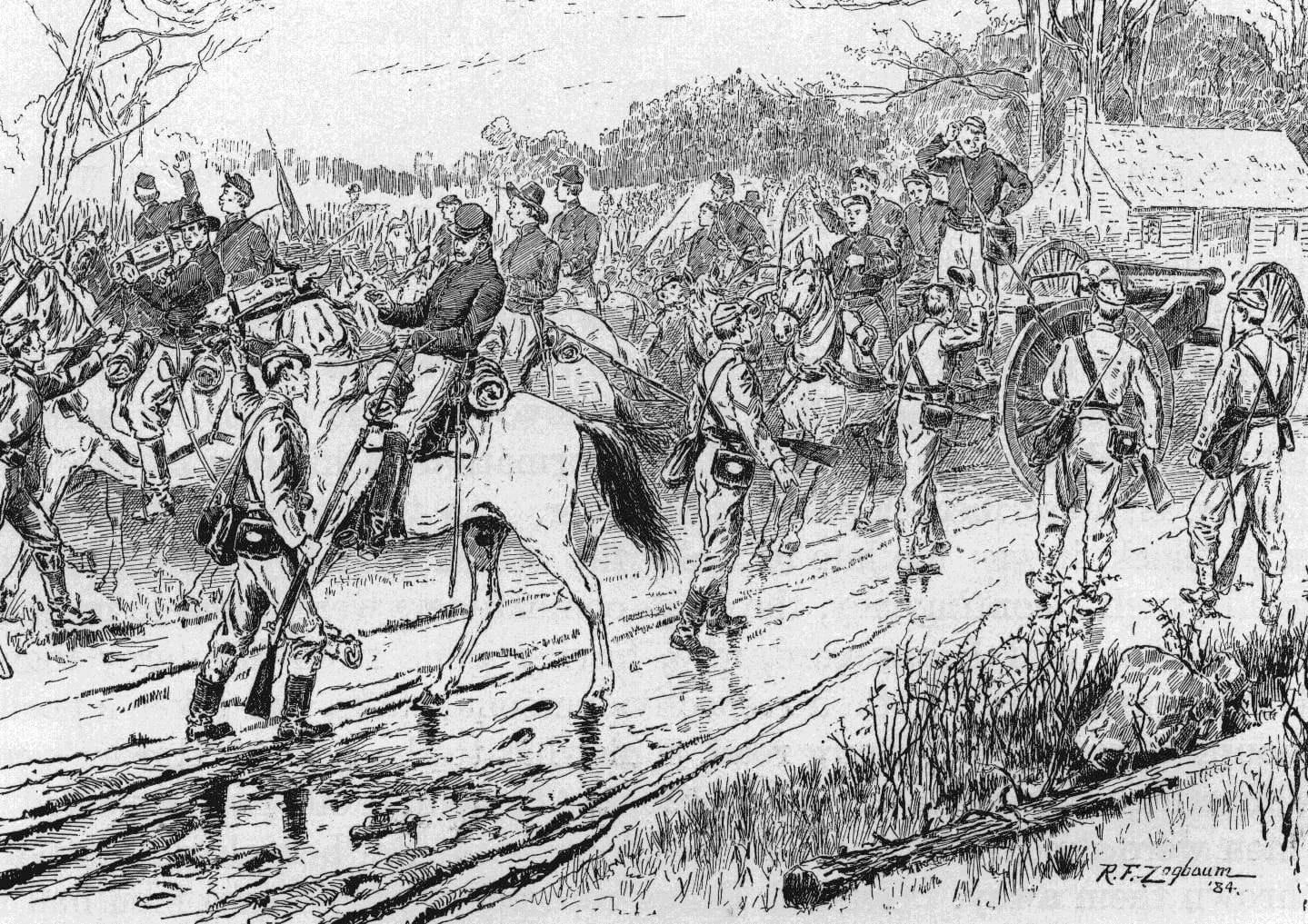
Miller personally surrendered to Polk, who, according to Miller, seemed disappointed. Miller tried to give his sword to Polk and Breckinridge, but both men declined it. Polk also found W.H.L. Wallace. Thinking he was dead, Polk placed a blanket over the body. Polk’s all-around kindness to the Federals was well remembered by several of his enemies and commented on after the war.
In breaking the Hornet’s Nest, Polk showed ability. He attacked with two brigades, but soon deduced it was wiser to use the terrain to his advantage and exploit the Federal flank. He struck only after Ruggles opened with his barrage and had driven off the Federal artillery and went to the front to bolster his men, many of whom had been fighting all day and needed such encouragement. Most interestingly, he then used his cavalry correctly by ordering a pursuit that led to one of the mounted arm’s best showings in 1862.
In leading what amounted to a division, Polk showed admirable leadership and flexibility. However, Polk never again showed such skill, for given his rank, he would be leading a corps instead of at Shiloh, where he essentially led a division. He would not be alone. In the Federal lines on April 7, Alexander McCook led his division with considerable skill. For this he was promoted to corps command, and outside of Tullahoma, he never quite met his early promise. Nor would Polk, but Shiloh was one reason he was the army’s most popular general. Those men could remember what he did and his coolness under fire.
Sources
Ambrose, D. Leib. History of the Seventh Regiment Illinois Volunteer Infantry. Springfield: Illinois Journal Company, 1868, 50
Daniel, Larry J. Shiloh: The Battle That Changed the Civil War. New York: Touchstone, 1998 (1997).
Deupree, J.G. “Reminiscences of Service with the First Mississippi Calvary.” Publication of the Mississippi Historical Society 3 (1903): 85-100.
Hickenlooper, Andrew. “The Battle of Shiloh.” In Sketches of War History, 1861-1865, 5: 402-483. Cincinnati: Robert Clarke, 1903.
Kiner, F.F. One Year’s Soldiering, Embracing the Battles of Fort Donelson and Shiloh. Lancaster: E.H. Thomas, 1863.
Miller, Madison. “The 18th Missouri Infantry on the Battlefield of Shiloh.” In Personal Recollections of the 18th Missouri Infantry in the War for the Union. Unionville, MO: Stille & Lincoln, 1891.
Montgomery Daily Advertiser, April 17, 20, 1862
War of the Rebellion: A Compilation of the Official Records of the Union and Confederate Armies. 53 vols. Washington, DC: Government Printing Office, 1880-1901. Pages: 149 150 151-152 154 162 164 166 281 410 417 421 428 434 435 439 459 472 476-477 478 479 498-499 507 523 525 526 529 574-575 576 578 582 593 597 599 601 606 608 616
Report of the Proceedings of the Society of the Army of the Tennessee, at the Fourteenth Annual Meeting, Held at Cincinnati. April 6-7, 1881. Cincinnati: Society of the Army of the Tennessee, 1885.
Sargeant, Charles Sheldon. Personal Recollections of the 18th Missouri Infantry in the War for the Union. Unionville, MO: Stille & Lincoln, 1891.
Smith, Timothy B. Shiloh: Conquer or Perish. Lawrence: University Press of Kansas, 2014.
Shiloh National Military Park Position Marker 341
Shiloh National Military Park Union Regiment Files, 7th Iowa File, E.W. Herman Diary
Shoup, F.A. “The Art of War in ‘62 – Shiloh.” The United Service: A Monthly Review of Military and Naval Affairs 11 (July 1884): 1-13.
Sweeny, T.W. “Man of Resource.” The National Tribune, September 5, 1895.
Walker, Alexander. “Narrative of the Battle of Shiloh. By Alex. Walker, of the N.O. Delta.” In Diary of the War for Separation: 114-161. Edited by H.C. Clarke. Augusta, GA: Chronicle & Sentential, 1862.
Woodhead, Henry, ed. Voices of the Civil War: Shiloh. Alexandria, VA: Time-Life Books, 1996.
Wright, Charles. A Corporal’s Story. Philadelphia: James Beale, 1887.


This is an engaging deep dive into the Hornets’ Nest that has the elements of a good study in contrasts. One thing I never understood was why the Confederates didn’t just bypass the position entirely. They wasted so many men and so much ammunition on pointless frontal attacks.
Shiloh could have set back Federal aims in the West two years, even caused young men to refuse to enlist after seeing Grant’s army totally destroyed…but for terrible Confederate errors. The biggest lay with the failure to recruit every man possible in the West in the first 11 months of the war; much of the force Albert Sydney Johnston gathered in Corinth in March 1862 was completely green. The men had never been inducted into the Confederate army, uniformed, armed, equipped, drilled, trained, and organized into regiments. Why not? What was the high command waiting for? Had a proper force been formed well in advance of Shiloh, their movement upon that field would have been much better conducted.
Furthermore, the chaos in Corinth meant that Johnston’s army took three days to march 20 miles and arrived wet, muddy and hungry – terrible mismanagement. This continued with the bungling of the battle design, stretching regiments out in single lines instead of having them in two or three lines marching in blocks. This guaranteed terrible loss of communication and control by their officers. They attacked well after sunrise when they should have been hitting the Federal camps half an hour before the sun rose. No provision was made for dealing with the Federal gunboats on the Tennessee River – imagine Forrest’s cavalry being joined by at least two brigades of infantry and four batteries of artillery on the eastern side of the river, firing on the Federal gunboats and on the thousands of shirkers taking refuge under the riverbank on the western side. It would have been a turkey shoot, and Grant’s army would have been destroyed by lunchtime – before he awoke from his drunken stupor and headed for the battlefield.
Blown opportunities…